
Key Takeaways
- ActiveCampaign empowers marketing teams to manage sophisticated audience segmentation, multi-step customer journeys, and automated email campaigns within a consolidated account interface.
- ActiveCampaign offers its Plus package starting at 49 dollars monthly billed annually for 1,000 contacts, supplying one dedicated user seat.
- ActiveCampaign provides comprehensive developer access across all subscription tiers through REST endpoints, automated webhooks, and Model Context Protocol connections.
- ActiveCampaign does not suit outbound prospecting workflows or businesses seeking an integrated customer relationship management system included in the base subscription.
Your campaign program needs more than a sending tool when customer behavior should trigger its next message. ActiveCampaign is the best fit for a marketing team that needs to turn customer data into email campaigns and multi-step automations, and Plus at $49 a month is the sensible starting plan for most teams. Skip it if the job is outbound prospecting rather than customer marketing, or if you need a CRM included in the plan price rather than as an add-on.
Agent access
- API
- Yes, Valid ActiveCampaign account, including a trial
- MCP server
- Official, ActiveCampaign login credentials and connection approval
- Works with
 Claude
 ChatGPT
- Automation
- Zapier
What are the core pros and cons of ActiveCampaign?
What works
- Unlimited automation actions from Plus
- API, webhooks and MCP access on every plan
- More than 1,000 apps and integrations across all plans
What to watch
- Starter limits each automation to five actions
- Enhanced CRM is a paid add-on, not a base-plan feature
- SMS and WhatsApp are add-ons on paid plans above Starter
What does ActiveCampaign do for marketing automation teams?
ActiveCampaign is a marketing automation platform that lets your team build campaigns, segments and automated customer journeys around the data it holds. For the team deciding where to run its recurring email program, it is a stronger choice than a simple sending tool because automation is part of every plan, while Plus adds the landing pages, site messages and generative tools that make a campaign program feel complete. If you are still mapping the category, the marketing tools directory is a useful place to see the adjacent options.
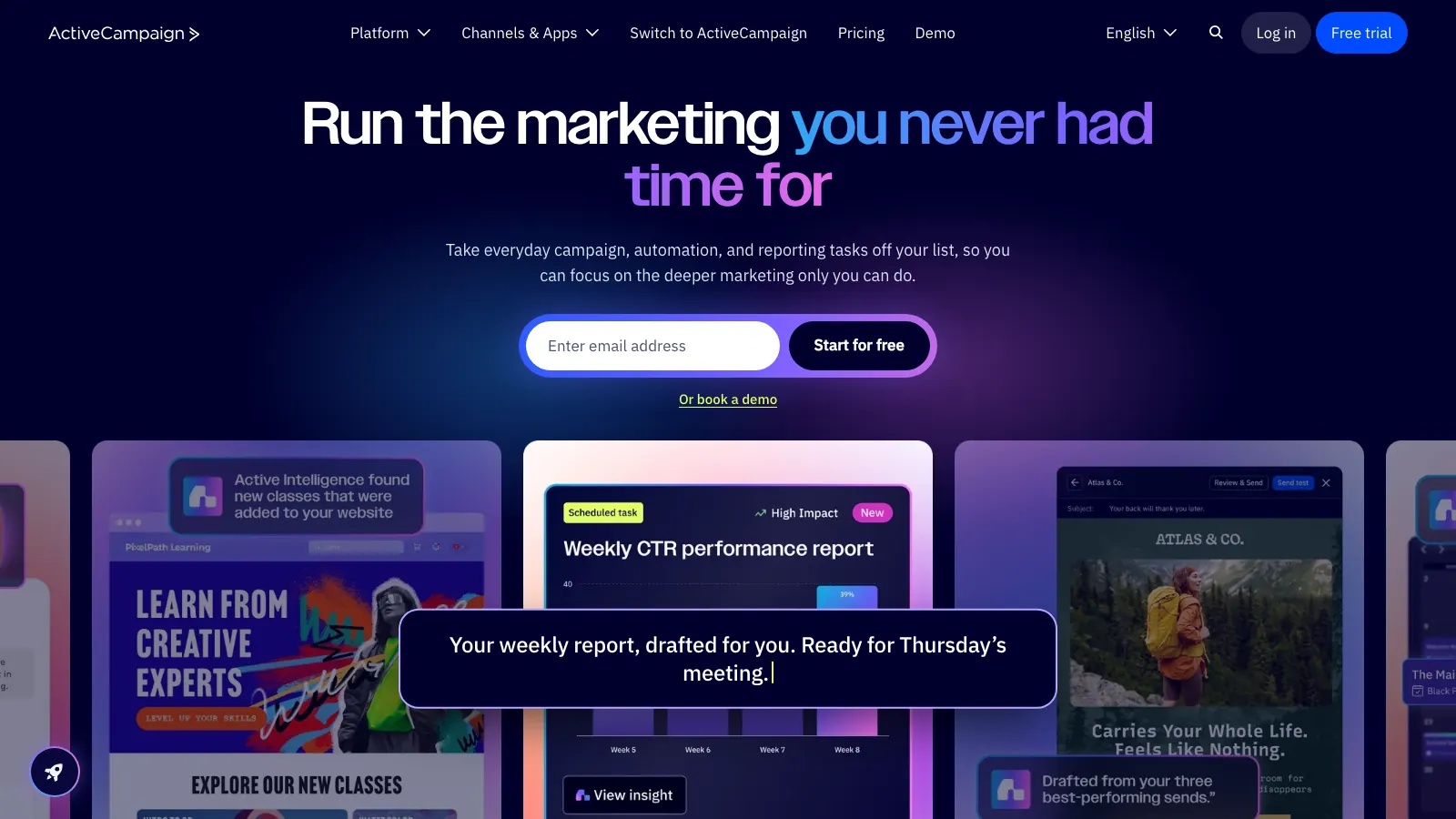
The product's AI layer is called Active Intelligence. It can work from a prompt or a recommendation, use a Brand Kit, and model a new email on your best campaigns. The important limit is approval: ActiveCampaign describes generated work as ready for you to approve, which is where a marketing team should keep the final decision.
I would not start on Starter just because it is the cheapest price. Its five actions per automation suit a basic welcome sequence, but they constrain a team that needs branching journeys or a campaign that changes with customer behavior. Plus is the plan where the product's marketing proposition becomes practical.
Who gets the most value from ActiveCampaign?
Lifecycle marketing teams
Build multi-step customer journeys, then add landing pages and site messages on Plus.
Growing ecommerce teams
Use standard ecommerce integrations and abandoned-cart automation across every paid plan.
Teams with technical help
Connect account data to custom workflows through the API and webhooks.
Multi-brand marketers
Give each account a Brand Kit, with five kits on Plus and above.
It is less compelling for a sales-led team whose first task is finding and contacting new prospects. ActiveCampaign can support customer and lead data, but the enhanced CRM is an add-on on Plus, Pro and Enterprise, and it is unavailable on Starter. A team that needs pipelines or sales engagement should price that extra before deciding.
Which automation features does ActiveCampaign provide?
Automation built around customer activity
Every plan includes multi-step marketing automation. The decision point is the action limit: Starter allows five actions per automation, while Plus, Pro and Enterprise list unlimited actions. That makes Plus the threshold for a real lifecycle program, where a journey can react to more than one customer action without being forced into separate, fragile flows.
Active Intelligence and Brand Kit
Active Intelligence uses what it knows about your business and customers to prepare campaigns and automations. Its workspace is limited on Starter and Plus, then unlimited on Pro and Enterprise. Generative AI for content and images begins on Plus, while the AI Brand Kit gives Starter one kit and the higher tiers five. Choose Pro only when the greater AI access and its other marketing controls justify the jump.
Campaign channels
Email campaigns are included throughout the range. Plus adds cross-channel marketing, landing pages and site messages, so your team can build the message and its destination together. SMS and WhatsApp extend campaigns as add-ons, rather than arriving inside the listed subscription price. That can be useful when email is enough today, but it also means channel expansion changes the bill.
Integrations and machine access
ActiveCampaign lists more than 1,000 apps and integrations on every plan, along with API and webhooks. Its integration table also lists Claude and ChatGPT via MCP on every tier. The API can sync and view contact information, add contacts to automations, and create or send campaigns. That is genuine agent-ready access, but it needs careful permissions: each account user has their own API URL and key, so removing that user breaks the integrations built with their credentials.
Segmentation and optimization
Plus has standard segmentation. Pro moves to advanced segmentation, predictive sending, conditional content and attribution and conversion tracking. Those are meaningful upgrades for a large program, but not automatic reasons to buy Pro. Move when your team has enough data and sends to act on conditional content and timing, not merely because the features sound more sophisticated.
How does ActiveCampaign price its subscription tiers?
Price checked 27 Nov 2026
| Plan detail | Starter$15/mo | Plus$49/mo | Pro$79/mo | Enterprise$145/mo |
|---|---|---|---|---|
| Billing basis | Yearly, 1,000 contacts | Yearly, 1,000 contacts | Yearly, 1,000 contacts | Yearly, 1,000 contacts |
| Users included | 1 | 1 | 3 | 5 |
| Automation actions | 5 per automation | Unlimited | Unlimited | Unlimited |
| Landing pages | ✕ | ✓ | ✓ | ✓ |
| API, webhooks and MCP | ✓ | ✓ | ✓ | ✓ |
| Enhanced CRM | ✕ | Add-on | Add-on | Add-on |
ActiveCampaign prices in US dollars, 27 Nov 2026.ActiveCampaign pricing
Plus is $49 a month on annual billing for 1,000 contacts and one user. Pro is the first listed plan with three included users, at $79 a month on annual billing for 1,000 contacts.
Plan price is not the whole budget. The vendor lists these additions or changes separately:
- Enhanced CRM, with Pipelines and sales engagement, is an add-on on Plus, Pro and Enterprise
- SMS and WhatsApp marketing are add-ons on Plus, Pro and Enterprise
- More Active Intelligence credits can be added from checkout or the account
There is a 14-day free trial with no credit card required, and ActiveCampaign says it offers results in 30 days or money back. Use the trial to see whether your actual customer data and campaign cadence fit the workflow, not just whether the builder is easy to click through.
What does ActiveCampaign Enterprise deliver for growing businesses?
ActiveCampaign Enterprise begins at $145 per month billed annually for 1,000 contacts and includes five user seats. Its job is control and scale, not a new kind of marketing program. A team should reach it when the operating requirements are real, especially SSO, HIPAA support, premium segmentation, custom objects, premium CRM integrations, or a dedicated account team and uptime SLA.
Enterprise also lists unlimited Active Intelligence workspace access, five Brand Kits and 15,000 email sends a month at the 1,000-contact starting band. If you only need a third user or advanced content controls, Pro gets there with a lower starting price. Enterprise makes sense when governance and data structure are the reason for the move.
Where does ActiveCampaign fall short for basic users?
ActiveCampaign Starter appears inexpensive, yet its five actions per automation and missing AI, landing pages, and site messages restrict utility. For a marketing team, the $15 plan is best treated as a test of the core builder, not the cost of a finished campaign operation.
CRM pricing is another place where an apparent all-in-one platform becomes more selective. Pipelines and sales engagement sit in an Enhanced CRM add-on, and Starter cannot add it. If marketing and sales both need to work from the same customer record, that is a budget question to settle before implementation.
The plan price also rises as contacts grow. The quoted figures are all for 1,000 contacts and annual billing, so they are not a promise of what a larger database will cost. Do not compare that advertised starting price with a competitor's price for a different contact band.
What are the primary alternatives to ActiveCampaign?
 AI Peekaboo review is useful if the marketing problem is visibility in AI answers rather than communicating with an existing audience. Its plans start at $30 a month and include an API, MCP access and Looker Studio, but it is not a campaign automation platform.
For a team whose work begins with identifying and approaching new prospects, read the  Apollo.io review, which lists 240M+ contacts and 30M+ accounts with B2B data, or the
 Autoklose review, which lets teams save an email sequence as a template and set delays between follow-ups. Those are distinct jobs from ActiveCampaign's customer lifecycle marketing.
What is the final evaluation on ActiveCampaign?
ActiveCampaign represents the right choice when real customer activity must trigger next campaign steps instead of basic blast emails. Plus is the practical choice for a one-user marketing team because it removes the automation cap and adds the landing pages, site messages and generative AI that make campaigns more complete. Pro is the first listed tier with three included users and adds advanced personalization.
Start the 14-day trial with a real welcome or re-engagement journey. If Plus handles it without workarounds, price the CRM and channels you need before committing to annual billing.
How was this ActiveCampaign review verified?
ActiveCampaign pricing, product, integration, and developer documentation supplied all limits and plan specifications examined on 27 Nov 2026. Prices are in US dollars as ActiveCampaign shows them, and every figure follows how we check figures.
- ActiveCampaign pricing and plan-comparison pages
- Active Intelligence and integrations pages
- ActiveCampaign API and developer documentation
Where can teams find practical how-to guides for ActiveCampaign?
What are common questions regarding ActiveCampaign?
How much does ActiveCampaign cost?
Starter starts at $15 a month, Plus at $49, Pro at $79 and Enterprise at $145. Each listed price is billed yearly for 1,000 contacts.
Which ActiveCampaign plan has unlimited automations?
Plus, Pro and Enterprise list unlimited automation actions. Starter limits each automation to five actions.
Does ActiveCampaign include a CRM?
No plan includes Enhanced CRM by default. It is an add-on on Plus, Pro and Enterprise, and it is unavailable on Starter.
Does ActiveCampaign work with AI agents?
Yes. Every plan lists API and webhooks, plus Claude and ChatGPT access via MCP. The API can sync contacts, add contacts to automations, and create or send campaigns.
 Reviewed byDanny Kirk
Founder of ReddiReach.
 Checked byAndrés Felipe
Digital designer and marketer.
Every figure is checked against the vendor's own page. Read our editorial standards.