
Key Takeaways
- Allegrow verifies business email addresses behind catch-all domains and secure corporate gateways, giving sales teams confident deliverability signals before launching outreach.
- Allegrow starts at ninety-nine dollars monthly for five thousand verified contacts, scaling up to an annual contract plan priced at thirteen hundred forty dollars.
- Allegrow provides documented API resources and an MCP connector for Claude, supporting custom enterprise data workflows and automated sales agents.
- Allegrow is not designed for teams running occasional email cleanups or buyers seeking native software integrations without committing to top-tier annual contracts.
Allegrow is worth choosing when your B2B list has catch-all domains or secure email gateways that leave ordinary verification inconclusive, and you need a clear decision before a sales sequence runs. Skip it if you only clean occasional small lists: Starter begins at $99 a month, while the unlimited workflow plan needs annual billing and a demo.
Agent access
- API
- Yes, available on request on paid packages; the 14-day trial excludes API access.
- MCP server
- Allegrow login and authorization
- Works with
 Claude
What are the primary pros and cons of Allegrow?
What works
- Valid or Invalid outcomes for catch-all contacts
- Free 14-day trial for up to 1,000 addresses
- API options for synchronous, asynchronous and CSV validation
What to watch
- Starter includes 5,000 contacts monthly, not unlimited cleaning
- Native integrations begin on Scale Plus
- API plan pricing is quoted, not published
What outbound deliverability challenges does Allegrow solve?
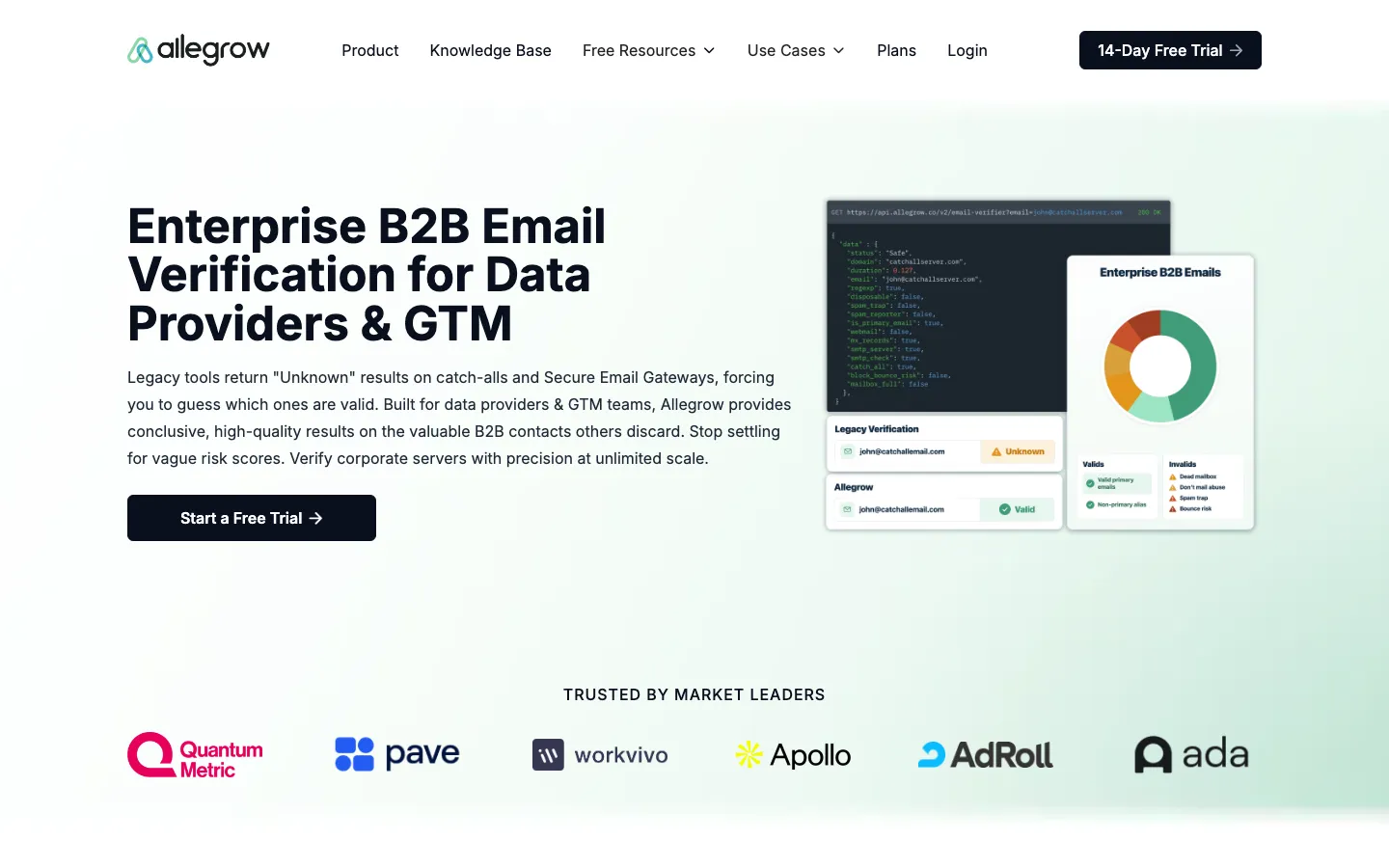
Allegrow is built around a narrow but valuable outbound problem: a B2B email address can sit behind a catch-all server or a secure gateway, leaving a basic verifier unable to give a useful answer. Allegrow says it returns Valid or Invalid statuses in those cases, then adds list cleaning and sender-health tools around the result. If your team is comparing the infrastructure behind a campaign, start with the Amazon SES review for the sending side of that decision.
That focus makes the product easier to place. It is not a broad sales platform. It is the layer between contact data and an outbound system, intended to identify primary addresses, risky contacts and mailboxes that deserve a closer look before they enter a sequence. The wider marketing tools directory helps when this is one piece of a larger stack decision.
The plans also reveal the intended motion. Starter is a self-serve way to clean a defined monthly volume. Scale Plus moves verification into supported workflows and removes CSV and integration credit limits. The API plan is for data providers and builders that need custom throughput, rather than a team buying a few extra credits.
Who gets the highest return from implementing Allegrow?
GTM teams with catch-all data
Use it when catch-all contacts and enterprise gateways make a large part of your list inconclusive.
Sales operations teams
Scale Plus fits teams that need verification inside a CRM or sales engagement workflow.
Data product builders
The API plan suits products that need configurable validation at high volume and custom speeds.
Teams watching domain health
Connect mailboxes when authentication checks and domain reputation belong beside contact verification.
The wrong fit is a one-off CSV that does not contain many difficult B2B domains. The first 5,000-contact allowance costs $99 a month, and the features that make Allegrow distinctive in a live sales workflow, including native integrations and unlimited verification, are higher up the plan ladder.
Which inbox monitoring and verification capabilities does Allegrow include?
Catch-all and secure gateway verification
Allegrow's central promise is a conclusion where catch-all servers and secure email gateways make normal checks uncertain. It identifies catch-all contacts as Valid or Invalid, and says it uses automated greylisting resolution for gateways such as Proofpoint and Mimecast. That matters most when discarding an unresolved address would cut too deeply into an enterprise prospect list. It does not make every address a sending decision, so keep your own suppression and consent rules in place.
Primary and high-risk contact detection
The platform can identify a primary email and flag non-primary aliases, spam traps, disposable addresses and inactive mailboxes. The practical benefit is less duplicate outreach to an executive with several valid aliases. It also gives an operations team a way to separate an address that exists from one it wants in the next campaign.
Deliverability controls
Verification is only the front door. Paid plans can connect mailboxes for domain health and reputation tracking, automated positive email interactions, hourly SPF, DKIM and DMARC checks, and a Safety Net for high-risk sends. Those controls make the product more relevant to a team that sends continuously, but they are not a substitute for reviewing the reputation and authentication setup of each sending domain.
API, MCP and workflow connections
Developers can use synchronous validation, asynchronous validation with webhooks, or bulk CSV validation through Allegrow's public API. The API reference also lists endpoints for credits, connected mailboxes, connected domains, users and Safety Net settings. A Claude MCP connector can verify contacts, check sender reputation and audit deliverability in plain language. Starter makes API access available on request; the API plan has custom speeds and unlimited API keys.
Integrations for active outbound teams
Scale Plus adds native  HubSpot,
 Outreach and
 Salesloft integrations, while Starter lists a
 Clay connection through an API key. Allegrow also presents
 Apollo.io and
 ZoomInfo integrations. The distinction is important: naming an integration is not the same as getting it in every plan. Confirm the plan, setup and workflow you need before you make it part of a launch sequence.
How does Allegrow structure contact tiers and plan pricing?
Price checked 27 Nov 2026
| Plan detail | 14-Day TrialFree | Starter$99/mo | Scale Plus$1,340/mo | API PlanCustom |
|---|---|---|---|---|
| Verification volume | Up to 1,000 addresses | From 5,000 contacts monthly | Unlimited | Millions of monthly requests |
| Catch-all Valid or Invalid status | ✓ | ✓ | ✓ | ✓ |
| CSV list cleaning | List upload, up to 1,000 addresses | ✓ | ✓ | Not specified |
| API access | ✕ | On request | Up to 1M requests/mo | Custom speeds |
| Native workflow integrations | ✕ | ✕ | ✓ | Not specified |
| Mailbox connection | ✕ | 1 mailbox | ✓ | Not specified |
Allegrow prices in US dollars, 27 Nov 2026.Allegrow plans
Starter is the meaningful paid entry point because it adds one connected mailbox and monitoring. The monthly price covers a starting allowance of 5,000 contacts. When a team needs more capacity without moving plans, extra credits cost $8 per 1,000 contacts and the vendor lists additional users at $40 per mailbox/user.
Scale Plus costs $1,340 a month billed annually, a $16,080 commitment for twelve months. The published plan does not specify how many users or connected mailboxes that price includes, so ask before using it as a team-budget total. It includes unlimited verification through integrations or CSV under the vendor's fair usage guidelines, plus up to 1 million API requests a month for internal automation. The API plan's CSV-upload, integration and mailbox entitlements are not specified; separately, the public API documents bulk CSV validation.
How does Allegrow serve high-volume enterprise data teams?
Allegrow's API Plan is the enterprise path for companies embedding verification into their own product, data workflow or AI application. It is custom priced for millions of monthly API requests, supports custom validation speeds and can be used to resell or embed verification. This is not an unlimited API plan: Allegrow says request or contact pricing applies to API packages.
Scale Plus is the better enterprise option when the job is internal outbound rather than a product feature. It adds a dedicated Customer Success Manager, customizable user governance and permissions, with SSO available as an add-on. Ask for the final security and SSO terms in writing because the published plan presents these as enterprise options, not a universal default.
Where does Allegrow fall short for lean sales groups?
Allegrow asks a smaller team to pay for its specialization early. Starter is a $99 monthly commitment for a starting 5,000 contacts, while the free trial is limited to 1,000 addresses and excludes integrations, API access and mailbox connection. That is enough to compare difficult records, but not to run a complete recurring workflow.
The plan boundary is sharper than the feature list first suggests. Starter includes API access only on request and does not include native integrations or unlimited verification. A team that wants verification to run inside its core sales systems needs Scale Plus, which is billed annually and requires a demo request.
Finally, the API plan gives no published rate. If your business model depends on per-contact economics, the sales conversation needs to settle price, rate limits and the validation method mix before you can compare it fairly with a self-serve alternative.
What email verification alternatives compare to Allegrow?
Allegrow is strongest when the hard part is resolving difficult B2B addresses and keeping a connected outbound workflow clean. If your immediate problem is the sending service itself, assess that layer separately from contact verification.  Amazon SES sends transactional, marketing and bulk email from applications through an API or SMTP interface, so it is sending infrastructure rather than an equivalent verification service.
For a more focused validation comparison, the  Bouncer review is the useful next read: Bouncer says $8 verifies 1,000 email addresses, checked 27 Nov 2026. Check each tool's published plan volume, API terms and treatment of the contacts that matter to your list before treating either one as a like-for-like substitute.
What is the definitive verdict on using Allegrow?
Allegrow addresses catch-all domains and secure gateways that frequently leave outbound sales teams with inconclusive verification results. Allegrow is the specialist option for that problem: its advantage is catch-all resolution, risk signals and sender-health controls, not the lowest price for an occasional upload.
Use the 14-day trial on up to 1,000 of the catch-all and gateway-protected addresses that currently stall your process. Move to Starter only if that result changes a recurring list-cleaning decision, then request a Scale Plus demo when native workflow integration becomes the priority.
How were the features and pricing of Allegrow reviewed?
Allegrow prices, plan limits and product capabilities were checked against its product, plans, integrations, deliverability and API pages on 27 Nov 2026. The Amazon SES and Bouncer alternative facts were checked against their respective vendors' pages on the same date. Prices are in US dollars as shown, and every figure follows how we check figures.
- Allegrow plans and product pages
- Allegrow integrations and deliverability pages
- Allegrow API reference
What are frequently asked questions regarding Allegrow deployment?
Does Allegrow have a free trial?
Yes. The trial lasts 14 days and verifies up to 1,000 addresses without a credit card. It includes catch-all analysis but not integrations, API access or mailbox connection.
How much does Allegrow cost?
Starter is $99 a month from 5,000 contacts monthly. Scale Plus is $1,340 a month billed annually, and the API Plan uses a custom quote. Extra Starter credits cost $8 per 1,000 contacts.
Is Allegrow verification unlimited?
Scale Plus offers unlimited verification through CSV uploads or native CRM and sales engagement integrations for internal sales teams, under fair usage guidelines. The API Plan is priced by request or contact.
Does Allegrow send test emails to verify an address?
No. Allegrow says it does not send emails to verify catch-all addresses and instead uses a signal-based system to analyze individual contacts.
 Reviewed byDanny Kirk
Founder of ReddiReach.
 Checked byAndrés Felipe
Digital designer and marketer.
Every figure is checked against the vendor's own page. Read our editorial standards.