
Key Takeaways
- Budibase helps operations and technical teams construct unified internal apps, approval flows, and automations directly around their existing data sources.
- Budibase allows organizations to self-host Community for free, whereas managed hosting on Budibase Cloud begins at $299 every month.
- Budibase includes an autonomous agent builder featuring integrated tool calling, custom knowledge source retrieval, and strict human approval checkpoints.
- Budibase proves cost-prohibitive for small experimental rollouts because its managed cloud tier starts with two creators and twenty end users.
Budibase is the right pick when you need to turn a governed internal process into an app, automation and approval flow without splitting that work across separate products. Its tradeoff is deployment: Community is free when you self-manage it, while Cloud starts at $299 a month for managed hosting, updates and maintenance.
Agent access
- API
- Yes, Self-hosted Enterprise. Budibase documents a Cloud base URL, but its current pricing page only identifies Public API availability in the self-hosted Enterprise comparison.
- MCP server
- Not found on official pages
- Automation
- Zapier, n8n
What are the primary strengths and trade-offs of Budibase?
What works
- Apps, agents and automations share one process platform
- Community is free with unlimited users and apps
- Cloud includes hosting, updates and maintenance
What to watch
- Cloud starts at $299 a month
- Cloud includes two creators and 20 end users
- Enterprise governance is a custom package
How does Budibase streamline internal business operations and workflows?
Budibase prevents operational friction that occurs when forms, underlying databases, and employee approval stages remain disconnected. Budibase joins those pieces in one platform: an app gives someone a place to make a request, an automation moves the work, and an approval can keep a consequential decision with a person. The marketing tools directory can help separate that internal-tool decision from ordinary marketing automation. That is a stronger proposition than a standalone workflow builder when the process also needs its own interface.
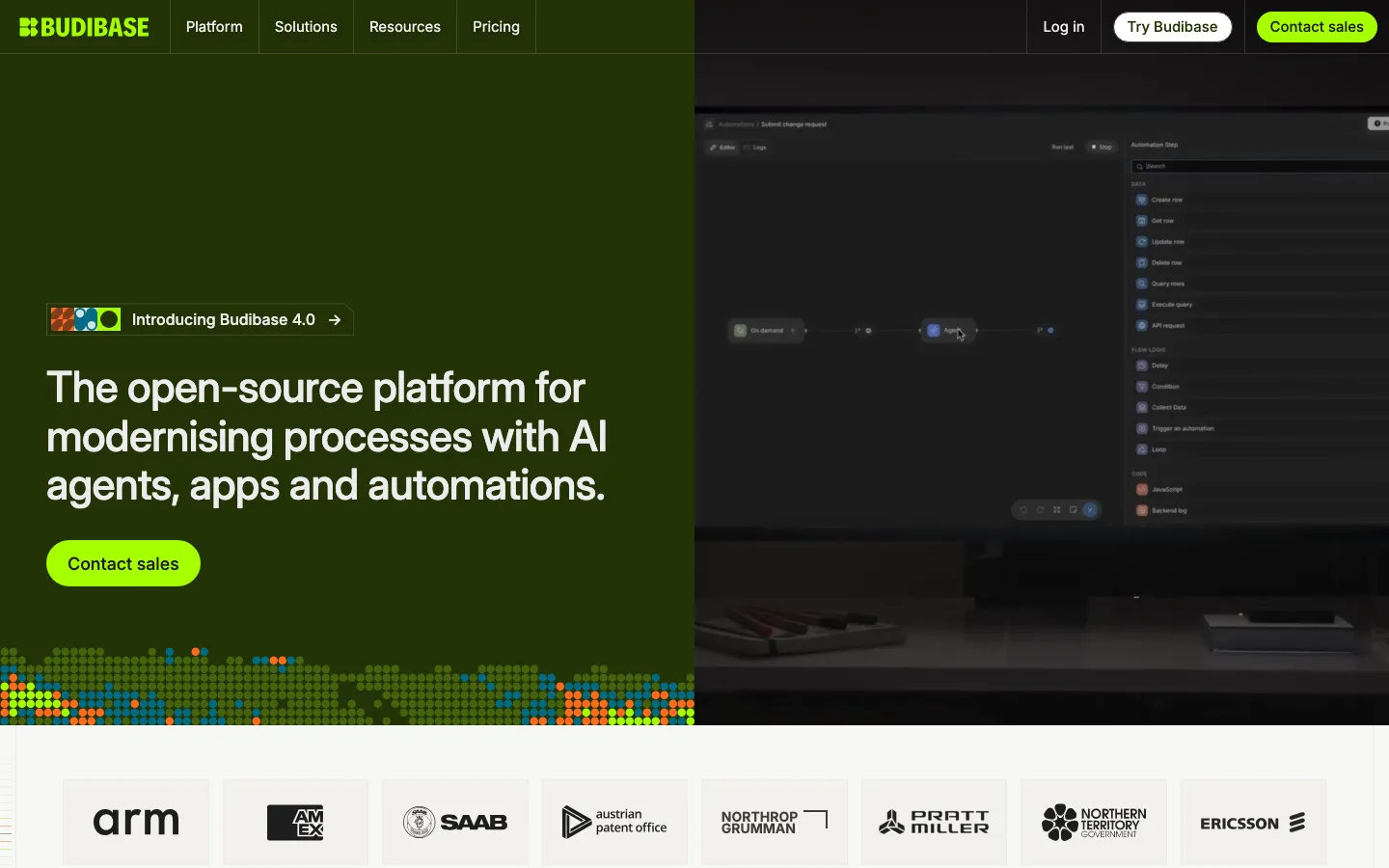
The platform is aimed at internal tools and workflow automation. Its app builder uses a drag-and-drop interface designer, while its automation builder can start from an app, agent, webhook, email, schedule or row change. A process can also call a connected API, run JavaScript, apply a condition and pause for a human decision. The important judgment is simple: Budibase fits a defined business process, not a vague ambition to automate everything.
Deployment is the dividing line. Community lets you run the complete platform on infrastructure you control, with unlimited users and unlimited apps, agents, automations and requests. Cloud moves hosting, updates and maintenance to Budibase, but begins at a materially different budget.
Who should choose Budibase for internal business tool development?
Operations teams
Build request and approval processes that need a clear interface, routing and accountable human decisions.
Internal tool teams
Connect business data and create apps without making every new operational need a custom software project.
IT and platform owners
Use Community when infrastructure control, standard SSO and unlimited users fit the operating model.
Regulated organizations
Evaluate Enterprise when flexible deployment, audit controls, dedicated support and air-gapped options are required.
I would start with Budibase only after naming one process owner, its data sources and the decision points that must remain human. Those boundaries let the team decide whether Community’s operational control or Cloud’s managed service is the better fit. A team that needs models built from custom entities, fields and relations should compare the Fibery review; a team designing a visual mobile or web app should compare the FlutterFlow review.
Which automation and application building features does Budibase include?
Apps for process work
Budibase’s app builder combines screens, data, automations and reusable components. The interface designer supports drag-and-drop construction, multi-screen responsive apps and more than 40 pre-built components on the self-hosted comparison. That gives a process owner somewhere more structured than an inbox to collect a request, show its status and send it to the next person.
Automations with explicit handoffs
The automation builder supports more than 20 triggers and actions in the published self-hosted comparison. Workflows can begin with a webhook, email, schedule, app or agent, then call APIs, transform data with JavaScript and update a connected system. Budibase also lets you test a workflow before deployment. That combination is valuable when a repeatable task has enough rules to deserve a real process, rather than an opaque chain of app actions.
Agents with approval rules
Budibase positions agents as workers that use your data, tools and approval rules. The self-hosted plans list an agent builder, bring-your-own AI key, tool calling, evaluations and knowledge sources. The automation product shows agents alongside deterministic steps and human approvals, so the intended model is not an unattended agent making every decision. Keep that distinction in the design: an agent can gather context or prepare work, while the process defines where a human must approve it.
Data, APIs and connections
The marketplace organizes connections across APIs, databases, AI models and knowledge bases. Budibase lists a custom REST API connector and supports internal and external data sources on both self-hosted plans. The docs also enumerate data sources including common SQL databases, spreadsheets, object storage and REST APIs. The connection list is broad, but a build still succeeds or fails on the exact fields, permissions and actions your particular process needs.
Deployment and governance
Community is self-managed, with one workspace, one day of automation-log retention and standard SSO. Enterprise expands the self-hosted offer with unlimited workspaces, extended activity and audit logs, backups, enterprise identity and access controls, flexible deployment including air-gapped environments, and dedicated support, onboarding, training and SLAs. Cloud is a separate hosted offer. That is a sensible range for organizations that want the same process model but have different requirements for hosting and governance.
How are self-hosted and cloud tiers priced in Budibase?
Price checked 27 Nov 2026
| Plan detail | Community$0 | CloudFrom $299/mo | EnterpriseCustom |
|---|---|---|---|
| Hosting | Self-managed | Managed by Budibase | Flexible deployment |
| Users | Unlimited | 20 end users | Unlimited |
| Creators | Unlimited | 2 | Unlimited |
| Apps and agents | Unlimited | Unlimited | Not stated |
| Automations | Unlimited | Unlimited | Unlimited |
| Monthly actions | Not stated | 250K | Not stated |
| Monthly AI credits | Not stated | 50K | Not stated |
Budibase prices in US dollars, 27 Nov 2026.Budibase pricing
The actual team bill depends first on deployment. At Cloud’s published starting rate, 12 months total $3,588, an annualized calculation rather than a published annual billing offer. That rate includes two creators, 20 end users, 250,000 monthly actions and 50,000 monthly AI credits. A Community team has no subscription price but runs Budibase on infrastructure it controls. These are different operating models, so treating the free plan as a like-for-like alternative to Cloud would hide the work Cloud is designed to take on.
- Community: self-hosted, unlimited users, and unlimited apps, agents, automations and requests
- Cloud: hosted service, two creators, 20 end users, 250K monthly actions and 50K monthly AI credits
- Enterprise: custom package with unlimited users, creators, groups and workspaces
- Special packages: partner, charity and public-sector arrangements are available on request
What additional governance and deployment capabilities does Budibase Enterprise offer?
Budibase Enterprise provides advanced governance, security controls, and deployment options beyond published Community and Cloud tiers. It includes extended activity, audit logs and backups, enterprise identity and access controls, flexible deployment and dedicated support, onboarding, training and SLAs. The self-hosted comparison also lists synchronous webhooks, Budibase AI, public API access, user groups and workspace backup retention as Enterprise features.
That makes Enterprise a governance purchase, not simply a way to remove user limits. A team with a real policy requirement can justify the custom discussion. A team that only wants to get one internal request process live should establish whether Community or the published Cloud allowance already covers the work before moving to a bespoke package.
Where does Budibase create challenges for smaller business teams?
Budibase Cloud does not offer the kind of small hosted starting plan that lets a few people pay a modest amount to experiment. Its published offer starts at $299 a month and sets two creators, 20 end users, 250,000 monthly actions and 50,000 monthly AI credits. That can be entirely reasonable for a live internal process, but it is a substantial commitment for an early idea.
The free route is not a cheaper hosted tier. Community is explicitly self-managed, and Cloud’s price includes hosting, updates and maintenance managed by Budibase. Budget and operational capacity therefore matter together. Use Community when running Budibase on your own infrastructure is a deliberate choice, not because the $0 label makes it look interchangeable with a hosted service.
Finally, some controls sit beyond the Community offer. Its self-hosted comparison shows a one-workspace limit, one day of automation-log retention, no synchronous webhooks, no Budibase AI, no public API and no user groups. Those limits may not matter for a first internal tool, but they matter when the workflow becomes a shared, governed service.
Which low-code platforms compete directly against Budibase?
Budibase alternatives should be selected based on specific internal operational requirements rather than generic no-code marketing classifications.  Fibery review is the better comparison when the team needs flexible process models built from custom entities, custom fields and custom relations.
 FlutterFlow review is the more relevant comparison when the outcome is a visual mobile or web app: FlutterFlow Studio is its visual builder.
Budibase is strongest when the app, automation and approval belong to the same operational workflow. If the main task changes, the product category should change with it.
Does Budibase offer the best balance of speed and governance?
Budibase earns a place in an operations or IT stack when an internal process needs more than a trigger and an email. The app builder, automations, agents and approvals make a coherent system for requests that need data, rules and human accountability. Community is compelling for a team that deliberately wants self-management; Cloud is the better practical choice when managed hosting is worth $299 a month and its published allowances fit the rollout.
Pick one request or approval process, define its data connections and human decision points, then choose the deployment model before building. Start with Community only when your team intends to operate Budibase. Choose Cloud when managed updates and maintenance are part of the value you are buying.
How were Budibase product claims and deployment costs evaluated?
Budibase documentation, product specifications, and official pricing pages supplied all verified details evaluated on 27 Nov 2026. Prices are in US dollars as Budibase displays them, and the approach follows how we check figures.
- Budibase pricing and self-hosted plan comparison
- Budibase app and automation product pages
- Budibase connections marketplace and documentation
What are common technical questions about deploying Budibase?
Is Budibase free?
Yes. The Community plan is $0 and self-managed. It includes unlimited users and unlimited apps, agents, automations and requests.
What does Budibase Cloud cost?
Budibase Cloud starts at $299 a month. The published offer includes two creators, 20 end users, 250,000 monthly actions and 50,000 monthly AI credits.
Can Budibase handle approvals?
Yes. Budibase describes requests and approvals as part of its platform, and its automation product lets teams require human decisions at points they define.
Does Budibase support AI agents?
Yes. The self-hosted plan comparison lists an agent builder, tool calling, evaluations and knowledge sources. Budibase also describes agents that work with data, tools and approval rules.
 Reviewed byDanny Kirk
Founder of ReddiReach.
 Checked byAndrés Felipe
Digital designer and marketer.
Every figure is checked against the vendor's own page. Read our editorial standards.