
Key Takeaways
- DinoRANK equips lean search optimization teams with rank tracking, competitive research, on-page content assistance, and automated reporting in a single interface.
- DinoRANK prices its Starter package at thirty-three euros monthly on annual plans or thirty-nine euros billed month-to-month for four hundred keywords.
- DinoRANK provides intermediate Pro plans starting at fifty-four euros monthly alongside the comprehensive Business tier at one hundred sixteen euros per month.
- DinoRANK includes programmatic API and Model Context Protocol capabilities on every tier, tracking up to one hundred twenty large language model prompts.
You need a lean SEO workspace that can track rankings, shape content work and pass data to an AI agent, with API and MCP access listed on every plan. DinoRANK is the sensible pick for a small team that values those basics over a sprawling platform, starting at €33 a month on annual billing.
Agent access
- API
- Yes, all DinoRANK plans, starting with Starter
- MCP server
- Official, hosted, API key
- Works with
 Claude
 ChatGPT
What are the core DinoRANK pros and cons?
What works
- API and MCP access are listed from the Starter plan
- DinoBRAIN content generation is part of DinoRANK, not a separate product
- Annual billing lowers Starter from €39 to €33 a month
What to watch
- Starter has 400 tracked keywords and one DinoBRAIN content item
- GeoGrid local analyses begin on Pro, with 30 per plan period
- LLM prompt tracking stops at 120 prompts on Business
What does DinoRANK do for your SEO workflow?
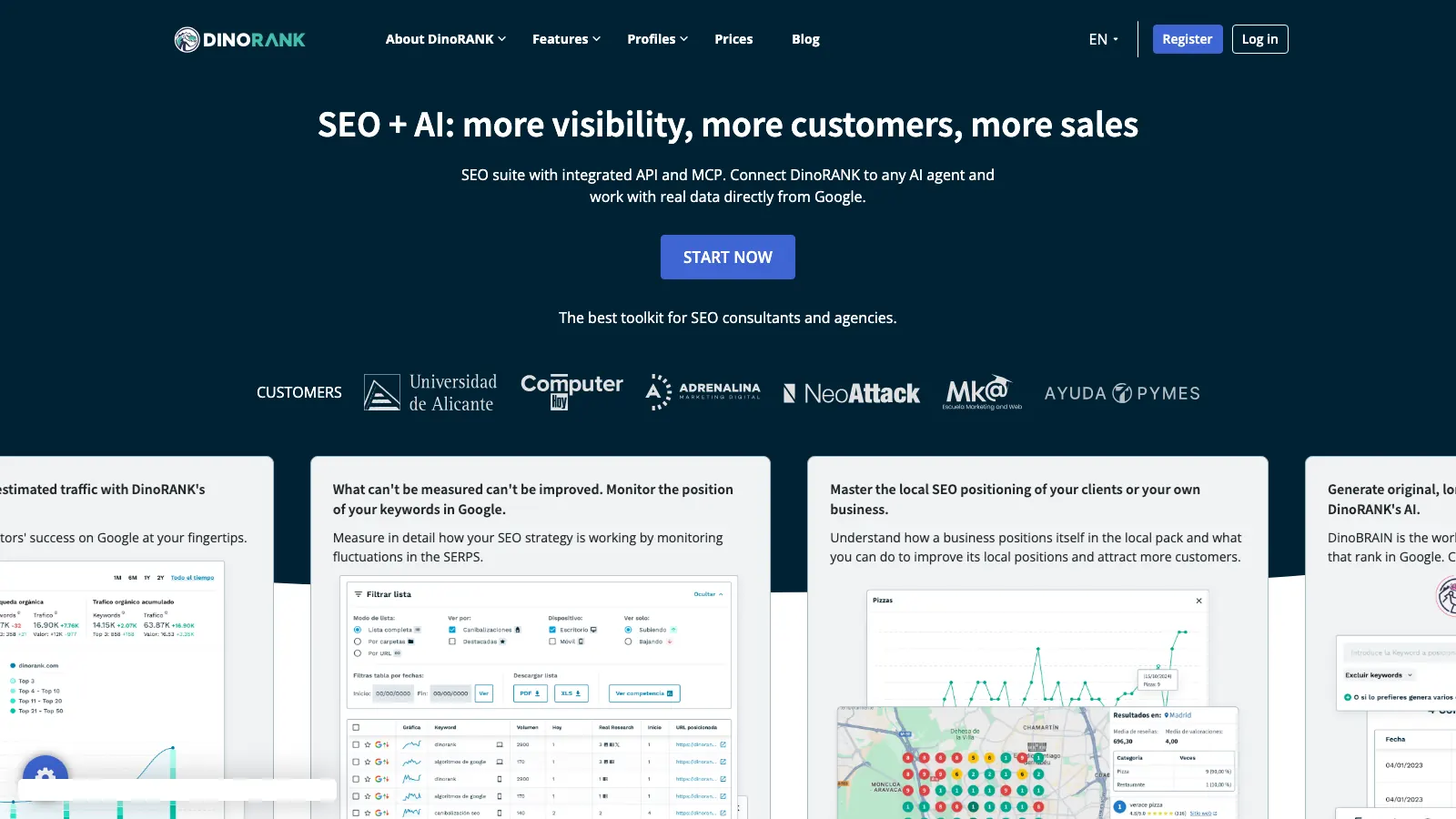
DinoRANK puts the ordinary work of a search team in one place: keyword positions, competitor visibility, content opportunities, local work and reports. It is a useful option among SEO suites when the priority is getting a clear working set of SEO tools rather than paying for a platform whose depth your team will not use.
The product’s practical advantage is the handoff between research and execution. Its visibility graph estimates competitors' traffic and surfaces the terms they rank for. DinoBRAIN then sits inside the same product for article generation, web architecture and content curation. That does not remove editorial judgment, but it does keep the research and drafting workflow closer together.
DinoRANK also treats machine access as part of the base subscription. The vendor lists an API and MCP connection for any AI agent, and says the MCP can connect with Claude, ChatGPT and other AI tools. Its SEO for LLMs module adds AI-answer monitoring, while Pro and Business list 50 and 120 prompts to track. That makes the divide between plans mostly one of capacity, not whether the workflow is possible at all.
Who is DinoRANK best suited for?
Small business teams
Starter combines 400 tracked keywords, one DinoBRAIN content item and unlimited domains at the entry price.
SEO consultants
Rank tracking, competitor visibility graphs and white-label reports support recurring client work.
Content-focused teams
DinoBRAIN is built into the suite, with 20 content items on Pro and 80 on Business.
Teams using agents
Every plan lists API and MCP access, while higher plans add LLM prompt tracking capacity.
Pro is the natural working plan for a consultant or compact team. It includes 800 tracked keywords, 20 DinoBRAIN content items, 150 competitor-visibility analyses and 30 local SEO analyses. For a larger agency workflow, Business raises those limits to 2,000 keywords, 80 content items, 300 visibility analyses and 70 local SEO analyses.
Which SEO tools does DinoRANK include?
Daily rank tracking and SERP context
DinoRANK monitors daily movement and positions in Google search results. The tracker can show desktop and mobile movement, keyword behavior graphs, geolocated tracking and report downloads. It also flags when Google displays an AI Overview for a keyword, which helps explain why a strong rank may not have the visibility a team expects.
Competitor visibility and content gaps
The visibility graph estimates competitor traffic and reveals keywords for which competing domains are positioning. DinoRANK also presents the content competitors rank with when your site does not. Treat estimated traffic as a planning signal, not as an audited traffic number, but the feature gives a team a direct route from a competitor domain to potential content work.
DinoBRAIN content work
DinoBRAIN and DinoBRAIN Pro are functions of DinoRANK itself. The product describes generated articles, web architecture and content curation, alongside tools for finding terms Google already associates with your pages and identifying what competitor content includes. Starter lists one DinoBRAIN content item, Pro 20 and Business 80, so volume is the first capacity check before committing to the suite.
Local SEO and reporting
Geolocated rank tracking is available on all three plans, but GeoGrid analyses begin at Pro. The local module compares a business's local-pack positioning with competitors. DinoRANK also lists white-label reports on every plan, and its feature page says reports can carry your logo and connect with Looker Studio while combining DinoRANK, Google Analytics and Google Search Console data.
SEO for LLMs, API and MCP
The SEO for LLMs module covers brand mentions, citations, AI-source traffic and competitor analysis in AI responses. DinoRANK names ChatGPT, Gemini and Claude among the models it can monitor. The API and MCP are listed from Starter, so an agent can use the data without buying a higher tier just for access. The important ceiling is tracking volume: Pro lists 50 prompts and Business 120.
How much does DinoRANK cost across its tiers?
Price checked 27 Nov 2026
| Plan detail | Starter€33/mo yearly | Pro€54/mo yearly | Business€116/mo yearly |
|---|---|---|---|
| Monthly price | €39/mo | €65/mo | €139/mo |
| Tracked keywords | 400 | 800 | 2,000 |
| DinoBRAIN content items | 1 | 20 | 80 |
| Competitor visibility analyses | 50 | 150 | 300 |
| GeoGrid local analyses | 0 | 30 | 70 |
| API and MCP | ✓ | ✓ | ✓ |
| LLM prompt tracking | Not listed | 50 prompts | 120 prompts |
DinoRANK prices in euros, 27 Nov 2026.DinoRANK pricing
Annual billing gives a 20% discount. The annual totals shown are €390 for Starter, €650 for Pro and €1,390 for Business. For a team that needs Pro's published capacity, the bill is €54 a month on annual billing, or €650 for the year, with 800 keywords, 20 DinoBRAIN content items, 150 visibility analyses, 30 local SEO analyses and unlimited domains. DinoRANK does not publish a seat count or an extra-user price, so ask before sizing it for several people.
Where does DinoRANK fall short for larger agencies?
DinoRANK limits its entry-level Starter package to four hundred tracked keywords and a single DinoBRAIN content run. Starter includes 400 tracked keywords, one DinoBRAIN content item, 50 competitor visibility analyses and zero GeoGrid local analyses. It can be enough for a modest site, but a team publishing regularly or managing local clients will reach Pro's allowances much faster than the entry price suggests.
AI visibility is present, but the published allowance is modest for a serious monitoring program. Pro tracks 50 prompts and Business 120. A team that needs much broader prompt coverage should size that requirement first, rather than treating the module as a substitute for a dedicated AI visibility product.
DinoRANK publishes API and MCP access, but it does not publish the API limits, seat count or extra-user price. Get those terms in writing if an automated reporting workflow or a changing team size is central to the purchase.
What are the primary DinoRANK alternatives?
 AI Peekaboo review is the better comparison when AI-answer monitoring is the primary job. Its plans start at $30 a month and include API and MCP access, while DinoRANK is the broader choice for rank tracking, competitor research and SEO content work.
 EmbedSocial review has a permanent Free plan with one source and 500 views a month. It turns social content and customer reviews into website widgets, rather than supplying SEO tracking.
 GatherContent (Bynder Content Workflow) review is now sold as Bynder Content Workflow, with customizable multi-stage approval workflows, defined roles and content templates. It has a 14-day trial, while paid packages are quote-based.
What is the final DinoRANK verdict?
DinoRANK earns a place for a small team that wants practical SEO coverage, built-in content assistance and agent access at a published price. Pro is the balance point: it adds 800 keywords, 20 content items, local analyses and 50 LLM prompts without moving to Business. The Starter plan makes sense only when its tighter limits are genuinely enough.
Start by counting your tracked keywords, monthly content requirement and LLM prompts. Pick Pro when those needs exceed Starter, and ask DinoRANK to confirm API limits, seat count and extra-user pricing before building it into an agency reporting workflow.
How was DinoRANK evaluated and verified?
DinoRANK plan specifications, pricing tables, tracking limits, and documentation were evaluated directly on 27 Nov 2026. Prices are in euros as DinoRANK shows them, and every figure follows how we check figures.
- DinoRANK English product and annual pricing pages
- DinoRANK features, rank tracking and local SEO pages
- DinoRANK API, MCP, DinoBRAIN and SEO for LLMs pages
What are common questions about DinoRANK?
How much does DinoRANK cost?
Starter costs €33 a month on annual billing or €39 monthly. Pro costs €54 annually or €65 monthly, while Business costs €116 annually or €139 monthly.
Does DinoRANK have an API and MCP?
Yes. DinoRANK lists API and MCP access on every plan, and says its MCP can connect with Claude, ChatGPT and other AI tools.
Which plan includes local SEO analyses?
All plans include geolocated rank tracking, but GeoGrid local SEO analyses start on Pro. Pro lists 30 analyses and Business lists 70, while Starter lists none.
Does DinoRANK track AI answers?
Its SEO for LLMs module covers brand mentions, citations, AI-source traffic and competitor analysis. Pro lists 50 prompts to track and Business lists 120, with ChatGPT, Gemini and Claude named among the models.
 Reviewed byDanny Kirk
Founder of ReddiReach.
 Checked byAndrés Felipe
Digital designer and marketer.
Every figure is checked against the vendor's own page. Read our editorial standards.