
Key Takeaways
- EasyDMARC manages email authentication across small domain portfolios with unlimited user seats on every published tier, starting at €35.99 monthly billed annually.
- EasyDMARC packages domain authentication on DMARC Plus for €35.99 monthly across two domains, scaling to DMARC Premium at €71.99 monthly for four.
- EasyDMARC provides a 64-endpoint public API, a 10-endpoint Partner API, and an MCP server to connect external agents directly into security workflows.
- EasyDMARC proves unsuitable if your operational objective requires dedicated standalone email list verification or inbox placement testing without paying for custom deliverability consulting.
EasyDMARC is the best fit when you need to manage DMARC for a small group of domains without rationing seats, starting at €35.99 a month on annual billing. Its Email Verification tool can identify invalid, risky or undeliverable addresses before sending, while the entry plans focus on authentication. The marketing tools directory helps when you need to separate those adjacent jobs.
Agent access
- API
- Yes, Enterprise: Email Trust or EasyDMARC for MSPs
- MCP server
- Official, hosted, EasyDMARC account sign-in
- Works with
 ClaudeClaude Code
 ChatGPT
 Cursor
What are the primary pros and cons of EasyDMARC?
What works
- 14-day free trial, with no credit card required
- Unlimited users on all four published plan tiers
- Free record tools for SPF, DKIM, DMARC, BIMI, MTA-STS and TLS-RPT
What to watch
- DMARC Plus has two domains and three months of history
- Inbox-placement testing is on the quoted Deliverability plan
- Deliverability and Enterprise costs are not published
What does EasyDMARC do for your domain security?
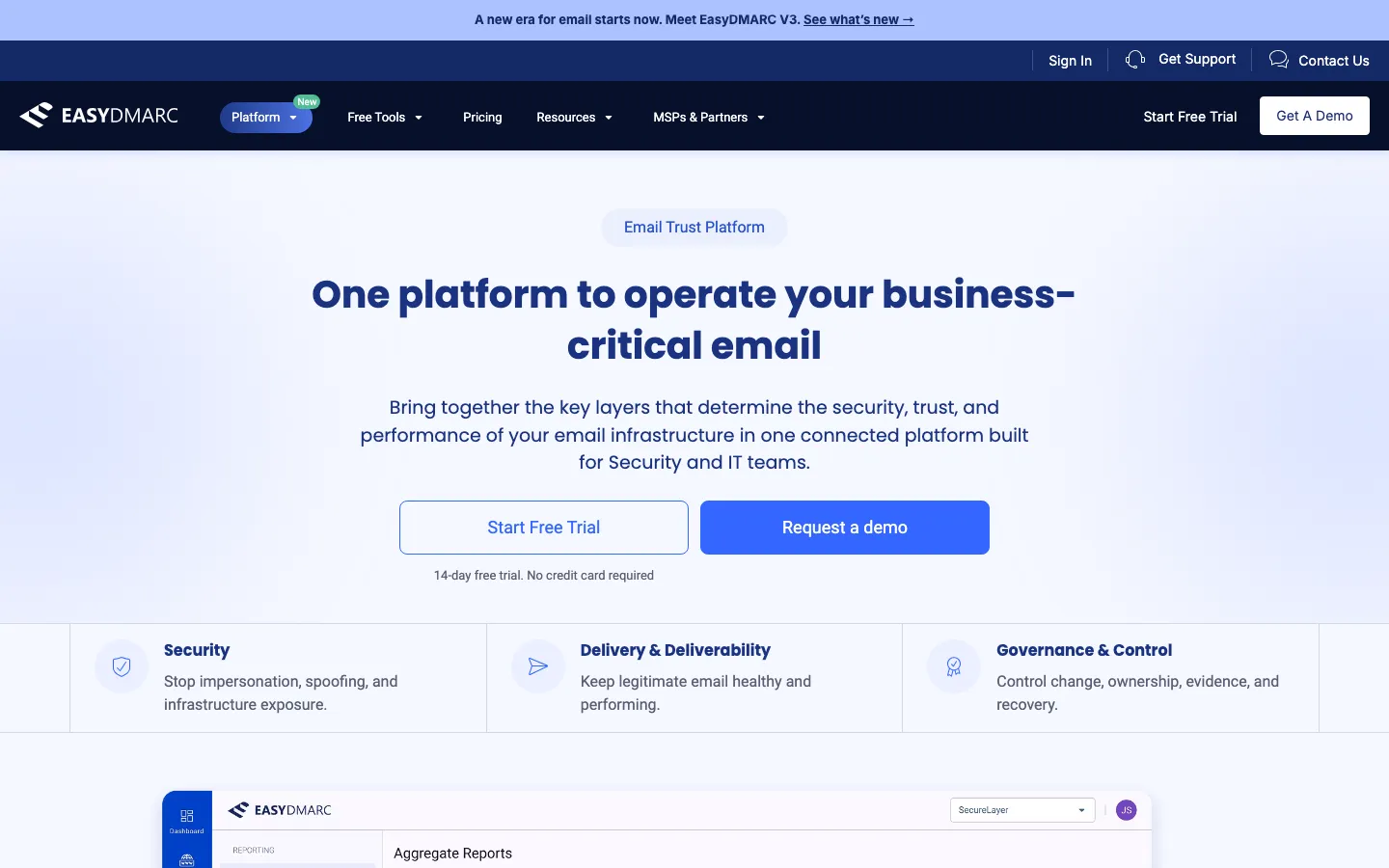
EasyDMARC brings domain authentication, DNS work and sender insight into an Email Trust Platform. That makes it a sensible choice when your question is not merely whether a record exists, but which services are sending mail for your domain and how the team will manage the policy around them. Its free tools give you a quick starting point, while the paid plans add the operational layer.
The useful division is between the two self-serve plans and the two quoted tiers. DMARC Plus is the controlled start for two domains. DMARC Premium expands that to four domains, one year of history, AI Agents and proactive DMARC alerts. Deliverability then adds sender-focused work such as delivery analytics, reputation monitoring and inbox-placement testing. Enterprise adds selectable modules including DNS Manager, Sender Insights and Threat Intelligence.
That breadth is a strength only when email authentication is someone’s ongoing responsibility. If your team is repairing a one-off sending issue, begin with the free checks. If you need a dependable place to operate several protected domains, the paid plans give the work a home without making seats the first budgeting problem.
Who should use EasyDMARC to protect email deliverability?
Small security teams
Two domains, unlimited users and a self-serve price suit teams making DMARC a shared operational responsibility.
Growing domain portfolios
Premium supports four domains and one year of history when several brands or sending services need attention.
Delivery-focused operators
The custom Deliverability tier combines authentication with placement, reputation and email-investigation capabilities for ongoing delivery work.
MSPs and agencies
The MSP offer starts at 10 domains and includes unlimited users, training and partner-portal access for client operations.
EasyDMARC's Email Verification tool can identify invalid, risky or undeliverable addresses before sending. Its DMARC Plus and Premium entry plans focus on the sender side of trust, so a dedicated list-verification workflow may be clearer when contact validation is the only job. A healthy record set still does not configure DMARC for the domain sending a campaign.
Which authentication and DNS management features does EasyDMARC provide?
DMARC reporting and managed records
The core DMARC module covers aggregate reports, failure reports, managed DMARC, BIMI reporting, managed BIMI, managed DKIM, managed MTA-STS and TLS reporting. EasySPF is aimed at the SPF “too many DNS lookups” permerror. For a small team, that collection is more useful than a raw report feed because it keeps the records and the policy work in the same place.
Free diagnostics before a trial
The free tool set covers SPF, DKIM, DMARC, BIMI, MTA-STS and TLS-RPT, as well as a DNS Record Checker and a one-click domain check. Use those tools to identify which kind of problem you have before making a subscription decision. They are especially practical when a marketing or security lead needs a first answer from free checks.
Delivery and sender insight
Deliverability is the point where EasyDMARC moves beyond policy management. The plan lists delivery analytics, reputation monitoring, email investigation and preview, plus 300 monthly inbox-placement tests. It also lists 300 monthly investigation tests, 100K email verifications and 200 monthly previews. Those quantities make a clearer case for a team with a recurring delivery workload than for an occasional bulk sender.
AI agent, API and integrations
EasyDMARC’s AI Agent covers security, delivery, deliverability and compliance, with human approval for actions. The public API, version 1.0, has 64 endpoints across five categories, and the Partner API has 10 across two categories for reseller and wholesale operations. EasyDMARC also lists more than 50 integrations and MCP support for bringing permitted context and selected actions into external AI assistants and agents.
MSP operation
The MSP offer is not just a larger business account. It includes DMARC and DNS Manager, has a 10-domain minimum and uses flexible domain-based scaling. Unlimited MSP technical training, a partner portal and a growth program sit alongside EasyDMARC, which makes it relevant when your service team is managing email trust for clients rather than one company.
How is EasyDMARC priced across different domain volumes?
Price checked 27 Nov 2026
| Plan detail | DMARC Plus€35.99/mo | DMARC Premium€71.99/mo | DeliverabilityCustom | EnterpriseCustom |
|---|---|---|---|---|
| Billing shown | Annual | Annual | Talk to sales | Talk to sales |
| Monthly price | €44.99/mo | €89.99/mo | Custom | Custom |
| Starting email volume | 100,000/mo | 100,000/mo | Custom | Custom |
| Domains | 2 | 4 | Up to unlimited | Up to unlimited |
| Data history | 3 months | 1 year | Up to 3 years | Up to 3 years |
| Users | Unlimited | Unlimited | Unlimited | Unlimited |
| Inbox-placement tests | Not stated | Not stated | 300 monthly | Custom |
EasyDMARC prices in euros, 27 Nov 2026.EasyDMARC pricing
The cleanest team bill is also unusually simple: three people can use DMARC Plus for €35.99 a month on annual billing, because the plan lists unlimited users. That price covers two domains and a starting volume of 100,000 emails a month. Add domains, a larger volume or delivery testing, and the published entry price stops being the number that decides your spend.
- DMARC Premium costs €71.99 a month annually, or €89.99 month to month
- Annual billing is presented as a 20% saving with bonus features
- Deliverability includes a dedicated engineer as an optional add-on
- Enterprise includes a dedicated engineer and lists SSO, API access and audit logs
How do EasyDMARC Enterprise and MSP plans support service providers?
EasyDMARC Enterprise is designed for teams that need to choose from modular Email Trust Platform features rather than stay inside DMARC alone. The tier can include DMARC, DNS Manager, Sender Insights and Threat Intelligence, then carries forward Deliverability capabilities. Its price is custom, so it is not possible to compare it directly with a self-serve Premium account before a sales conversation.
The MSP plan is also custom and begins at 10 managed domains. It gives one year of data history, unlimited users and all integrations. The plan page also lists alerting, API access, SSO and audit logs, but does not show whether they are included, so confirm those terms before buying. Add-on quantities scale per domain increase, including 25 email-investigation tests, 5K email verifications and 25 inbox-placement tests. That is a different buying unit from the business plans, so treat it as a managed-service offer, not a seat bundle.
Where does EasyDMARC fall short for growing domain portfolios?
EasyDMARC keeps its two affordable entry plans deliberately narrow on domain counts. Plus gives you two domains and Premium gives you four, so a business with multiple brand, regional or transactional domains can outgrow the public plans quickly. Plus also retains only three months of history, which is a short window if your team is trying to understand a change that unfolded across a quarter.
The delivery work is behind the sales boundary. Inbox placement, delivery analytics and reputation monitoring belong to Deliverability, whose price is custom. That makes the entry price a good test of DMARC operations, not a promise of the full deliverability toolkit.
There is one more practical limit for automation teams: the site lists the public API, Partner API and MCP, but the plan comparison does not place all of that access on the two self-serve tiers. If automation is central to your implementation, make the commercial terms part of the conversation before you build around it.
Which security and deliverability tools represent practical EasyDMARC alternatives?
EasyDMARC alternatives address campaign delivery issues when recipient file unreliability is the root cause. The  Emailable review is useful for address verification because it uses one credit per verification and its credits never expire.
For another route through that pre-send question, the  EmailListVerify review lists domain and SMTP validation, an email duplicates remover and pay-as-you-go pricing. Neither option replaces DMARC reporting when the sender’s domain configuration is the source of risk.
What is the overall verdict on choosing EasyDMARC?
EasyDMARC provides an unusually clear ownership model with unlimited user seats for teams consolidating two to four domains under shared authentication. The free tools make a sensible first stop, while Premium is the better self-serve choice when four domains, one year of history and proactive alerts match your operating model.
Start with the free tools, then use the 14-day trial to map the domains and sending sources your team actually manages. Buy Plus for a small two-domain operation, move to Premium for the wider self-serve allowance, and request a Deliverability quote only when ongoing placement and reputation work are part of the job.
How were the specifications and rates for EasyDMARC compiled?
EasyDMARC features, limits, and prices were gathered directly from official vendor pricing, platform, API, free-tools, and MSP pages on 27 Nov 2026. Prices are in euros as EasyDMARC shows them, and every figure follows the rules in how we check figures.
- EasyDMARC pricing for businesses and MSPs
- EasyDMARC pages for free tools, the AI Agent and APIs
- EasyDMARC platform and company pages
What are the common questions asked about EasyDMARC?
Is there a free EasyDMARC trial?
Yes. EasyDMARC offers a 14-day free trial without a credit card, and its two self-serve plans display a Start Free Trial option.
How much does EasyDMARC cost?
DMARC Plus is €35.99 a month on annual billing or €44.99 month to month. DMARC Premium is €71.99 a month billed annually or €89.99 a month billed monthly. Deliverability and Enterprise have custom prices.
Does EasyDMARC have an API?
Yes. Its public API, version 1.0, lists 64 endpoints across five categories, and its Partner API lists 10 endpoints across two categories. The platform also lists MCP support for external assistants and agents.
Does EasyDMARC have an MSP plan?
Yes. The MSP offering includes DMARC and DNS Manager, starts at 10 domains and includes unlimited users, technical training and partner-portal access.
 Reviewed byDanny Kirk
Founder of ReddiReach.
 Checked byAndrés Felipe
Digital designer and marketer.
Every figure is checked against the vendor's own page. Read our editorial standards.