
Key Takeaways
- Factors.ai unifies B2B account identification, marketing attribution, and CRM activation to help demand generation teams identify in-market buying intent across complex funnels.
- Factors.ai provides a Lite tier at $199 monthly after a 14-day trial, while complete account segmentation and CRM synchronization begin on Basic at $6,000 annually.
- Factors.ai offers its proprietary Scout MCP integration as an add-on, giving AI agents structured access to account intelligence and pipeline attribution metrics.
- Factors.ai proves impractical for marketing teams that merely require standard site analytics or lack the sales volume to warrant an enterprise account-based marketing platform.
Factors.ai is a practical fit when you run B2B demand generation and need account activity, campaign influence and follow-up workflows in the same system. You can start on Lite at $199 a month after a 14-day trial, but the meaningful account segmentation and CRM sync begin on the $6,000-a-year Basic plan.
Agent access
- API
- Yes, FREE, LINKEDIN, GROWTH, and ENTERPRISE are listed in the Account Journey API throttle table.
- MCP server
- Official, hosted, Personal access token
- Works with
 ClaudeClaude Code
 ChatGPT
 Cursor
- Automation
- Zapier, n8n
What are the primary pros and cons of Factors.ai?
What works
- Published Lite price and no-card trial
- Account activity, attribution and CRM sync
- Scout MCP connects first-party GTM data to agents
What to watch
- Core ABM controls start at $6,000 a year
- Growth jumps to $20,000 a year
- Some add-ons still require a sales quote
How does Factors.ai connect account intent with pipeline revenue?
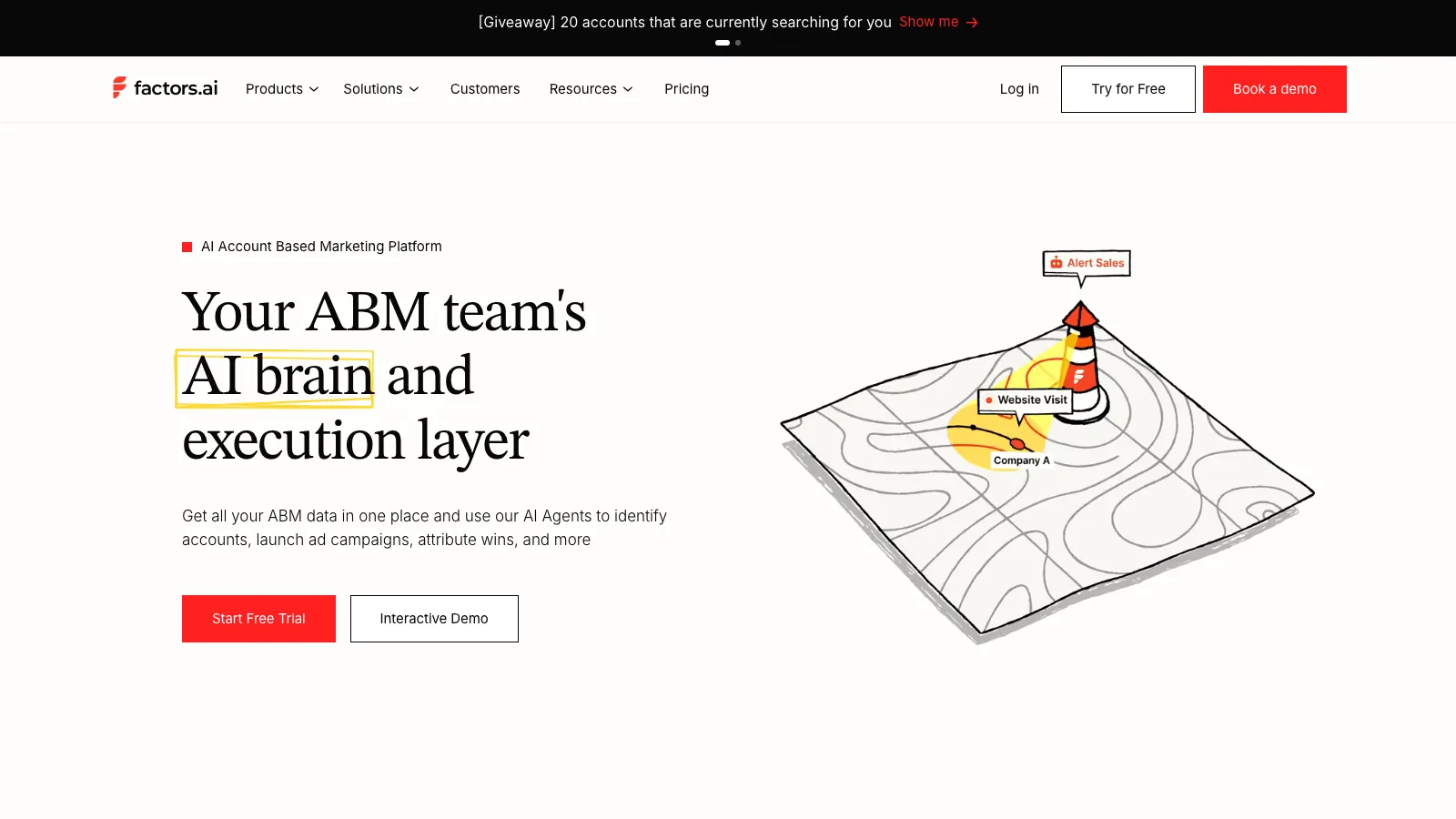
Factors.ai unites account identification, marketing attribution, and CRM activation for enterprise B2B revenue teams. It identifies companies visiting your site, combines those signals with ad and CRM data, then lets you build alerts, reports and audience workflows around accounts that matter. Its first job is not broad web reporting. It is helping a demand team decide which account activity deserves a response. If you only need privacy-focused web analytics rather than account enrichment, the Fathom Analytics review is the better comparison.
Lite gives you company identification, website traffic analysis and Slack or Microsoft Teams alerts. Basic adds account segmentation, LinkedIn Ads influence, rule-based workflows, up to 50 reports and CRM sync. That makes Basic the real starting point when you need sales and marketing to work from the same account record, rather than simply receive an alert.
The tool is an especially strong match for paid B2B programs. Its Attribution and Analytics product ties ad spend from Google, LinkedIn, Meta and Bing to pipeline and revenue, while account views collect calls, emails, meetings and ad engagement together. If your job is to explain why a campaign worked after an account converts, that is a more useful frame than session counts alone.
Who should deploy Factors.ai for account-based marketing?
B2B demand teams
Tie paid campaigns, intent signals and pipeline actions to target accounts.
Revenue operations teams
Send CRM account activity and timely sales alerts through one shared workflow.
 LinkedIn advertisers
Measure LinkedIn account influence and create intent audiences without manual list maintenance.
Agent-building GTM teams
Give MCP-compatible assistants account signals, deal context and follow-up actions for GTM work.
It is not the natural choice for a solo marketer looking for uncomplicated traffic reports. Nor is it a person-identification product. Factors says it does not offer person-level identification, although geography and job-title filters can help narrow down who likely visited.
Which attribution and account intelligence tools does Factors.ai offer?
Account intelligence
Factors identifies companies visiting your website and can enrich accounts with geography and job titles. On Basic and above, it says it can unmask more than 75% of companies visiting your site. The distinction matters: that is company identification, not a promise to name an individual visitor.
Attribution and journey analysis
The attribution product lets teams filter reports by channel, campaign and funnel stage, then examine content engagement and the path between stages such as MQL, SQL, opportunity and closed-won. Growth adds complete buyer-journey visibility, custom account scoring and G2 buyer-journey impact. Use that tier only if those additional signals will change how your team allocates spend or prioritizes outreach.
AdPilot and audience activation
LinkedIn AdPilot is designed to build intent-based audiences, send conversion feedback and show how LinkedIn ads influence pipeline. Enterprise adds impression control, dynamic audience sync to Google and LinkedIn Ads, and enhanced Google conversions. Those are meaningful operating controls, but they are not included in the lower plans.
Integrations and workflows
Factors lists CRM connections for HubSpot, Salesforce and Zoho CRM, communication alerts for Slack and Microsoft Teams, plus ad, CDP, intent and webhook connections. The practical benefit is a shared account timeline: CRM events, campaign engagement and web behavior can be examined together. CRM sync is a Basic-plan feature, so confirm the systems you need during the demo.
Scout MCP and API
Scout Patrol connects a Factors account to MCP-compatible clients including Claude, ChatGPT, Gemini, Cursor and Cowork. Factors says the connection can surface account signals and open-deal details from first-party data, and its help center documents an Account Journey API. The plan comparison lists MCP as an add-on, so ask for its price and access terms before treating it as part of a standard subscription.
How much does a Factors.ai subscription cost across tiers?
Price checked 27 Nov 2026
| Plan detail | Lite$199/mo | Basic$6K/yr | Growth$20K/yr | Enterprise$36K+/yr |
|---|---|---|---|---|
| Buying route | Free trial, no card | Demo | Demo | Demo |
| Company identification | ✓ | ✓ | ✓ | ✓ |
| Account segmentation | ✕ | ✓ | ✓ | ✓ |
| CRM sync | ✕ | ✓ | ✓ | ✓ |
| Complete buyer journey | ✕ | ✕ | ✓ | ✓ |
| Predictive scoring | ✕ | ✕ | ✕ | ✓ |
| Seats included | 3 | 5 | 10 | 25 |
Factors prices in US dollars, 27 Nov 2026.Factors.ai pricing
For a five-person team, Basic's published allowance is five seats at $6,000 annually, equivalent to $500 per month. Factors says it typically bills on annual contracts. Growth costs $20,000 a year, a $14,000 jump for full journey visibility, custom account scoring, G2 buyer-journey impact and custom agentic workflows. Enterprise begins at $36,000 a year and adds predictive scoring, impression control and dynamic ad audiences. MCP and Scout are add-ons. Scout credit bundles are published at $2,000, $5,000 and $10,000, while other add-ons require a sales conversation.
What capabilities does Factors.ai Enterprise deliver for high-volume advertising?
Factors.ai Enterprise supports complex teams executing substantial multichannel account-based advertising campaigns. It adds predictive account scoring, LinkedIn impression control and conversion feedback, dynamic audiences for Google and LinkedIn, enhanced Google conversions and buyer-stage behavior analysis. At $36,000 a year and up, it only earns its place when those controls will actively shape a large paid-media program.
Where does Factors.ai introduce adoption and cost barriers?
Factors.ai maintains a substantial cost and feature gap between its entry trial tier and fully operational account-based deployments. Lite is clear and accessible, but account segmentation, CRM sync and rule-based workflows arrive only at Basic. Growth then makes another substantial jump. The pricing tells you that Factors expects its best buyers to have a mature demand operation, not a tentative experiment.
The product also asks you to be precise about identity. Factors can identify companies, and it can use filters to help identify who may have visited, but it does not offer person-level identification. That limitation should be understood before sales teams build outreach processes around an assumed individual visitor.
Finally, not every integration question has a self-serve answer. The plan comparison puts MCP in the add-ons column, and some add-ons are priced only through sales. Get the full annual figure for access, credits and implementation before comparing it with simpler analytics products.
Which analytics and attribution tools serve as Factors.ai alternatives?
 Factors.ai alternatives include AI Peekaboo for marketing teams focused on brand visibility in AI responses rather than B2B account identification. It starts at $30 a month, checked 27 Nov 2026, and includes API and MCP access, while Factors focuses on account signals, attribution and GTM workflows. Read the AI Peekaboo review if AI answer visibility is the main outcome you need.
 Fathom Analytics is the simpler option when you want privacy-focused web analytics and do not need account enrichment or CRM workflows.
Google Analytics 4 is the obvious fit when you need free tools to understand the customer journey and improve marketing ROI across sites and apps.
What is the final verdict on adopting Factors.ai?
Factors.ai earns a place when your marketing work is measured in accounts and pipeline, not only visits and conversions. Basic is the practical buying line: it is where segmentation, CRM sync and workflow controls become available. The higher tiers make sense only after you can name the paid-media or sales process they will improve.
Use the 14-day Lite trial to check data collection and alerts, then request a Basic quote that itemizes MCP, Scout credits and any integration work before making an annual commitment.
How were the data and terms in this Factors.ai review verified?
Factors.ai features, security policies, and subscription pricing were verified directly from vendor resources on 27 Nov 2026. Prices remain in US dollars as shown by Factors.ai, and the approach follows how we check figures.
- Factors.ai pricing and product pages for plans and feature limits
- Account Intelligence, Attribution and AdPilot pages for product scope
- Integration, help and MCP pages for connections and agent access
You can browse more reviewed products in the marketing tools directory.
What are common user questions about Factors.ai?
Does Factors.ai have a free trial?
Yes. Factors advertises a 14-day free trial, and the Lite card says no credit card is required. Lite becomes $199 a month after the trial.
Does Factors.ai identify individual website visitors?
No. Factors says it does not offer person-level identification. Geography and job-title filters can help narrow down who likely visited.
What does Factors.ai cost for ABM?
Basic is $6,000 a year, Growth is $20,000 a year, and Enterprise starts at $36,000 a year. Lite costs $199 a month after its trial.
Can Factors.ai work with AI agents?
Yes. Scout Patrol uses MCP with compatible clients such as Claude, ChatGPT and Gemini. The plan comparison lists MCP as an add-on.
 Reviewed byDanny Kirk
Founder of ReddiReach.
 Checked byAndrés Felipe
Digital designer and marketer.
Every figure is checked against the vendor's own page. Read our editorial standards.