Key Takeaways
- GlockApps provides email deliverability testing, automated inbox placement analytics, spam filter evaluations, and continuous DMARC compliance monitoring for sending domains.
- GlockApps grants two free tests to new accounts, offering an Essential subscription at eighty-five dollars monthly or fifty-nine dollars monthly on annual billing.
- GlockApps provides programmatic API endpoints and an MCP connector across all tiers, enabling external software agents to retrieve live inbox placement reports.
- GlockApps splits spam-testing credits, automated DMARC monitoring, and credit bundles into separate product fees, complicating billing for teams needing high-volume placement testing.
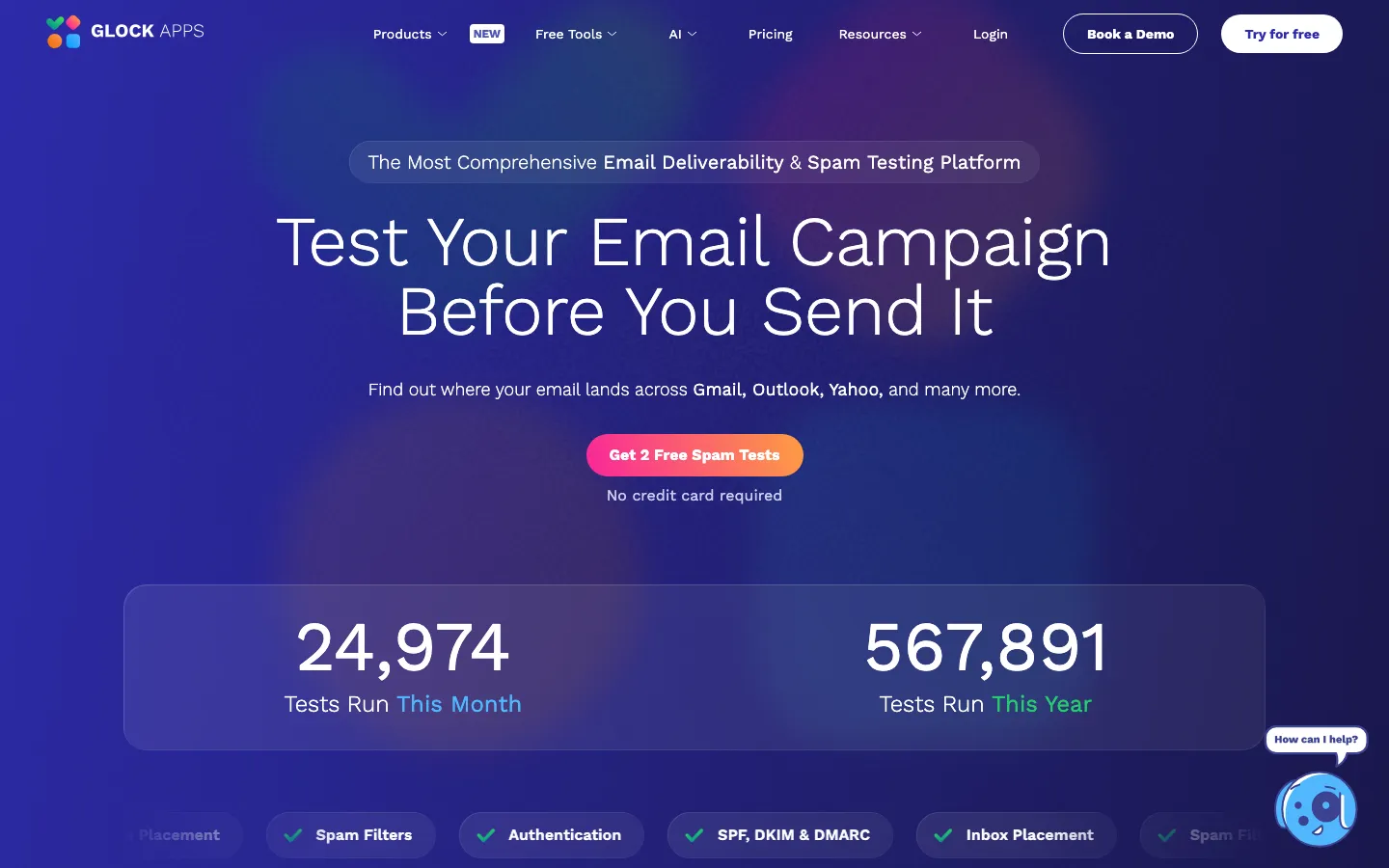
When a campaign is ready but you do not know whether it will reach an inbox, GlockApps is the best fit for checking placement before you send. It suits teams that need spam-filter results, DMARC monitoring and machine access in one account, but its separate bundle, DMARC and credit-pack prices demand a careful comparison.
Agent access
- API
- Yes, every plan, including free accounts, according to GlockApps' API page; its Inbox Insight API specification says free accounts do not have API access.
- MCP server
- Official, hosted, OAuth 2.1 authorization code with PKCE
- Works with
 ClaudeClaude Code
 ChatGPT
 Cursor
What are the key advantages and drawbacks of GlockApps?
What works
- Placement results for inbox, spam and sub-folders
- Five named spam filters in Inbox Insight
- API and MCP access on every plan
What to watch
- Essential includes 30 tests on monthly billing
- Bundle, DMARC and credit-pack prices are separate
- Automatic cold-email tests are on Growth
How does GlockApps test inbox placement before sending email campaigns?
GlockApps answers a practical question before a launch: where will this particular message land? It sends a test across mailbox providers and reports inbox, spam-folder and sub-folder placement. That makes it a useful specialist beside the wider marketing tools directory, especially when a campaign can fail quietly because a sending domain or message has slipped.
Inbox Insight is the center of the product. It combines placement results with authentication checks for SPF, DKIM and DMARC, spam-filter scores, IP analytics and blocklist records. The wider account adds DMARC Analytics, record monitoring, IP reputation monitors and a Google Postmaster Tools V2 connection. GlockApps also offers managed services, but the public pages do not state their price, so treat that as a separate conversation rather than an included plan feature.
The sensible way to judge GlockApps is not by its feature list alone. A team that sends occasional campaigns can use the free checks to identify a problem. A team that sends continually needs to calculate test credits, DMARC messages and the people who will use the account, because those limits change substantially between the Bundle plans.
Which marketing teams and deliverability specialists should use GlockApps?
Campaign owners
Check a finished message before send time, then see whether it reaches inboxes or spam folders.
Deliverability specialists
Use authentication checks, IP analytics and blocklist records to isolate the likely source of a placement problem.
DMARC administrators
Monitor SPF, DKIM and DMARC records, with daily reports and alerts for suspicious domain activity.
Agencies with reporting needs
Growth includes PDF export and white label, while Enterprise is the plan labeled for agencies.
It is less compelling when you only need a one-time authentication check, or when a very high volume of placement tests must be bought through one uncomplicated subscription. GlockApps has a free spam checker without an account, but regular testing pulls you into bundles or credit packs whose limits deserve a line-by-line comparison.
What spam testing, DMARC monitoring, and sender health tools does GlockApps provide?
Inbox placement and sender-path detail
GlockApps reports whether a test email lands in the inbox, spam folder or a sub-folder at providers including Gmail, Outlook, Yahoo, AOL,  Zoho, Proton Mail and GMX. The report also maps the IP chain used to deliver the email and shows blocklist records. That pairing matters: placement tells you what happened, while the sender-path view gives a technical team somewhere to start looking.
Five spam filters
Inbox Insight runs an email through SpamAssassin, Barracuda, Microsoft Exchange Online Protection, Proofpoint and an exclusive Google filter. It returns spam scores, content insights and recommended actions. Do not mistake a pass on those filters for a guarantee of inbox placement, but the checks give a team a specific message or configuration issue to fix before sending to a full list.
Cold email and mailbox connections
Growth adds automatic tests with real-time alerts for cold email outreach, smart tests using an auto-updating proxy address, mailbox integration, PDF export and white label. The integration list includes Gmail, Google Workspace,  Mailgun,
 SendGrid, Outlook,
 Mailjet,
 Klaviyo,
 HubSpot, SparkPost and
 Mailchimp. The useful distinction is plan placement: the automatic workflow is presented under Growth, not the free or Essential steps.
DMARC and uptime monitoring
DMARC Analytics supplies daily reports and instant notifications about suspicious activity on a domain. Every account receives 10,000 free DMARC messages each month, and the pricing grid lists unlimited DMARC domains for all four Bundle plans. Its uptime monitors check SPF, DKIM and DMARC records every two hours. This is the part of GlockApps that turns a pre-send checker into an ongoing operational tool.
API and MCP access
GlockApps says an AI assistant can connect through its MCP server to retrieve live deliverability data on demand. Its API can run spam tests, retrieve deliverability data and analyze reports without manual exports. Both are listed as available on all plans. For a technical team, that is unusually direct access for an email deliverability product, though you should confirm the rate limits and the exact fields needed for your workflow before building around it.
How are GlockApps subscription tiers and credit packs priced?
Price checked 27 Nov 2026
| Plan detail | Free$0/mo | Essential$85/mo | Growth$142/mo | Enterprise$185/mo |
|---|---|---|---|---|
| Spam test credits (monthly billing view) | 2 new-user tests | 30 | 90 | 150 |
| DMARC messages | 10,000 | 50,000 | 100,000 | 1,000,000 |
| Uptime monitors | 5 | 15 | 25 | 30 |
| IP reputation monitors | 1 | 10 | 20 | 25 |
| Users | 1 | 1 | 5 | 10 |
| API and MCP | ✓ | ✓ | ✓ | ✓ |
GlockApps Bundle prices in US dollars, 27 Nov 2026.GlockApps pricing
The table uses monthly Bundle prices. Annual Bundle billing is $59 a month for Essential, $99 for Growth and $129 for Enterprise, paid as $708, $1,188 and $1,548 up front. That changes the first-year bill, but not the need to budget for use above the included limits.
- DMARC overage costs $7.50 per 100,000 messages on Essential, $5 on Growth and $2 on Enterprise
- Spam-test credit packs start at $16.99 for 3 credits, valid for 1 month
- DMARC-only monthly plans start at $55 for Essential, with 1,000,000 DMARC messages
For a five-person team, Growth is the first monthly Bundle that covers all five users, at $142 a month before tax. It includes 90 test credits and 100,000 DMARC messages, so it is a concrete team bill rather than an entry-price illusion. If your need is primarily DMARC, the $95 Growth DMARC-only plan provides 2,000,000 messages, but it is a different product view and should not be treated as a like-for-like Bundle replacement.
What features does GlockApps Enterprise provide to marketing agencies?
GlockApps Enterprise addresses agency requirements within its Bundle structure by providing higher testing capacity and account scaling. On monthly billing it costs $185 a month and includes 150 spam-test credits, 1,000,000 DMARC messages, 30 uptime monitors, 25 IP reputation monitors and 10 users. The pricing page also invites organizations that need more volume to build a custom plan. Get the written limits for credits, messages and users before committing, because the public custom-plan invitation does not publish them.
Where does GlockApps introduce friction in pricing or credit limits?
GlockApps introduces friction through its multi-layered pricing architecture, which divides testing credits and DMARC tools into separate line items. Bundles, DMARC Analytics and Spam Test Credit Packs each have their own view, which makes it easy to compare the wrong numbers. A lower headline price might cover DMARC but not give your team the spam-test credits it assumed were included. Decide which job you are buying first, then compare that specific plan family.
Credits are the next constraint. Essential includes 30 monthly Bundle credits, so a regular pre-send routine can use them quickly. Annual billing reduces the displayed monthly price, but it requires payment for the year in advance. High-volume DMARC users also need to account for overage, which is billed per 100,000 messages.
The cold-email automation features are not entry-level. Automatic tests, the proxy-address workflow, PDF export and white label appear with Growth. That is reasonable for a team with active sending operations, but it means the free and Essential plans are best treated as a check-and-diagnose layer rather than a fully automated deliverability program.
Which email deliverability platforms compete with GlockApps?
Use the  InboxAlly review alongside this one when you need an engagement-based approach: InboxAlly says it teaches email providers to put messages in the inbox. That makes it a useful comparison when the question is how to improve placement, rather than how to inspect a message before sending it.
The  Infraforge review is the useful comparison when your decision includes the underlying cold-email infrastructure. Infraforge says it creates domains and mailboxes with a dedicated IP and automated DNS setup, while GlockApps focuses on placement tests, filter analysis, monitoring and API and MCP access.
Is GlockApps the right deliverability platform for your marketing program?
GlockApps earns its place when email delivery is an operational concern, not a vague percentage on a dashboard. The mix of placement results, named filters, DMARC monitoring and all-plan API and MCP access gives a team a clear way to investigate a campaign before and after it goes out. The tradeoff is a product catalog that asks you to understand credits and plan families before you can see the true recurring cost.
Start with the two free spam tests or the no-account spam checker, then price your usual monthly testing cadence against the Essential and Growth Bundle credits. Add a DMARC-only plan only when that is the separate operational need you actually have.
How were the test tools and pricing tiers of GlockApps audited?
GlockApps feature limits, plan prices, and bundle structures were verified directly from company documentation on 27 Nov 2026. The alternatives use their own vendors' published pages. Prices are in US dollars, as GlockApps shows them, and every figure follows the rules in how we check figures.
- GlockApps homepage for placement, monitoring, API and MCP details
- Bundle and DMARC pricing views for limits, users and overage
- Spam Test Credit Pack pricing for one-off credit prices and validity
What are the most frequent questions regarding GlockApps?
Is there a free version of GlockApps?
Yes. New users get 2 free spam tests. The Free Bundle pricing grid also lists 10,000 DMARC messages and 5 uptime monitors. GlockApps also offers a free spam checker that does not require an account.
How much does GlockApps cost?
Bundle plans are $59, $99 and $129 a month on annual billing for Essential, Growth and Enterprise, or $85, $142 and $185 on monthly billing. Spam-test credit packs start at $16.99.
Which spam filters does GlockApps check?
Inbox Insight checks SpamAssassin, Barracuda, Microsoft Exchange Online Protection, Proofpoint and an exclusive Google filter. It also checks the sending IP against blocklists.
Does GlockApps work with AI agents?
Yes. GlockApps lists API and MCP integration on all plans. Its MCP connection can retrieve live deliverability data, while the API can run spam tests and retrieve reports.
 Reviewed byDanny Kirk
Founder of ReddiReach.
 Checked byAndrés Felipe
Digital designer and marketer.
Every figure is checked against the vendor's own page. Read our editorial standards.