
Key Takeaways
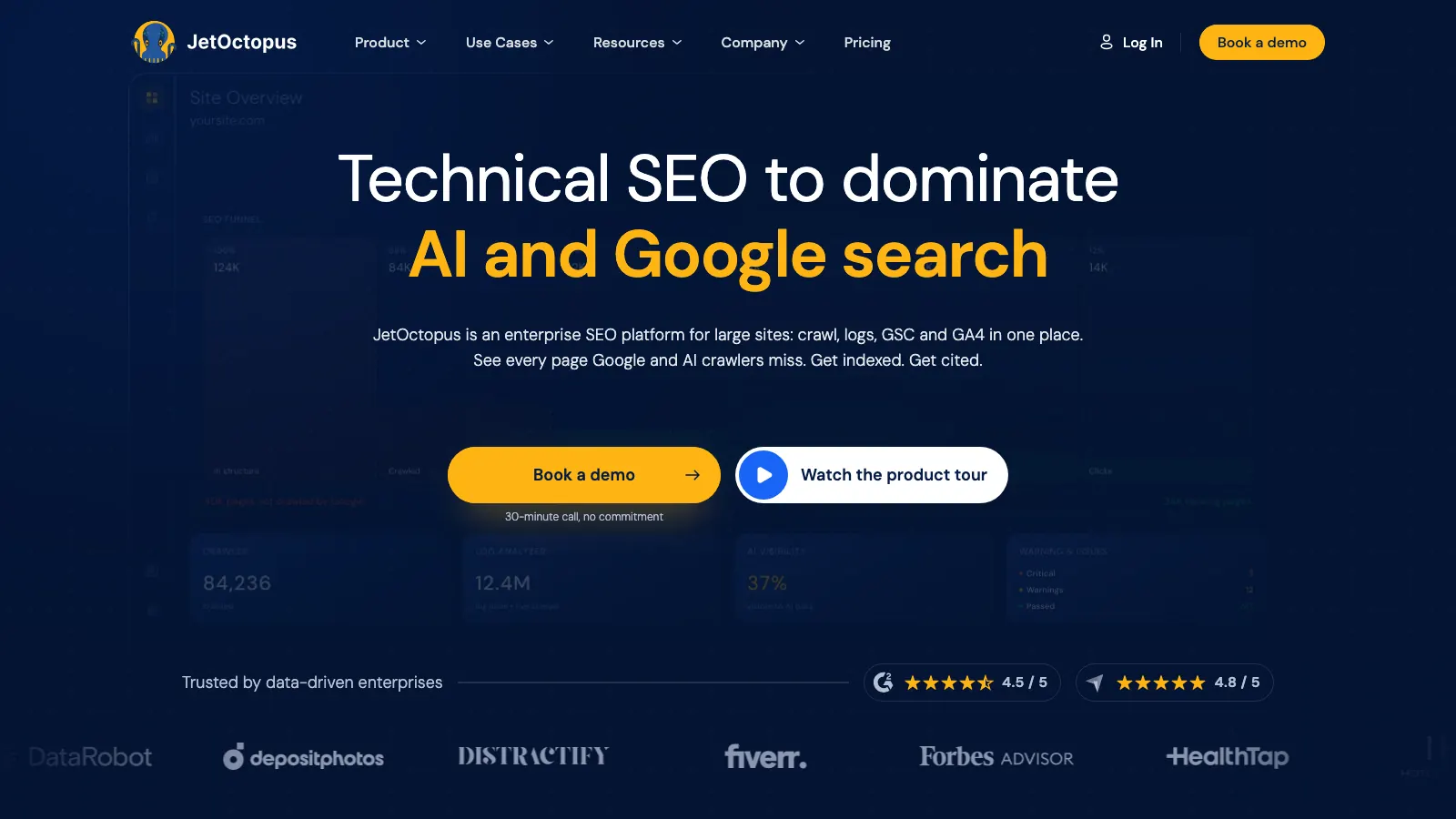
- JetOctopus combines site crawl data, server access logs, Google Search Console metrics, and Google Analytics 4 inside a consolidated technical platform.
- JetOctopus provides its in-house Growth plan at $349 monthly billed annually, including 500,000 monthly crawled URLs and two million log lines.
- JetOctopus equips every subscription plan with programmatic API and MCP connectivity, allowing autonomous agents to query performance metrics and trigger site crawls.
- JetOctopus proves unnecessarily complex for smaller websites conducting periodic technical audits or teams unwilling to complete sales demonstrations prior to product trials.
JetOctopus is the technical SEO platform to choose when your large site needs crawl data, server logs, GSC and GA4 in the same decision, rather than in four exports. In-house Growth costs $349 a month on annual billing and lets the whole team in, but a smaller site doing occasional audits should choose a lighter crawler instead.
Agent access
- API
- Yes, all JetOctopus clients
- MCP server
- Official, hosted, OAuth or revocable API token
- Works with
 ClaudeClaude Code
 ChatGPT
 Gemini
 Cursor
 n8n
- Automation
- n8n
What are the primary pros and cons of JetOctopus?
What works
- Crawl, logs, GSC and GA4 join at the URL level
- Unlimited users and projects on every published plan
- MCP and API access included across the plan range
What to watch
- Growth starts at $349 a month on annual billing
- A free trial is opened after a demo, not self-serve
- Standard plans still have crawl and log-volume limits
How does JetOctopus analyze crawl data and server logs for enterprise sites?
JetOctopus is built for the point where a crawl report alone stops answering the hard questions. It brings crawl data, server logs, Google Search Console and GA4 into one workspace. That is a different job from browsing the wider marketing tools directory: it is for teams that must decide what engineering work deserves attention first.
The useful distinction is that JetOctopus works from actual server requests as well as its own crawl. Its Log Analyzer covers Googlebot, Bingbot, GPTBot, ClaudeBot and more than 40 other crawler types, while the JavaScript crawler highlights pages with no rendered content. A developer gets a concrete page-level case rather than a generic audit finding.
It also combines those sources rather than treating integrations as separate tabs. GSC history, crawl health, log behavior and GA4 data can be read together by URL. For an established ecommerce catalog, publisher or multi-market site, that joined view is JetOctopus's reason to exist. For a small brochure site, it is probably more system than you need.
Which SEO teams benefit most from JetOctopus?
Enterprise technical SEO teams
Large sites that need full-site crawl, bot-log and search-performance context in one workspace.
Agencies with big client sites
Unlimited seats and projects let specialists, developers and clients work from the same account.
Teams with server-log access
Log data exposes the pages bots request, skip or repeatedly encounter as errors.
AI-search technical owners
AI-bot behavior can sit beside Googlebot behavior and JavaScript rendering gaps.
The fit is not simply "anyone doing SEO." JetOctopus makes sense when technical fixes have enough pages, brands or stakeholders behind them that joining data changes the action you take. If your team needs 30+ pre-built checks for domain expiry, SSL, redirects, robots.txt, Core Web Vitals and tracking tags across a site portfolio, read the Little Warden review before paying for crawl and log capacity you will not use.
What technical SEO features are included in JetOctopus?
Log analysis and AI bot activity
Server logs show which URLs bots actually request, not just what a crawler can discover. JetOctopus identifies Googlebot, Bingbot, GPTBot, ClaudeBot, PerplexityBot and more than 40 crawler types, with fake-bot filtering and real-time log streaming. That gives a technical team evidence for crawl-budget work and a way to compare AI crawlers with Googlebot.
JavaScript rendering checks
The JavaScript crawler verifies whether the content a user sees is also present after rendering. It flags zero-content pages, a useful check when client-side rendering hides content from search and AI crawlers. Treat that as a rendering investigation, not a substitute for a full front-end quality process.
Search Console, GA4 and other data sources
JetOctopus retains 16+ months of GSC data, with cannibalization and ranking-decay analysis, and connects GA4 for organic traffic context. It can also bring Ahrefs metrics into the same URL-level view, import custom data, export crawl and GSC data to BigQuery, and send data to Looker Studio. The benefit is prioritization: you can put bot behavior beside search and traffic signals before deciding what to fix.
Alerts and internal-linking work
Alerts cover indexation, Core Web Vitals and bot behavior, while the AI Internal Linker prioritizes links from stronger pages to weaker ones. JetOctopus says the linker can improve crawl efficiency by up to 30%. I would use that figure as a reason to investigate the opportunity, not as a forecast for your site.
MCP and API access
JetOctopus offers an MCP server on every plan. It supports MCP-compatible clients including ChatGPT, Claude Desktop, Cursor, Claude Code, Codex CLI, Gemini CLI and n8n. An agent can query crawl, log and GSC data, then start, pause, resume or schedule crawls. Quota-consuming and destructive actions show an impact preview and require confirmation.
How much does a JetOctopus subscription cost across plans?
Price checked 27 Nov 2026
| Plan detail | Growth$349/mo | Pro$809/mo | Ultra$1,559/mo | UnlimitedCustom |
|---|---|---|---|---|
| Billing basis | Annual | Annual | Annual | Talk to sales |
| Crawled URLs per month | 500K | 2M | 5M | Custom |
| Log lines per month | 2M | 8M | 25M | Unlimited |
| GSC properties | 3 | 10 | 20 | Unlimited |
| GA4 properties | 3 | 10 | 20 | Unlimited |
| Users and projects | Unlimited | Unlimited | Unlimited | Unlimited |
| MCP and API | ✓ | ✓ | ✓ | ✓ |
JetOctopus in-house prices in US dollars, 27 Nov 2026.JetOctopus pricing
For an in-house team, Growth starts at $349 a month, billed annually, or $4,188 for the year before any currency conversion. Quarterly billing raises Growth to $459 a month. There is no seat calculation to add, because every published tier lists unlimited seats and projects.
- Growth includes 500K crawled URLs, 2M log lines, and 3 properties each for GSC and GA4
- Pro raises those limits to 2M URLs, 8M log lines, and 10 GSC and GA4 properties
- Ultra raises them to 5M URLs, 25M log lines, and 20 GSC and GA4 properties
- Unlimited is a sales conversation for custom crawl capacity, with unlimited log lines and properties
Agencies have their own annual US-dollar table, checked 27 Nov 2026: Growth is $409 a month, Pro is $809, and Ultra is $1,729. Those plans include 20, 40 and 80 GSC and GA4 properties respectively; Pro includes 6M log lines and Ultra 12M, while all three list unlimited seats and projects. All modules are included in every plan, and JetOctopus offers a custom configuration that can mix modules and features. The vendor also shows USD and EUR options, but the published figures above are the US-dollar table. A trial exists, though JetOctopus opens it after a demo, so it is not a click-to-start evaluation.
When should enterprise sites upgrade to JetOctopus Unlimited?
JetOctopus Unlimited becomes necessary when enterprise crawling volumes and server log quotas exceed standard subscription thresholds. JetOctopus positions it for multiple brands, markets and very large sites, with custom crawl volume, unlimited log lines, full historical logs, direct database access, onboarding and priority 24/7 support. It is quoted rather than priced publicly.
That makes the buying question pleasantly direct: compare the custom quote with the cost of partial crawls, retained data elsewhere and manual joining work. Do not assume it is cheaper without a quote, but do not judge it by Growth's capacity if your site already exceeds that range.
Where does JetOctopus fall short for smaller websites?
JetOctopus exhibits its primary limitation in substantial base pricing rather than user seat restrictions. It is scale before you know whether the workflow will stick. Growth is a meaningful annual commitment, and access to a free trial follows a demo. Teams with one modest site should not confuse an unlimited-seat policy with a low-cost entry point.
Standard plans are also volume plans. Crawled URLs, log lines, GSC properties and GA4 properties rise by tier, and the price climbs quickly from Growth to Pro. Calculate your crawl and log needs from the numbers you already have before you let the no-project-limit claim drive the decision.
MCP is strong for a team prepared to govern it, but it is not a raw-log download. The server exposes processed log columns stored by JetOctopus, and project or dataset restrictions are not available today. That is an important boundary if access control is part of your agent rollout.
What are the top software alternatives to JetOctopus?
 JetOctopus alternative AI Peekaboo serves organizations monitoring brand prominence across AI search answers instead of auditing search engine bot crawls. Its plans start at $30 a month and include the API and MCP access, while JetOctopus begins at $349 a month for technical SEO capacity. The AI Peekaboo review explains what its plans include.
 The Little Warden review is the better fit for 30+ pre-built checks across domain expiry, SSL, redirects, robots.txt, Core Web Vitals and tracking tags across a site portfolio.
 The Lumar review suits enterprise teams that need technical SEO crawling alongside AI brand visibility and WCAG 2.2 accessibility testing, and can work with a demo-led purchase because Lumar publishes no prices.
JetOctopus is not a substitute for every technical tool. Its differentiator is one joined view of crawl, log, GSC and GA4 data around the same URLs. Start there when the question is what bots actually do, then choose a narrower monitoring product only when that joined technical context does not matter.
Is JetOctopus the best technical SEO platform for large sites?
JetOctopus earns its place when a technical SEO team has outgrown isolated crawls and needs proof of what bots actually do. The $349 Growth plan buys a joined crawl, log, GSC and GA4 workflow, unlimited seats, projects, MCP and API access. That is compelling for a serious large-site program, but it is an expensive way to run a one-off audit.
Choose JetOctopus if you already have server-log access and several people need the same evidence. Bring a month of crawl and log volumes to the demo, confirm the Growth capacity fits, and only then take the trial account.
How were the specifications and data in this JetOctopus review verified?
JetOctopus specifications, tier limits, pricing, and MCP documentation were checked directly against its official portal on 27 Nov 2026. Prices are in US dollars as shown in its annual in-house table, and every figure follows how we check figures.
- JetOctopus pricing and Unlimited pages
- JetOctopus Log Analyzer, JavaScript SEO and GSC pages
- JetOctopus integrations and MCP pages
What are common technical questions about JetOctopus integrations?
How much does JetOctopus cost?
Growth costs $349 a month billed annually, or $459 a month with quarterly billing. Pro is $809 a month annually and Ultra is $1,559 a month annually. Unlimited is quoted.
Does JetOctopus have a free trial?
Yes, but it is not self-serve. JetOctopus says it opens a trial account for your site after a demo, with no credit card required.
Does JetOctopus work with AI agents?
Yes. Every plan includes MCP and API access. Its MCP can query crawl, log and GSC data, and can manage crawls after it presents any required confirmation.
What does JetOctopus track in server logs?
Its Log Analyzer reports on Googlebot, Bingbot, GPTBot, ClaudeBot, PerplexityBot and more than 40 other crawler types, including real-time log streaming.
 Reviewed byDanny Kirk
Founder of ReddiReach.
 Checked byAndrés Felipe
Digital designer and marketer.
Every figure is checked against the vendor's own page. Read our editorial standards.