Key Takeaways
- Kalicube Pro provides dedicated brand identity optimization that aligns Google Knowledge Panels and artificial intelligence answer engines across digital ecosystems.
- Kalicube Pro utilizes unpublished custom pricing structured around five-entity blocks and mandates a minimum six-month service agreement.
- Kalicube Pro operates through a proprietary web dashboard without offering customer-accessible developer APIs or external MCP server interfaces.
- Kalicube Pro is impractical for businesses seeking self-serve, entry-level tracking tools or immediate short-term visibility measurement dashboards.
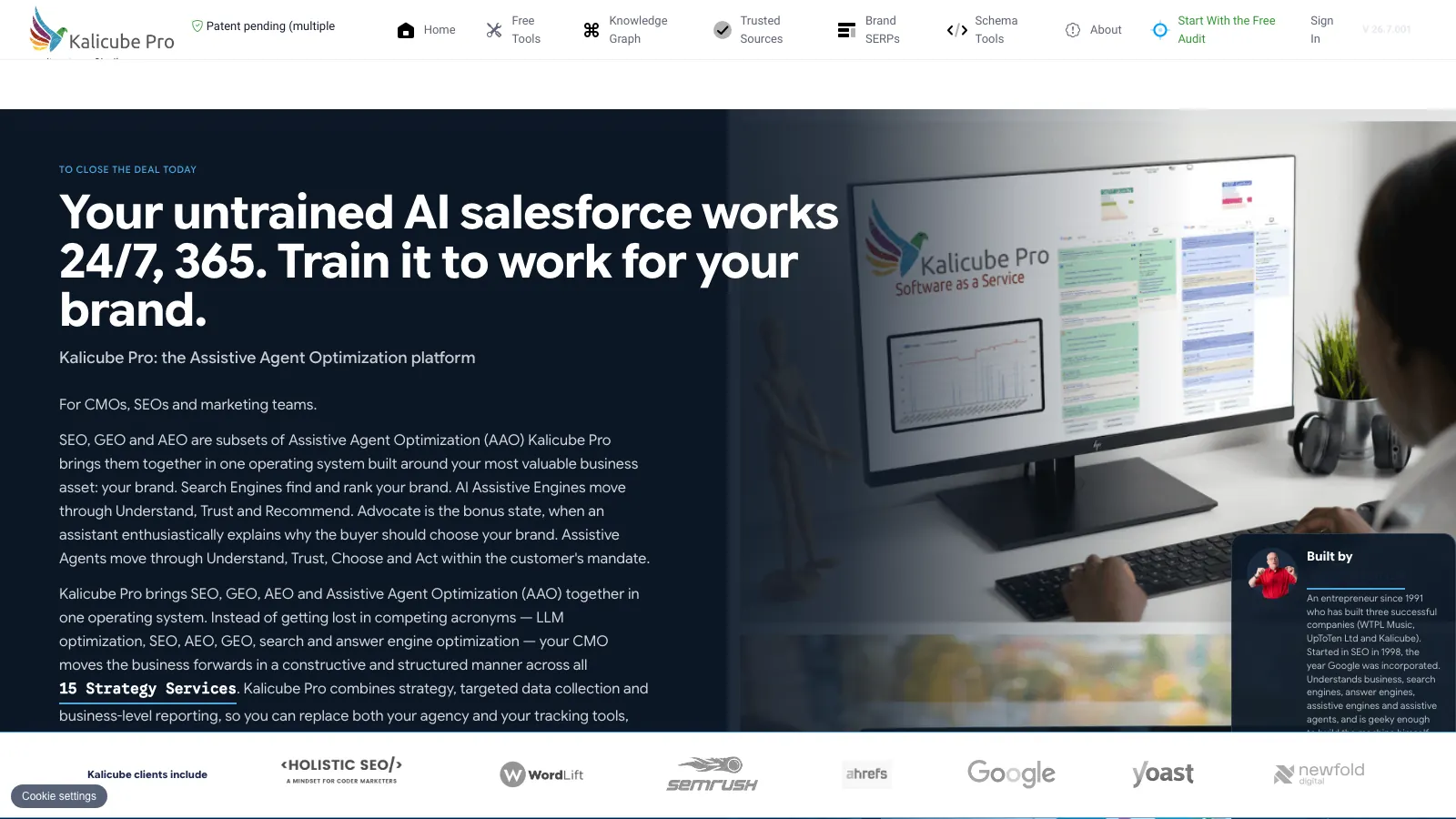
When Google or ChatGPT tells buyers the wrong story about your company, Kalicube Pro is Kalicube Pro built to fix the source, for a CMO with an in-house team ready to work through a 52-week plan on and off your site. If you only want to see where you appear in AI answers next week, it asks for too much commitment: prices are unpublished, contracts run at least 6 months, and AI Peekaboo starts at $30 a month with its API and MCP included.
Agent access
- API
- Yes, Certified Kalicube Partner Agency
- MCP server
- Not found on official pages
What are the pros and cons of implementing Kalicube Pro?
What works
- Weekly answers from search, AI assistants and knowledge graphs
- A 52-week plan that says what to do, when and why
- Owned pages kept apart from third-party sources
What to watch
- No published price and a 6-month minimum
- Your own team implements on the Intelligence tier
- No API or MCP listed for your own tools
How does Kalicube Pro align your brand identity across Google and AI models?
Most of the best AI visibility tools count how often you appear in AI answers. Kalicube Pro starts a step earlier, with what Google and AI assistants believe your brand is. Jason Barnard built it, Kalicube owns it, and it is designed to measure and improve the entity evidence AI engines process. In practice you get a strategy kickoff where Team Kalicube agrees one goal with you, a weekly collection of what engines say about you, and a list of work for your team, on your site and off it.
The depth of history is the unusual part. Kalicube says it has collected data on 73 million brands weekly since 2015, and Kalicube Pro keeps historical Brand SERP and Knowledge Panel data, including whether you have a Knowledge Panel at all. No tracker launched last year can show you that history.
I read Kalicube Pro as a consulting method turned into software. It comes with onboarding, a year-long plan and a minimum term, which is the right shape for a brand identity problem and the wrong shape for a quick visibility check.
Which brands and executives benefit most from Kalicube Pro?
Brands Google describes wrongly
Historical Brand SERP and Knowledge Panel data shows what changed and what still needs fixing.
CMOs reporting to a board
Weekly reports track Control, Response Fidelity and Brand Visibility across your tracked questions.
Names that collide
A Disambiguation question set runs when AI may confuse you with a similarly named entity.
Groups with many brands
Enterprise keeps subsidiaries, products, people and locations in sync through one shared graph.
It suits a company badly when nobody inside can implement: Kalicube sells Kalicube Pro to teams that can do the work, and sends everyone else to its done-for-you service.
What entity management and knowledge panel features does Kalicube Pro offer?
A weekly collection, every Sunday
Every Sunday Kalicube Pro collects what is said about you on your website and across the rest of the web. The search engines are Google Search and Bing. The AI assistants are Google AI Mode, ChatGPT, Claude, Gemini, Perplexity, Grok and You.com. The knowledge sources are Google's Knowledge Graph, Wikidata, Wikipedia and Common Crawl. Results keep the site you own apart from profiles and articles you do not, so you know whether to fix your page or chase a third-party source.
Six question sets, written for you
Kalicube writes the question sets for your brand, so your team does not have to invent prompts. Each set does a different job:
- Standard covers who the brand is, in the same shape for every brand
- Funnel Pathway follows one audience and one intent through to the decision
- Due Diligence asks the checks AI runs before it trusts you
- Comparison sets you against one named peer, two questions per peer
- AI Brand Perception shows what the machine believes about a theme
- Disambiguation runs only when another entity shares your name
The 52-week plan and weekly measures
The strategy is laid out across 52 weeks in order of expected impact, and each action explains how it serves your goal. Progress is reported weekly as Control, Response Fidelity and Brand Visibility. They are Kalicube's own measures, so agree what each means before they reach your board.
Schema delivery and KaliNexus
On Intelligence, a JavaScript snippet adds Schema and a verified claims accordion to your About page, which Kalicube calls your Entity Home. Engineering adds KaliNexus, which builds and maintains site-wide Schema and can add or replace supporting HTML, along with page-by-page Audits, ordered Worksheets and step-by-step off-site Playbooks. For a team short on developers, KaliNexus decides whether the plan gets done.
An assistant that knows your brand
An AI assistant on every screen already holds your strategy, claims, proof and brand voice, and the same context feeds writers for site pages, guest articles, social posts and press releases. Drafting from approved claims is a sensible guard against copy that invents facts about you.
What your own agents can reach
Kalicube Pro lists no customer API or MCP server. When Kalicube talks about webpages, APIs, MCP and apps, it means the formats in which your brand facts are served to search engines and AI assistants, not a way for your agents to pull reports. Teams that need answer data inside their own dashboards should buy a tracker with an API instead.
What contract terms and pricing models does Kalicube Pro use?
Price checked 27 Nov 2026
| What you receive | IntelligenceNot published | EngineeringNot published | EnterpriseNot published |
|---|---|---|---|
| Starting size | One block of 5 entities | One block of 5 entities | 5 or more blocks |
| Strategy and 52-week plan | ✓ | ✓ | Group-wide |
| Weekly reporting | ✓ | ✓ | ✓ |
| About page Schema | JavaScript snippet | Extended site-wide | Every Entity Home |
| Site-wide Schema and HTML | ✕ | ✓ | ✓ |
| Page Audits and Worksheets | ✕ | ✓ | ✓ |
| Group Sync and Drift Guard | ✕ | ✕ | ✓ |
Kalicube Pro tiers and commercial terms, 27 Nov 2026.Kalicube Pro pricing
Kalicube Pro does not publish prices. What it does publish is the unit you buy: one block of five entities, where an entity is a company, product, person or location, with more blocks added as you grow. Each block comes with Kalicube Pro, onboarding, one agreed strategy goal, the 52-week plan and weekly reporting. The contract is for companies and runs for a 6-month minimum. Around the paid tiers sit three other routes:
- Free tools and a free audit and strategy that Kalicube says takes 60 seconds
- Strategy Plus, offered to groups running several brands
- A done-for-you service on kalicube.com, if your team cannot implement
Five capabilities are listed as planned for 2027 and not included today, so negotiate on what exists now, not on the roadmap.
When should multi-brand organizations implement Kalicube Pro Enterprise?
Kalicube Pro Enterprise scales entity engineering across multiple coordinated blocks for corporate groups and franchise networks. It earns its place only when local teams keep editing pages that should tell one story:
- Group Sync keeps the parent company, subsidiaries, products, people and locations on one shared graph, voice and vocabulary
- Drift Guard watches page, URL and fact changes, so a local edit is checked before search and AI engines receive conflicting information
Where does Kalicube Pro demand significant client commitment?
Kalicube Pro requires clients to place significant organizational trust in its long-term algorithmic optimization methodology. With no published price and a 6-month minimum, you commit to half a year before your own data shows whether the work is paying off. Kalicube itself says brand work takes time and has no magic bullet, so agree what success looks like at month three before you sign.
The second ask is people. On Intelligence, Kalicube Pro tells you what to do, when and why, and your team writes the HTML and Schema. Engineering automates much of that and the done-for-you service removes it, at a higher cost each step.
The third gap is machine access. There is no API or MCP server listed for your own agents or dashboards, and Microsoft Copilot is missing from the assistants it collects answers from.
What are the best software alternatives to Kalicube Pro?
 Kalicube Pro alternative AI Peekaboo serves marketing teams needing fast, exportable visibility tracking rather than an extensive strategic consulting commitment. Plans start at $30 a month with the API, MCP and Looker Studio included and no seat charge, and you can start without a sales call.
 Knowatoa is a self-serve tracker from $59 a month, checked 27 Nov 2026, with competitor gaps, citations and sentiment alerts, and its Growth plan adds an API and an MCP server. The Knowatoa review explains which plan a brand team needs.
If perception matters more to you than presence,  LLM Pulse starts at €49 a month for weekly tracking with unlimited team members, and its Scale plan adds reputation reports across seven dimensions. The LLM Pulse review covers what each plan unlocks.
Is Kalicube Pro worth the long-term investment for brand management?
Choose Kalicube Pro when the problem is identity: your Knowledge Panel, AI assistants and the open web disagree about who you are, and you have people ready to fix that for six months or more. The history back to 2015 and the owned versus third-party split are the reasons to pay. Pass on it if you need a price on day one, or data your agents can query.
Run the free audit first, then ask for a quote per block of five entities on both Intelligence and Engineering, and pick the tier that matches the developer time your team really has.
How was the data in this Kalicube Pro review gathered?
Kalicube Pro's tiers, contract terms and features come from Kalicube's own site, read on 27 Nov 2026: its pricing and commercial terms page, its home and how-it-works pages, its about pages and its Brand SERPs tool page. Kalicube publishes no prices, so none are given here, and the rest follows the rules in how we check figures.
- Kalicube Pro pricing and commercial terms
- Kalicube Pro home page and how-it-works explainer
- Kalicube Pro about pages for the product and its founder
What are common questions about Kalicube Pro knowledge graph strategies?
How much does Kalicube Pro cost?
Kalicube does not publish prices. Kalicube Pro is sold to companies in blocks of five entities on a 6-month minimum contract, and the free audit comes first.
Is Kalicube Pro a Knowledge Panel tool?
Partly. It keeps historical Brand SERP and Knowledge Panel data, and adds weekly AI answers and a strategy for fixing what they say.
Which AI assistants does Kalicube Pro collect answers from?
Google AI Mode, ChatGPT, Claude, Gemini, Perplexity, Grok and You.com, alongside Google Search, Bing and several knowledge graphs.
Can Kalicube do the work for us?
Engineering automates Schema and supporting HTML through KaliNexus. A fully done-for-you service is sold separately on kalicube.com.
 Reviewed byDanny Kirk
Founder of ReddiReach.
 Checked byAndrés Felipe
Digital designer and marketer.
Every figure is checked against the vendor's own page. Read our editorial standards.