
Key Takeaways
- Klenty helps phone-first sales development teams coordinate cold calling, multi-touch email cadences, and CRM synchronization within an integrated sales engagement platform.
- Klenty Starter pricing begins at fifty dollars monthly billed annually for unlimited users, while Growth costs $70 and Plus costs $99 per user.
- Klenty provides multichannel cadence automation, CRM task execution, and artificial intelligence call coaching on higher tiers, with dialing engines available as optional add-ons.
- Klenty offers API connections on Starter plans, though authentication requirements and Model Context Protocol availability must be confirmed directly before designing agent workflows.
Klenty is the best fit when your SDR team treats phone conversations as the center of outbound work, not an afterthought to email sequences. Start with its $50 monthly annual-billing Starter plan only for email outreach, move to Growth for calling and CRM work, and require Plus when AI call coaching matters; choose another tool if your job is broad marketing automation rather than prospecting.
Agent access
- API
- Yes, Starter
- MCP server
- Not found on official pages
- Automation
- Zapier
What are the primary pros and cons of Klenty?
What works
- Unlimited users and mailboxes on the $50 Starter plan
- Calling, SMS, social selling and CRM tools from Growth
- AI call coaching and Action AI listed on Plus
What to watch
- Starter is positioned for email outreach, not multichannel work
- Growth and Plus are charged for every user
- Power and Parallel Dialing cost $45 per user a month extra
What does Klenty do for sales development representatives?
Klenty is built for SDR teams that spend their day moving between calls and follow-ups. It combines cadences across calls, email, SMS, WhatsApp and social touchpoints, then brings those conversations into one inbox. If you are deciding whether that sales-specific workflow belongs in your stack, the marketing tools directory helps separate it from tools designed for lifecycle campaigns.
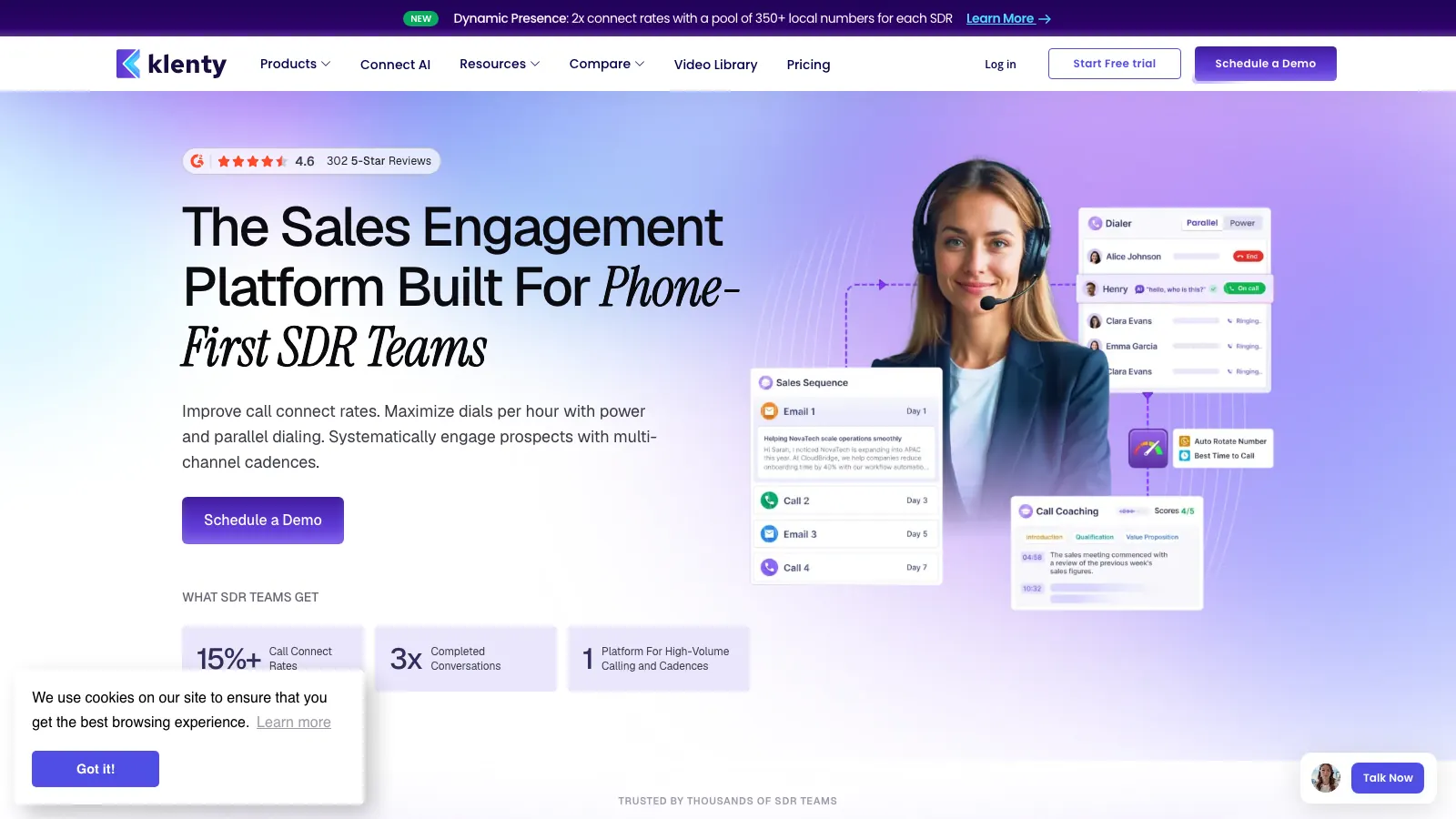
Phone work is the product's clearest point of view. Its Power Dialer runs through a prospect list sequentially, while its Parallel Dialer can call multiple lines at once. Klenty also lists number auto-rotation, local dialing, timezone detection, smart lists, AI voicemail and IVR detection, plus Action AI for follow-up after a conversation. Those tools matter when a rep's next useful action is a live conversation, not another email template.
The sensible purchase decision is less about the headline starting price than the channel you need. Starter gives an unlimited-user email operation a low fixed entry point. Growth brings the sales channels and CRM layer. Plus is where the account-based selling, Action AI and call-coaching proposition becomes visible. That split is honest about the product: Klenty can begin cheaply, but a phone-first team should budget for more than Starter.
Who is Klenty best suited for in outbound sales?
Phone-first SDR teams
Use live conversations, voicemail detection, and contextual follow-up to build reliable outbound routines.
Teams coordinating channels
Coordinate calls, email, SMS, WhatsApp, and social touchpoints through a visible team cadence.
Sales managers coaching reps
Use structured scorecards and coaching insights to make feedback consistent across SDR conversations.
CRM-led sales operations
Sync  HubSpot, Salesforce, or
 Pipedrive while keeping account and contact fields continuously aligned.
Klenty is a weaker fit for a marketing team whose work begins with consent-led newsletters, customer journeys and website conversion. It calls itself a sales engagement platform for phone-first SDR teams, and its plan structure reinforces that focus.
Which sales engagement and dialing features does Klenty provide?
Multichannel sales cadences
Klenty walks SDRs through calls, emails and social touchpoints for a prospect list. Its multichannel material also describes SMS and WhatsApp follow-ups, and a shared inbox for phone, email, SMS and WhatsApp conversations. Growth is the threshold in the published plan table for multichannel outreach, SMS automation and social selling. Do not read the unlimited users on Starter as unlimited access to every channel.
Calling and dialer controls
Growth includes click-to-call, 200 minutes, number auto-rotation, SmartLists and AI voicemail and IVR detection. The Power and Parallel Dialers are separate add-ons at $45 per user a month. That distinction matters: use the base Growth price when a rep needs call tools, then add the dialer fee only when sequential or parallel high-volume dialing is part of the actual operating plan.
Agentic Cadences and account research
Klenty says Agentic Cadences can complete account and prospect research, write bespoke one-to-one emails and personalize old templates. Its product page says the research draws on more than 150 public data sources and can put prospect insights into fields. It is a useful way to reduce repetitive preparation, but the plan cards do not clearly assign Agentic Cadences to a named tier. Confirm its inclusion in writing before making it the reason for a plan choice.
AI call coaching
Plus lists Call Coaching, an AI Call Scorecard and Coaching Summary. The dedicated coaching product adds talk-track scoring, coaching insights and AI battlecards for recurring prospect questions. This is not a reason for every SDR team to buy Plus. It becomes relevant when a manager has a real coaching routine and needs the system to help make feedback consistent across recorded calls.
CRM integrations
Growth and Plus list CRM integrations and bidirectional field mapping. Klenty has dedicated dialer integrations for HubSpot, Salesforce and Pipedrive: the pages say calls, outcomes, notes and recordings are logged on the appropriate record, while account and contact fields stay synced. That makes Klenty more credible for a team that already runs pipeline work in a CRM, rather than asking reps to keep a separate calling log.
Machine access
Starter lists API Connections and Zapier Integration, while Growth and Plus include everything in Starter. The API address requires sign-in. Confirm scopes, authentication, limits and MCP availability before planning an agent workflow.
How is Klenty priced across annual subscription tiers?
Price checked 27 Nov 2026
| Plan detail | Starter$50/mo | Growth$70/user/mo | Plus$99/user/mo |
|---|---|---|---|
| Billing shown | Annual | Annual | Annual |
| Users and mailboxes | Unlimited | Not stated | Not stated |
| Core focus | Email outreach | Multichannel outreach and CRM | Account-based selling and Action AI |
| Click-to-call | ✕ | ✓ | ✓ |
| SMS and social selling | ✕ | ✓ | ✓ |
| CRM integrations | ✕ | ✓ | ✓ |
| Call coaching | ✕ | ✕ | ✓ |
Klenty prices in US dollars, 27 Nov 2026.Klenty pricing
Starter is not charged per person, which makes it unusually straightforward for a team focused on email outreach. Growth and Plus are per-user prices. For example, a three-person Growth team is $210 a month on annual billing before any dialer add-on, while three Plus users are $297. That is the team bill to compare, not $50.
- Quarterly billing is $60 a month for Starter, $85 per user a month for Growth and $119 per user a month for Plus, all billed quarterly
- Power and Parallel Dialing are a $45 per-user, monthly add-on
- The Sales Engagement trial gives 14 days of full access and allows up to 200 emails before an upgrade is required
- A separate Sales Dialer range starts at $40 per user a month on annual billing, with Call Intelligence listed at $25 per user a month billed annually
The free trial is enough to see whether the cadence builder and basic workflow fit your team. It is not a free plan: without an upgrade, the account is deactivated after the trial. For a dialer purchase, Klenty describes a 14-day trial after a demo call, which is a separate evaluation path.
Where does Klenty fall short for outbound sales organizations?
Klenty has its most attractive price on its narrowest plan. Starter is $50 a month with unlimited users and mailboxes, but it is for personalized email outreach. The features that make Klenty distinctive for a phone-first team, such as click-to-call, multichannel outreach, CRM integrations and voicemail detection, start at Growth.
The dialer economics need equal attention. Growth is $70 per user a month, billed annually, plus the $45 per user a month dialer add-on, for a combined monthly equivalent of $115. Confirm the add-on's billing commitment. That may still be a clean operating choice, but it is a different decision from buying a $70 sales engagement seat.
Finally, Starter lists API Connections, but the API address requires sign-in. Confirm scopes, authentication, limits and MCP availability before connecting an agent or internal system.
What are the leading alternatives to Klenty?
 AI Peekaboo review is the first alternative to consider only when your marketing question is where your brand appears in AI-generated answers, not SDR outreach.
 Landbase review is for teams that want to describe an ICP in plain language and receive a verified, scored account list for their CRM.
 lemlist review is worth reading when email, LinkedIn, calls, WhatsApp and SMS all need to reach the same leads.
Klenty puts its strongest product emphasis on calling and the team work that follows a conversation. Use the alternatives to decide whether account qualification or multichannel outreach better matches the way your SDRs work.
What is the final verdict on Klenty?
A phone-first SDR team gets the clearest value from Klenty when better conversations and disciplined follow-up are the job. Growth is the practical starting point for a sales team that needs calls, channels and CRM data together. Plus earns its higher price only when AI coaching and account-based work are active parts of the team's operating rhythm.
Run the 14-day trial with a real prospect list, then price your actual headcount on Growth and add $45 per caller only where Power or Parallel Dialing is necessary. Confirm API scopes, authentication, limits, MCP availability and Agentic Cadence terms before committing to a workflow that depends on either.
How were Klenty features and pricing verified?
Every price, plan limit and feature in this review comes from Klenty's own pricing, sales engagement, dialer, integration and product pages, read on 27 Nov 2026. Prices are in US dollars as Klenty shows them, and every figure follows how we check figures.
- Klenty Sales Engagement and Sales Dialer pricing pages
- Klenty pages for multichannel outreach, Agentic Cadences, calling and AI coaching
- Klenty dialer integration pages
What are frequently asked questions about Klenty?
How much does Klenty cost?
Sales Engagement Starter is $50 a month billed annually with unlimited users and mailboxes. Growth is $70 per user a month, and Plus is $99 per user a month, both billed annually.
Does Klenty have a free trial?
Yes. The Sales Engagement trial gives 14 days of full access and up to 200 emails. You need to upgrade with a credit card after that or the account is deactivated.
Which Klenty plan includes calling?
Growth and Plus list click-to-call, cold calling, number auto-rotation, SmartLists and AI voicemail and IVR detection. Power and Parallel Dialing are a separate $45 per-user add-on.
Does Klenty work with AI agents?
Starter lists API Connections, and Klenty markets Agentic Cadences for account research and personalized emails. The API address requires sign-in, so confirm scopes, authentication, limits and MCP availability before planning an agent workflow.
 Reviewed byDanny Kirk
Founder of ReddiReach.
 Checked byAndrés Felipe
Digital designer and marketer.
Every figure is checked against the vendor's own page. Read our editorial standards.