
Key Takeaways
- Klue connects competitive intelligence gathering and win-loss deal analysis into an operational enablement platform designed for enterprise product marketing and revenue organizations.
- Klue operates exclusively on custom enterprise quotes rather than published self-serve pricing, requiring prospective customers to complete a formal sales demonstration.
- Klue delivers curated battlecards, market tracking feeds, deal intelligence, and seller guidance tools designed to equip sales teams during active deal negotiations.
- Klue provides a documented Model Context Protocol connector that enables teams to integrate curated win-loss analysis directly into Claude and custom language model workflows.
Klue suits product marketing and sales teams that need competitive intelligence and win-loss work to shape the same deals. Look elsewhere if a published monthly price is essential: Klue asks you to book a demo before it shows a number, while AI Peekaboo publishes plans from $30 a month.
Agent access
- API
- Yes
- MCP server
- Official, OAuth 2.0 or API Key (Personal Access Token)
- Works with
 Claude
What are the primary pros and cons of Klue?
What works
- Competitive intelligence and win-loss work share one platform
- Compete Agent delivers deal-specific guidance to sellers
- Integrations place competitive intelligence in revenue-team workflows
What to watch
- No published plan prices or billing terms
- Free-plan and trial terms are not published
- Feature access must be confirmed in a sales conversation
What does Klue do for competitive intelligence programs?
Klue brings two jobs that often drift apart into the same system: understanding competitors and understanding why a deal was won or lost. That makes it a strong choice when a product marketer needs the evidence behind a battlecard to keep helping a seller after the card is published. If you are still mapping the category, the marketing tools directory is a useful place to see the broader set of jobs these tools cover.
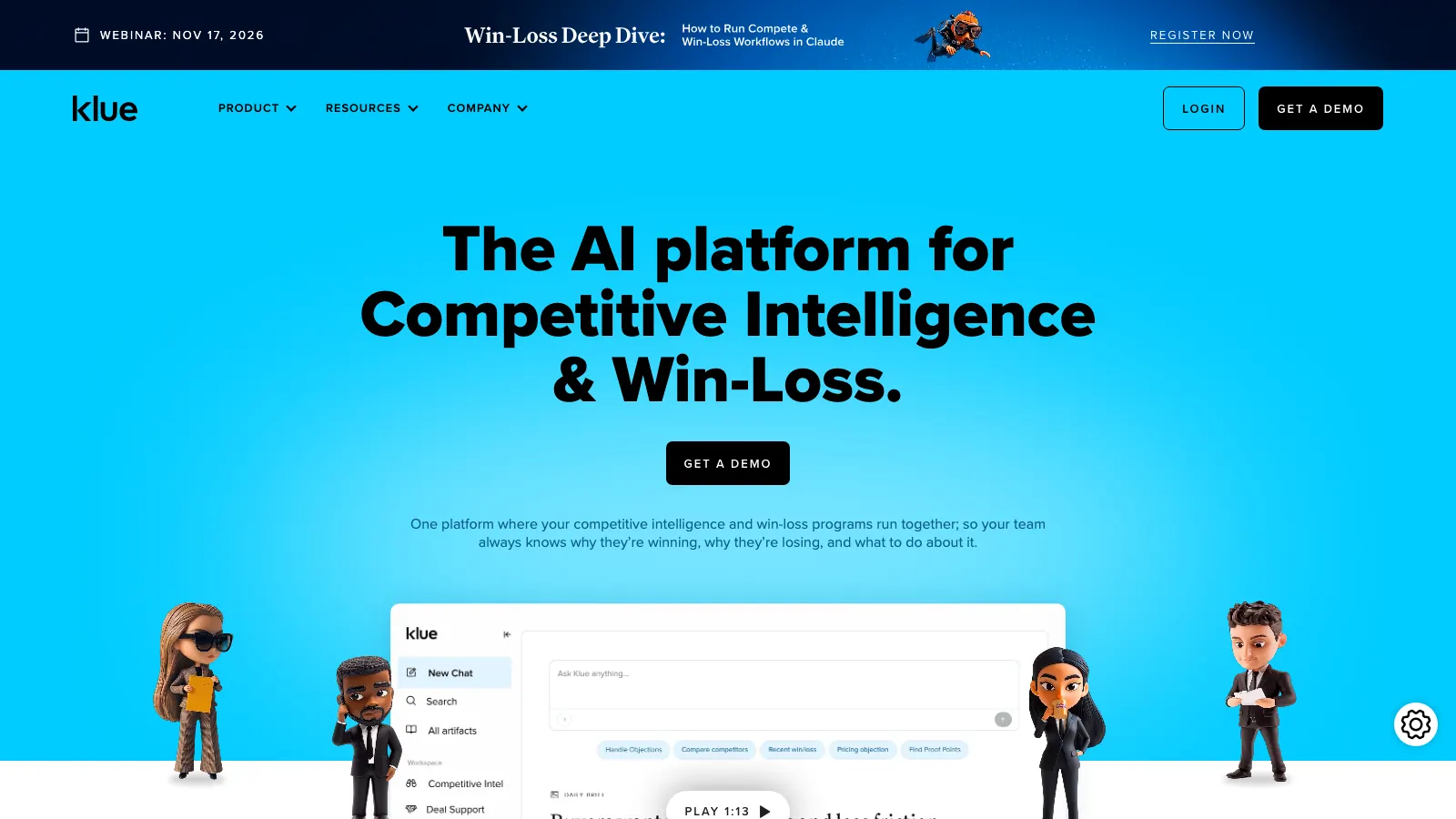
The product is split between Klue Compete and Klue Win-Loss. Compete Agent continuously gathers and analyzes intelligence, creates competitor profiles, and surfaces trends. Win-Loss captures buyer and seller feedback through five methods, then analyzes and activates it inside the same platform. The combination is its real distinction: a loss theme can become material for the next competitive conversation instead of ending in a separate report.
I would treat Klue as a program platform, not a document library. Its value rests on keeping market signals, deal context and curated messaging connected for people who need to act on them.
Who is Klue best designed for in product marketing and sales?
Product marketing teams
Keep positioning, battlecards and buyer signals connected across the competitive program.
Competitive intelligence leads
Collect market signals and turn them into maintained competitor profiles and insights.
Sales enablement teams
Give sellers deal-specific guidance where they already handle active competitive opportunities.
Revenue leaders
Use win-loss patterns to understand competitive pressure across the full revenue pipeline.
Klue is a poor fit for a team that only wants to watch a competitor's website or collect a few sales notes. Its case is strongest when competitive intelligence has owners, sellers need it in active deals, and win-loss feedback needs to change what the team says next.
Which competitive intelligence and deal analysis features does Klue offer?
Compete Agent
Compete Agent is Klue's AI research analyst and deal assistant. It monitors competitive activity across open opportunities and delivers actionable insight to sellers at the moment they need it. Klue also says the agent can collect from web sources, win-loss interviews, Gong calls and internal documents, making it more useful for a team with evidence spread across several places than one relying on a static battlecard.
Deal support and battlecards
When a call points to a competitive threat, Klue can send a Deal Tip through a rep's inbox, Slack or Microsoft Teams. Ask Klue is available in Slack, Teams, Salesforce, HubSpot and an LLM, with answers grounded in competitive, market and buyer intelligence for the deal. Battlecards cover the practical questions sellers raise, including differentiation, pricing information and objections, while PMM and CI teams can vet and edit answers.
Win-loss analysis
Klue Win-Loss combines AI Interviewer, Blindspot Interviews, Win & Loss Stories, Human Expert Interviews and Bring Your Own Interview. That breadth matters because different deals leave different usable signals. Automatic AI analysis and activation keep the findings in Klue alongside competitive intelligence, rather than treating interviews as a separate research archive.
Where the intelligence appears
Klue integrates with the places a revenue team is likely to work, including Slack, Teams, Salesforce, HubSpot, Gong, Highspot and SharePoint. Its Chrome and Edge extensions let a contributor add web intelligence, monitor pages, highlight text, capture screenshots and comment. The integrations are a practical strength if adoption depends on taking competitive work to the team, rather than asking every seller to open another tab.
LLM workflows
Klue's competitive and win-loss insights can live inside Claude, ChatGPT, Perplexity and Glean. Klue also describes a Claude workflow where product marketers analyze win-loss patterns and competitive signals, research buyer voice and update content. Its Win-Loss MCP connector makes win-loss data available inside Claude and other LLM-based workflows, where it can ground battlecard drafts, competitive briefs and positioning analysis. Klue does not publish the connector's pricing or product entitlement, so confirm that scope in the quote.
How does Klue handle its enterprise pricing and quotes?
Price checked 27 Nov 2026
| Plan detail | Klue |
|---|---|
| Published price | Not published |
| Published plan tiers | Not published |
| How to start | Book a demo |
| Billing terms | Ask Klue |
| Compete Agent | Available product, quote scope to confirm |
| Win-Loss | Available product, quote scope to confirm |
Klue pricing information, 27 Nov 2026.Klue website
There is no honest team bill to calculate from the public material. Klue does not publish a starting price, included seats, add-on prices or billing cadence. That does not make it unsuitable for a larger program, but it means price discovery is part of the buying process rather than something you can settle from a table.
- Ask what Compete Agent, Win-Loss and deal support are included in the quote
- Ask which integrations and LLM workflows are included for your team
- Ask for seat, implementation and contract terms in writing before comparing total cost
How does Klue scale for larger enterprise revenue teams?
Klue's public pages are built around revenue teams that need competitive coverage across active deals, not around a simple entry package. Its platform connects sales, product marketing and competitive intelligence through Salesforce, communications tools, enablement platforms and LLMs. That is the kind of footprint a larger team may need, but Klue does not publish a separate Enterprise tier or its limits, so confirm the scope you need in the quote.
Where does Klue fall short for smaller sales teams?
Klue shows its clearest limitation in its lack of published pricing. Without plan, seat or add-on figures, you cannot compare Klue's cost with another competitive intelligence tool before talking to sales. A serious team can still evaluate the product, but it should ask for a written scope before treating the demo as a budget decision.
The same caution applies to access. Klue documents a Win-Loss MCP connector for Claude and other LLM workflows, but does not publish its pricing, product entitlement or public API details. If your workflow depends on programmatic extraction or a particular agent connection, make the exact access a contract question rather than an assumption.
Finally, Klue gives a lot of attention to competitive deals and win-loss patterns. That focus is valuable when sellers and product marketers need a shared answer, but it is more machinery than a small team needs for occasional market monitoring.
What are the main alternatives to Klue?
 Klue alternative AI Peekaboo comes first for a team whose main question is whether AI answers recommend its brand. Its plans start at $30 a month and include API, MCP and Looker Studio access, so the AI Peekaboo review is the better next read when published pricing and machine access matter more than deal support.
 Kompyte review is worth reading if your team needs battlecards kept consistent, up to date and readily available.
 RivalSense review is the better next read when weekly email or Slack competitor updates matter most.
What is the final verdict on Klue?
For teams that must turn competitive signals and deal outcomes into seller guidance, Klue makes a compelling program platform. The joined-up model, deal support and broad workplace integrations make a stronger case than a standalone monitoring tool for a team running a real competitive program. Pass if you need a transparent monthly budget or only a narrow tracking function.
Bring a written list of the deals, integrations and LLM workflows your team needs to the demo. Then require the quote to spell out seats, implementation, contract terms and the exact feature scope.
How was Klue evaluated for this review?
Every feature and buying detail in this review comes from Klue's own product, AI, deal-support, integrations and win-loss pages, read on 27 Nov 2026. Klue publishes no prices, so there are no price figures to report. We apply the same rules to unpriced products as to published plans in how we check figures.
- Klue home and product pages
- Compete Agent and deal-support pages
- Win-Loss and integrations pages
What are common questions about Klue?
How much does Klue cost?
Klue does not publish plan prices, tiers, seat costs or billing terms. You need to book a demo and ask for a written quote.
What does Klue do?
Klue combines competitive intelligence and win-loss work. Its platform includes Compete Agent, battlecards, deal support and several ways to capture and analyze buyer and seller feedback.
Which tools does Klue integrate with?
Klue lists integrations including Slack, Teams, Salesforce, HubSpot, Gong, Highspot, SharePoint, Claude, ChatGPT, Perplexity and Glean, plus Chrome and Edge extensions.
Does Klue work with AI agents?
Klue documents a Win-Loss MCP connector that makes win-loss data available in Claude and other LLM-based workflows. Confirm the connector's pricing and product entitlement directly with Klue.
 Reviewed byDanny Kirk
Founder of ReddiReach.
 Checked byAndrés Felipe
Digital designer and marketer.
Every figure is checked against the vendor's own page. Read our editorial standards.