
Key Takeaways
- LLMrefs monitors brand presence across eleven conversational search engines using standard keyword target lists rather than requiring manual user prompt authoring.
- LLMrefs provides an All in One subscription priced at $79 monthly, featuring unlimited projects, unlimited seats, and an introductory seven-day trial.
- LLMrefs provides a read-only REST API with a JavaScript SDK rate-limited to 10 requests per minute, but lacks Model Context Protocol connectivity.
- LLMrefs may be unsuitable for teams requiring programmatic write capabilities, MCP agent support, or guaranteed long-term subscription pricing stability.
Your SEO team already has a keyword list, and you want to see that same list through ChatGPT, Google's AI answers and nine other engines without writing prompts: LLMrefs is the simplest way to do it, on one $79 a month plan with unlimited projects and seats. Look elsewhere if your agents need an MCP server or a price you know will hold, since $79 is marked limited time; AI Peekaboo includes its API and MCP from $30 a month.
Agent access
- API
- Yes, all in One
- MCP server
- Not found on official pages
What are the core pros and cons of using LLMrefs for search tracking?
What works
- 11 AI engines with no extra fees
- Unlimited projects and team members
- Prompts generated from your keywords
What to watch
- The $79 price is marked limited time
- 500 prompts shared across every client
- No MCP server, and a read-only API
How does LLMrefs eliminate manual prompt engineering in AI search tracking?
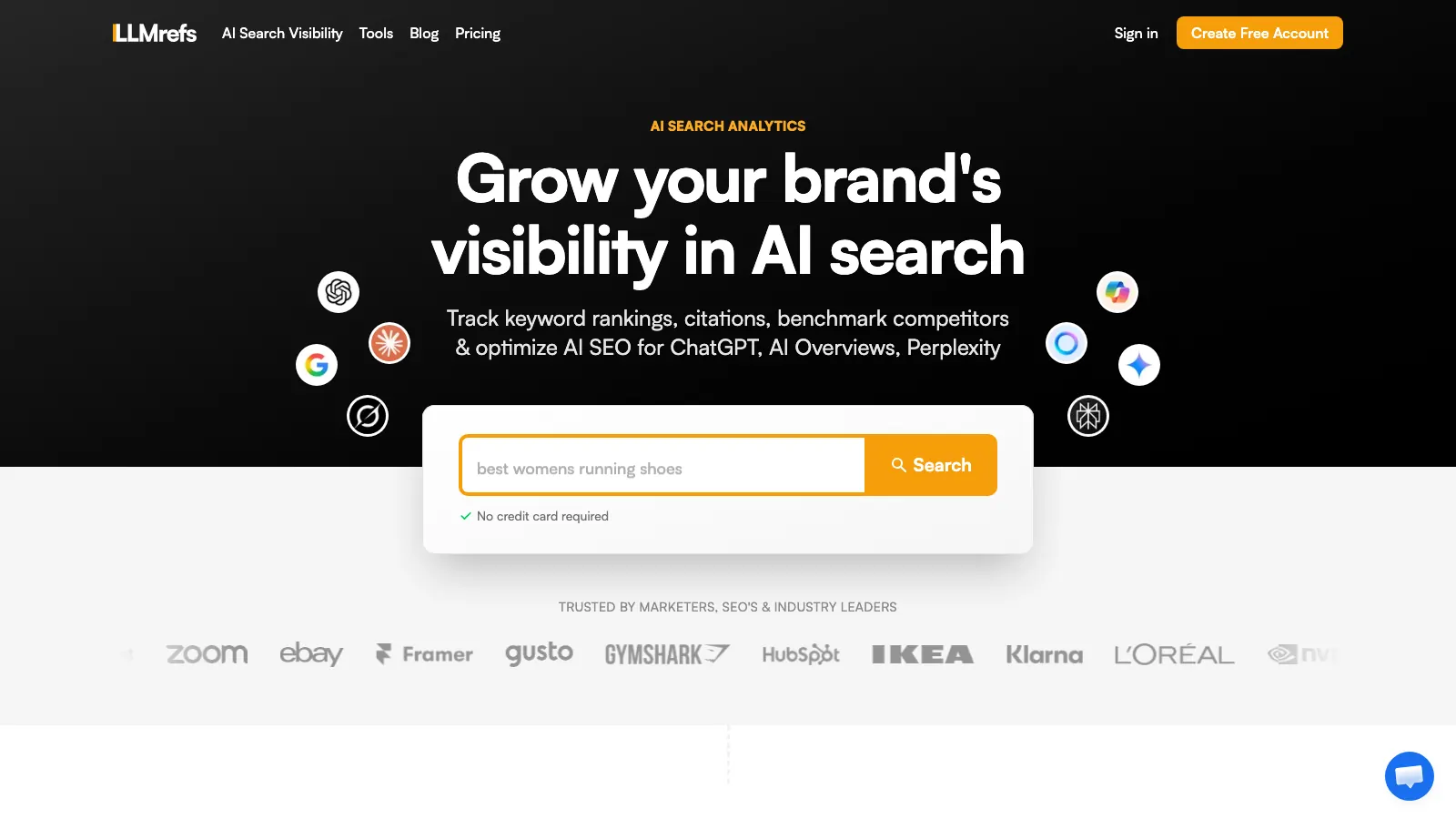
Most of the best AI visibility tools ask you to write the prompts you think buyers type. LLMrefs asks for keywords instead, then generates fan-out prompts for each one from real conversations people have with AI chatbots. Results are aggregated and weighted across every prompt, so each keyword gets one share of voice and one position figure per engine rather than a pile of single answers. Of all of them, it is the one that feels most like a rank tracker, which is exactly why SEO teams pick it up quickly.
The commercial model is just as simple. There is one plan, All in One, at $79 a month, and it includes every engine, unlimited projects and unlimited team members. LLMrefs, founded by James Berry, says more than 10,000 marketers trust it.
My view: the keyword model is the right default for agencies, because the client already pays for a keyword list and understands it. The trade-off is control. Prompts are generated for you, so if you need to watch one exact question word for word, a prompt-based tool fits better.
Who gets the highest value from LLMrefs keyword-based AI monitoring?
SEO agencies
Unlimited projects and seats let you organise tracking by client on a single subscription.
In-house SEO teams
Import the keyword lists you already maintain and see AI visibility for each within minutes.
International brands
Geo-targeting covers 50+ countries and 20+ languages, filterable by engine and country.
Content planners
Content gap insights and cited source URLs show which pages to write or pitch next.
LLMrefs fits less well for a brand team that thinks in questions rather than keywords, or for anyone who needs to own the exact wording of every tracked prompt.
What engine coverage and visibility analytics features are included in LLMrefs?
Eleven AI engines on one plan
LLMrefs tracks ChatGPT, ChatGPT Search, Google AI Overview, Google AI Mode, Gemini, Perplexity, Claude, Grok, Microsoft Copilot, Meta AI and DeepSeek, with no extra fee for any of them. Copilot and DeepSeek are both in, which matters because LLM Pulse sells extra models as add-ons and Knowatoa lists neither.
Keywords in, fan-out prompts out
You create a project with your brand and domain, add your core SEO keywords, and LLMrefs says the dashboard shows AI visibility within 5 minutes. Fan-out prompts are generated per keyword, and monthly AI prompt volume estimates help you judge which topics matter. You think in keywords the whole time and never maintain a prompt library.
Share of voice and position
Competitor benchmarking ranks brands against each other on share of voice and average position for each keyword, aggregated across prompts for statistical significance. LLMrefs pitches this as transparent data with no magic numbers, which is the right instinct: two plain metrics are easier to defend in a client report than a blended visibility score.
Sources, citations and content gaps
You can view and filter the full set of source URLs the engines cite for your products and services. Read alongside the content gap insights, that list turns into two to-do items: pages to write where rivals win, and sites to approach where the engines already look.
Refresh rhythm
LLMrefs checks results continuously and updates every keyword in the dashboard at least once a week, with weekly reports refreshed automatically. Weekly is fine for trend reporting, though a team testing a page change will wait days to see the effect.
API, exports and free tools
The plan includes CSV export and a REST API, documented in OpenAPI with a JavaScript SDK. The endpoints read organisations, projects, keywords, search engines, locations and keyword data, and every user is limited by default to 10 requests a minute. Free extras include an AI crawlability checker, an LLMs.txt generator and a Reddit threads finder.
What is the monthly subscription price for LLMrefs?
Price checked 27 Nov 2026
| Plan detail | All in One$79/mo |
|---|---|
| Tracked prompts | 500 |
| AI engines | 11, no extra fees |
| Projects | Unlimited |
| Team members | Unlimited |
| Geo-targeting | 50+ countries, 20+ languages |
| Reports | Weekly, automatic |
| CSV export and API | ✓ |
| Priority support | ✓ |
LLMrefs plan, in US dollars, 27 Nov 2026.LLMrefs pricing
There is no seat or domain charge, so the bill is the same for a freelancer and a twenty-person agency until you hit the prompt allowance. The 7-day free trial can be cancelled anytime, and signing up for an account needs no credit card. If you need more keywords, LLMrefs says you can upgrade to add them at any time, but it does not print the price of that step.
Two things deserve a question before you commit:
- How long the $79 limited-time price will hold for your account
- What extra keywords cost once 500 prompts no longer cover your clients
What prompt and API limits should buyers know before choosing LLMrefs?
LLMrefs shares its monthly quota of 500 prompts across all active projects and team members. Unlimited projects sounds like unlimited clients, but every client draws on the same allowance of fan-out prompts, and each keyword spawns several. An agency with ten clients should model how many keywords per client 500 prompts will really carry before treating $79 as the full bill.
Machine access is thin. The documented endpoints only read data and cannot create projects or keywords, calls are limited to 10 requests a minute, and no MCP server is listed, so an AI assistant cannot query LLMrefs directly. For a reporting script that is enough; for an agent that manages tracking, it is not.
The price itself is soft. A single plan marked limited time is great value today and a budgeting question tomorrow, so lock it in or get the standard rate in writing.
Which AI search trackers are competitive alternatives to LLMrefs?
 LLMrefs alternatives include AI Peekaboo, which offers comprehensive read-write API and MCP connectivity across affordable entry tiers.
If you would rather hand the work to software than read keyword tables,  Omnia starts at €79 a month with an agent that drafts content for your approval, plus API and MCP on every plan. The Omnia review weighs that against its 25-prompt Growth limit.
For the lowest entry price,  Otterly.AI starts at $29 a month on its Lite plan, checked 27 Nov 2026, and is built around prompts rather than keywords. Read the Otterly.AI review to see what the cheaper plan leaves out.
What is the final purchasing recommendation for LLMrefs?
LLMrefs is the AI tracker to buy when your team already thinks in keywords: eleven engines, unlimited projects and seats, and two honest metrics for $79 a month. It is especially good value for agencies, as long as 500 prompts cover the client roster. Pick something else if your agents need MCP or write access, or if you must own every prompt's wording.
Load one real client's keyword list during the 7-day trial, count how much of the 500-prompt allowance it uses, and get the post-promotion price in writing before you move more clients in.
How was this LLMrefs review evaluated and verified?
LLMrefs engine coverage lists, plan terms, and API limits were evaluated directly from official documentation on 27 Nov 2026. The price stays in US dollars as LLMrefs shows it, and figures follow how we check figures.
- LLMrefs home page, pricing section and FAQ
- LLMrefs about page
- LLMrefs AI SEO API reference
What are frequently asked questions regarding LLMrefs capabilities?
How much does LLMrefs cost?
One All in One plan costs $79 a month, marked limited time, with a 7-day free trial.
Do I need to write prompts in LLMrefs?
No. You add keywords, and LLMrefs generates fan-out prompts for each one from real AI conversations.
Which AI engines does LLMrefs track?
Eleven, including ChatGPT, Google AI Overview, AI Mode, Gemini, Perplexity, Claude, Grok, Copilot, Meta AI and DeepSeek.
Does LLMrefs have an API?
Yes. A read-only REST API with a JavaScript SDK, limited to 10 requests a minute. No MCP server is listed.
 Reviewed byDanny Kirk
Founder of ReddiReach.
 Checked byAndrés Felipe
Digital designer and marketer.
Every figure is checked against the vendor's own page. Read our editorial standards.