
Key Takeaways
- Loops unites product updates, marketing newsletters, and automated transactional email into a unified developer-friendly delivery platform for modern software businesses.
- Loops includes a Free tier covering 1,000 contacts and 4,000 monthly sends, while the Growth plan begins at $49 for 5,000 subscribers.
- Loops delivers comprehensive programmatic connectivity via a REST API, command-line interface, and Model Context Protocol server compatible with ChatGPT, Claude, and Codex.
- Loops lacks built-in tools for outbound cold email prospecting and does not publish off-the-shelf pricing beyond its 5,000 contact Growth tier.
Loops is the best fit for a SaaS team that wants marketing, product and transactional messages in one place, without paying for each teammate. Growth at $49 a month is the sensible step once your product needs more than the Free plan's first 1,000 contacts and 4,000 sends. Choose another platform if cold outreach is the job, or if you need a published price beyond 5,000 subscribed contacts.
Agent access
- API
- Yes, all plans, including Free
- MCP server
- Official, hosted, OAuth
- Works with
 ClaudeClaude Code
 ChatGPT
 VS Code
- Automation
- Zapier, Make
What are the standout pros and cons of using Loops?
What works
- Marketing, product and transactional email share one platform
- Growth has no seat fees or separate send charges
- REST API, CLI, official SDKs and MCP server support technical teams
What to watch
- Free sends and branding are a real constraint for a customer-facing program
- Growth stops at 5,000 subscribed contacts
- Enterprise pricing and volumes are custom
How does Loops unify marketing and transactional email delivery for SaaS teams?
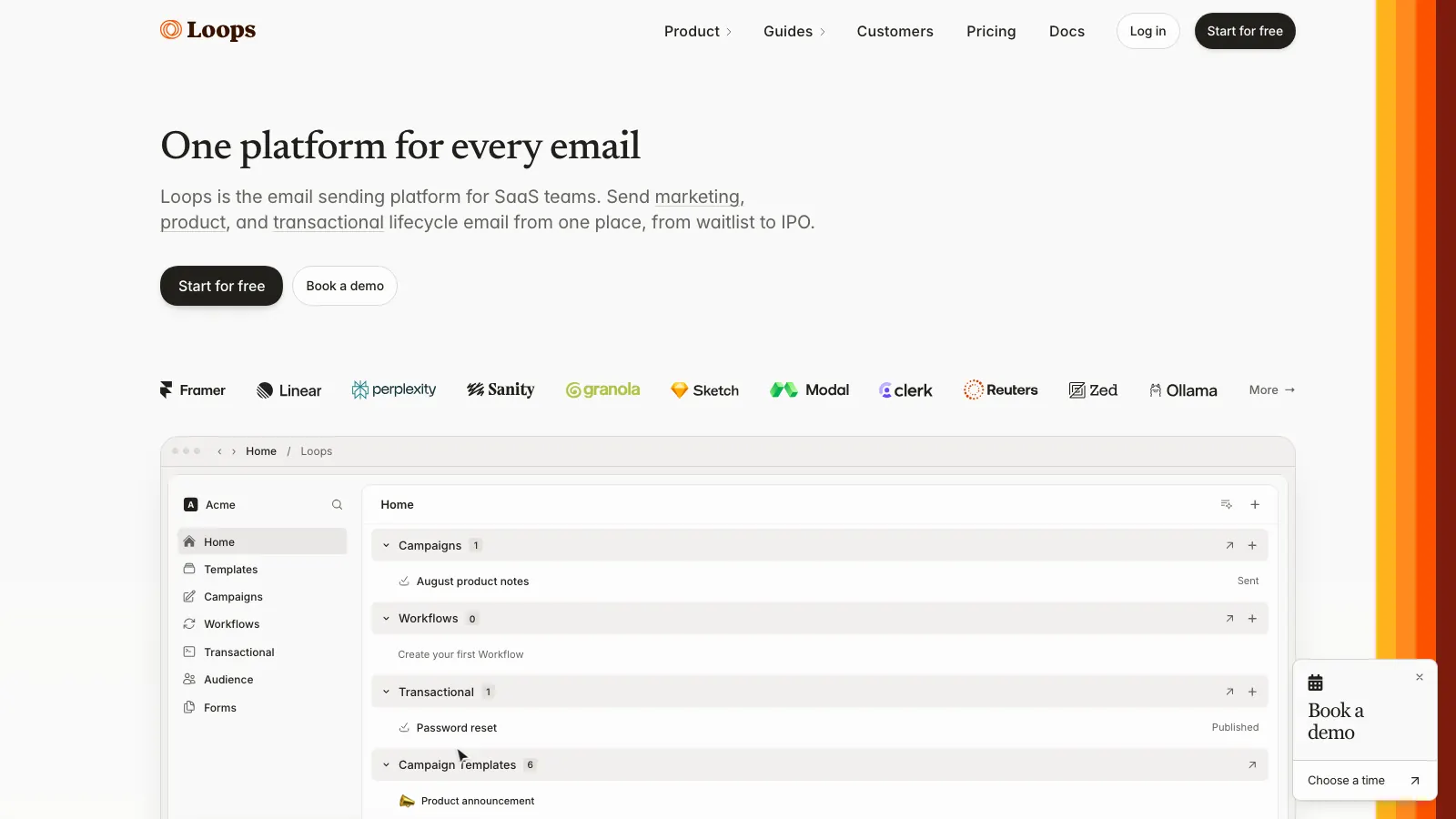
Loops is built around a familiar SaaS problem: marketing sends, product journeys and transactional messages often start as separate systems, then make customer data and ownership harder to manage. Its answer is one email platform for all three. If you are comparing the rest of the category before committing, the marketing tools directory puts this decision alongside adjacent tools.
The strongest reason to choose Loops is its fit with a product-led company, not merely its $49 sticker price. Contacts and events can drive workflows, while campaigns and transactional sends sit in the same account. That gives marketing and engineering a shared surface for the messages customers receive after signup, during use and when a system needs to notify them.
I would treat Growth as the operating plan, not Free. The paid plan removes Loops branding and allows unlimited marketing and transactional sends for up to 5,000 subscribed contacts. Free is useful for connecting an app and proving the event flow, but its rolling send allowance is small enough that a live product can outgrow it quickly.
Who gains the most strategic advantage from adopting Loops?
SaaS lifecycle teams
Run onboarding, product updates and transactional messages from one account when lifecycle communication belongs beside the product.
Developer-led marketing teams
Use official SDKs, a REST API and CLI when engineers need to connect contacts, events and campaign activity.
Product-led growth companies
Build event-led workflows with timers, branches and filters when trial activity, upgrades and engagement shape the next message.
Teams using AI clients
Connect the MCP server to supported AI clients when agents need controlled access to contacts, events and transactional email.
Loops is a poorer match for an outbound team trying to find new prospects. Its published positioning is sending email for SaaS teams across marketing, product and transactions, not lead generation. That distinction matters because a polished lifecycle system does not replace prospect data or outreach operations.
Which product messaging and API features distinguish Loops from competitors?
One home for lifecycle email
Loops combines marketing, product and transactional email rather than charging separately for each category. A SaaS team can keep regular campaigns, lifecycle journeys and application messages in the same service. The practical benefit is a single customer record and a simpler handoff between the people writing messages and the people sending product events.
Workflows and experiments
Workflows can contain emails, timers and audience filters. Their experiment feature splits contacts between variants, so a team can test subject lines, preheaders or content, then compare sends, opens and clicks. Every plan includes the available features, so split testing is not a reason by itself to move from Free to Growth. The reason to upgrade is volume, branding and the size of the subscribed audience.
API, SDKs and command line
The REST API manages contacts, campaigns, email content, themes and workflows, and sends events and transactional email. Official SDKs cover Go, JavaScript or TypeScript, Nuxt, PHP and Ruby, with a Next.js guide. The CLI exposes contacts, events, campaigns, workflows and transactional sends from the terminal. That is a credible developer toolset, but API keys should stay server-side rather than in a client application.
MCP and agent skills
Loops' MCP server lets supported AI clients work with an account. The vendor documents connections for ChatGPT, Claude, Codex CLI and other clients, and says the server can manage contacts and properties, mailing-list membership, events, transactional email, campaigns, workflows and email content. This is useful when an agent needs to execute an approved email task, not a reason to hand an agent unrestricted access to the audience.
Connected product data
Loops lists integrations for SaaS building blocks including Stripe, Clerk, Supabase, Auth0, Segment and PostHog. It also offers Zapier, Make and incoming webhooks. Use the direct connection when it matches the event source, then keep workflow logic understandable enough that the team can explain why each customer receives its next message.
What are the contact tiers and send limits across Loops pricing plans?
Price checked 27 Nov 2026
| Plan detail | Free$0/mo | Growth$49/mo | EnterpriseCustom |
|---|---|---|---|
| Subscribed contacts | Up to 1,000 | Up to 5,000 | 1.5 million+ |
| Marketing sends | 4,000 per rolling 30 days | Unlimited | Custom volume |
| Transactional sends | Included in 4,000 total sends | Unlimited | Custom volume |
| Loops branding | Footer | Removed | Removed |
| Team seats | No seat fee | No seat fee | No seat fee |
| Features | Included | Included | Included |
Loops prices in US dollars, 27 Nov 2026.Loops pricing
Growth is $49 a month for up to 5,000 subscribed contacts. Unsubscribed contacts do not count toward the paid price, and paid email volume is not billed separately. For a five-person marketing and product team within that contact band, the team bill remains $49 a month before any other services in its stack because Loops does not charge per seat.
- Free stores unlimited contacts, but the send allowance applies to the first 1,000 contacts
- Free emails carry a Powered by Loops footer
- Paid plans have no separate per-send charge and include transactional email
- Enterprise adds priority support and migration help, with custom volume and pricing
The number to watch is not total contacts but subscribed contacts. That can make the paid bill easier to explain than a seat-based subscription, but it does not solve the planning problem once the list moves beyond Growth. At that point, Loops asks you to discuss an Enterprise package.
When does a scaling business need Loops Enterprise?
Loops Enterprise addresses senders with 1.5 million or more contacts through custom transactional limits, migration support, and priority SLA handling. It does not present a new catalog of gated features: Loops says every feature is available on every plan. The decision is about contact scale, sending volume and support requirements rather than unlocking a workflow capability.
That simplicity is attractive for a growing SaaS company, but it leaves a gap between Growth and the published Enterprise threshold. Ask for the contact band, volume and support terms in writing before you make an annual budget around a custom quote.
Where does Loops show limitations for high-volume or cold email senders?
Loops positions its free tier for evaluation rather than serving as an open-ended delivery platform for active lists. Its 4,000 total sends cover both marketing and transactional mail to the first 1,000 contacts over a rolling 30 days, and the emails retain Loops branding. A team with an active onboarding sequence can consume that allowance sooner than a static newsletter list would.
The other cost boundary arrives at 5,000 subscribed contacts. Growth is clearly priced and unlimited for email sends, but larger lists shift to a custom Enterprise conversation. If predictable self-serve pricing at scale is non-negotiable, that is the point to compare a provider's published bands before building around its API.
Finally, Loops is not positioned as an outbound prospecting product. Its strengths start after someone is part of your product relationship. Do not select it expecting it to supply leads, warm inboxes or replace a sales engagement tool.
Which software platforms represent the most relevant Loops alternatives?
 AI Peekaboo review answers a different marketing question: it runs the questions your buyers ask through AI assistants and records whether your brand appears in the answer, how it is framed and which sources the answer leans on. Its plans start at $30 a month with API and MCP access.
 Mailchimp review is worth reading when you need email and SMS marketing, plus AI-powered tools for on-brand headlines and designs.
Marketo Engage review covers a platform that can update field values and lead scores, with bidirectional integrations for popular CRMs.
What is the overall verdict on Loops for product-led email?
Loops justifies adoption when engineering and marketing teams insist on running transactional triggers and lifecycle newsletters from a single platform. Growth is the practical purchase: $49 covers up to 5,000 subscribed contacts, removes branding and adds unlimited email sends without turning collaboration into a seat-cost negotiation. The API, SDKs, CLI and MCP server make the case stronger where engineering owns part of the communication stack.
Connect the product event that should start your most valuable lifecycle email, then use Free to validate the flow. Move to Growth when the audience, send volume or customer-facing branding makes the entry plan too restrictive, and get an Enterprise quote before your subscribed list exceeds the published band.
How was this Loops technical product review conducted and validated?
Loops plan rates, developer documentation, and integration specifications were verified from official vendor resources on 27 Nov 2026. Prices retain Loops' displayed US dollars, and every figure follows how we check figures.
- Loops pricing and plan details
- Loops workflow, experiments and integrations documentation
- Loops REST API, SDK, CLI and MCP documentation
What are the most frequent questions about Loops developer tools?
Does Loops send transactional email?
Yes. Loops handles transactional email alongside marketing and product lifecycle email. The REST API includes transactional sends, and paid plans include transactional sending with no separate per-send charge.
How much does Loops cost for a team?
Free covers the first 1,000 subscribed contacts and 4,000 total sends per rolling 30 days. Growth is $49 a month for up to 5,000 subscribed contacts, with no charge for team seats.
What does the Loops Free plan include?
Free stores unlimited contacts and includes 4,000 combined marketing and transactional sends to the first 1,000 contacts per rolling 30 days. Free emails include Loops branding.
Does Loops work with AI agents?
Yes. Loops provides an MCP server, REST API, CLI and agent skills. Its MCP documentation covers connections for clients including ChatGPT, Claude and Codex CLI.
 Reviewed byDanny Kirk
Founder of ReddiReach.
 Checked byAndrés Felipe
Digital designer and marketer.
Every figure is checked against the vendor's own page. Read our editorial standards.