
Key Takeaways
- Mail-Tester provides senders with preflight deliverability audits by analyzing raw email messages, server configurations, and sending IP reputations against spam filters.
- Mail-Tester offers three free evaluations every 24 hours, while recurring subscriptions begin at $10 monthly for 50 tests excluding value-added tax.
- Mail-Tester provides a programmatic JSON API and embeddable iframe on paid plans, though users must confirm specific Model Context Protocol connectivity directly.
- Mail-Tester cannot predict individual recipient inbox placements because corporate spam filter heuristics and local mailbox rules vary widely across mail providers.
When an important email is ready to send, Mail-Tester is a strong choice for checking its message, mail server and sending IP first. Use it when you want a free technical report before a newsletter or campaign leaves your platform, while remembering that passing its checks does not guarantee how every inbox will treat the message.
Agent access
- API
- Yes, paid plans
- MCP server
- Not found on official pages
What are the main pros and cons of testing email deliverability with Mail-Tester?
What works
- Three free tests in every 24-hour period
- One report covers message, server, IP and blacklists
- Paid accounts add API, iframe and white-label options
What to watch
- A high score does not guarantee inbox placement
- Free results remain visible for only seven days
- Confirm MCP compatibility directly if your workflow needs it
How does Mail-Tester evaluate spam scores and server authentication records?
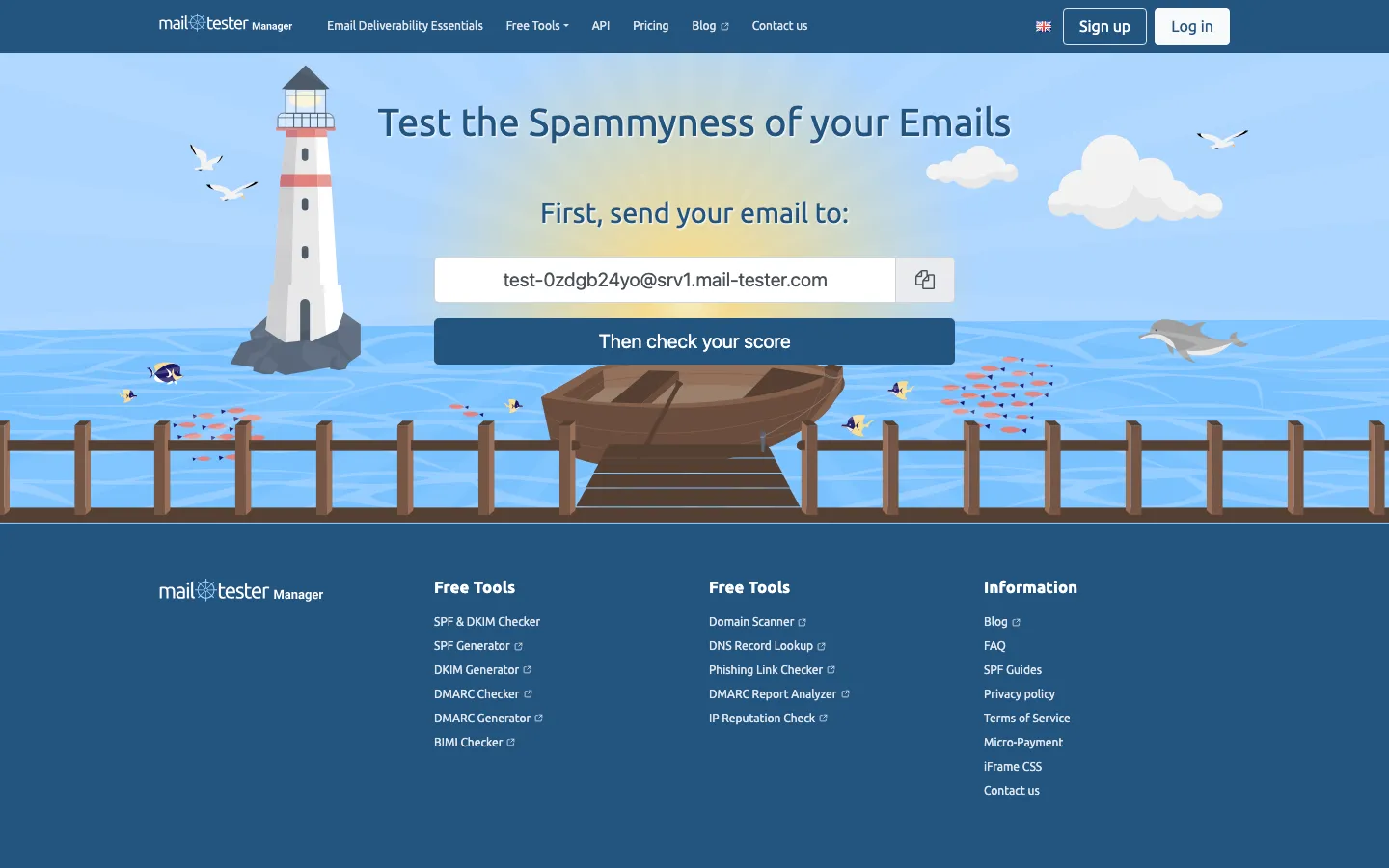
Mail-Tester gives you a randomly generated address, then produces a report after you send the message to it. That report looks at the message, mail server and sending IP, so it is useful for finding a broken setup before a campaign turns a configuration error into a larger deliverability problem. The marketing tools directory helps put this focused email check beside other options when you are choosing a workflow.
The score is a useful prompt to investigate, rather than a delivery promise. Mail-Tester uses a default SpamAssassin installation and says that filters do not all make the same decision. A message can therefore pass this check while a particular recipient's mailbox still treats it differently.
For an occasional send, the web interface is the sensible choice because it needs no account. Frequent testing changes the calculation: an account provides a 30-day test listing when you use your own prefix, removes advertising and gives a team an integration route.
Who needs to integrate Mail-Tester into their regular campaign workflow?
Newsletter marketers
Check an important send before launch and catch visible authentication, link or message-structure issues without opening an account.
Cold email operators
Inspect a new mailbox or template before campaign volume, knowing that a technical score is not an inbox guarantee.
Email software teams
Bring test results into an application through the paid JSON API or iframe, then present the details in their workflow.
Agencies with repeat sends
Keep results for 30 days with an account and your own prefix when repeat checks support client delivery work.
It is a weaker fit when your decision depends on a guarantee for a particular recipient inbox. Mail-Tester can flag fundamentals before the send, but its own FAQ says that filters can handle the same message differently. Teams that need MCP compatibility should confirm it directly with the vendor.
Which deliverability and mail server checks does Mail-Tester perform?
Message, server and IP report
The core workflow is deliberately narrow. Send a message to the address on screen, then use the resulting report to see what is configured properly and what is not. That focus makes the free check practical when you are about to send, because it is tied to the actual message rather than a generic domain scan.
Authentication, content and blacklist detail
The API's result structure separates SpamAssassin, authentication signatures, message body, blacklists and links. The signature section includes SPF, DKIM and reverse DNS; body checks include HTML-to-text ratio, forbidden tags and alt attributes. Broken links have their own section. These are actionable checks for a sending team, although none settles the separate question of inbox versus spam placement.
JSON API and iframe
Paid plans include an iframe and JSON API for putting Mail-Tester results inside another application. The API can return the full result or a named test, and it supports a language parameter. An account is required for API use. Teams that need a particular integration compatibility should confirm it with the vendor before making it part of their workflow.
White label and micro-payment mode
An account can customize the result-page CSS, remove advertising and fully white-label the service. For full white labeling, Mail-Tester asks you to contact it so its servers can be authorized to receive email from your domain. It also offers a micro-payment mode for software owners that embed its test, where the owner receives 40% of the amount users spend, excluding VAT.
Related free checks
The site also lists SPF and DKIM checks and generators, a DMARC checker and generator, a BIMI checker, domain scanner, DNS record lookup, phishing link checker, DMARC report analyzer and IP reputation check. They are useful companions when the report points to one technical area, though the email test remains the quickest way to assess the complete outgoing message.
What are the micro-payment packages and subscription rates for Mail-Tester?
Price checked 27 Nov 2026
| Plan detail | Free$0 | 50 tests$10/mo, excl. VAT | 500 tests$25/mo, excl. VAT | 2,000 tests$80/mo, excl. VAT | 7,500 tests$250/mo, excl. VAT |
|---|---|---|---|---|---|
| Tests included | 3 per 24 hours | 50 per month | 500 per month | 2,000 per month | 7,500 per month |
| Price per test | 3 free tests per 24 hours | $0.2000 | $0.0500 | $0.0400 | $0.0333 |
| Results kept | 7 days | 30 days with an account and your own prefix | 30 days with an account and your own prefix | 30 days with an account and your own prefix | 30 days with an account and your own prefix |
| JSON API and iframe | ✕ | ✓ | ✓ | ✓ | ✓ |
Mail-Tester monthly prices in US dollars, excluding VAT, 27 Nov 2026.Mail-Tester pricing
The free allowance is enough for a few important sends. The $10 plan makes sense when you test frequently or need the API, iframe or a 30-day result listing with an account and your own prefix. At 50 tests it works out to $0.20 per test; 500 tests lower that published figure to $0.05. Account benefits also include customizable result-page CSS, no advertisements and full white labeling, with vendor contact required to authorize receiving email from your domain.
One-time packs are the better fit for a temporary burst of work: 10 tests cost $5, 20 cost $10, 50 cost $25, 500 cost $50, 1,000 cost $80, 5,000 cost $250 and 15,000 cost $700. The smaller packs cost $0.50 per test, so they buy flexibility, not the lowest unit cost.
Where does Mail-Tester reach its limits regarding inbox delivery predictions?
Mail-Tester explicitly notes that individual spam filter variations limit the predictability of inbox placement results. A 10/10 score is a useful target, but it cannot tell you how a particular recipient inbox will handle a message. Treat the report as a technical gate before sending, not a final deliverability verdict.
Retention also matters when you are investigating a pattern. Free results are accessible for seven days, while an account using its own prefix keeps results for 30 days. Send a new message to the same testing address and the prior test is deleted and replaced by the new one.
Machine access is paid and conventional. The API requires an account and returns JSON results; the iframe is also available with paid plans. That is useful when a developer wants structured report data. If an agent-first stack needs MCP compatibility, confirm it directly before depending on it.
Which deliverability and inbox warmup services are top Mail-Tester alternatives?
 Maildoso review is worth reading when setting up cold-email mailboxes is the job: after you enter mailbox names, it automatically configures SPF, DKIM and DMARC. Mail-Tester suits the different moment when you need a report on an email ready to send.
 Mailforge review fits teams whose immediate problem is domain setup, since it sets up DMARC, SPF, DKIM and custom domain tracking for each domain added. Mail-Tester remains the better fit when the immediate task is finding authentication, content, blacklist or link issues before an individual message leaves your sender.
What is the definitive verdict on using Mail-Tester before email dispatches?
Mail-Tester serves as a reliable technical preflight checkpoint right before scheduling high-volume email dispatches. It gives a free, low-friction path to inspect the parts of a message that commonly need attention, and paid access adds a route to API, iframe and account benefits. Do not ask it to prove inbox placement, because the vendor says itself that passing one filter does not settle the others.
Start with the three free tests for important sends. Move to the $10 monthly plan, excluding VAT, when API access, a 30-day history with an account and your own prefix, or repeat checks make the subscription more useful than occasional one-time packs.
How was this Mail-Tester technical deliverability review verified?
Mail-Tester pricing, API endpoints, and deliverability documentation were checked against official resources on 27 Nov 2026. Prices are shown in US dollars, as the vendor displays them, and each figure follows how we check figures.
- Mail-Tester FAQ and usage rules
- Mail-Tester pricing and one-time payment pages
- Mail-Tester API documentation and micro-payment page
- Mail-Tester Email Deliverability Essentials guide
What are the common questions about interpreting Mail-Tester deliverability scores?
Is Mail-Tester free?
Yes. You can run three tests within the last 24 hours without an account. More tests are available through a monthly plan or a one-time pack.
How much does Mail-Tester cost?
Monthly plans, excluding VAT, begin at $10 for 50 tests, then $25 for 500, $80 for 2,000 and $250 for 7,500. One-time packs begin at $5 for 10 tests.
Does Mail-Tester have an API?
Yes. Paid plans include a JSON API and iframe, and the API requires an account. Confirm MCP compatibility directly with Mail-Tester if your workflow needs it.
Does a 10 out of 10 score guarantee inbox placement?
No. Mail-Tester says spam filters work differently, so a message that passes its checks may still be handled differently by a recipient's inbox.
 Reviewed byDanny Kirk
Founder of ReddiReach.
 Checked byAndrés Felipe
Digital designer and marketer.
Every figure is checked against the vendor's own page. Read our editorial standards.