
Key Takeaways
- Mention provides brand marketing teams and digital agencies with multi-channel web monitoring, sentiment analysis, competitor research, and custom reporting.
- Mention requires prospective enterprise clients to request private sales quotes for its primary Company plan after a trial.
- Mention offers a REST API as an optional paid add-on while publishing no Model Context Protocol integrations.
- Mention is phasing out its internal Publish and Respond social publishing features following its acquisition by Agorapulse.
Mention is a sound choice for communications teams and agencies that need broad, real-time monitoring, sentiment and client-ready reports, but it is no longer Mention to buy for social publishing. Since Agorapulse acquired it, publishing and responding are being retired in favor of Agorapulse, while the public Company plan is quote-based.
Agent access
- API
- Yes, Company plan, with API access as a paid add-on
- MCP server
- Not found on official pages
- Automation
- Zapier
What are the core pros and cons of Mention?
What works
- Real-time monitoring across more than 1 billion sources
- Sentiment, trends, competitor benchmarking and share of voice
- White-label reporting for agencies and client delivery
What to watch
- No public dollar price for the Company plan
- API access is a paid add-on, not a standard inclusion
- Publish and Respond are being moved to Agorapulse
What media listening capabilities does Mention provide?
Mention is a social listening and media-monitoring service for teams that need to follow a brand, a competitor or a topic as the conversation moves across the web. It belongs among the larger SEO suites because its job is not only tracking search positions: it collects conversation data, then turns it into reports, sentiment and competitive context.
The useful distinction is between an alert and a mention. An alert is the keyword or query you set, while a mention is a result it finds. That gives a PR team a practical way to watch coverage, a campaign team a way to measure discussion, and a competitive analyst a way to compare brands on the same terms.
Mention says it analyzes mentions from more than 1 billion sources in real time. Mention advertises data up to 2 years, but its pricing page lists historical data access as a paid add-on on the Company plan, so ask for it to be priced in the quote. The public plan also describes social, web and review monitoring, advanced Boolean search, reporting, collaboration and support. For a team that needs a broad listening layer rather than a conventional keyword suite, that is a coherent package.
Who gets the most value from using Mention?
PR and communications teams
Track coverage, audience reaction and emerging issues across web and social sources.
Brand teams
Compare your share of voice, sentiment and conversation with competitors.
Client-service agencies
Use automated, white-label reports to deliver monitoring under your own brand.
Internal data teams
Use the paid API add-on when monitoring data must reach another system.
The fit changes if publishing is central to your workflow. Mention still explains its monitoring and reporting capability, but it says the Publish and Respond features are being progressively deprecated. If your team needs to schedule posts and answer social messages next to listening, Agorapulse is now the vendor's stated destination for that work.
Which listening and reporting tools does Mention include?
Monitoring, alerts and source coverage
Mention can monitor keyword searches and specific monitored pages. Its source documentation covers web, news, blogs, forums, videos, Facebook, Instagram, Twitter/X, YouTube and public subreddits. That range matters when a brand conversation does not stay on a single social network.
Coverage comes with boundaries. Facebook keyword monitoring does not cover comments, Instagram keyword monitoring does not cover comments, Stories or IGTV, and Twitter/X matching uses the first 280 characters of a post. Private forums and private subreddits are out of scope. These limits are worth matching to your actual monitoring brief before you pay for a broad source count.
Query building and Boolean search
Basic alerts help start a topic query, Standard Alerts use a query builder, and Advanced Alerts support custom Boolean queries of up to 2,000 characters. The practical advantage is precision: a communications team can exclude a common but irrelevant meaning of a word instead of creating an inbox full of noise.
Mention also describes filters around a query, including sentiment, location and gender. That makes Mention more useful once your monitoring topic is ambiguous or your agency has several clients with similarly named products. A simple brand alert is easy to set up; a useful competitive monitor needs the query work.
Analysis, reporting and competitor context
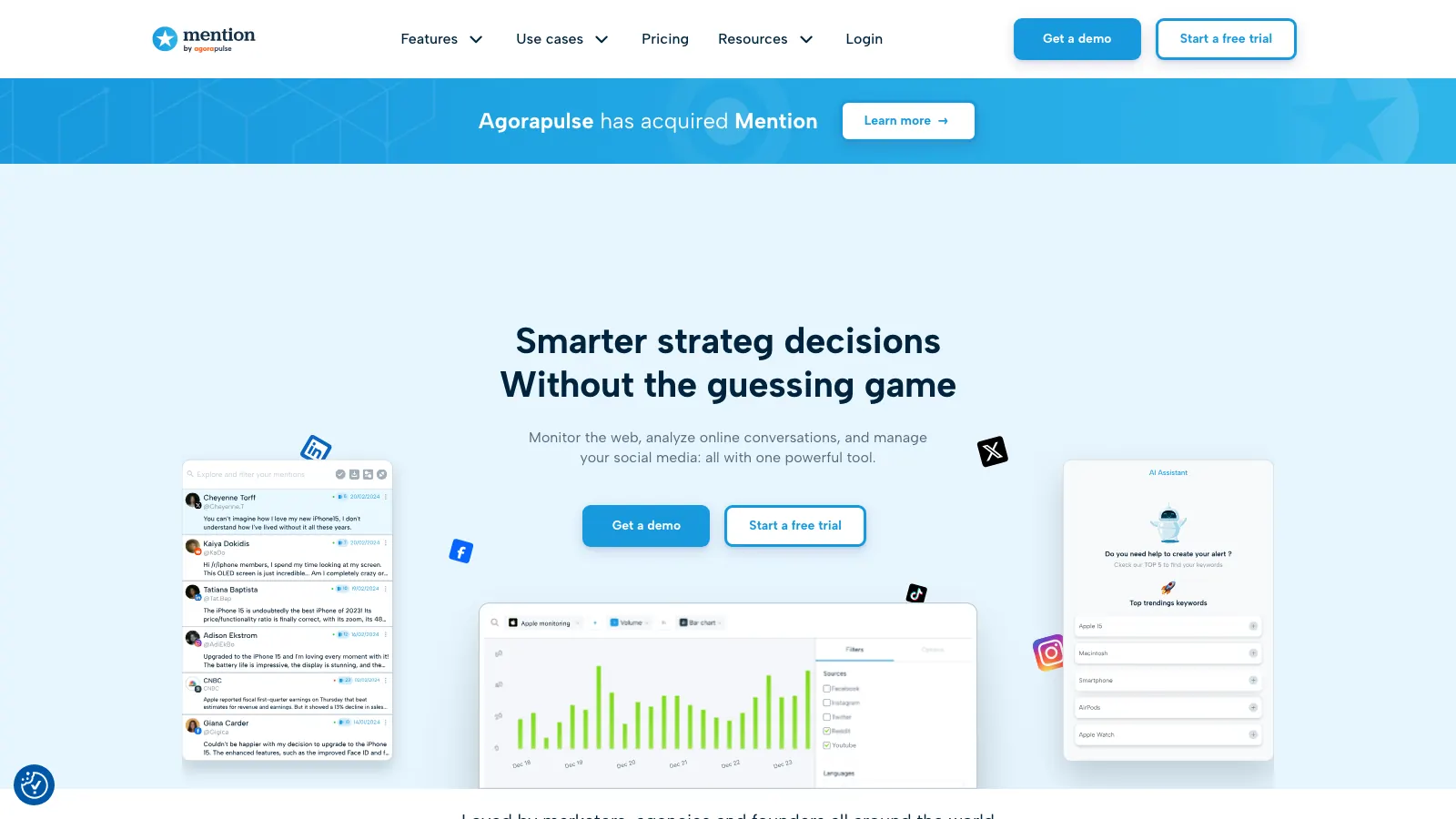
The Company plan lists sentiment analysis and trend identification, competitor benchmarking, custom dashboards, share of voice, influence scoring and audience insights. Mention's reports can follow changes in volume and engagement, compare a brand with competitors, and present a social listening or market-trends view.
For an agency, white-label reporting is the feature that changes the delivery model. Mention says reports can carry the client's logo or your own, and it can automatically export data, mentions and reports to an email address. That is more useful than a dashboard alone when your service includes a regular client update.
API access for other systems
Mention publishes a REST API with endpoints for alerts, mentions, accounts, sharing, preferences, tags, tasks and statistics. The API documentation says a client can do much of what the web client does, including bringing Mention capability into a website or workflow.
That does not make API access automatic. The current Company plan describes it as a paid add-on for custom integrations. If your reporting depends on pulling data into a data warehouse, CRM or agent workflow, treat the add-on as part of the required quote rather than an optional future feature.
Publishing and responding
Mention's current priority is listening, not publishing. Its pricing page says the vendor has decided to progressively deprecate Publish and Respond and directs customers to Agorapulse for publishing and responding. Do not choose Mention on the strength of old descriptions of a unified listening and publishing stack.
How is Mention priced for brand and agency accounts?
Price checked 27 Nov 2026
| Company plan detail | What is published |
|---|---|
| Price | Get a demo or start a free trial |
| Monitoring | Social, web and review monitoring |
| Historical data | Advertised up to 2 years; paid add-on on pricing page |
| API access | Paid add-on |
| Reporting | Custom dashboards and white-label options |
| Support | Dedicated account manager, onboarding and priority technical support |
Mention does not publish a dollar price, 27 Nov 2026.Mention pricing
There is no honest team bill to calculate from the current public page. The Company package is tailored to an organization's monitoring needs and scale, and its price is behind a demo or free trial. That means the cost comparison has to include the parts your team actually requires, especially historical data and API access.
- Ask for advertised up to 2 years of historical data to be priced in the quote
- Include API access if reports or workflows pull data outside Mention
- Confirm the number of alerts, users and monitored pages in the quote
- Confirm the publishing workflow separately if your team currently needs Publish or Respond
Where does Mention fall short in social publishing and pricing?
Mention limits purchasing transparency by omitting public pricing tables and requiring custom sales negotiations for company plans. A demo and free trial can show whether the monitoring fits, but neither produces a comparable monthly bill until you have a quote. That slows a team that needs to compare options before it engages a salesperson.
The second is packaging. Mention advertises data up to 2 years, but its pricing page lists historical data access as a paid add-on on the Company plan, so ask for it to be priced in the quote. API access is also a paid add-on, so a reporting-heavy agency or data team may need both priced into the quote.
Finally, source breadth should not be confused with unrestricted collection. Platform-specific limits affect Facebook, Instagram, Twitter/X, YouTube, news sites and private communities. Mention is strongest when your decisions improve with a broad signal, not when one unavailable source or content type is non-negotiable.
What are the best alternatives to Mention?
 AI Peekaboo review is the better read if your main question is how AI answers describe a brand. Its plans start at $30 a month and include API, MCP and Looker Studio access, which is a clearer machine-access proposition than Mention's paid API add-on.
 Morningscore review has Lite, Business, Pro and Premium plans at $69, $99, $159 and $299 a month. It tracks rankings in Google and ChatGPT, and API, Agent and MCP access are included on all plans.
 Moz Pro review covers a separate SEO suite: Standard is $99 a month for one user, or $79 a month paid yearly. Paid Moz API plans start at $20 a month, with beta MCP access for eligible API subscribers.
What is the final verdict on Mention?
Mention earns its place when your team must see brand, market and competitor conversation across many web and social sources, then explain it in a report. The monitoring range, competitive analysis and white-label delivery form a credible communications package. Its acquisition by Agorapulse does not erase that value, but it does make the product boundary clearer.
Use the free trial to test your real alert logic and the sources that matter most, then request a Company quote that separates monitoring, historical data and API access. If publishing is part of the requirement, price Agorapulse alongside it rather than assuming Mention will retain it.
How was this Mention review researched and evaluated?
Mention pricing matrices, social listening documentation, agency service agreements, and developer portals provided the verified evidence on 27 Nov 2026. The public price is not stated in dollars, and every figure follows how we check figures.
- Mention pricing and product pages
- Mention source and support documentation
- Mention API documentation and Agorapulse's acquisition announcement
What are common questions about Mention?
How much does Mention cost?
Mention does not publish a dollar price for its Company plan. The current pricing page offers a demo or free trial and says the solution is tailored to an organization's monitoring needs and scale. Mention advertises data up to 2 years, but its pricing page lists historical data access as a paid add-on on the Company plan, so ask for it to be priced in the quote. API access is also listed as a paid add-on.
What does Mention monitor?
Mention monitors web and social sources, including news, blogs, forums, videos, Facebook, Instagram, Twitter/X, YouTube and public subreddits. Individual sources have limits, such as no Instagram comments or Stories and no monitoring of private forums or private subreddits.
Does Mention have an API?
Yes. Mention publishes a REST API for alerts, mentions, accounts, sharing, tags, tasks and statistics. The current Company plan lists API access for custom integrations as a paid add-on, so confirm the commercial terms before making it a dependency.
Can agencies white-label Mention reports?
Yes. Mention says its reports can be white-labeled with a client's logo or an agency's own logo. The Company plan also lists custom reporting and dashboards, team collaboration, onboarding and priority technical support.
 Reviewed byDanny Kirk
Founder of ReddiReach.
 Checked byAndrés Felipe
Digital designer and marketer.
Every figure is checked against the vendor's own page. Read our editorial standards.