
Key Takeaways
- Meta Ad Library delivers a direct first-party database enabling marketing teams to inspect active competitor ad creative across Facebook and Instagram networks freely.
- Meta Ad Library provides unverified commercial rates for custom integrations, requiring corporate ad buyers to clarify specific developer access parameters with Meta.
- Meta Ad Library supports programmable queries through its official application interface, requiring an authenticated Facebook account alongside verified developer credentials.
- Meta Ad Library restricts historical advertising records and audience demographic insights strictly to political campaigns, social issues, and selected regional regulatory zones.
Meta Ad Library is the right first stop when you need to verify which Meta ads an advertiser is running right now, because you can search by advertiser or keyword before buying a research platform. Use Meta's Report or API only when their political, issue, UK, or EU scope matches the work, and use AI-answer monitoring when the question is how a brand appears in ChatGPT.
Agent access
- API
- Yes
- MCP server
- Not found on official pages
What are the core Meta Ad Library pros and cons?
What works
- Search active ads by advertiser or keyword
- Seven years of political and issue-ad history
- Report downloads for political and issue-ad data
What to watch
- API scope is not a global commercial-ad archive
- API setup needs identity and developer-account steps
- Spend and demographics apply to transparency categories
What creative insights does Meta Ad Library deliver for paid social teams?
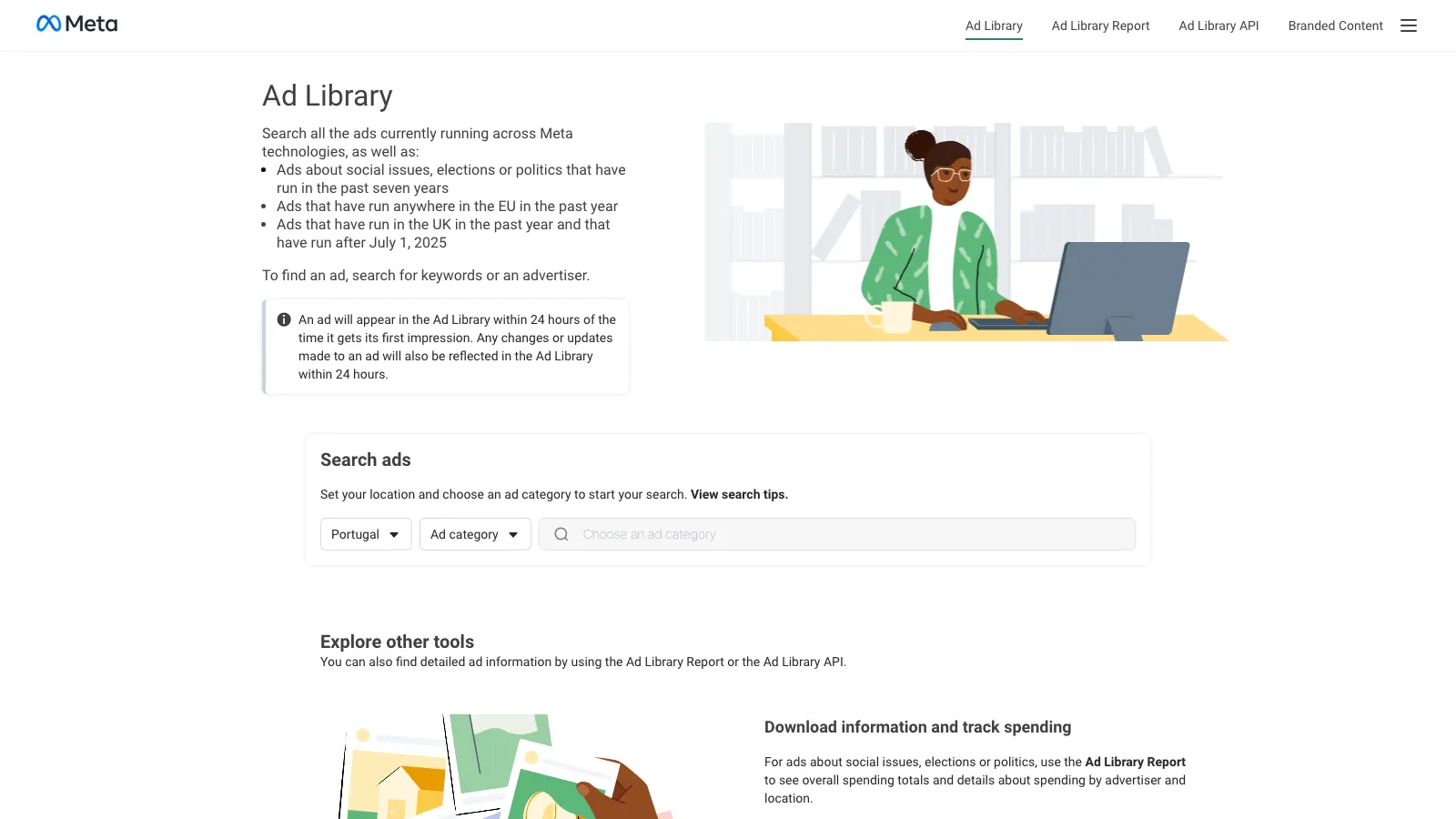
Meta Ad Library answers the initial question of what creative is live when a competing advertiser launches a campaign. Meta Ad Library answers that question from Meta's own public surface: set a location, choose an ad category, then search an advertiser or keyword. That makes it a sensible starting point inside the marketing tools directory for someone checking live paid social rather than guessing from a secondary database.
The important qualification is history. Meta keeps social-issue, election, and political ads for seven years, ads delivered in the European Union for one year, and UK ads that ran after July 1, 2025 for one year. An ad appears within 24 hours of its first impression, and later changes or updates appear within 24 hours of the change. Do not read the name "library" as a promise of a permanent worldwide record for every finished commercial campaign.
I would treat the core search as a verification layer. Meta also offers a Report, an API, and branded-content search. Each has a published scope, which helps when transparency is the job and gives a team clear boundaries to assess for its own workflow.
Who should rely on Meta Ad Library for competitor intelligence?
Paid-social strategists
Check active competitor creative by advertiser or keyword before drawing campaign conclusions.
Political-ad researchers
Use seven-year records and downloadable reporting for regulated advertising transparency work.
Compliance teams
Inspect stated spend ranges, reach data, and disclosed advertiser information where available.
Partnership teams
Find paid-partnership content across Facebook and Instagram, filtered by app and date.
It is strongest when the question fits a published search, retention, or transparency scope. Before choosing another system, verify that its history, collaboration, and reporting capabilities match the requirements of your team.
Which search filters and reporting tools does Meta Ad Library offer?
Active advertiser and keyword search
The primary search covers ads currently running across Meta technologies. You choose a location and category, then search by advertiser or keyword. That is enough to ground a creative review in current visible work. It is not a shortcut to every commercial campaign that has ever stopped running, so build your conclusion around the time period the public result actually represents.
Transparency history with distinct retention windows
Political, election, and social-issue ads have the broadest stated history: seven years. Meta separately lists one year for ads delivered in the EU, and one year for UK ads delivered after July 1, 2025. The distinction matters most for retrospective work. A team examining a regulated campaign has published retention rules to work from, while an ordinary worldwide commercial audit should start with the live view.
Ad Library Report for political and issue advertising
The Ad Library Report lets people explore, filter, and download data for ads about social issues, elections, or politics. It shows overall spending totals and spending detail by advertiser and location. That gives a compliance, research, or public-affairs team a usable reporting route, but it should not be sold internally as a general spend-reporting product for ecommerce or lead-generation ads.
Scoped API access
The Ad Library API can search political, election, and issue ads delivered worldwide during the past seven years, and ads of any type delivered to the UK or EU during the past year. Available records carry a library ID, creative content, associated Page name and ID, delivery dates, and placements. Political and issue ads also carry spend and impression ranges plus demographic reach information. UK and EU records add estimated impressions and estimated targeting and reach demographic information, while EU records also add advertiser and payer information.
This is useful machine access when the question falls inside those published boundaries. It is not a quick export button for general creative research: authorization requires a Facebook account, identity and location confirmation, a Meta for Developers account, and an app.
Branded-content search
The adjacent branded-content search finds Facebook and Instagram posts, stories, videos, and reels involving a paid partnership, with filters for app and date. Use it when you are studying disclosed creator relationships rather than conventional ad delivery. That separation is valuable: partnership content and paid-ad creative can both inform a market review, but they answer different questions.
How does Meta Ad Library handle commercial pricing and developer access?
Checked 27 Nov 2026
| Commercial detail | Status in this review | What is confirmed |
|---|---|---|
| Pricing | Unverified | Search current ads by keyword or advertiser |
| Seats | Unverified | Report explores and downloads political and issue-ad data |
| Paid add-ons | Unverified | API has published political, issue, UK, and EU scopes |
| Billing model | Unverified | Branded-content search finds paid partnerships on Facebook and Instagram |
Meta public product pages, 27 Nov 2026.Meta Ad Library
Pricing, seats, paid add-ons, and a billing model are unverified. Do not calculate a team bill from that gap. Confirm commercial terms with Meta before making a budget decision.
- The Report is for exploring, filtering, and downloading political and issue-ad data
- The API requires identity, location, developer-account, and app setup
- Branded-content results can be filtered by app and date
Where does Meta Ad Library fall short for comprehensive ad intelligence?
Meta Ad Library conceals a key limitation behind its name, as rich historical records and demographic figures apply only to mandated transparency categories. The API's published scope is seven years for political and issue ads worldwide, then one year for ads of any type delivered to the UK or EU. That makes the API precise for compliance work, but not a universal archive for commercial creative research.
Access is another dividing line. The public search is a straightforward place to start, while the API asks for a Facebook account, identity and location confirmation, a developer account, and an app. If you are trying to answer a one-off creative question, those steps are disproportionate. If you are building a regulated-ad data workflow, they are an understandable gate.
Finally, the available spend, impression, and demographic fields are not a blanket promise for all ads. They attach to political and issue ads, with separate stated information for UK and EU records. Keep that scope in the brief, otherwise a transparency data point becomes an unsupported claim about ordinary commercial activity.
Which ad tracking platforms serve as Meta Ad Library alternatives?
 AI Peekaboo review is first to consider when the job is tracking brand visibility in ChatGPT and other AI answers. Plans start at $30 a month and include API and MCP access, checked 27 Nov 2026, while Meta Ad Library remains the first-party place to inspect active Meta creative.
Metistic review fits a narrower ChatGPT advertising brief: its $79 monthly Starter plan, checked 27 Nov 2026, tracks 50 commercial prompts in one market with history, competitor product prices, alerts, and CSV exports. It measures observed placements, rather than serving as a live Meta ad search.
 Minea review is the better match when ad discovery needs to connect to ecommerce product, shop, and supplier research. Minea lists spend signals and estimated budgets, so use them to prioritize what to investigate and validate campaign performance independently.
What is the overall verdict on using Meta Ad Library?
For a first-party view of an advertiser's live Meta creative, Meta Ad Library earns the first search. It gives you a grounded starting point, plus defined transparency routes for political, issue, UK, EU, and branded-content work. Choose any additional system after verifying that its scope meets your own history, collaboration, and reporting requirements.
Search the advertiser and the few keywords that define the offer, then assess whether Meta's published scope and retention windows meet the requirements of the investigation.
How was this Meta Ad Library research compiled and checked?
Meta Ad Library documentation, API parameters, reporting tools, and branded content specifications were checked on 27 Nov 2026. The review uses the public scope, retention windows, and access steps Meta states, and follows how we check figures.
- Meta Ad Library search and transparency information
- Meta Ad Library API scope, fields, and authorization steps
- Meta Ad Library Report and branded-content search pages
What are frequently asked questions regarding Meta Ad Library?
Can I search an advertiser's active Meta ads?
Yes. Meta says you can search ads currently running across its technologies by keyword or advertiser after setting a location and ad category.
How long does Meta Ad Library keep ads?
Meta lists seven years for social-issue, election, and political ads, one year for ads delivered in the EU, and one year for UK ads delivered after July 1, 2025.
What can the Meta Ad Library API return?
Available records include a library ID, creative content, Page name and ID, delivery dates, and placements. Political and issue ads also have stated spend and impression ranges plus demographic reach information.
Does Meta Ad Library have a published team price?
Pricing, seats, and paid add-ons are unverified. Confirm Meta's commercial terms before budgeting for a team.
 Reviewed byDanny Kirk
Founder of ReddiReach.
 Checked byAndrés Felipe
Digital designer and marketer.
Every figure is checked against the vendor's own page. Read our editorial standards.