
Key Takeaways
- Technical SEO agencies rely on Nozzle to capture deep five-page SERP data across Google search results instead of simple top-ten rank positions.
- Custom quote calculators on Nozzle price monthly volumes around specific needs, such as 73,333 SERPs costing $315 monthly on annual Pro plans.
- Subscribers across all Nozzle plans receive complete REST API access and direct BigQuery data warehousing exports for scalable keyword warehousing.
- Search teams should pass on Nozzle if their marketing campaigns require dedicated tracking for generative AI platforms like ChatGPT, Gemini, or Perplexity.
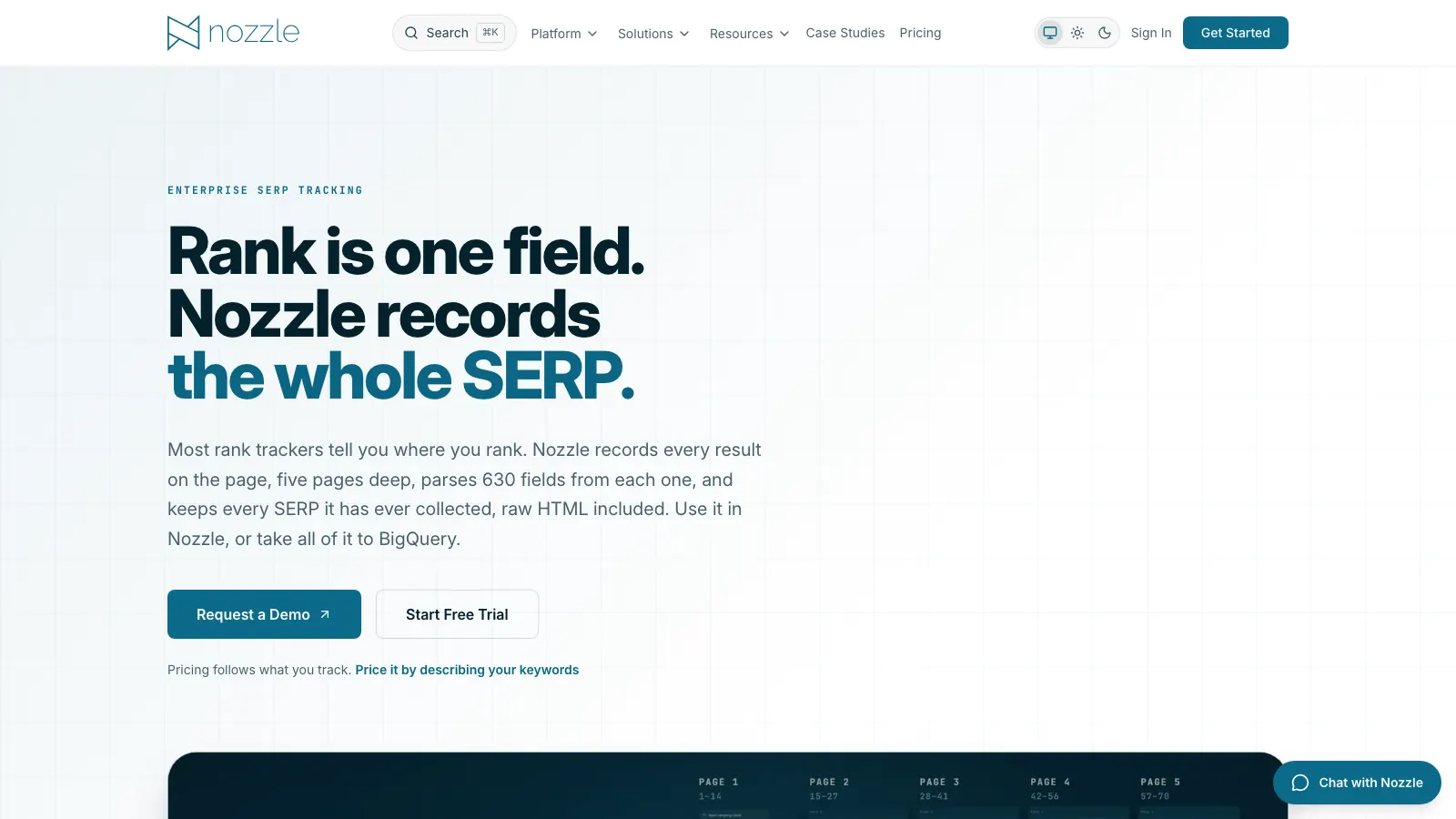
Nozzle is the right call when you need the shape of a Google results page, not just your rank, and it suits technical SEO teams that can put five-page SERP data to work. Its collection records about 50 to 60 results across five pages for every keyword, which is more than a daily top-10 report needs: the Pro Rank Tracker review is a more relevant comparison for that narrower job.
Agent access
- API
- Yes, every plan
- MCP server
- Not found on official pages
What are the core advantages and drawbacks of Nozzle?
What works
- Five pages of results, about 50 to 60 entries, with 630 fields per result
- Schedules per keyword group, from hourly to yearly, with custom time windows
- API, BigQuery export, users and competitors included on every plan
What to watch
- Costs are driven by every location, device and refresh in the collection plan
- ChatGPT, Gemini and Perplexity tracking are on the roadmap, not live
- Overage is billed after the collection volume passes the monthly allowance
How does Nozzle collect and analyze deep Google SERP data?
Nozzle gathers a much broader slice of a Google results page than a rank tracker that simply reports where your domain landed. One collection covers the top five pages, roughly 50 to 60 results, and parses 630 fields from each result. That gives a search lead room to inspect features such as AI Overviews and product packs alongside their own result and their competitors.
The product's pricing makes the tradeoff unusually explicit. You pay for SERPs collected, while the number of keyword groups is unlimited. A keyword checked on two devices, across several locations and on a fast schedule creates more volume than the same keyword checked weekly. That is useful when a large list has a small, business-critical core, because you can assign different schedules to different groups rather than treating every term alike.
Nozzle also makes the collected data available through its API and BigQuery export without a separate access fee. That matters if your reporting ends in a warehouse or a custom client dashboard. A conventional tracking workflow may be enough for many teams, which is why the Ranktracker review is worth reading before you pay for this level of collection.
Who gets the most value from Nozzle five-page SERP tracking?
Technical SEO teams
Use it when a position alone cannot explain what changed in a search result or which feature crowded it out.
Data-led agencies
API and BigQuery access fit agencies that deliver their own dashboards rather than relying on a fixed report format.
Multi-market programs
Per-group schedules let you separate priority locations and devices from terms that only need a slower check.
Competitive search teams
Every competitor already appearing in a collected SERP can be tracked without an added competitor charge.
Nozzle is harder to justify when the decision is simply whether a few priority keywords are in the top 10. Its useful unit is a complete SERP collection, not a stripped-back rank report. Teams focused chiefly on how brands appear in AI answers should compare it with the AI Peekaboo review, which is purpose-built for AI visibility monitoring.
What competitive search metrics and scheduling features does Nozzle provide?
Five-page SERP data
Each SERP retrieves the top five pages of results, around 50 to 60 results, with 630 fields parsed from each. Nozzle identifies SERP features and records data for them, including AI Overviews and product packs. The practical gain is context: a movement can be examined alongside the page composition that surrounded it.
Scheduling by keyword group
You can give each keyword set its own cadence. The published presets cover hourly, every 6, 8 or 12 hours, then daily, weekly, monthly and yearly schedules. Custom schedules can use a time window, with an official example of every 30 minutes between 9 a.m. and 9 p.m. Event windows can also apply an hourly schedule between set dates.
Competitive analysis
Nozzle records competitors that appear in the SERPs it collects. Its comparison views can show share of voice, estimated traffic, and who holds the most top-three or top-ten rankings, broken down by keyword group and SERP feature. That is more useful than choosing a handful of rivals in advance when the real competitors shift query by query.
API and data delivery
All plans include full API access and BigQuery export. The platform also documents programmatic authentication for pulling ranking data. Custom plans are available if your delivery needs include S3, Snowflake or your own schema, so confirm the delivery design before committing to an unusual setup.
Google AI Overview tracking
Nozzle tracks Google AI Overviews on the keywords it collects and records the sources cited in them. It does not yet track answer engines across ChatGPT, Gemini or Perplexity: Nozzle says that coverage is on its roadmap. Treat that boundary seriously if your visibility work spans more than Google's results page.
How does Nozzle calculate custom pricing for SERP tracking volume?
Price checked 27 Nov 2026
Nozzle does not publish a flat monthly price for each plan in text. Its calculator quotes a monthly price for the collection volume you enter. The table shows what the same 73,333-SERP monthly example costs on an annual term, including overage where needed, rather than a plan's standalone price.
| Annual-term plan | SERP allowance | Cost of the 73,333-SERP example |
|---|---|---|
| Basic | 10K | $421/mo |
| Advanced | 21K | $395/mo |
| Pro | 60K | $315/mo |
| Pro Plus | 130K | $499/mo |
| Business Basic | 275K | $999/mo |
| Business Advanced | 725K | $2,499/mo |
| Business Pro | 1.5M | $4,999/mo |
Calculator examples in US dollars, checked 27 Nov 2026.Nozzle pricing
The calculator quotes $315 a month on Pro for 73,333 SERPs on an annual term, or $365 a month month to month. That example runs 13.3K SERPs above Pro's 60K allowance, billed at $4.98 per 1K SERPs, about $66 a month. For that example volume, annual billing is $3,780 across 12 months versus $4,380 month to month, a $600 difference. Every plan lists full SERP monitoring, API access, BigQuery export, unlimited users, unlimited projects and unlimited competitors. The variable is collection volume.
For a real team bill, the user count does not change the total. Nozzle's 49,500-SERP example is $249 a month on Pro annually, while its 73,333-SERP example is $315 a month on Pro annually. Plans can be changed or canceled for the next billing period, and Nozzle says excess SERPs are billed in arrears at the plan's overage rate rather than stopped or throttled.
- A 14-day free trial includes full access to every feature and data field, with no credit card
- The calculator turns keywords, locations, devices and refresh frequency into the required collection volume
- Custom plans cover volumes or data delivery needs outside the standard packages
How does Nozzle scale data feeds for enterprise SERP tracking?
Nozzle Business tiers offer high-capacity data collection ranging between 275,000 and 1,500,000 monthly SERP checks. Those plans do not change the stated feature set. They add collection capacity, which is the relevant measure when you monitor many locations, devices or high-frequency keyword groups. Nozzle's 600,000-SERP example is $2,416 a month on Business Basic annually. A custom plan is the sensible conversation when the collection total or delivery requirement does not fit those published packages.
Where does Nozzle fall short in tracking generative AI answers?
Nozzle monitors Google AI Overviews and their cited sources, but it lacks direct tracking capabilities for standalone AI answer engines. ChatGPT, Gemini and Perplexity are all named as roadmap coverage. If those systems are part of your report, choose a dedicated platform or run it alongside Nozzle rather than assuming the SERP data fills that gap.
The price model rewards careful scheduling but asks you to forecast it. A change in locations, devices or refresh rate changes the number of SERPs consumed. Use the calculator with your actual groups before you compare proposals, and ask for the overage rate attached to the plan it recommends.
The sub-hourly examples are custom schedules. Confirm the cadence you need with Nozzle before building alerting on it.
What are the best alternatives to Nozzle for search tracking?
 Nozzle alternatives like AI Peekaboo cater directly to brands needing to track entity presence across generative AI responses. Plans start at $30 a month and include API, MCP and Looker Studio, while Nozzle's AI coverage is confined to Google AI Overviews for now.
 Pro Rank Tracker's Starter plan is $99 a month for 1,000 terms and daily Top-100 Google rankings. It is a better place to start if daily SEO and AI rank tracking with white-label reporting is the agency requirement, rather than a five-page SERP data pipeline.
 Ranktracker is an all-in-one SEO platform with rank tracking, competitor analysis, backlink monitoring and an AI article writer. Its monthly plans run from Launch at $39 to Authority at $299, giving you a lower-cost reference point before you pay for Nozzle's deeper collection model. Browse the marketing tools directory if the job spans other parts of the search stack.
What is the overall verdict on Nozzle for technical search teams?
Nozzle justifies its quote when search teams require full SERP landscape data and competitive context rather than single rank positions. changes matter. The API and BigQuery inclusion reinforce that technical focus.
It is not a replacement for AI answer-engine tracking, and it is more collection than a small site needs. Compare the actual device, location and cadence mix in the calculator before you decide. That calculation, not a headline plan price, is the number that determines whether Nozzle fits.
Choose Nozzle when your reporting or data team will use five-page SERP records, competitor data and the API. Start with the 14-day trial, model your real collection volume, and keep a separate AI-visibility tool if ChatGPT, Gemini or Perplexity matter.
How were Nozzle features and data pipelines audited?
Nozzle pricing calculators, SERP scheduling mechanisms, AI Overview monitors, and BigQuery export options were evaluated on 27 Nov 2026. Prices are shown in US dollars as Nozzle displayed them, and our method follows how we check figures.
- Nozzle pricing and monthly-pricing pages
- Nozzle platform, SERP-data, flexible-scheduling and competitive-analysis pages
- Nozzle AI Overviews and API documentation pages
What are common questions about configuring Nozzle SERP scans?
Does Nozzle track Google AI Overviews?
Yes. Nozzle records AI Overviews on the SERPs it collects, including cited sources. Tracking across ChatGPT, Gemini and Perplexity is on its roadmap, not available now.
How does Nozzle charge for rank tracking?
It charges by monthly SERP volume, and the calculator quotes a price for the volume you enter rather than listing a flat plan price. Keywords, locations, devices and refresh frequency determine how many SERPs you collect. Allowances run from Basic at 10K SERPs to Business Pro at 1.5M SERPs, with custom plans available.
Can Nozzle check rankings more than once a day?
Yes. Published presets include hourly, every 6, 8 or 12 hours, as well as daily through yearly. Its custom scheduling example checks every 30 minutes within a time window.
Is Nozzle's API included?
Yes. Full API access and BigQuery export are listed on every plan, with no separate API charge.
 Reviewed byDanny Kirk
Founder of ReddiReach.
 Checked byAndrés Felipe
Digital designer and marketer.
Every figure is checked against the vendor's own page. Read our editorial standards.