
Key Takeaways
- OmniBound connects generative engine prompt tracking, citation gap identification, and end-to-end content production workflows into a cohesive system for enterprise marketing teams.
- OmniBound operates without published price lists or self-serve signup options, requiring prospective enterprise customers to schedule a product demonstration.
- OmniBound offers a Model Context Protocol server that integrates with Claude, ChatGPT, Cursor, OpenAI Codex, and Claude Code environments.
- OmniBound lacks public REST API endpoints and transparent pricing tiers, creating operational friction for engineering teams needing open developer interfaces.
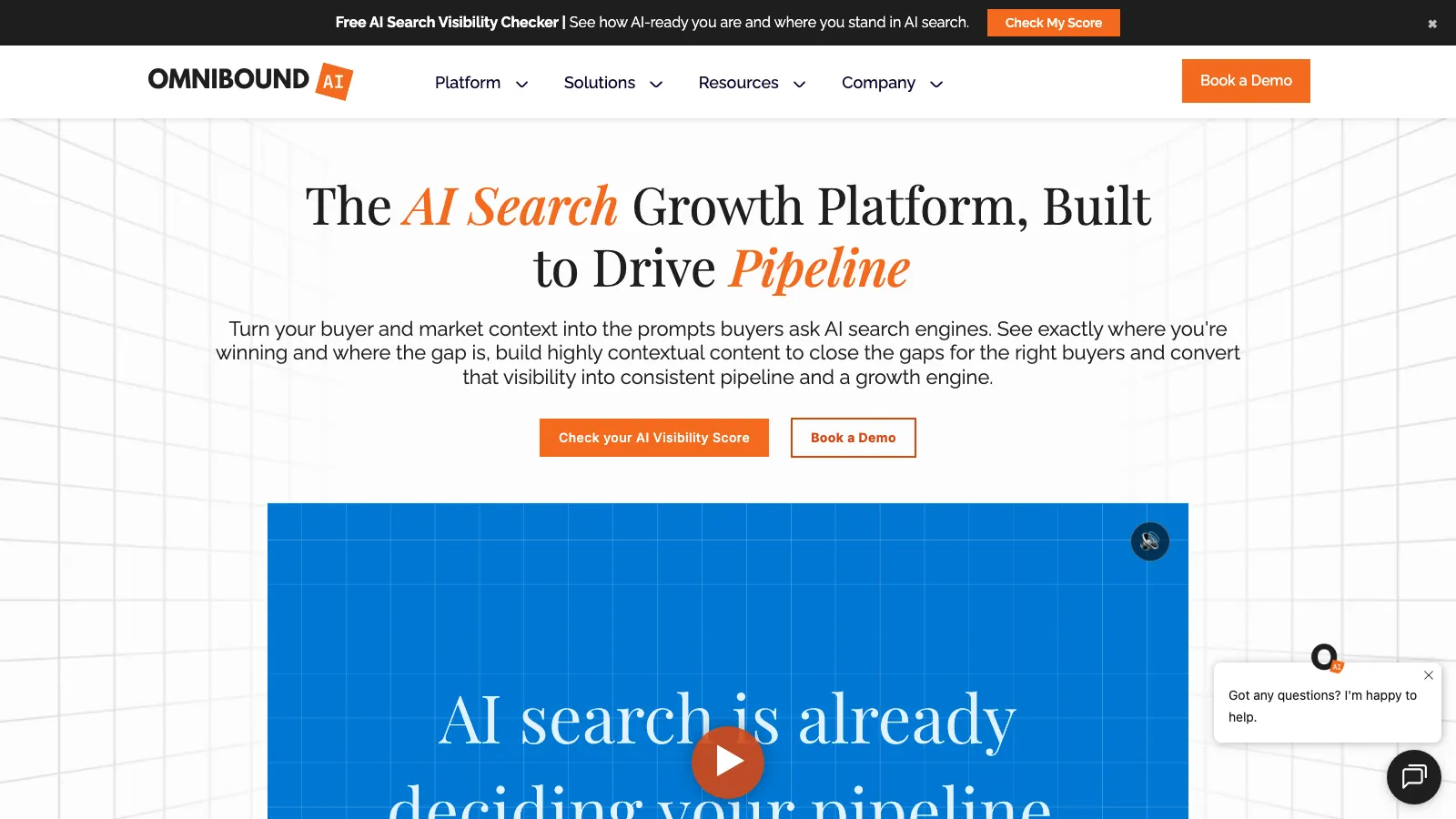
When you need to turn buyer questions and citation gaps into content work, OmniBound is the better fit for a B2B marketing team than an AI visibility dashboard alone. Pass if a published price, a self-serve start or a public REST API is essential: OmniBound asks you to book a demo and documents MCP instead.
Agent access
- API
- Yes
- MCP server
- Official, Sign in with an Omnibound account
- Works with
 Claude
 ChatGPT
 CursorClaude Code
- Automation
- Zapier
What are the primary advantages and disadvantages of OmniBound?
What works
- Tracks buyer prompts across five documented AI engines
- Turns citation gaps into content opportunities and workflows
- MCP supports both querying data and taking documented actions
What to watch
- No public price, plan grid or self-serve product trial
- OmniBound does not publish separate public REST API documentation; confirm requirements before building an integration
- Detailed limits, seats and add-ons are not published
How does OmniBound turn generative search citations into content production?
OmniBound proves valuable when teams need to determine which specific buyer queries in generative search require targeted content responses. It tracks AI-search visibility and citations for prompts across ChatGPT, Perplexity, Gemini, Claude and Google AI Mode, then maps those prompts to ICP, persona and intent. That makes it a more hands-on choice than a dashboard-only entry in the marketing tools directory.
The platform starts with buyer and market context. OmniBound says it can bring together signals from CRM activity, calls, support, competitor activity and other sources, then use that context to generate prompts or let your team add strategic prompts itself. You can see which pages are cited, which prompts cause those citations and where competitors appear instead.
I think the value lives in the handoff from that finding to work. A team with an established content program can use the gaps to decide what to refresh, what to create and what to prioritize. A team looking only for a low-cost mention monitor will find the demo-first model and wider workflow more than it needs.
Which marketing and revenue organizations get the most value from OmniBound?
B2B marketing leaders
Connect buyer questions, citations and pipeline signals across the full marketing program.
Content strategy teams
Prioritize refreshes and new content around buyer intent and citation gaps.
Demand generation teams
Relate AI-search visibility to leads, customer context, and pipeline conversations across your program.
Teams using AI assistants
Bring prompt, citation, and competitor intelligence into supported MCP clients and take action.
It fits best when content, demand generation and the people who own customer context can work from the same program. If no one owns the follow-through after a citation gap appears, OmniBound's main advantage becomes a very elaborate report.
Which buyer-prompt tracking and content tools are built into OmniBound?
AI Search Intelligence
OmniBound has two paths to a prompt layer. It can generate prompts from buyer conversations, CRM data, competitor content and market signals, or your team can add prompts directly. For every tracked prompt, it shows citation visibility by engine and can surface competitors cited where your brand is absent. Its opportunity view also calls out declining citation strength, growing category topics and inconsistent presence.
Marketing Context Engine
The context layer is OmniBound's most distinctive bet. The vendor describes a continuously updated layer built from customer and market signals, including calls, CRM notes, support feedback, competitor changes and industry material. Human-in-the-loop verification and traceable, source-linked insights are part of that description. I would judge this feature by how cleanly your own data can be connected and governed, since its usefulness depends on the context you supply.
Content audit and refresh
Content Audit evaluates a piece of content across ten dimensions, including ICP fit, buyer language, brand voice, competitor signals, AEO and SEO alignment. The Content Refresh Grid extends that to a site view, identifying pages that are strong, declining or invisible and prioritizing updates by buyer intent and pipeline relevance. That is a better answer for a team with a back catalog than starting every AI-search initiative with net-new posts.
Content Workflows
Content Workflows begins with one brief and lets the team define how outputs flow from one asset to another. It can generate content in sequence or in parallel while carrying buyer intelligence, AI-search signals and brand messaging forward. The pitch is consistency across assets and buying stages, not an isolated first draft. That distinction matters if you need a content system that supports social and email as well as the core page.
AI Authority Building and measurement
OmniBound also identifies third-party pages it says AI engines cite in a category and presents them as outreach targets. Its measurement layer connects sentiment and citation data to Google Analytics, CRM and marketing automation, with the aim of relating prompts, pages and citations to inbound leads and pipeline. Treat those as operational features to assess in a demo, not as a promise that a citation caused a deal.
MCP for AI agents
OmniBound MCP connects buyer context, competitor intelligence and AI-search performance to Claude, ChatGPT, Cursor, Codex and Claude Code. Inside a conversation, the documented actions include pulling a visibility report, drafting from a content gap, updating a tracked prompt, approving a draft and logging a decision back to OmniBound. The public materials do not document a separate general REST API, so MCP is the machine interface to evaluate.
What is the commercial pricing structure for OmniBound?
Checked 27 Nov 2026
| What is published | Public answer |
|---|---|
| Price | Request a demo |
| Plan grid | ✕ Not published |
| Self-serve product trial | ✕ Not advertised |
| Seats and limits | Not published |
| MCP | ✓ Documented |
| Public REST API | Not documented |
OmniBound public site, 27 Nov 2026.OmniBound website
There is no honest team bill to calculate from the public site. OmniBound's pricing route returned a 404 page, while the main site directs prospective customers to book a demo. That means you cannot compare seats, usage allowances, implementation charges or add-ons until the company provides a quote.
- Ask for the price, contract length and any setup or implementation cost
- Confirm the number of users, prompts, engines and connected data sources included
- Confirm whether MCP, content workflows and reporting carry separate limits or charges
What commercial and technical limitations should prospective OmniBound buyers consider?
OmniBound presents an undisclosed commercial pricing structure as its primary limitation. A demo can tell you whether the product fits, but it cannot make the cost comparable before you have a conversation. That is reasonable for a complex B2B implementation, but it is a real barrier for a team with a fixed monthly budget or an urgent reporting need.
The public details also stop before the operational limits most buyers need: seats, prompt volume, connected sources, export rules and implementation scope are not stated. The same restraint applies to integrations. The site describes connections to Google Analytics, CRM and marketing automation, but it does not publish a general REST API. Build an agent workflow around the documented MCP server, not an assumed API.
Finally, this is not a content replacement machine. It can create and audit content in a workflow, but the underlying strategy still needs clean buyer context, editorial judgment and people who can approve the output. Without those, it risks turning a useful intelligence layer into another queue of tasks.
What alternative tools offer public pricing comparable to OmniBound?
 AI Peekaboo review is the first stop if published, usage-based pricing and a REST API matter more than a content operating system. Its plans start at $30 per month on monthly billing, or $26 per month billed annually, checked 27 Nov 2026, and include API and MCP access, while OmniBound publishes neither a price nor a separate REST API.
 Read the PathFactory review when personalized content experiences and first-party engagement signals for revenue teams are the priority. PathFactory also uses a demo-led commercial model, but focuses its public product story on content engagement and CRM or marketing-automation integrations.
 The Rankdots review is the contrast for a team that wants public, self-serve content-planning software. Rankdots publishes four paid plans from €49 per month on monthly billing, or €29 per month billed annually, checked 27 Nov 2026, and a 14-day free trial, though it does not list an API.
Does OmniBound justify the sales demo requirement for marketing teams?
OmniBound earns a serious look when your B2B team needs AI visibility work to become a content and pipeline program, not a weekly screenshot. Buyer-prompt tracking across five documented engines, content audits and an action-oriented MCP server give it a more complete operating model than a pure tracker.
The trade-off is a commercial and technical unknown. You have to request a demo before you see a rate, and MCP is the documented integration path rather than a public REST API. That makes OmniBound strongest for a funded team ready to connect its customer context and act on the findings.
Start the conversation when you can define the buyer questions, data sources and content owners you want to connect. Ask for written pricing, limits and implementation scope, then test whether the MCP workflow makes the next action clearer than your current process.
How were OmniBound features and protocol integrations examined?
OmniBound capability and commercial details come from its own product, MCP, content audit, workflow and public pricing-route pages, checked on 27 Nov 2026. Alternative details are checked against the respective vendors' own pages. OmniBound does not publish a rate card, and every figure follows how we check figures.
- OmniBound home and AI Search Intelligence pages
- Marketing Context, Content Audit and Content Workflow pages
- OmniBound MCP page and its public pricing route
What are the common queries regarding OmniBound deployment?
Which AI engines does OmniBound track?
OmniBound documents tracking for ChatGPT, Perplexity, Gemini, Claude and Google AI Mode, with citation visibility for each prompt and engine.
Does OmniBound publish prices?
No public rate card or plan grid was available on 27 Nov 2026. The site asks prospective customers to book a demo, and its public pricing route returned a 404 page.
Does OmniBound have an API?
Its public materials document an MCP server for Claude, ChatGPT, Cursor, Codex and Claude Code. They do not document a separate general REST API.
What can OmniBound MCP do?
It can pull visibility information and support actions including drafting from a content gap, updating a tracked prompt, approving a draft and logging a decision back into OmniBound.
 Reviewed byDanny Kirk
Founder of ReddiReach.
 Checked byAndrés Felipe
Digital designer and marketer.
Every figure is checked against the vendor's own page. Read our editorial standards.