
Key Takeaways
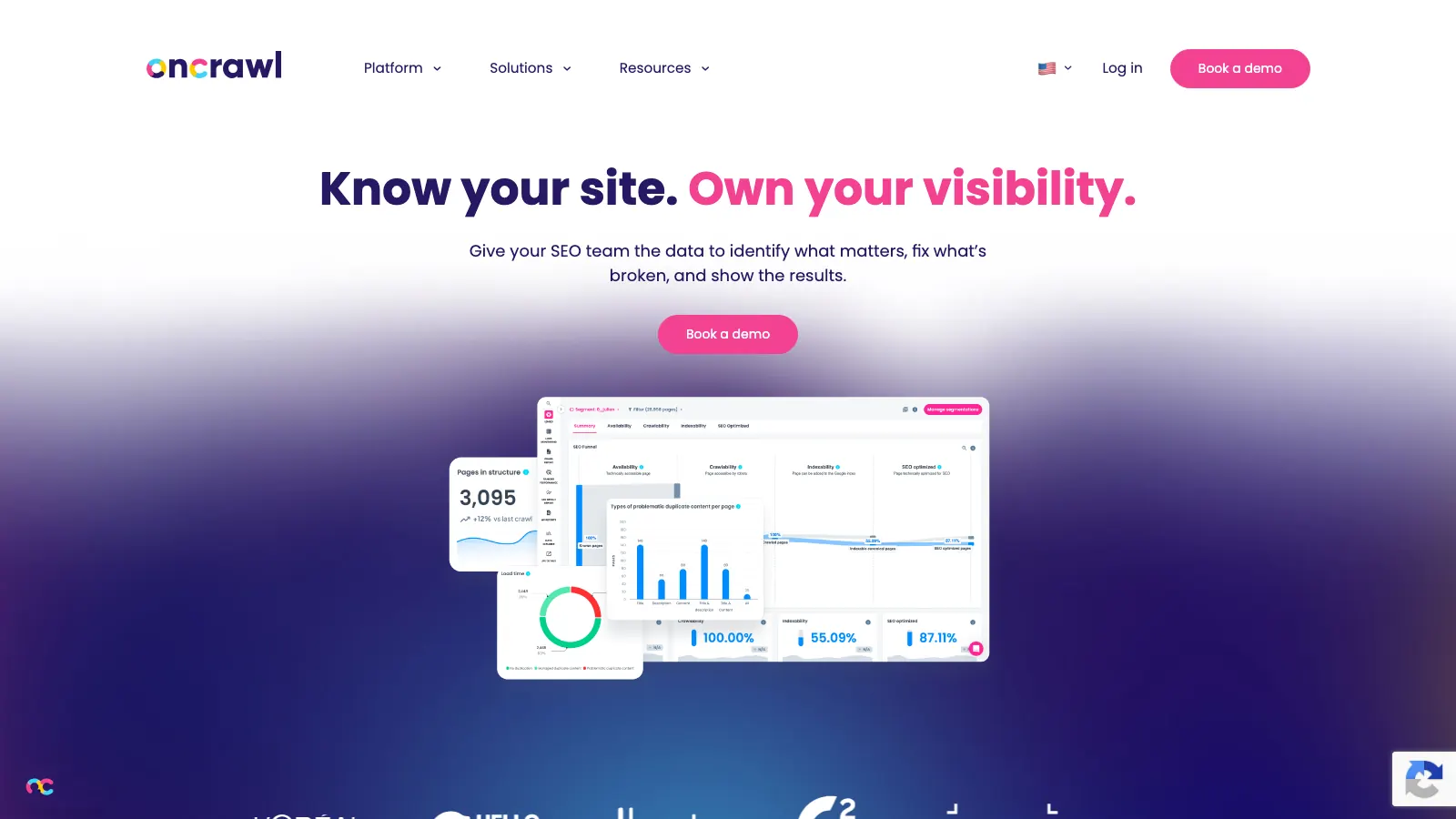
- Oncrawl delivers enterprise technical search engine optimization by pairing large-scale web crawling with server log analysis to evaluate real crawler visits.
- Oncrawl requires custom enterprise sales contracts, offering no self-serve trials, predictable public price points, or published add-on rates.
- Oncrawl provides a Model Context Protocol server and programmatic APIs that allow autonomous clients to query crawl histories and raw server logs.
- Oncrawl demands significant technical infrastructure and data pipeline setup, making it poorly suited for smaller websites seeking lightweight website crawlers.
Oncrawl is the best fit when your technical SEO team needs to join a large crawl with the server logs that show what bots actually did. It is built for complex sites, and its AI bot monitoring, API and MCP server make it a strong choice for teams with an existing data stack. Skip it if you need a published price or a small self-serve crawler.
Agent access
- API
- Yes, A subscription that includes the Oncrawl API option
- MCP server
- Official, hosted, OAuth or API token in headers
- Works with
 Claude
 ChatGPT
 Cursor
What are the core technical advantages and disadvantages of Oncrawl?
What works
- Crawl and server-log analysis in the same platform
- AI bot activity for OpenAI, Perplexity, Claude, Gemini and Mistral
- REST API, exports and an MCP server for connected workflows
What to watch
- No public price, plan limits or seat cost
- API tokens require a subscription with the API option
- Its depth can be excessive for a small, simple site
How does Oncrawl combine web crawling with server log intelligence?
Among the products in the marketing tools directory, Oncrawl stands apart when the question is what search engines and AI systems have actually visited, and whether that behavior matches the architecture you built. It pairs a JavaScript-rendered crawl with server logs, then adds analytics, Search Console and other connected signals. That gives a technical team a way to trace a problem from a page group to bot behavior instead of treating the crawl as a static checklist.
The practical value is scale and context. Oncrawl says it can crawl millions of URLs without artificial limits on speed, depth or site size, while its Log Analyzer processes the raw activity recorded by your server. It can also run multiple projects, configurations and schedules. For an enterprise site with sections, subdomains and frequent releases, that is a better operating model than exporting a desktop crawl whenever a regression appears.
Its connectors bring in Google Search Console, GA4, Majestic and custom datasets, and the product is designed to export data or trigger crawls from other workflows.
Which enterprise technical teams derive the highest value from Oncrawl?
Enterprise SEO teams
Analyze large sites, recurring crawls and bot behavior across complex architecture.
Teams with log access
Use server logs to see how search engines and AI bots explore the pages you publish.
Data-led agencies
Connect projects and exports to the reporting and analysis workflow you already use.
AI search practitioners
Track AI user-bot activity and investigate the path from indexation to citation and traffic.
It is not the natural first tool for a solo marketer with one modest site. The product assumes that crawl configurations, log infrastructure and data access are part of the job. Since the commercial terms appear only through a demo, it also asks you to start a sales conversation before you can judge the true team cost.
What crawl rendering and server log monitoring features does Oncrawl include?
Crawler and technical monitoring
The crawler audits structure, content, performance and internal linking, with standard and custom metrics. JavaScript rendering lets it inspect the rendered content and Core Web Vitals. Teams can set the scope, frequency and notifications for each configuration, compare crawls over time, and alert on important changes. The useful distinction is not a longer issue list, but being able to monitor the technical factors that can change how search and answer engines evaluate the site.
Server-log analysis
Log Analyzer reads real server-log data to show how Googlebot, Bingbot, other crawlers, AI bots and users interact with the site. It surfaces crawl patterns and frequency, the technical factors that influence bot behavior, and the timing from publication to crawl and first organic visit. For a migration or an indexation problem, that evidence can settle whether a page is actually being discovered rather than merely present in a crawl.
AI Search Lens
Oncrawl identifies activity from OpenAI, Perplexity, Claude, Gemini and Mistral, and separates training bots from AI user bots. Its AI Search Lens tracks pages accessed by AI user bots for potential citation and maps an indexation, citation and traffic funnel. Cross-analysis can relate that activity to depth, load time, word count and structured data. Treat it as technical visibility intelligence, not a promise that a bot visit results in an answer citation.
Data connections and Lenses
The platform can ingest logs from Cloudflare, Google Cloud Platform, Amazon Web Services, Microsoft Azure or direct access-log files. It also connects Google Search Console, GA4 and Majestic, and accepts custom data such as revenue or conversions. Lenses package common analyses into focused paths, including content quality, accessibility, performance, Google Discover and Sanity Check, which continuously monitors your most business-critical pages. That makes Oncrawl less intimidating for stakeholders who need an answer rather than a raw dataset.
API and MCP for connected work
Oncrawl's REST API exposes the crawl, log and cross-analysis metrics available in Data Explorer. It can create or modify crawl profiles, run and schedule crawls, and query data through Oncrawl Query Language. The API option is subscription-dependent, so confirm it in the contract before planning an integration.
The MCP server makes projects, crawls, page details and log data available to an MCP-compatible AI client. Depending on permission, it can also launch crawls, manage projects and create exports. OAuth is supported, and token-based configuration requires the API option. Give an agent read permissions when analysis is all it needs, since write permissions can perform operations on the account.
How does Oncrawl price its enterprise crawl and log packages?
Price checked 27 Nov 2026
| Commercial detail | What Oncrawl publishes |
|---|---|
| Price | Custom quote after a demo |
| Plans | Not published |
| Seats | Not published |
| API option | Subscription-dependent |
| Looker Studio connector | Plan-dependent |
Oncrawl pricing and help pages, 27 Nov 2026.Oncrawl demo and contact page
Nothing Oncrawl publishes lets you price a team in advance. Oncrawl publishes no plan, seat or API prices; its route to a price is Book a demo. It also does not publish whether the API, MCP access or Looker Studio connector come with a base subscription. The Looker Studio help page says the connector must be included in the plan, while the API documentation says the same about the API option.
Before procurement, ask for a written quote that names crawl capacity, log volume, projects, user roles, API access, MCP access, connector access and any export quota. Only a written quote lets you set it beside a tool with a public price.
How does Oncrawl scale crawling and log ingestion for enterprise sites?
Oncrawl positions its enterprise offering around scale and collaboration: full-site crawling with JavaScript rendering and Core Web Vitals, hundreds of millions of log lines processed daily, recurring crawls across sites and subdomains, role-based access and project spaces. It also says the API can connect technical SEO data to deployment workflows. Those are sensible capabilities when technical SEO sits with developers, product and content teams, not just one analyst.
Security may matter in that buying process. Oncrawl lists ISO 27001 certification, SOC 2 Type I and Type II compliance, GDPR and CCPA compliance, EU data hosting and Data Protection Agreements. Validate the current terms and the scope of each control with the vendor during procurement.
What commercial and operational hurdles accompany choosing Oncrawl?
Oncrawl presents pricing opacity as its primary drawback for prospective buyers. A demo can be appropriate for a large site, but it prevents a buyer from comparing a three-person team, an agency workspace or a required integration before speaking to sales. Oncrawl publishes no rate, included seat count or API add-on cost.
The integrations also need careful reading. The platform can connect with an MCP client, but API-token authentication requires the API option, and the availability of some MCP functions depends on the client, plan and permissions. Likewise, an API key does not automatically give access to the Looker Studio connector. A technical team should make these items acceptance criteria, not assumptions.
Finally, log analysis is only powerful when the team can supply and interpret the logs. If you only need occasional crawl diagnostics, a simpler tool can be faster to adopt and easier to fund.
Which crawl and search monitoring alternatives compare with Oncrawl?
 Oncrawl alternatives like AI Peekaboo represent a strong choice when the immediate objective is AI response tracking rather than server-log analysis. Its published plans start at $30 a month and include the API, MCP access and Looker Studio, while Oncrawl's public material does not show a plan price. The AI Peekaboo review explains the published pricing model.
 RUMvision review is useful when you need real-user Core Web Vitals from every visitor rather than the 28-day Chrome-only CrUX window. Its Growth plan costs €150 a month.
 Ryte review covers its Website User Experience platform for SEO, performance and accessibility. Semrush acquired Ryte on 12 July 2024, and its pricing is by contact.
Is Oncrawl the premier enterprise solution for technical site audits?
Oncrawl earns its place when technical SEO decisions need to rest on both a full crawl and the server record of what bots did afterward. The combination of logs, large-site crawling, AI bot activity and programmatic access is more serious than a conventional audit tool. Its limits are commercial, not conceptual: you have to get the quote and confirm the add-ons before you can call it the right platform.
Book a demo only if your team can use log data and needs technical SEO at scale. Bring a list of required capacity, user roles, API and MCP permissions, then ask Oncrawl to price those terms in writing.
How were Oncrawl capabilities and platform tools evaluated?
Oncrawl feature sets and integration requirements were sourced from its official crawler, log analysis, AI search, API, and MCP documentation on 27 Nov 2026. No public price was available, so we describe the price as custom rather than inventing a monthly figure. Our approach follows how we check figures.
- Oncrawl crawler, Log Analyzer and AI Search Lens pages
- Oncrawl integrations, API and MCP documentation
- Oncrawl enterprise and Looker Studio connector documentation
What are the common technical questions regarding Oncrawl?
Does Oncrawl analyze server logs?
Yes. Log Analyzer uses server-log data to show how search engines, AI bots and users interact with the site.
Can Oncrawl track AI bot activity?
Yes. It identifies activity from OpenAI, Perplexity, Claude, Gemini and Mistral, and separates training bots from AI user bots.
Does Oncrawl have an API and MCP server?
Yes. Its REST API covers crawl, log and cross-analysis data, and its MCP server can query data and run permitted actions. API-token use requires the API option in the subscription.
How much does Oncrawl cost?
Oncrawl did not publish a public plan or price when checked on 27 Nov 2026. Buyers are directed to book a demo for a custom quote.
 Reviewed byDanny Kirk
Founder of ReddiReach.
 Checked byAndrés Felipe
Digital designer and marketer.
Every figure is checked against the vendor's own page. Read our editorial standards.