
Key Takeaways
- Plausible Analytics delivers streamlined, privacy-conscious web analytics without utilizing tracking cookies, harvesting personal data or necessitating EU consent banners.
- Plausible Analytics prices its Starter tier at €9 monthly for a single domain, moving to €14 for Growth covering three websites.
- Plausible Analytics reserves its read-only Stats API for Business plans starting at €19 monthly, supporting up to 600 hourly programmatic requests.
- Plausible Analytics excludes native Looker Studio integrations and multi-site support on entry plans, requiring immediate upgrades for broader reporting workflows.
When you need to answer a traffic question without a cookie or consent-banner project, Plausible Analytics keeps the reporting job unusually clear for your team. It is the stronger fit for privacy-first web analytics, but choose another route if machine-readable reporting is the job from day one, because the Stats API and Looker Studio connector begin on Business at €19 a month.
Agent access
- API
- Yes, Business for the Stats API; Enterprise for the Sites API
- MCP server
- Community, hosted or local, Plausible Stats API key sent as a Bearer token
- Works with
 ClaudeClaude Code
 Cursor
What are the primary pros and cons of Plausible Analytics?
What works
- No cookies or personal-data collection
- EU processing on European-owned infrastructure
- Open-source code with a self-hosting option
What to watch
- Public plan prices are shown in euros
- Stats API starts on Business
- Starter covers only one site
What web analytics data does Plausible Analytics deliver?
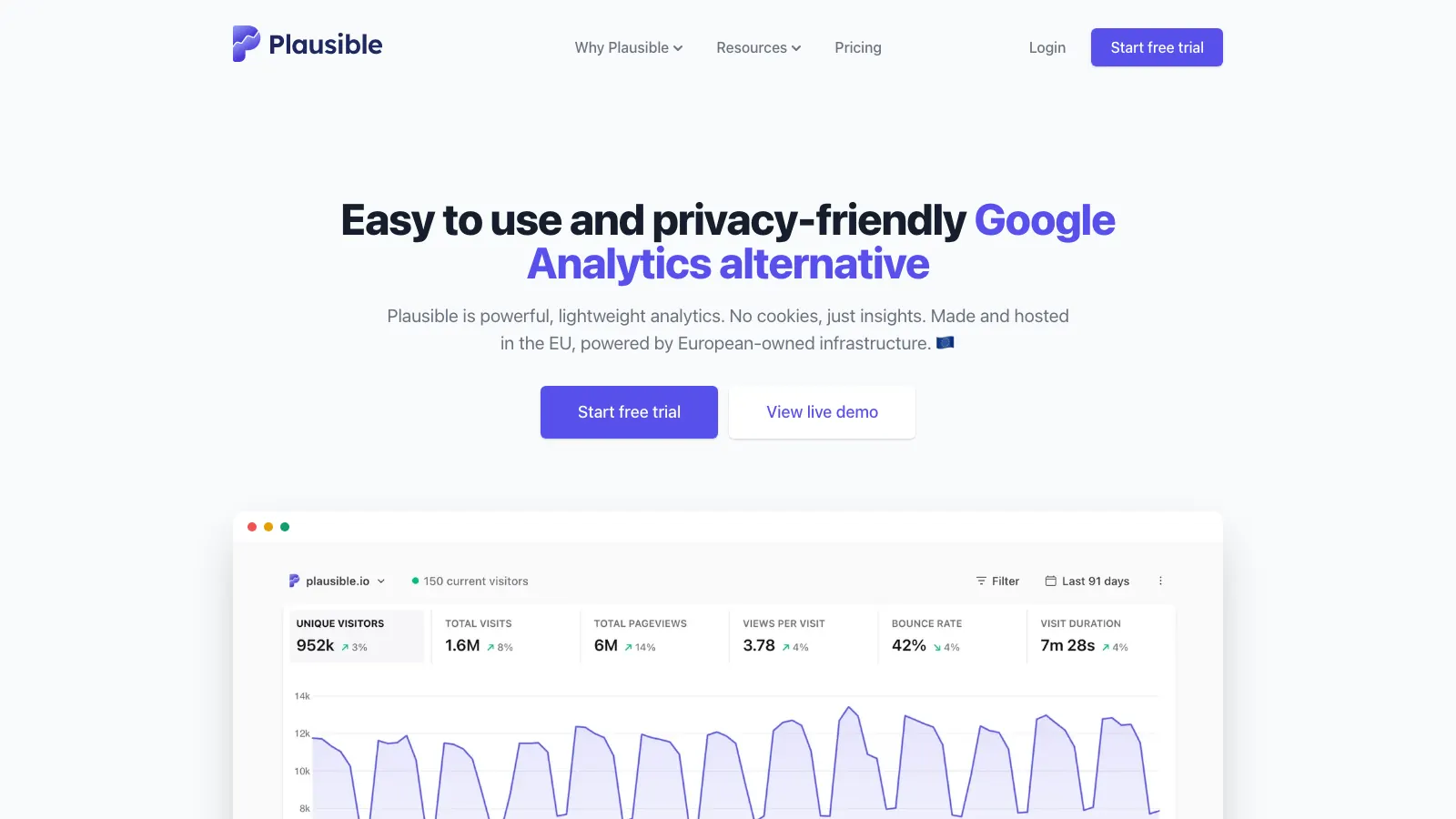
Plausible Analytics provides a clean alternative when Google Analytics 4 makes basic traffic reporting overly complex. Its dashboard puts the essential site metrics on one page, and it pairs that simplicity with a privacy model that collects no personal data and sets no cookies. For a reporting job that reaches beyond visitor traffic, the marketing tools directory is the better place to compare the wider options.
The practical appeal is not only compliance. Plausible says its script is 54 times smaller than Google Analytics, with 135KB less JavaScript transferred to each visitor. Its data stays on servers owned and run by European companies in the EU. That combination makes Plausible particularly convincing for teams that want a lighter site and a clearer explanation of what analytics does.
It is still a web-analytics product, not a broad reporting warehouse. You can pull AI-assistant referrals, Search Console data, goals and revenue signals into the dashboard. Once the work becomes blending those numbers with a wider reporting stack, use a broader reporting system rather than forcing every reporting question through one traffic dashboard.
Who should choose Plausible Analytics for website tracking?
Content and SEO teams
See traffic, Search Console queries, scroll depth and conversion goals without building custom reports.
Privacy-first organizations
Use analytics without cookies, personal-data collection or a separate analytics consent banner.
Agencies with client sites
Manage client sites together, share dashboards and move to Business for consolidated reporting.
Teams that self-host
Run the open-source code on your own infrastructure when hosted service is unsuitable.
I would not put Plausible in front of a team whose first requirement is programmatic data access. The Stats API is a Business feature, so its real entry point for that use case is €19 a month. The same plan is the one that adds funnels, user journeys, revenue tracking and a consolidated view.
Which cookieless reporting features does Plausible Analytics include?
Privacy-first traffic measurement
Plausible does not collect personal data, track individual users or set cookies. It has no persistent identifiers or cross-site tracking, and its compliance documentation says a DPA applies automatically for customers. That makes the decision simple for a team that wants site measurement without configuring a consent flow for the analytics script itself.
AI referral and Search Console reporting
Plausible shows traffic sent by AI tools including ChatGPT, Perplexity and Claude, then lets you see the pages those visitors reach and the conversions they complete. It also connects Search Console so search queries and organic performance sit beside site statistics. Those two views are useful together when you need to distinguish search-led attention from AI-assistant traffic.
Goals, events and revenue
Turn a page into a goal, and Plausible can automatically track file downloads, form completions and outbound-link clicks. It also supports custom events and revenue tracking. Funnels and user journeys are Business features, so the cheaper plans suit a team measuring clear outcomes rather than one mapping every step through a site.
Reports for a team or client
Starter includes email and Slack reports, while Growth adds shared links, embedded dashboards and team management. Agencies can keep sites under their own team, give a client its own team, or transfer a site when a project ends. Business adds the consolidated view, which combines the sites your team manages into one dashboard.
Stats API and white-label paths
The read-only Stats API returns historical and real-time metrics as JSON and has a default limit of 600 requests an hour. It is a Business feature, along with the Data Studio connector. Business also allows an embedded dashboard, while Enterprise is required for the Sites API, a managed proxy or more than 10 sites. That is a sensible split: embed or query reporting data at Business, then use Enterprise for automated customer-site provisioning, large scale, SSO, managed proxying or raw data exports when those requirements apply.
Open source and self-hosting
Plausible publishes its code under the AGPL and documents self-hosting. A self-hosted instance keeps the analytics data on your own servers. The hosted service remains the simpler choice for a marketing team, but the option matters when infrastructure ownership is part of the brief rather than a nice extra.
How does Plausible Analytics calculate its monthly subscription costs?
Price checked 27 Nov 2026
| Plan detail | Starter€9/mo | Growth€14/mo | Business€19/mo | EnterpriseCustom |
|---|---|---|---|---|
| Sites | 1 | Up to 3 | Up to 10 | 10+ |
| Team members | 1 | Up to 3 | Up to 10 | 10+ |
| Goals and custom events | ✓ | ✓ | ✓ | ✓ |
| Shared links and embeds | ✕ | ✓ | ✓ | ✓ |
| Stats API and Data Studio | ✕ | ✕ | ✓ | ✓ |
| Funnels and user journeys | ✕ | ✕ | ✓ | ✓ |
Plausible prices in euros, 27 Nov 2026.Plausible pricing
Every plan starts from the same pageview tiers, and the paid choice is about sites, people and reporting depth. Your tier is based on the total pageviews and billable custom events across every site in one team. Billable custom events include outbound clicks, file downloads, form submissions, 404 tracking and manually tracked events, while pageview goals do not count toward usage. A 30-day trial requires no credit card and includes Business plan features and limits. Annual billing shows two months free: €7.50 a month for Starter, €11.67 for Growth and €15.83 for Business at the 10k-pageview tier.
- Starter at €9 a month: one site, one member, email and Slack reports, and goals
- Growth at €14 a month: up to three sites and members, shared links and embedded dashboards
- Business at €19 a month: up to 10 sites and members, API, Data Studio, revenue, funnels and consolidated reporting
For a three-person team managing three sites, Growth is €14 a month when the combined pageviews and billable custom events across those sites stay in the 10k tier. For a team at that same aggregate usage tier that also needs the Stats API and Looker Studio, the comparable bill is Business at €19 a month. There is no per-seat add-on inside those published member limits.
What capabilities are available in Plausible Analytics Enterprise?
Plausible Analytics Enterprise provides custom configurations for high-volume data collection and embedded product reporting. Its available Enterprise-only features include SSO, the Sites API, a managed proxy and scheduled raw event exports; the quote can also raise pageview volume, site and team-member limits, and API rate limits. An Enterprise subscription does not automatically include the whole bundle, so ask for a quote that names the features and limits you require.
The white-label route is especially relevant for a SaaS platform or agency portal. Business can embed a dashboard or query the Stats API; Enterprise is needed when your backend must create sites for customers automatically, and it may also fit requirements for SSO, a managed proxy, raw data exports or larger limits. That distinction keeps a normal reporting setup on a public plan and reserves the quoted plan for the specific provisioning or scale requirements you need.
Where does Plausible Analytics restrict essential reporting features?
Plausible Analytics creates significant friction with its decision to wall off API access on lower tiers. Plausible's Stats API is read-only and begins on Business, so Starter and Growth cannot feed its analytics data into an agent or custom dashboard through that interface. If your reporting workflow starts with an API, do not price this as a €9 product.
Site count is the next constraint. Starter is one site and one member, while Growth tops out at three of each. That makes the visible entry price excellent for a single property, but a business with several sites or colleagues should plan from Growth rather than discover the limit after rollout.
Finally, Plausible's focus is deliberate. Its strongest offer is clear web analytics with less collection and less dashboard overhead. A team that needs site provisioning, managed proxying or scheduled raw-event exports moves to Enterprise, so ask for that scope in writing before treating the public plan prices as comparable.
What are the leading alternatives to Plausible Analytics?
 AI Peekaboo review is the useful first comparison when your report must answer how AI assistants mention a brand rather than how visitors reached a website. Its monthly starting price was $30 when checked 27 Nov 2026, and paid plans include MCP and API access plus Looker Studio reporting, whereas Plausible measures the traffic that arrives after a user clicks through.
For reporting that must share insights securely across Microsoft Teams, PowerPoint, SharePoint and other daily apps, read the Power BI review. For marketing measurement that needs multi-touch attribution, which Ruler lists on all four plans, read the  Ruler Analytics review. Plausible is the clearer choice when the priority remains a privacy-first web dashboard, AI referrals, Search Console and conversion goals in the same place.
What is the final verdict on Plausible Analytics?
Plausible Analytics excels when teams want clear website traffic insights without managing complex tracking consent banners. Its one-page reporting, EU processing and small script make that promise credible. Start at Growth if a team or several sites will use it, then move to Business only when API access, Data Studio, revenue reporting or funnels become necessary.
Run the 30-day trial against a real reporting month. Choose Growth for shared site reporting, or Business when the Stats API and Data Studio need to join the team's regular workflow.
How was this Plausible Analytics review verified?
Plausible Analytics documentation, compliance details and pricing were verified against vendor pages on 27 Nov 2026. Prices are in euros as Plausible shows them, and every figure follows how we check figures.
- Plausible pricing and annual pricing
- Plausible features, plan and Stats API documentation
- Plausible compliance, agency and white-label documentation
What are the most common questions regarding Plausible Analytics?
Does Plausible Analytics need a cookie banner?
No. Plausible says it sets no cookies, collects no personal data and needs no analytics consent banner. It can also run alongside a banner used for other tools.
How much does Plausible Analytics cost?
At the listed 10k-pageview tier, Starter is €9 a month, Growth €14 and Business €19. Enterprise is a custom quote. Annual billing shows two months free.
Does Plausible Analytics have an API?
Yes. Its Stats API is a read-only HTTP interface for historical and real-time statistics, returns JSON and is available on Business. The default limit is 600 requests an hour.
Can Plausible Analytics track AI traffic?
Yes. Plausible shows traffic from AI tools including ChatGPT, Perplexity and Claude, the pages those visitors reach and the conversions they complete.
 Reviewed byDanny Kirk
Founder of ReddiReach.
 Checked byAndrés Felipe
Digital designer and marketer.
Every figure is checked against the vendor's own page. Read our editorial standards.