
Key Takeaways
- PRWeb facilitates self-serve online press release syndication on a per-release basis without requiring recurring software platform subscriptions.
- PRWeb charges one hundred twenty dollars for Basic releases, scaling through Standard at $245, Advanced at $360, and Premium at $480.
- PRWeb publishes no public API endpoints or Model Context Protocol connectors, preventing autonomous AI agents from managing release distribution directly.
- PRWeb proves unsuitable for public relations teams seeking relationship-building media databases, proactive journalist outreach, or down-funnel revenue attribution analytics.
When a finished announcement needs a predictable route into online distribution, PRWeb lets you buy that distribution release by release, starting at $120. Skip it if your real job is building journalist relationships or proving revenue from coverage, because its public packages center on distribution and reporting views and engagements.
Agent access
- API
- Not found on official pages
- MCP server
- Not found on official pages
What are the main pros and cons of using PRWeb for syndication?
What works
- Four public packages, charged per release rather than monthly
- Keyword tagging by an editorial team on every public package
- PR Newswire syndication to 1,200+ websites from Standard
What to watch
- Journalist-list email distribution starts at $360 per release
- Published reporting names views and engagements, not attribution
- API and MCP access are not published on the public packages
How does PRWeb distribute press releases across digital media networks?
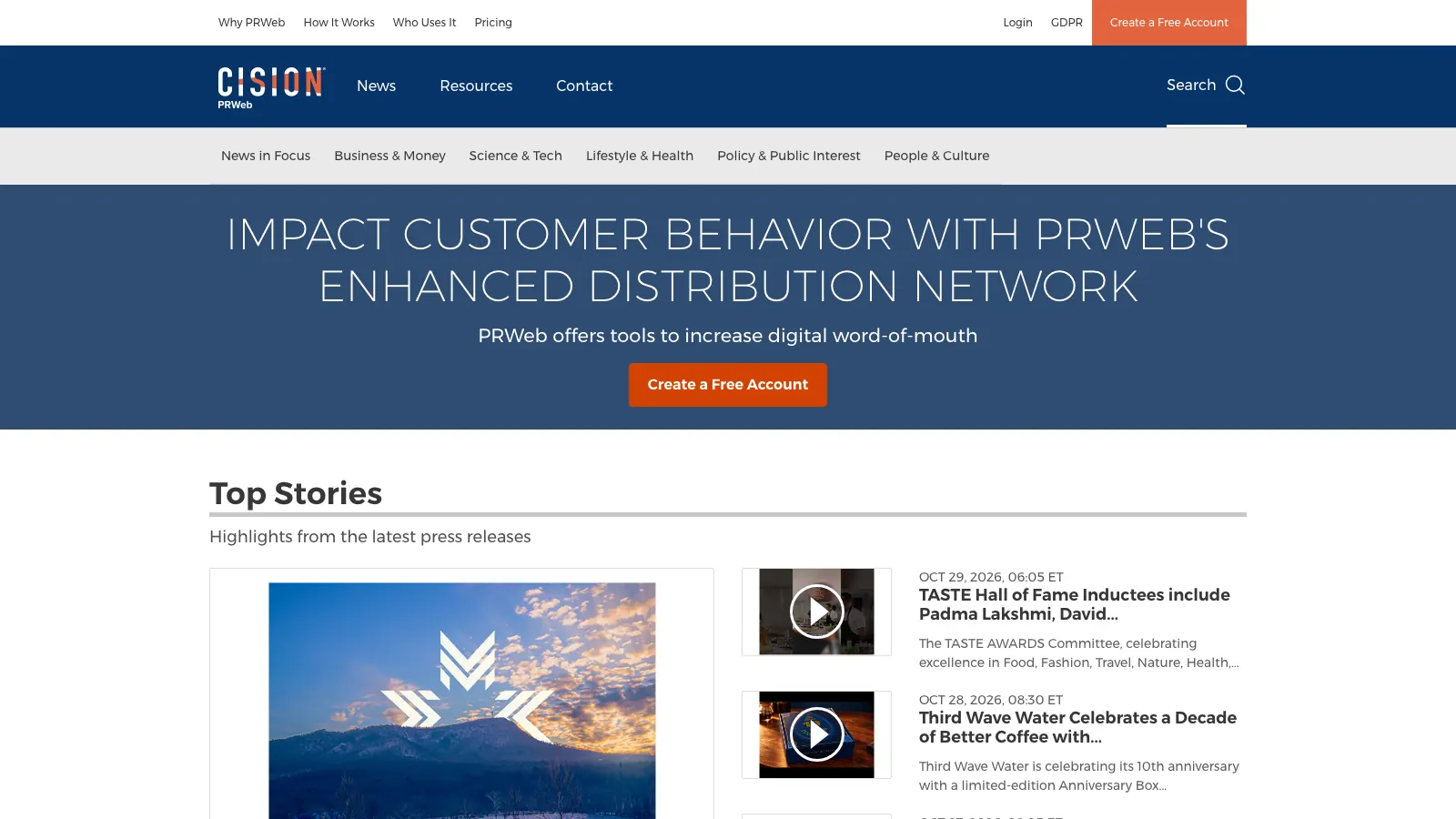
PRWeb is Cision's self-serve service for getting a finished announcement into online distribution. You create the release, add the material that supports the story, select a package and submit it for distribution to websites, search engines, social networks and, on higher packages, industry-curated journalist lists. That makes it a practical marketing tool when your immediate problem is reach rather than a year-round media relations program. The marketing tools directory can help when the rest of your campaign needs a separate tool.
The useful distinction is between publishing a release and running PR. PRWeb gives you a route to publication and a report on the release afterward. It does not present a self-serve contact database, pitch workflow or media-monitoring workspace in its public package details. If those are the activities your team does every week, the low entry price can hide the need for another tool or service beside it.
For an occasional launch, partnership, event or company update, that narrowness can be an advantage. A team can put budget behind the announcements that matter and pay nothing in months when it has nothing newsworthy to distribute.
Which organizations benefit most from the pay-per-release model of PRWeb?
Occasional announcement teams
Pay per release when a launch, event or company update is ready.
Small businesses
Start with Basic when search visibility matters more than broad syndication reach.
Marketing teams needing reach
Use Standard for PR Newswire-powered online syndication across 1,200+ partner websites.
Agencies with release work
Choose Advanced when one industry-curated journalist list and proofreading are necessary.
PRWeb is a weak fit for the person who needs to work named contacts, monitor coverage across campaigns or connect a reporting system to an API. Its public pages do not set out those capabilities. It is better understood as a paid distribution decision attached to each release.
What syndication networks and reporting metrics does PRWeb provide?
Online distribution
All four public packages promise increased search visibility and include unlimited media assets. Standard adds syndication to a network of more than 1,200 websites powered by PR Newswire. That is the point at which you are paying for a wider distribution route, not merely a place for the release to live.
Editorial keyword tagging
PRWeb says its editorial team tags every public release for relevant keywords. Basic is the lean package for this job, with a basic press release template, search-oriented distribution and a 48-hour turnaround. It is the package to choose when the announcement itself is strong and you do not need an outreach layer attached to it.
Journalist-list delivery
Advanced includes email distribution to one industry-curated list of journalists and bloggers sourced from the Cision Database. Premium includes two lists. PRWeb describes those lists as built around a particular industry, so treat them as a distribution addition, not as a substitute for a personal relationship with a reporter.
Proofreading and speed
Advanced and Premium add proofreading from PRWeb's editorial staff and reduce the published turnaround from 48 hours to 24 hours. Both packages can also add Priority Distribution for $110, which PRWeb says gets news out within four hours. That makes Advanced the realistic floor when a release needs editorial support or a faster deadline.
Rich media and social distribution
Standard supports file attachments and a callout quote. Advanced adds embedded hyperlinks and images, while Premium adds embedded video, the Sovrn content recommendation network and Cision PR Newswire SocialPost. Those additions are most useful when the release already has visual material and a clear audience, not when the underlying announcement is thin.
Release reporting
PRWeb publishes real-time reporting for its packages, naming views, engagements and analytics that measure a release's impact and reach. Use that as a release report, not as a promise of full-funnel attribution. The public descriptions do not state how to connect that activity to leads, pipeline or revenue.
How much does PRWeb charge per individual press release tier?
Price checked 27 Nov 2026
| Plan detail | Basic$120/release | Standard$245/release | Advanced$360/release | Premium$480/release |
|---|---|---|---|---|
| Search visibility and keyword tagging | ✓ | ✓ | ✓ | ✓ |
| PR Newswire-powered syndication | ✕ | 1,200+ sites | 1,200+ sites | 1,200+ sites |
| Industry-curated journalist lists | ✕ | ✕ | 1 list | 2 lists |
| Editorial proofreading | ✕ | ✕ | ✓ | ✓ |
| Published turnaround | 48 hours | 48 hours | 24 hours | 24 hours |
PRWeb prices in US dollars, 27 Nov 2026.PRWeb pricing
There is no recurring plan price in the four public package cards. Your team pays the release fee each time, then chooses the level of reach and editorial support that fits that announcement. The add-ons and sales-led packages matter when your workload changes:
- Priority Distribution costs $110 on Advanced and Premium and has a published four-hour delivery target
- Web Influence and Web Power have preferred pricing available through sales
- The comparison page lists enhanced placement, Cision SocialPost, priority distribution and journalist lists among package add-ons or inclusions
For a team bill, three Standard releases in a month cost $735 before any sales-led package or add-on. That is a sensible benchmark for a marketing calendar with several announcements, but it does not turn PRWeb into a subscription service. The price resets with each release.
What features do the enterprise sales packages of PRWeb include?
PRWeb also lists Web Influence and Web Power alongside the four public packages, with preferred pricing available through sales. Their comparison table shows more journalist lists, priority distribution, account management and expanded reporting options. Since PRWeb does not publish a price for either package, ask for the release volume, included distribution and reporting terms in writing before treating them as an enterprise plan.
Where does PRWeb fall short for long-term media relations?
PRWeb exhibits its core limitation in narrow distribution scope rather than the initial entry price. A release distribution service cannot replace the daily work of finding contacts, pitching an angle, following up and tracking coverage. Advanced and Premium do add delivery to industry-curated lists, but that is still a packaged distribution feature rather than a public workspace for managing your own media relationships.
Measurement is the next boundary. Views and engagements help you understand whether a release drew attention, but PRWeb's public pages do not describe full attribution to traffic, leads or revenue. Decide before purchase what evidence you need after distribution, then make sure your web analytics and campaign tracking handle the rest.
Finally, machine access is not a documented selling point. PRWeb's public pages mention Cision Communications Cloud integration for subscription customers, but they do not publish API or MCP access for these packages. Keep the release workflow human-led unless a sales conversation confirms the exact integration you need.
Which modern PR and communications platforms serve as alternatives to PRWeb?
 PRWeb alternatives like AI Peekaboo solve the challenge of tracking brand visibility within generative engine answers. As priced on 27 Nov 2026, its plans start at $30 a month and include API and MCP access, which is a different job from distributing a press release. Read the AI Peekaboo review when reporting AI-answer visibility is part of the campaign.
 Qwoted review suits a lighter starting point for source requests: its free Basic Plan allows two pitches a month.
 Roxhill review is for teams that need to search journalists by topic, sector, keyword or company and get direct access to them.
What is the final purchasing recommendation on distributing via PRWeb?
PRWeb makes the most sense for distributing a standalone corporate announcement with a clear, fixed budget. Basic is enough for a search-oriented release, while Standard is the meaningful step up for PR Newswire-powered syndication. Advanced is the better choice when journalist-list delivery, proofreading or a 24-hour turnaround affects the outcome.
Use the $120 Basic package for a single search-oriented release. Move to Standard only when the 1,200+ website syndication is material, and to Advanced only when the added journalist list, proofreading or turnaround changes your launch plan.
How were the distribution packages and rates of PRWeb verified?
PRWeb package rates and published syndication limits were verified on 27 Nov 2026. Prices and package limits came from PRWeb's public pricing and package pages. Product details came from PRWeb's own distribution, FAQ and company pages. Every figure follows how we check figures.
- PRWeb pricing and package pages
- PRWeb distribution and product pages
- PRWeb FAQ and company information
What are the common questions about editorial guidelines on PRWeb?
How much does PRWeb cost?
PRWeb's four public packages cost $120, $245, $360 and $480 per release. Basic and Standard list a 48-hour turnaround, while Advanced and Premium list 24 hours. Web Influence and Web Power require a sales conversation for preferred pricing.
Does PRWeb include PR Newswire distribution?
Yes, from Standard. PRWeb says Standard, Advanced and Premium distribute a release through an enhanced network of more than 1,200 partner websites powered by PR Newswire. Basic does not list that syndication feature.
Does PRWeb send releases to journalists?
Yes, on higher public packages. Advanced includes delivery to one industry-curated journalist and blogger list sourced from the Cision Database, and Premium includes two lists. Basic and Standard do not list journalist-list distribution.
Does PRWeb have an API for AI agents?
PRWeb's public package pages do not publish API or MCP access. They do mention Cision Communications Cloud integration for subscription customers, but that does not establish access for a PRWeb public package. Confirm the exact integration with PRWeb before designing an agent workflow.
 Reviewed byDanny Kirk
Founder of ReddiReach.
 Checked byAndrés Felipe
Digital designer and marketer.
Every figure is checked against the vendor's own page. Read our editorial standards.