
Key Takeaways
- Red Sift OnDMARC centralizes SPF, DKIM, DMARC, BIMI, and MTA-STS configuration to prevent DNS errors across multi-sender corporate domains.
- Red Sift OnDMARC starts at $9 per month billed annually for Express, while Essentials and Enterprise editions require custom vendor quotes.
- Red Sift OnDMARC includes Radar MCP integration with 52 tool capabilities for LLMs, though exact tier availability and terms remain unlisted publicly.
- Red Sift OnDMARC focuses specifically on email authentication and domain security rather than serving as an outbound marketing email delivery platform.
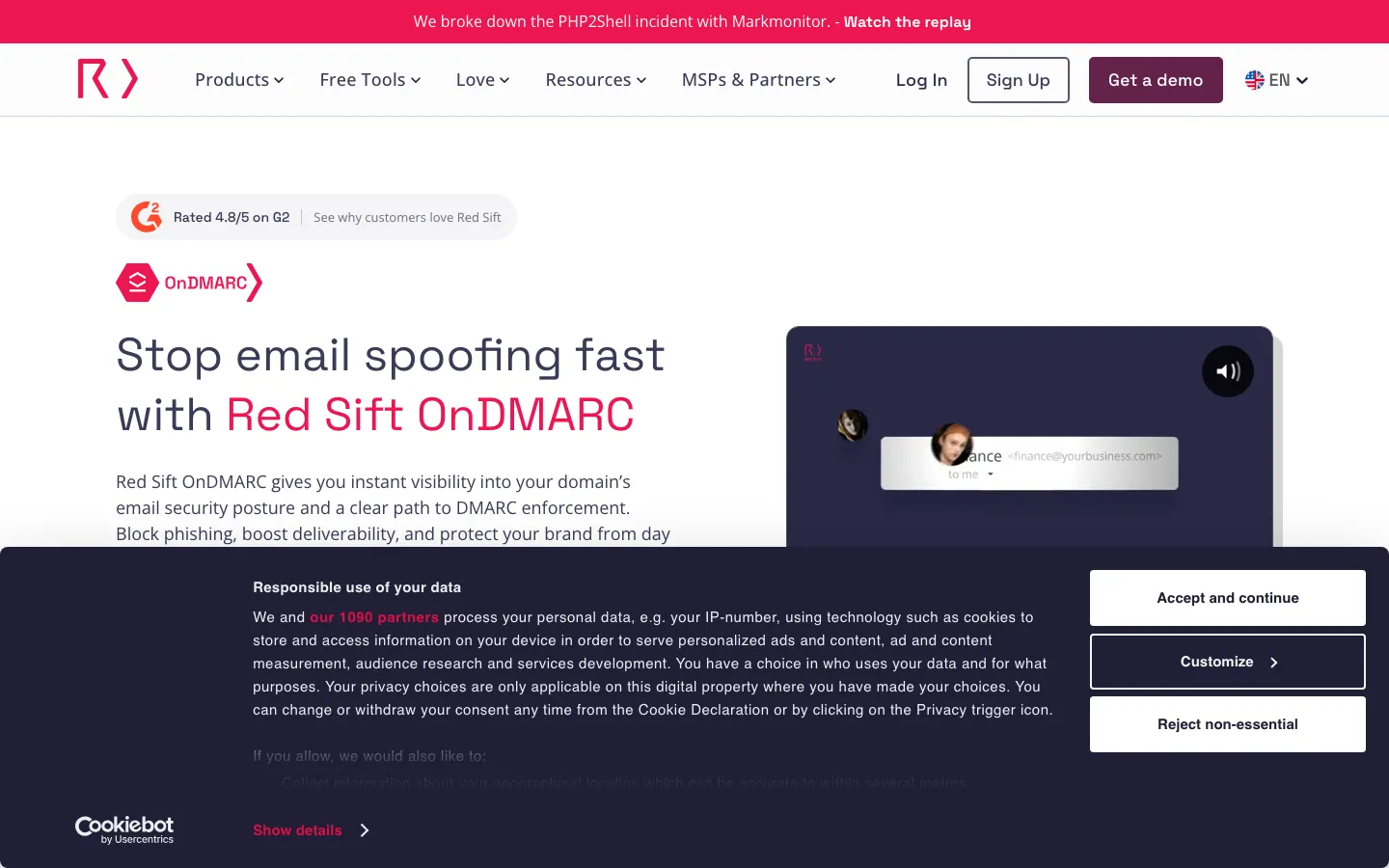
When several senders share a domain, Red Sift OnDMARC gives your team one place to manage SPF, DKIM, DMARC, BIMI and MTA-STS before a DNS change becomes a security problem. Its Express tier starts at $9 a month billed annually, while teams that need more domains, history or email volume need a quote.
Agent access
- API
- Yes, Express, Essentials, Enterprise and Premier
- MCP server
- Official, hosted, OAuth sign-in with a Red Sift account
- Works with
 Claude
 Cursor
 VS Code
What are the primary pros and cons of Red Sift OnDMARC?
What works
- Authentication settings gathered in one interface
- Express has a published annual starting price
- Dynamic SPF is designed to address lookup limits
What to watch
- Express starts at an annual-billing price
- Essentials and Enterprise need a sales conversation
- Express caps domains, mail volume and history
How does Red Sift OnDMARC protect corporate domain reputations?
Red Sift OnDMARC solves email authentication challenges that arise when domain ownership and sender systems are scattered across multiple departments. One team runs marketing mail, another owns transactional messages, and DNS changes have no obvious home. OnDMARC brings SPF, DKIM, DMARC, BIMI and MTA-STS configuration into one workspace, with visibility into a domain's email-security posture and a path toward DMARC enforcement. The marketing tools directory can help frame whether that is the missing layer in your stack.
That makes it an infrastructure choice, not a campaign tool. The value is in giving marketing, IT and security one place to discuss an email domain before they make policy changes. The vendor also lists an Investigate tool for diagnosing deliverability and forensic reporting, so the product has a route from an unexpected record to a focused follow-up.
It is worth separating that job from the service that sends messages. If your team is also comparing delivery platforms, read the  Resend review while defining which work belongs in authentication and which belongs in message delivery. That distinction prevents a cheap entry plan from becoming the wrong purchase.
Who should deploy Red Sift OnDMARC?
Small organizations
Express gives a visible starting point for teams with no more than four domains and one million monthly emails.
Marketing and IT teams
Keep email authentication records in one workspace when campaign and transactional senders share the same domain estate.
Security teams
Use a quoted Enterprise plan when scale, longer history, alerts and audit events need to fit security operations.
Teams with many senders
Consider Essentials when Express limits no longer cover active sender domains, mail volume or required data history.
The best fit is a team that has already decided email authentication deserves an owner. A team still choosing a delivery platform should settle that adjacent decision first, then use OnDMARC to keep the resulting senders aligned with the domain policy.
Which email security features does Red Sift OnDMARC provide?
One home for authentication
OnDMARC's Dynamic Services cover DMARC, SPF, DKIM, MTA-STS, TLS-RPT and BIMI. That range matters because an authenticated message depends on more than a DMARC policy alone. A shared workspace makes the relationship between records easier to see, but it does not remove the need for clear ownership of every authorized sender.
Dynamic SPF
SPF is often where a growing email stack gets fragile. Red Sift says Dynamic SPF consolidates records to solve the 10-lookup limit and removes the need for macros. That is a useful capability when third-party gateways and legacy services have made the record difficult to maintain. Confirm the applicable access level before treating it as part of a chosen tier.
Investigate, alerts and events
The pricing grid lists Investigate for immediate deliverability diagnosis and forensic reporting. It also lists smart alerts, API access and Event Hub, which can stream security and audit events through SIEM integrations and webhooks. This is where Red Sift OnDMARC has a practical place beside security operations: findings can have an owner and a route into an existing response process.
BIMI and brand presentation
OnDMARC includes integrated VMC provisioning for BIMI. Treat that as its own workstream, because it connects authentication, brand assets and certificate requirements. It is a reason to choose a platform that covers the surrounding records, rather than a reason to rush a change before the domain's sending inventory is understood.
Radar access
Red Sift Radar is the vendor's embedded AI capability for answering domain-security and configuration questions. Radar MCP brings 52 tool capabilities into Claude,  ChatGPT, Cursor, VS Code and other AI assistants, with read and write actions such as adding a domain or activating Dynamic SPF. The pricing grid lists limited Radar access on Essentials, four Radar Pro seats on Enterprise and eight on Premier, but does not publish Radar MCP tier eligibility or access terms. Ask for those details in a quote rather than assuming every account receives the same level.
How is Red Sift OnDMARC priced across tiers?
Price checked 27 Nov 2026
| Plan detail | ExpressFrom $9/mo | EssentialsCustom | EnterpriseCustom |
|---|---|---|---|
| Billing | Annual billing | Contact sales | Contact sales |
| Active sender domains | Up to 4 | 25, upgradable | 25, upgradable |
| Monthly email volume | Up to 1 million | Unlimited | Unlimited |
| Data history | 30 days | 1 year | 1 year |
| SPF lookups | Up to 10 | Unlimited | Unlimited |
| Radar | Not listed | Limited access | 4 Pro seats |
Red Sift prices in US dollars, 27 Nov 2026.Red Sift OnDMARC pricing
Express is the only published entry price: starting at $9 a month billed annually. At that starting rate, the annual commitment is $108, calculated as $9 times 12. It is not a simple per-user comparison or a guaranteed bill. Its limits are four domains, one million monthly emails and 30 days of history, so a team that exceeds them needs a quote. The trial lasts 14 days and the pricing page says no credit card is required, so it is the sensible point to measure the actual domain estate before committing.
Essentials and Enterprise shift to quotes. Both list 25 active sender domains that can be upgraded, unlimited email volume, unlimited parked domains, one year of history and unlimited platform users. Enterprise adds four Radar Pro seats, one VMC, Global IP Lookup, DNS History and Analyst View. The pricing page also lists a Premier tier with eight Radar Pro seats, DNS Guardian and 50 active sender domains, but without a published price.
What do the Enterprise and Premier plans add to Red Sift OnDMARC?
Red Sift OnDMARC Enterprise supports organizations that exceed Express tier limits and require dedicated security configurations rather than simple seat expansions. The vendor lists SAML/SSO, role-based access control, 2FA, RESTful API access, a dedicated account manager and a custom SLA in its Enterprise plan details. Premier extends the domain allowance to 50 active sender domains and adds DNS Guardian, while retaining quoted pricing.
- Enterprise includes four Radar Pro seats and one VMC
- Premier lists eight Radar Pro seats and DNS Guardian
- Both larger tiers list unlimited email volume and one year of data history
What are the key limitations of Red Sift OnDMARC?
Red Sift OnDMARC lacks transparent public pricing for tiers beyond the entry-level Express subscription. Essentials, Enterprise and Premier require a quote, so a growing team cannot calculate its eventual bill from the public page. Express also makes the trade-off visible: four domains, one million monthly emails and 30 days of history may be enough for a small estate, but are not a generous buffer for a business with several sending systems.
The tool is deliberately specific. It manages authentication and domain security, while a sending platform has a different job. Teams that need to compare delivery options should read the  SendGrid review alongside their authentication requirements, rather than expecting an OnDMARC plan to answer both questions.
Radar MCP is documented for LLM-based read and write actions, but Red Sift does not publish the tier eligibility or access terms. If an agent workflow is a buying requirement, make those terms, along with API scope, limits and authentication method, part of the sales conversation.
How does Red Sift OnDMARC fit into broader email infrastructure choices?
Red Sift OnDMARC functions as a specialized domain-authentication platform, making its evaluation distinct from standard email service provider selections. When a sending-platform decision is in scope, SendGrid review covers a service built around RESTful APIs or SMTP relay, with a separate Marketing Campaigns product. It remains an adjacent choice, not a replacement for DMARC, SPF and DNS governance.
Resend review is another sending option: its free plan includes 3,000 emails a month. That is useful for assessing message delivery needs separately from the authentication controls OnDMARC manages.
What is the final verdict on Red Sift OnDMARC?
Red Sift OnDMARC provides a disciplined starting point compared to ad hoc DNS updates for organizations aligning multiple legitimate senders under one policy. Express starts at $9 a month billed annually, while the larger tiers add capacity, history and security features through a quote. The public price disappears just as the buying decision becomes more complex.
Start the 14-day trial with a representative domain, compare its active senders and volume against Express limits, then ask for a written tier breakdown before moving to a quoted plan.
How was this Red Sift OnDMARC review verified?
Red Sift OnDMARC specifications, pricing models, and feature limits were audited directly against Red Sift documentation on 27 Nov 2026. Dollar figures are shown as the vendor displayed them, and our handling of figures follows how we check figures.
- OnDMARC product and pricing pages
- Dynamic SPF and BIMI product pages
- Red Sift Radar product page
What are common questions about Red Sift OnDMARC?
How much does Red Sift OnDMARC cost?
Express starts at $9 a month when billed annually. Essentials, Enterprise and Premier use contact pricing.
Is there a Red Sift OnDMARC trial?
Yes. Red Sift offers a 14-day trial, and its pricing page says no credit card is required.
What are the Express plan limits?
Express lists up to four domains, up to one million monthly emails, 30 days of history and up to 10 SPF lookups.
Does OnDMARC include API or MCP access?
The pricing grid lists RESTful API access. Red Sift also documents Radar MCP, with 52 tool capabilities available in LLMs for read and write actions. It does not publish the tier eligibility or access terms for Radar MCP, so teams should confirm those directly.
 Reviewed byDanny Kirk
Founder of ReddiReach.
 Checked byAndrés Felipe
Digital designer and marketer.
Every figure is checked against the vendor's own page. Read our editorial standards.