
Key Takeaways
- Riff Analytics provides daily brand tracking across seven generative engines, including DeepSeek, Grok, and Llama, using 250 automated prompts inside a single dashboard.
- Monthly subscriptions for Riff Analytics cost $49 for Starter or $199 for Pro excluding VAT, with a 10% discount available on annual plans.
- Automated systems cannot directly ingest Riff Analytics data because the platform omits public developer APIs, MCP server endpoints, and scheduled external export options.
- Marketing agencies should skip Riff Analytics if they manage multiple client workspaces or need to pipeline engine visibility metrics directly into reporting tools.
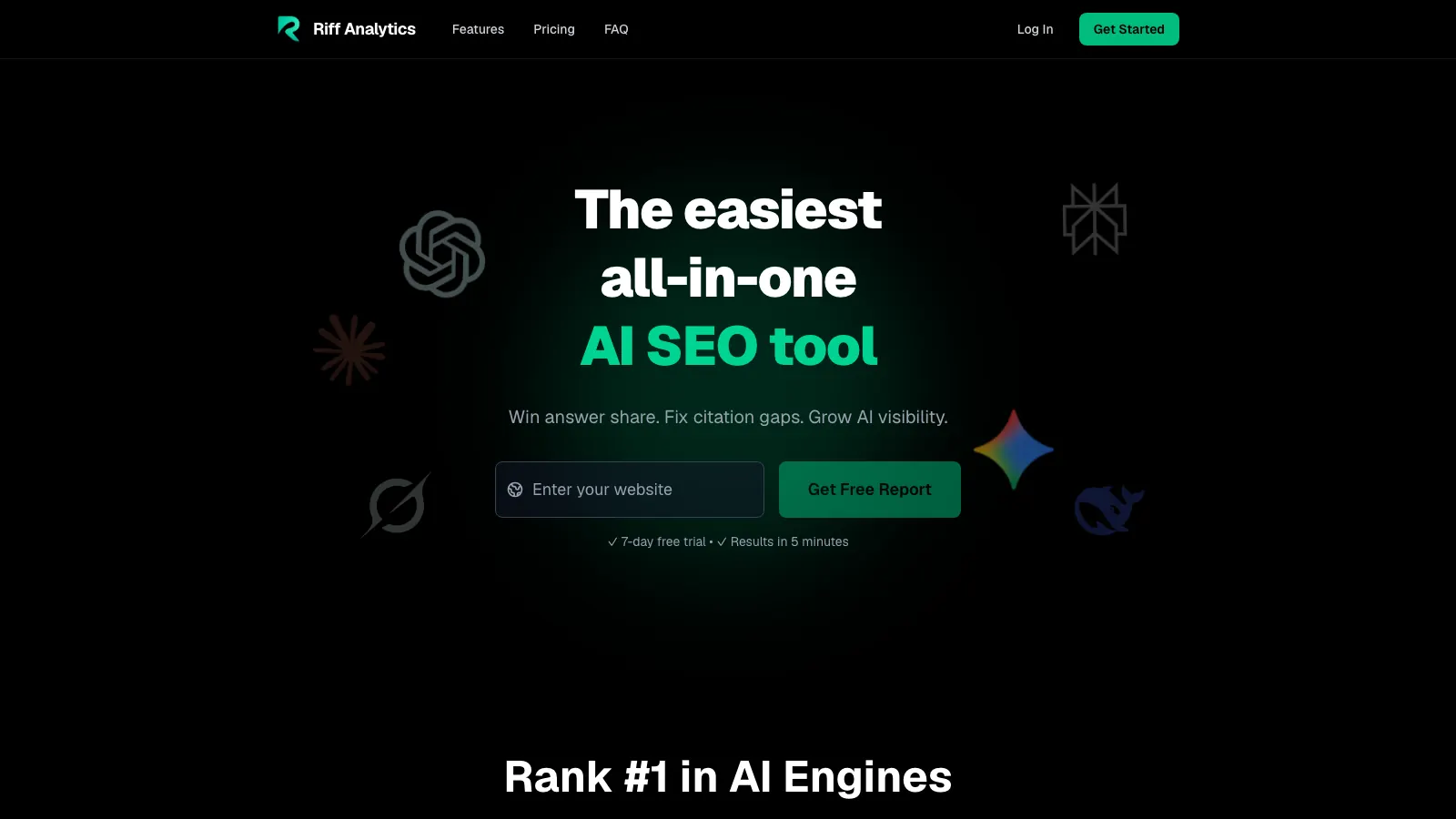
Your buyers do not all ask ChatGPT, and Riff Analytics is the low-cost way for a single in-house brand to watch the others too: $49 a month tracks seven AI engines, DeepSeek, Grok and Llama among them, with 250 prompts and daily checks. Look elsewhere if you run several clients or need the data in another tool, since Riff lists no API or client reporting, while AI Peekaboo includes an API and MCP from $30 a month.
Agent access
- API
- Not found on official pages
- MCP server
- Not found on official pages
What are the main pros and cons of Riff Analytics?
What works
- Seven engines on both plans, Llama included
- 250 prompts and unlimited competitors from $49
- An AI readiness audit of your own site
What to watch
- No API, export or client sharing on its plans
- Response caps sit well under the prompt count
- Pro has no free trial, only Starter does
What search visibility data does Riff Analytics track across generative models?
Riff Analytics runs your prompts through AI engines every day and logs whether your brand appears, how it is positioned, which competitors stand beside it and which sources the answers cite. Next to the other best AI visibility tools, its selling point is breadth for the money: ChatGPT, Perplexity, Claude, Gemini, Grok, DeepSeek and Llama are all on the $49 plan, and its pages also mention Google AI Mode and Google AI Overviews.
The product is a short list of jobs done in one dashboard. It tracks citation sources and the gaps between them, follows how often you are mentioned over time, reads the context that makes an answer positive or negative, benchmarks you against rivals and audits your own site for what AI crawlers see when they visit.
I see Riff as a monitoring tool for one marketing team looking after one brand. The pricing, the trial and the feature list all point at a person who wants to check answers each morning, not at an agency packaging AI visibility for clients. Judged on that brief, it covers more engines than you would expect at the price.
Who gains the most strategic value from Riff Analytics?
In-house brand marketers
Track one brand across seven engines with daily checks, for $49 a month.
Content and SEO leads
See which sources AI engines cite, then close the citation gaps you find.
Teams with global buyers
Cover DeepSeek, Grok and Llama beside ChatGPT, Claude, Gemini and Perplexity.
Competitive intelligence
Benchmark against as many rivals as you like and follow their mention trends.
Riff fits poorly with agencies. Its pages say nothing about client logins, branded reports or an API, so a team that reports to clients would be screenshotting the dashboard. A brand that needs every prompt on every engine every day may also find the response caps tighter than the prompt count suggests.
Which AI monitoring and competitor tracking features are built into Riff Analytics?
Seven AI engines on both plans
Both plans include all AI models, and Riff's tracking list names ChatGPT, Perplexity, Claude, Gemini, Grok, DeepSeek and Llama. That matters if part of your audience uses assistants beyond the usual three or four, and it means you never pay extra to add an engine. Google AI Mode and Google AI Overviews appear in Riff's own copy as well, so ask how those two are counted before you rely on them.
Citation sources and gaps
Riff shows where AI engines find the content they cite, ranks the most-cited sources and flags the gaps where you are absent. For a content team, the list of cited sources is the part to act on, because it names the pages and publications that already shape answers in your category.
Mention trends and response context
Mention trends follow how often your brand appears in AI responses over time, which is how you tell whether a content change moved anything. Response context reads how engines position your brand and what sets off a positive or negative mention, which is more useful than a sentiment score on its own.
Competitor benchmarking
Both plans allow unlimited competitors, and Riff shows where you rank against them in AI responses and how their presence shifts. Unlimited is generous at $49, though every competitor you add still draws on the same monthly response allowance.
AI readiness audit
The readiness audit scans your website for AI optimization issues and shows what engines see when they crawl it. It is the right first step for a site that has never been checked, since an engine that cannot read a page will not cite it however good the copy is.
Free report
Before any plan, Riff offers a free AI visibility report from the home page, with results in about five minutes. Use it to see the engines and the format, then decide whether the Starter trial is worth your time.
How is Riff Analytics priced across Starter and Pro tiers?
Price checked 27 Nov 2026
| Plan detail | Starter$49/mo | Pro$199/mo |
|---|---|---|
| Brands | 1 | 5 |
| Prompts | 250 | 250 |
| AI responses a month | 6,000 | 20,000 |
| URL checks a month | 1,000 | 5,000 |
| Competitors | Unlimited | Unlimited |
| Check frequency | Daily | Daily |
| Free trial | ✓ | ✕ |
Riff Analytics plans in US dollars, excluding VAT, 27 Nov 2026.Riff Analytics pricing
The response allowance, not the prompt count, decides how far a plan really goes. On Starter, 6,000 responses a month comes to about 200 a day, so 250 prompts across seven engines cannot all run on every engine daily. Riff warns you as you approach a limit and asks you to upgrade to keep monitoring. Other terms worth knowing:
- Annual plans are paid upfront and cost 10% less than monthly billing
- The 7-day trial covers Starter only, and the card is charged when it ends
- Cancel before the next invoice, and access runs to the end of the period
- Refunds can be requested within 14 days of paying for a plan
Pro is described as adding advanced analytics and automation, but the plan list itself only shows more brands, responses and URL checks, with the same 250 prompts. Ask Riff what the extra $150 a month buys beyond capacity before you upgrade.
Where does Riff Analytics fall short in data portability and integration?
Riff Analytics presents its most significant operational limitation in the total lack of data export outside the native dashboard. Riff's plans list no API, no MCP, no export, no Looker Studio connector and no white-label reports, so the data has nowhere to go except a screen someone opens. For an in-house marketer that may be fine. For an agency or a team that reports AI visibility alongside other channels, it is the deciding factor.
The plan limits also take some reading. Seven engines, 250 prompts and daily checks sound like full coverage, but the response cap means you will have to pick which prompts run where. Build your prompt set to fit 6,000 responses on Starter, or 20,000 on Pro, rather than to fill the 250 slots.
Finally, Pro cannot be trialled. The 7-day trial applies only to Starter, so a team that needs five brands from day one pays $199 before seeing the multi-brand setup.
What are the most capable alternatives to Riff Analytics?
 Riff Analytics alternatives include AI Peekaboo, which suits teams requiring data export, API connectivity, and MCP integration. Every plan from $30 a month includes the API, MCP and Looker Studio, extra users cost nothing and branded client reports open up from $100 a month, though it does not track DeepSeek or Llama. The AI Peekaboo review shows how the price follows your prompts and models.
For a larger brand with budget for persona analysis and site work,  Scrunch starts at $250 a month, keeps its API for Enterprise and is now part of Sitecore, as the Scrunch AI review explains.
 Trakkr is the step up for agencies, with eight models checked daily from $100 a month and client portals on its Scale plan. Our Trakkr review covers what each plan adds.
What is the final verdict on adopting Riff Analytics?
Riff Analytics earns its place when one brand wants the broadest engine list at a low monthly price, and the team is content to work inside the dashboard. Citation gaps and response context give it more depth than a mention counter. Choose another tool if clients, reports or agents need the data, or if you want to try multi-brand Pro before paying.
Run the free report, then take the Starter trial with a prompt set sized to 200 responses a day, and only move to Pro once you know what its analytics add.
How were the specifications and terms of Riff Analytics validated?
Riff Analytics prices, prompt limits, and terms were evaluated directly from the vendor's homepage, pricing tables, and policies on 27 Nov 2026. Prices are in US dollars excluding VAT, as Riff shows them, and every figure follows the rules in how we check figures.
- Riff Analytics pricing page and its FAQ
- Riff Analytics home page features
- Riff Analytics refund policy and terms of service
What are the common questions asked about Riff Analytics?
Does Riff Analytics have a free trial?
Yes, 7 days on Starter. The card is not charged until it ends, and Pro has no trial.
How much does Riff Analytics cost?
Starter is $49 a month and Pro $199, both excluding VAT, with 10% off when paid annually upfront.
Which AI engines does Riff Analytics track?
ChatGPT, Perplexity, Claude, Gemini, Grok, DeepSeek and Llama, on both plans.
Does Riff Analytics have an API?
None is listed on its plans or pages, and neither is MCP access, an export or white-label reporting.
 Reviewed byDanny Kirk
Founder of ReddiReach.
 Checked byAndrés Felipe
Digital designer and marketer.
Every figure is checked against the vendor's own page. Read our editorial standards.