Key Takeaways
- Salesloft delivers an integrated revenue platform that combines multichannel seller engagement, conversation intelligence, deal management, and pipeline forecasting across shared data signals.
- Salesloft does not publish fixed pricing tiers or subscription fees online, requiring prospective enterprise buyers to negotiate through direct sales discussions.
- Salesloft features an MCP server allowing compatible external AI agent workflows to query live pipeline status, opportunity records, account histories, and customer call transcripts.
- Salesloft is less suitable for lean prospecting teams seeking a lightweight email sequence application available with self-serve checkout and public rates.
Salesloft is the stronger choice when your revenue team needs sales engagement, conversation intelligence and forecasting to work from the same signals. It fits organizations that will use those connected products, but choose a narrower tool if you only need prospecting sequences and a published price before speaking with sales.
 Claude
 ChatGPT
What are the primary Salesloft pros and cons?
What works
- Cadence, Conversation Intelligence, Deals, Clari Forecast and Analytics are presented as one revenue system
- AI agents can research accounts and people, identify buyers and organize a seller's next actions
- The MCP Server connects compatible AI applications to live revenue context
What to watch
- Salesloft publishes no plan prices, seat minimums or module pricing
- Its product range spans several revenue workflows, which makes a focused purchase harder to scope
- Contract terms need to establish which products, services and data connections are included
What does Salesloft do for revenue teams?
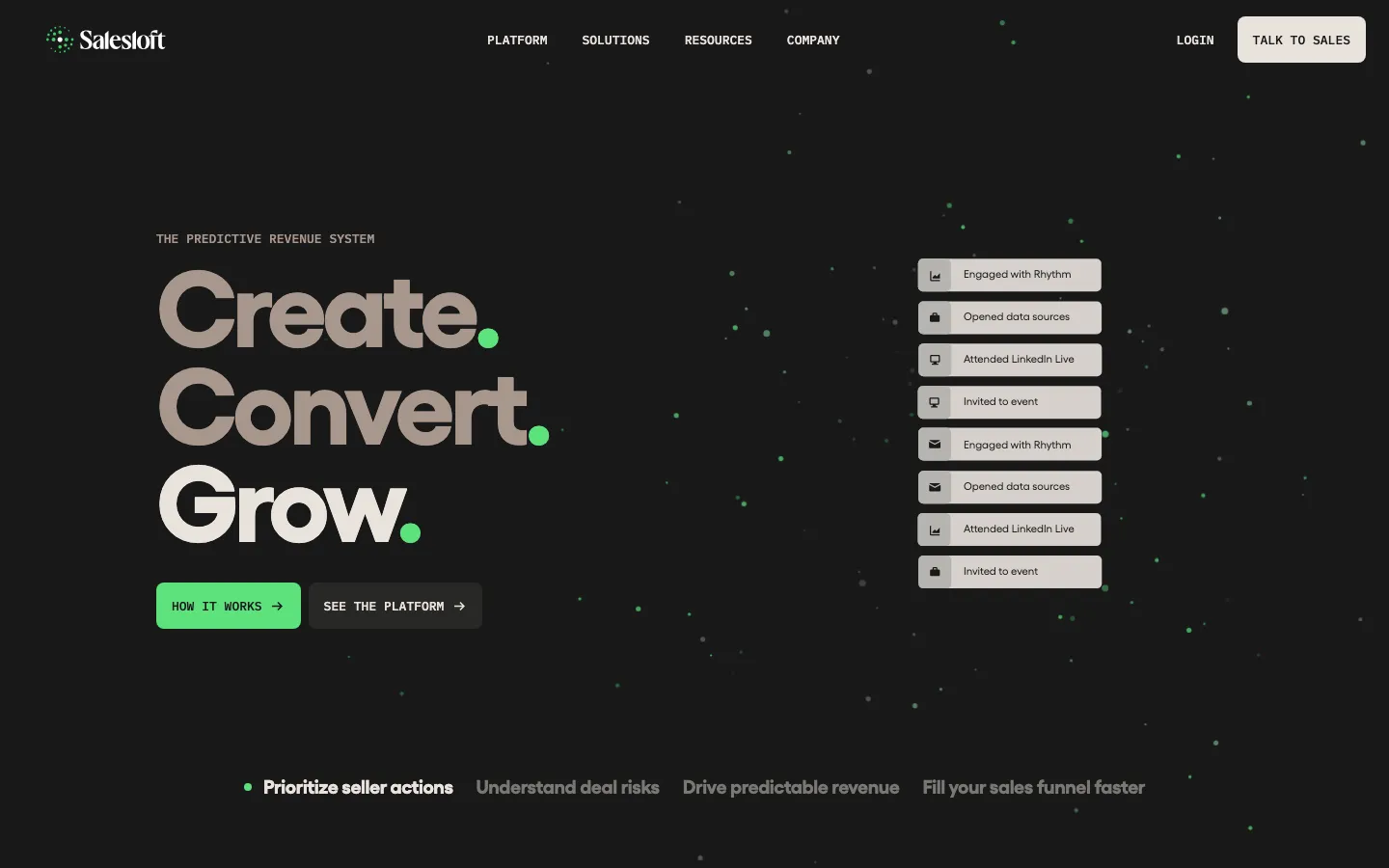
Salesloft is built around a broader job than sending a sequence. Cadence handles buyer engagement, Conversation Intelligence turns calls into signals, Deals keeps opportunities moving, and Rhythm puts the next task in front of sellers. For leaders, Clari Forecast, Inspect and Analytics cover forecasting, pipeline risk and reporting.
That is a meaningful difference if your team keeps switching between an engagement platform, a call-analysis product and a forecast process. The marketing tools directory helps separate CRM and sales tools from the rest of the catalog. Salesloft only earns its cost and implementation effort when more than one of those workflows matters to your organization.
Salesloft belongs on the more comprehensive end of that category: it is designed to connect account teams, revenue leaders and operations around the same signals rather than to replace a single email sequence tool.
Who is Salesloft built for?
Revenue organizations
Bring sales engagement, calls, opportunities and forecasts into one operating system for revenue work.
Revenue leaders
Use forecast visibility and early pipeline-risk signals to direct action before a deal slips.
RevOps teams
Connect revenue motions through shared data, governance and a platform that supports several roles.
AI-assisted sellers
Give compatible AI applications live pipeline context through MCP, alongside Salesloft's own revenue agents.
I would put Salesloft in front of a team that already has a defined sales motion and wants to reduce the gap between seller activity and the forecast. It is less convincing for a small group that has not decided whether it needs conversation intelligence, deal controls and forecasting together. The lack of a public price means the fit needs to be clear before you start a sales conversation.
What core capabilities are in Salesloft?
Cadence for sales engagement
Cadence is the execution layer for prospecting and follow-up. Salesloft says it supports automation rules, personalization and buyer identification, while its AI prioritizes engaged contacts and lets reps sort cadence steps by channel, time zone and account. A mobile app and sales dialer support running cadence steps away from a desk. That makes Cadence useful for teams that want repeatable outreach without treating every prospect as the same task.
Conversation Intelligence for action after calls
Conversation Intelligence surfaces stakeholder sentiment, objections and engagement signals from conversations. Salesloft says buyer statements can become CRM updates, seller actions and coaching moments. The important distinction is the intended handoff: call data is supposed to move into the operating workflow, not sit in a recording library. Ask to see the exact CRM updates and coaching workflow that match your sales process.
Clari Forecast and pipeline risk
Clari Forecast brings individual and team forecasts into one dashboard, with AI-powered forecasting, pipeline visibility and risk management. Salesloft says risks, gaps and opportunities can trigger next-best actions in the seller workflow, while Inspect is positioned to surface pipeline risk early. This is where Salesloft makes the clearest case for a connected system: forecast accuracy depends on whether the signals reaching leaders are useful enough to change what sellers do.
AI agents for research and prioritization
Salesloft groups its agents around pipeline creation, closing deals, customer growth and scaling winning behaviors. Account Research summarizes an account, Person Research summarizes contact-specific insights, and Buyer Identification recommends stakeholders for prospecting. Rhythm Prioritizer organizes daily work from signals and priorities. Those are practical agent jobs, but each should be evaluated against the data your team can actually make available to Salesloft.
Integrations, API and MCP
Salesloft documents Salesforce CRM Sync, a sync log, LinkedIn Sales Navigator, its API and an app directory. Salesloft Connect brings Salesloft features into Gmail or Outlook. Its MCP Server is the more notable option for AI-enabled operations: Salesloft says a compatible application can receive context from live pipeline, deals, accounts and call data. Confirm the access model and permitted actions before treating that connection as a production workflow.
How does Salesloft handle platform pricing?
Price checked 27 Nov 2026
| Commercial detail |  Salesloft |
|---|---|
| Published plan prices | ✕ Not published |
| Published plan tiers | ✕ Not published |
| Buying route | Talk to Sales |
| Platform products shown | Cadence, Conversation Intelligence, Deals, Clari Forecast, Analytics and AI Agents |
| MCP Server | ✓ Listed as a platform capability |
Salesloft pricing information, 27 Nov 2026.Talk to Sales
There is no honest team-bill calculation to make from the published information. Salesloft's pricing route asks for a business email and offers an introductory call, tailored walkthrough and follow-up. That leaves the commercial questions that matter most, including seat count, product scope, implementation services and renewal terms, for the quote. Treat that opacity as part of the product decision, not a minor missing line item.
- Request a quote that names every product and service included
- Ask whether Cadence, Conversation Intelligence, Clari Forecast and MCP are priced together or separately
- Confirm the contract's seats, data connections, implementation scope and renewal terms
How does Salesloft support enterprise revenue organizations?
Salesloft explicitly frames Salesloft around global scale, governance, security and controls for enterprise revenue organizations. Its platform overview describes a shared data and AI environment for account teams, leaders and operations, and its company page says sellers, managers and ops work from the same data in role-specific ways. That is the right shape for a revenue organization trying to standardize activity, signals and decision-making across teams.
The trade-off is not simply a bigger feature list. A multi-product platform asks your team to decide how seller workflows, call data, CRM sync, forecasting and agent access should work together. Keep the first contract tied to the workflow you want to improve, rather than buying every available module because Salesloft can support it.
Where does Salesloft fall short for buyers?
Salesloft's largest limitation is commercial visibility. No public tier, price or module breakdown appears on its pricing route, so a buyer cannot compare a three-person or fifty-person bill before a sales conversation. That does not make Salesloft unsuitable, but it does mean your budget and scope need to be established in the quote rather than through a self-serve trial calculation.
Its breadth is also a selection constraint. Salesloft presents Cadence, Conversation Intelligence, Deals, Rhythm, Clari Forecast, Inspect, Analytics, AI Agents and MCP as connected capabilities. That is compelling for a mature revenue operation, yet unnecessary complexity when your team wants one narrow job done well. The right counterweight is a tightly defined first workflow and a contract that only includes the products needed for it.
Finally, the vendor's AI story depends on context. Agents that research accounts, prioritize work or surface risks are only as useful as the revenue data and permissions supporting them. A demo should show the agent work against your CRM, call and account context, with clear boundaries on what it can read and do.
What are the top Salesloft alternatives?
Salesloft makes sense when you need a broad revenue system. If your immediate job is prospecting data rather than forecast and conversation workflows, the  Seamless.AI review is a useful next read: it can complete CSV rows for a CRM from an email or phone. If your team needs to verify email addresses before outreach, the
 Snov.io review covers that job with its Email Verifier.
Neither is a direct module-for-module replacement for the combined Salesloft platform. That is the point of the comparison: start with the job you actually need to solve, then decide whether a connected revenue system or a more focused prospecting tool deserves the budget and setup effort.
What is the overall verdict on Salesloft?
Salesloft justifies its investment by connecting daily seller engagement activity directly to executive forecasting and pipeline risk decisions. Cadence and the agent features make the seller workflow practical, while Clari Forecast and Inspect give leaders a reason to care about the same platform. I would not choose it on feature breadth alone. Choose it when the handoff from activity to pipeline judgment is a real operational problem you are ready to solve.
Ask Salesloft to demonstrate one complete path from a seller cadence or conversation to a forecast or risk action. Then request a quote that separates the products you need now from optional modules. If the workflow cannot justify the quote, keep the search focused on the individual sales job.
How was this Salesloft review researched?
Salesloft platform documentation, integration specifications, AI agent features, and enterprise inquiry flows were evaluated on 27 Nov 2026. The approach follows how we check figures.
- Platform overview for revenue execution, revenue intelligence, AI agents and MCP
- Cadence, Conversation Intelligence and forecasting pages for workflow details
- Integrations and Talk to Sales pages for connections and the absence of public pricing
What are common Salesloft questions?
Does Salesloft publish pricing?
No. Salesloft's pricing route leads to a Talk to Sales form and does not show public plan tiers or prices. Ask for a quote that lists the products, seats and services your team needs.
What does Salesloft do?
Salesloft combines Cadence for sales engagement, Conversation Intelligence, Deals, Rhythm, Clari Forecast, Inspect, Analytics, AI Agents and MCP capabilities across a revenue workflow.
Does Salesloft integrate with Salesforce?
Yes. Salesloft describes Salesforce CRM Sync, automatic activity recording, automation rules and a sync log. It also lists LinkedIn Sales Navigator, an API and an app directory.
Can AI applications use Salesloft data?
Salesloft says its MCP Server gives compatible AI applications context from live pipeline, deal, account and call data. Confirm the permissions and actions required for your own workflow before using it in production.
 Reviewed byDanny Kirk
Founder of ReddiReach.
 Checked byAndrés Felipe
Digital designer and marketer.
Every figure is checked against the vendor's own page. Read our editorial standards.