
Key Takeaways
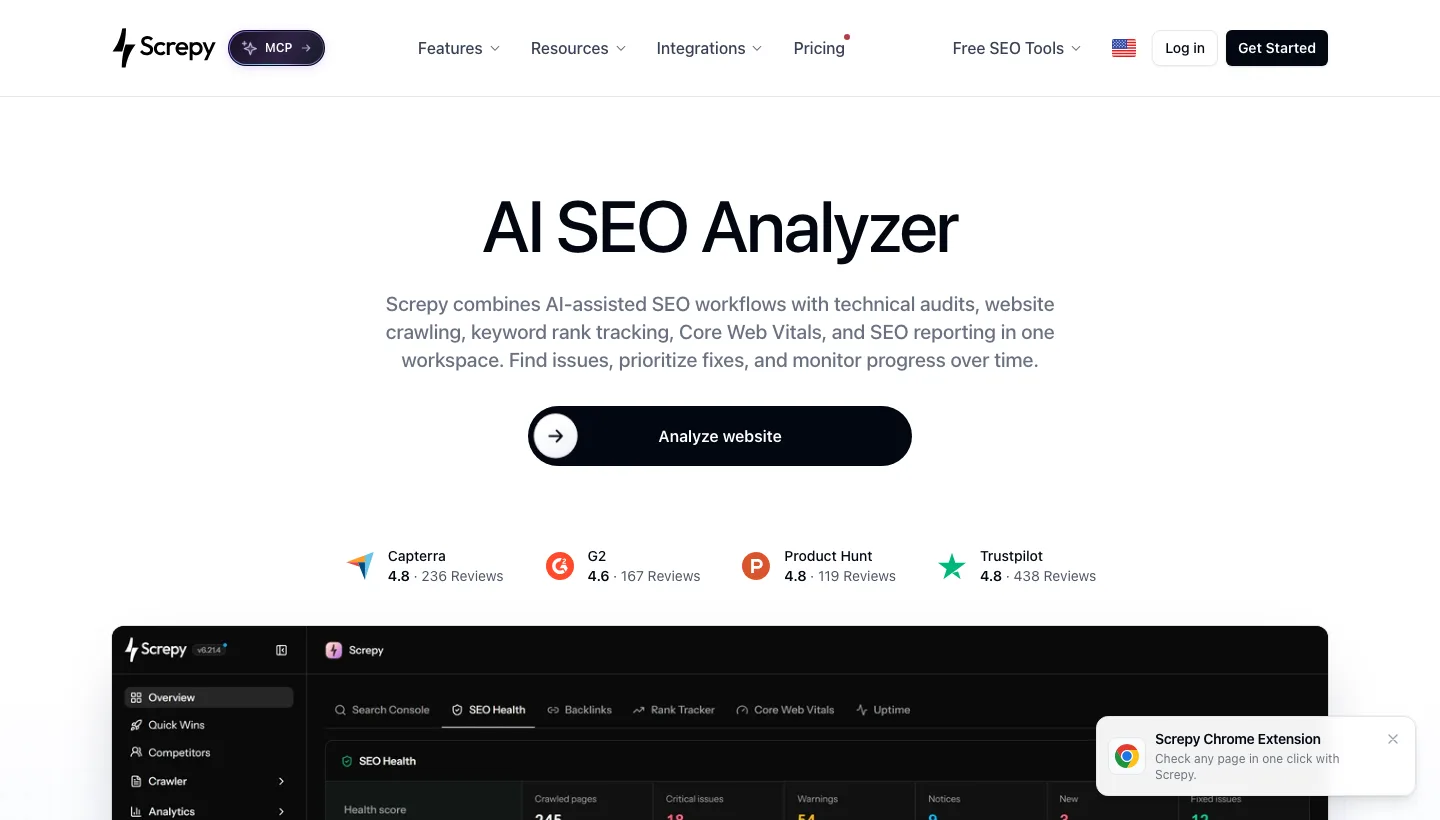
- Screpy unifies AI-assisted technical SEO crawls, Google keyword rank tracking, Core Web Vitals (LCP, INP, CLS), and uptime monitoring inside a single accessible dashboard for lean teams.
- Screpy's official pricing page returned a Cloudflare 503 error during verification, leaving current plan prices, monthly credit caps, and exact seat or project allowances unconfirmed from live vendor copy.
- Paid Screpy member accounts unlock an official REST API with OpenAPI support plus a hosted MCP server at mcp.screpy.com for Claude, ChatGPT, Cursor, VS Code, and Gemini.
- Screpy's crawl depth and technical check volume remain thinner than dedicated desktop crawlers like Screaming Frog or Sitebulb, making Screpy better for routine health checks than complex migrations.
When you manage multiple client or small-business websites without a dedicated technical SEO team, stitching together separate crawlers, rank trackers, and uptime monitors drains your budget and focus. Screpy is the right buy when you want AI-prioritized technical audits, Core Web Vitals tracking, uptime monitoring, and REST API or MCP workflows in one lightweight workspace, though starting prices could not be verified because Screpy's official pricing page returned a Cloudflare 503 error. Skip Screpy if you run enterprise domains that demand deep crawl diagnostics from dedicated tools like Screaming Frog or Sitebulb.
Agent access
- API
- Yes, paid member accounts
- MCP server
- Official, hosted, OAuth browser sign-in
- Works with
 ChatGPT
 Claude
 Cursor
 VS Code
 Gemini
- Automation
- n8n
What are the pros and cons of Screpy?
What works
- Combines technical SEO auditing, Google keyword rank tracking, Core Web Vitals monitoring, and uptime checks in one clean interface accessible to non-technical marketers.
- Provides official white-label PDF reporting with permitted agency branding, dated snapshots, and reusable report templates depending on your Screpy plan tier.
- Includes a documented REST API for paid member accounts alongside an official hosted MCP server with OAuth sign-in for AI-assisted SEO workflows.
- Offers a registration-free Website Analyzer and SEO Report Generator for single-page checks plus a free trial call-to-action for full workspace testing.
What to watch
- Screpy's public pricing page returned a Cloudflare 503 error during verification, preventing confirmation of current plan prices, credit tiers, and exact white-label thresholds.
- Audit crawl depth and diagnostic check volume are noticeably lighter than specialized technical crawlers such as Screaming Frog and Sitebulb on large websites.
- Search Console and Index Status data are routed exclusively through Screpy's MCP server rather than REST API endpoints, and REST lacks live SERP lookups.
- Official uptime monitoring pages do not publish check ping intervals or supported alert delivery channels before you register an account.
What does Screpy do for your team?
Screpy gives your marketing or agency team a consolidated SEO and website health workspace that brings technical site auditing, Google keyword rank tracking, PageSpeed monitoring, Core Web Vitals checks, and uptime tracking under one roof. Instead of exporting raw crawl spreadsheets and manually cross-referencing Google Search Console exports, Screpy runs AI-assisted workflows that surface on-page and technical errors, explain why each issue matters, and organize fixes into prioritized Quick Wins. For non-technical founders, solo consultants, and small agencies, Screpy removes the steep learning curve of enterprise SEO suites while keeping essential site health signals visible. Within our Technical SEO directory, weigh seat caps and reporting workflows early.
In day-to-day operations, Screpy bridges manual dashboard checks and automated AI agent workflows. Teams can inspect single URLs without creating an account using Screpy's free Website Analyzer and SEO Report Generator, or move into a full registered workspace via Screpy's free trial call-to-action to manage ongoing projects, crawl histories, and client PDF snapshots. Paid Screpy member accounts also extend beyond the browser through an official Bearer-authenticated REST API and a hosted Model Context Protocol (MCP) server at mcp.screpy.com, letting technical marketers query crawl summaries, Core Web Vitals, and Search Console trends directly inside AI coding and chat clients.
Prospective buyers should note two transparency caveats discovered when checking Screpy's official web properties. First, Screpy's public pricing page returned a Cloudflare 503 error during verification, meaning historical tier names and starting monthly rates could not be confirmed from live vendor copy. Second, while older third-party discussions and legacy notes have referenced an active platform rebuild that could shift feature stability, Screpy's live product and documentation snapshots do not mention an ongoing rebuild or version transition. Evaluating Screpy through its free trial before committing client reporting workflows remains the safest path.
Which teams is Screpy built for?
Freelancers and solo SEO consultants
Solo practitioners managing routine monthly health checks, basic Google keyword tracking, and uptime monitoring across client domains get a single, approachable Screpy workspace without juggling three or four separate single-purpose subscriptions.
Small business owners doing in-house SEO
Non-technical founders who want plain-language explanations of broken links, missing meta tags, canonical errors, and slow Core Web Vitals can use Screpy's AI-prioritized Quick Wins without hiring a dedicated SEO specialist.
Small agencies on lean software budgets
Boutique agencies that deliver recurring client summaries can use Screpy's white-label SEO reports with custom branding, reusable templates, and dated PDF snapshots, subject to plan-level widget and report volume allowances.
AI-assisted technical marketers and builders
Operators running Claude, ChatGPT, Cursor, VS Code, or Gemini can connect Screpy's official hosted MCP server or paid-member REST API to inspect crawls, Search Console trends, and disavow lists programmatically.
Which Screpy features matter most in daily work?
Screpy centers daily SEO maintenance around five practical modules: AI-guided website auditing, Google keyword rank tracking, PageSpeed and Core Web Vitals monitoring, uptime tracking, and customizable white-label PDF reporting, backed by official REST API and hosted MCP access for paid member accounts.
AI-assisted website audits and Quick Wins
Screpy crawls your registered project domains to detect technical and on-page SEO issues across meta tags, heading hierarchies, broken internal and external links, canonical tags, images, and page-level signals. Rather than dumping thousands of unranked warnings onto non-technical users, Screpy attaches AI-generated explanations and suggested fixes to surfaced problems and groups actionable opportunities into Quick Wins by priority order. Small business owners and junior account managers can immediately see which broken templates or missing tags deserve attention first during a monthly site review.
Where Screpy shows clear boundaries is crawl scale and diagnostic granularity. Compared against dedicated crawlers like Screaming Frog or Sitebulb, Screpy runs a lighter volume of technical checks and shallower crawl customization, making Screpy well suited to recurring health checks on small to mid-sized sites rather than complex JavaScript rendering audits or massive e-commerce migrations. Paid member accounts can also trigger crawls and read crawl status, pages, links, images, and Quick Wins programmatically via Screpy's REST API or start confirmed crawls via MCP.
Core Web Vitals, PageSpeed, and uptime monitoring
Screpy pairs technical crawl checks with continuous performance and availability tracking inside the same project view. On the speed side, Screpy monitors PageSpeed scores alongside Core Web Vitals metrics including Largest Contentful Paint (LCP), Interaction to Next Paint (INP), and Cumulative Layout Shift (CLS), allowing teams to spot performance regressions after theme changes or plugin updates. Screpy's official pages display modern INP metrics rather than legacy First Input Delay (FID) and do not explicitly label these speed measurements as Lighthouse-based.
Alongside speed tracking, Screpy monitors website uptime so teams can catch downtime events and availability interruptions next to their SEO metrics instead of paying for a separate basic pinger. However, Screpy's accessible official feature pages do not publish the exact uptime ping interval or list which alert notification channels are supported, so teams with strict SLA incident response needs should verify alerting inside the free trial. Both Core Web Vitals and uptime records are readable through Screpy's paid-member REST API.
Rank tracking, white-label reports, and AI agent access
For search visibility and client delivery, Screpy includes scheduled Google keyword rank tracking and official white-label PDF reporting. Screpy's Rank Tracker monitors target keyword positions over time to confirm whether priority pages are trending upward, covering core tracking without replacing deep SERP intelligence suites. Agencies can compile audit and ranking progress into white-label SEO reports featuring permitted custom branding, reusable templates, and dated PDF snapshots, with Screpy's official copy noting that custom branding, available widgets, and report volume depend on your selected plan.
Screpy stands out among budget-friendly SEO suites for its developer and AI agent connectivity. Paid member accounts receive Bearer API key access (configured under Settings and Connected Apps) to a documented REST API with OpenAPI specifications, pagination up to 100 records, and Retry-After 429 rate-limit handling. Screpy also runs an official hosted MCP server at mcp.screpy.com using browser OAuth for Claude, ChatGPT, Cursor, VS Code, and Gemini, uniquely exposing Google Search Console overviews and Index Status alongside confirmed write tools for crawls, tracked keywords, and disavows.
How much does Screpy cost for a team?
Screpy's current plan prices, billing cadences, and credit tiers could not be verified from live official copy because Screpy's public pricing page returned a Cloudflare 503 error during verification. While Screpy promotes a free single-page Website Analyzer and a free trial call-to-action on accessible product pages, the vendor's live pricing matrix was unavailable to confirm historical Lite, Pro, and Advanced rates.
| Plan / Access Tier | Monthly / listed price | Key limits & seats |
|---|---|---|
| Website Analyzer & SEO Report Generator | Free (no registration) | Single-page analysis only; excludes full projects, crawl history, keyword tracking, and saved project reports |
| Full Workspace Free Trial | Free trial CTA on official pages | Trial duration, credit cap, and card requirements not published on accessible non-503 product pages |
| Paid Member Plans (unverified on live pricing page) | Unverified (pricing page returned 503 error) | Unlocks full projects, REST API, and hosted MCP access; branding, report widgets, report volume, and allowances vary by plan |
Screpy pricing checked 27 Nov 2026.Screpy official pricing
Because Screpy's official pricing URL returned a Cloudflare 503 error during our primary-source check, finance and operations buyers cannot rely on live vendor pages right now to verify exact monthly fees, annual discount percentages, credit top-up costs, or whether unlimited projects and unlimited team seats apply across every paid tier. Official feature documentation confirms that account allowances govern how many projects you can create, which white-label branding elements and report widgets you unlock, and your monthly report volume. Before migrating multiple client domains, confirm your exact project, keyword, crawl credit, and seat caps directly inside Screpy's authenticated billing dashboard.
On the testing and automation front, Screpy gives prospective buyers two low-risk entry points before spending money: an unauthenticated Website Analyzer and SEO Report Generator for one-off URL checks, plus a free trial call-to-action for testing full project workflows. Official developer documentation confirms that Screpy's REST API is included for paid member accounts subject to account eligibility, feature allowances, and project permissions, without listing a separate API surcharge. Similarly, Screpy's hosted MCP server at mcp.screpy.com draws directly from the features, data, and quota allowances attached to your authenticated Screpy account.
Where does Screpy fall short?
Screpy's primary technical ceiling shows up in audit depth and crawl scale. While Screpy's AI-prioritized recommendations cover core meta tags, headings, canonicals, and broken links cleanly for small websites, its check volume and crawl controls feel thin next to dedicated technical SEO crawlers like Screaming Frog or Sitebulb. Technical SEO specialists auditing large e-commerce catalogs, complex international hreflang setups, custom log files, or intricate JavaScript rendering pipelines will quickly outgrow Screpy's health-check orientation and still need a dedicated desktop or enterprise crawler.
Screpy also splits certain data capabilities unevenly between its REST API, MCP server, and web dashboard, alongside thin specification detail on uptime monitoring. In Screpy's developer architecture, Google Search Console metrics and Index Status are accessible via the hosted MCP server rather than REST API endpoints, and the REST API cannot run live SERP lookups, trigger manual Rank Tracker reanalysis, or export Rank Tracker data to CSV or XLSX. Meanwhile, Screpy's accessible uptime pages omit check frequency intervals and supported alert channels.
Finally, pricing opacity caused by Screpy's public pricing page returning a Cloudflare 503 error creates real friction for agency budgeting. Until Screpy keeps its pricing matrix consistently reachable, buyers cannot verify current tier prices, credit consumption formulas, or the exact plan threshold required to unlock custom agency white-label PDF branding without registering first. Additionally, while live official pages do not mention a platform rebuild, historical references to an ongoing version transition mean teams should verify workflow stability during their free trial.
What are the best Screpy alternatives?
 AI Peekaboo is the stronger choice when tracking brand visibility across ChatGPT, Gemini, Perplexity and Google AI surfaces is the job, starting at $30 a month with API, MCP and multi-brand workspaces covered in our AI Peekaboo review.
If your primary job is deep technical SEO auditing rather than all-in-one lightweight monitoring, Screaming Frog SEO Spider and Sitebulb are stronger Screpy alternatives. Both Screaming Frog and Sitebulb deliver far deeper crawl diagnostics, custom extraction, and site architecture analysis for large or technically complex domains, though neither bundles built-in uptime monitoring or ongoing Google keyword rank tracking out of the box the way Screpy does. Teams prioritizing deep daily SERP tracking and competitor keyword research will also find dedicated rank trackers and full suites like Ahrefs or Semrush more capable than Screpy's baseline Rank Tracker.
For many freelancers and small agencies, the smartest setup is pairing rather than switching outright. You can use Screpy as your always-on client workspace for automated Core Web Vitals checks, basic uptime monitoring, prioritized Quick Wins, white-label PDF snapshots, and MCP queries inside Claude or Cursor, while keeping Screaming Frog on the desktop for quarterly deep-dive crawls and site migrations. Switch away from Screpy completely only when shallow crawl depth or unverified plan limits block your core deliverables.
Also compare  Little Warden review and
 SE Ranking review alongside our best AI visibility tools roundup.
Should your team buy Screpy?
Screpy earns a clear recommendation for solo consultants, non-technical small business owners, and budget-conscious boutique agencies that want routine technical SEO audits, Google rank tracking, Core Web Vitals (LCP, INP, CLS), uptime monitoring, and white-label PDF reports under one roof without enterprise bloat. Its official paid-member REST API and hosted OAuth MCP server add genuine modern utility for AI-assisted workflows. However, enterprise SEO teams needing deep crawl diagnostics should look elsewhere, and every buyer should verify live plan pricing and white-label tier rules inside the free trial given the public pricing page's Cloudflare 503 error.
Start with Screpy's registration-free Website Analyzer on a single priority URL, then activate the full-account free trial to confirm live plan pricing, crawl allowances, uptime alert options, and white-label PDF branding rules inside your billing settings before moving paid client retainers onto a paid member plan.
How did we verify these Screpy figures?
We verified Screpy's live product overview, feature pages, white-label reporting copy, REST API documentation (overview, authentication, errors, and limits), and official hosted MCP setup guides. During verification, Screpy's public pricing page returned a Cloudflare 503 error, preventing direct confirmation of current plan prices. Every figure follows our process in how we check figures. Checked 27 Nov 2026.
- Screpy official pricing page
- Screpy product documentation
- Screpy API and developer pages
What are common questions about Screpy?
Does Screpy offer a free plan or free trial?
Screpy provides a free Website Analyzer and SEO Report Generator that inspect a single page without registration, plus a free trial call-to-action on official pages for testing a full account. Managing full multi-page projects, crawl histories, tracked keywords, and saved reports requires a registered Screpy account, while paid plan rates could not be verified due to a pricing page 503 error.
Does Screpy include REST API access for paid accounts?
Yes. Paid Screpy member accounts can generate a Bearer API key under Settings and Connected Apps to use Screpy's documented REST API, subject to account eligibility, allowances, and project permissions. You can manage projects, start crawls, and read Rank Tracker, AI Visibility, backlink, disavow, Core Web Vitals, and uptime data, though Search Console and Index Status require MCP.
How does Screpy's official MCP server work with AI clients?
Screpy operates an official hosted MCP server at https://mcp.screpy.com secured via browser OAuth sign-in for Claude, ChatGPT, Cursor, VS Code, and Gemini. Once connected, AI assistants can read accessible projects and Google Search Console overviews, or request explicit user confirmation to start crawls, add Rank Tracker keywords, and append domains or URLs to project disavow lists.
Can agencies create white-label SEO reports in Screpy?
Yes. Screpy supports official white-label SEO reporting with permitted custom agency branding, reusable report templates, and dated PDF snapshots for client updates. Screpy's official copy states that custom branding permissions, available report widgets, and monthly report volume depend on your active plan, though the exact starting tier price could not be verified while the pricing page returned a 503 error.
 Reviewed byDanny Kirk
Founder of ReddiReach.
 Checked byAndrés Felipe
Digital designer and marketer.
Every figure is checked against the vendor's own page. Read our editorial standards.