
Key Takeaways
- SegmentStream delivers marketing measurement software providing multi-channel attribution, geo-holdout experiment frameworks, and marginal analytics to guide paid advertising capital allocations.
- SegmentStream prices its marketing measurement engagements per project following initial technical discovery, avoiding public per-seat subscription grids or standard self-serve rates.
- SegmentStream supports MCP integrations for compatible client environments, although specific enterprise agent capabilities must be validated during contract proposal scoping.
- SegmentStream is unsuited for businesses seeking a public monthly subscription, self-serve free trials, or a simple reporting dashboard for routine ad metrics.
When you need to explain where the next paid-media dollar belongs, SegmentStream is the best fit for a team prepared to shape measurement around that decision. Choose a published-price analytics product instead if you need a quick reporting layer, because SegmentStream prices marketing measurement per project after discovery.
Agent access
- API
- Yes, Self-serve pay as you go, with no feature gates.
- MCP server
- Official, hosted, OAuth for a signed-in member; API key for unattended work.
- Works with
 ClaudeClaude Code
 ChatGPT
What are the main SegmentStream pros and cons?
What works
- Attribution, incrementality and marginal analytics in one engine
- MCP can generate reports and support budget actions from AI clients
- Dedicated measurement expertise and onboarding are included
What to watch
- No public price or self-serve trial for marketing measurement
- Capabilities and cost are chosen during scoping
- Setup depends on your data sources and measurement needs
What does SegmentStream do for paid media teams?
SegmentStream functions as a marketing measurement engine when native ad platform figures become insufficient for making confident budget decisions. It combines cross-channel attribution, incrementality testing, marginal analytics and automated budget allocation, then connects the work to an AI client through MCP. The marketing tools directory has plenty of reporting products, but this is built around deciding where the next advertising dollar should go.
The engine takes data from advertising platforms including Google Ads, Meta Ads, TikTok Ads, LinkedIn Ads, Microsoft Ads, X Ads, Pinterest and Snapchat, plus 16 more platforms. It also lists GA4, BigQuery, HubSpot, Salesforce and Heap as data sources. That combination suits a team whose paid media, web analytics and CRM all need to be part of the same answer, not merely shown in neighboring tabs.
I would treat the measurement product as a system rather than a subscription you hand to one analyst. SegmentStream includes tailored setup, ongoing guidance and a dedicated measurement expert because the useful part is agreeing which data and decisions matter. That is a sensible shape for a complex paid-media operation, but too heavy for a team that wants a quick scorecard.
Who is SegmentStream best suited for?
Paid media teams
Move budget across major ad platforms using marginal performance rather than average ROAS.
Brands with CRM revenue
Connect advertising, web and CRM data when closed revenue matters beyond lead volume.
Measurement-led agencies
Bring client measurement questions into AI workflows through MCP-compatible assistants and shared data.
Teams planning experiments
Use geo-holdout testing when a campaign’s real incremental sales lift needs scrutiny.
The poor fit is equally clear: a small business that needs only visitor reporting, a consultant who cannot involve data owners, or a team that has to compare monthly bills before a conversation. Those buyers are better served by a simpler analytics product or an existing reporting stack, not a measurement engagement designed around their full funnel.
What measurement features does SegmentStream offer?
Cross-channel attribution and identity
SegmentStream lists an identity graph, cross-channel attribution, predictive cross-channel attribution, self-reported reattribution and CRM funnel attribution as measurement capabilities. Its identity layer is designed to connect interactions across sessions, devices, browsers and CRM records. The practical gain is a fuller route from advertising exposure to conversion, especially when your sales path does not end on the landing page.
Incrementality testing
Incrementality is the feature to care about when a campaign appears efficient but may be claiming sales that would have happened anyway. SegmentStream offers GeoLift experiments, using holdout and control regions to measure what ads add to overall sales. Its process includes choosing comparable markets, an A/A validation period and a holdout period. That is a more serious question than attribution alone can settle, although it must be included in the engagement during scoping.
Marginal analytics and allocation
Average ROAS can hide the moment an extra dollar becomes inefficient. SegmentStream’s marginal analytics focuses on the performance of each additional dollar, while scenario planning and automated budget allocation turn that signal into a budget decision. Its marketing site says the system can find an allocation, apply it across connected platforms and learn from each cycle. For a team spending materially across channels, that connection between measurement and action is the product’s strongest argument.
MCP for AI-assisted work
SegmentStream lists MCP access for Claude, Cursor and any MCP-compatible client as an available capability. The measurement workspace also names ChatGPT and Gemini, and says users can ask questions, generate custom reports and reallocate budgets from their AI workspace. Confirm MCP in the proposal scope, since the engagement decides which capabilities apply. Your AI subscription is separate, but this can be a useful interface when the people making spend decisions already work in an assistant instead of another analytics tab.
Data collection and conversion tracking
Server-side conversion tracking, historical backfill, US or EU data residency, a custom retention policy and an uptime SLA are available capabilities. The proposal should confirm which apply to your engagement. SegmentStream says onboarding covers data sources, the identity graph, conversions, attribution models and the first dashboards with a dedicated expert. Those are meaningful options for an organization handling CRM and advertising data, but they also explain why the product is not a plug-in dashboard.
How does SegmentStream price its services?
Price checked 27 Nov 2026
SegmentStream’s marketing measurement product has one commercial model: a discovery call, scoping, then a written proposal. Pricing is per project, not per user, and the vendor says there is no seat cap. The price changes with channels, data volume and the level of expert involvement, so no reliable team bill can be calculated before that proposal.
| Plan detail | Marketing measurement |
|---|---|
| Price | Scoped after discovery |
| Billing basis | Per project |
| Seats | No seat cap |
| Onboarding | Tailored setup with a dedicated expert |
| Support | Ongoing consulting and agreed response times |
| MCP access | Confirm in scope for any MCP-compatible client |
SegmentStream marketing measurement pricing, 27 Nov 2026.SegmentStream pricing
Everything on the marketing measurement page is available as a capability, but the final scope decides what you use. Before signing, make the proposal explicit about the channels, data sources, experiment design, automated allocation and expert time that are included. That is more useful than trying to force this kind of engagement into a fictional per-seat total.
What does SegmentStream Enterprise encompass?
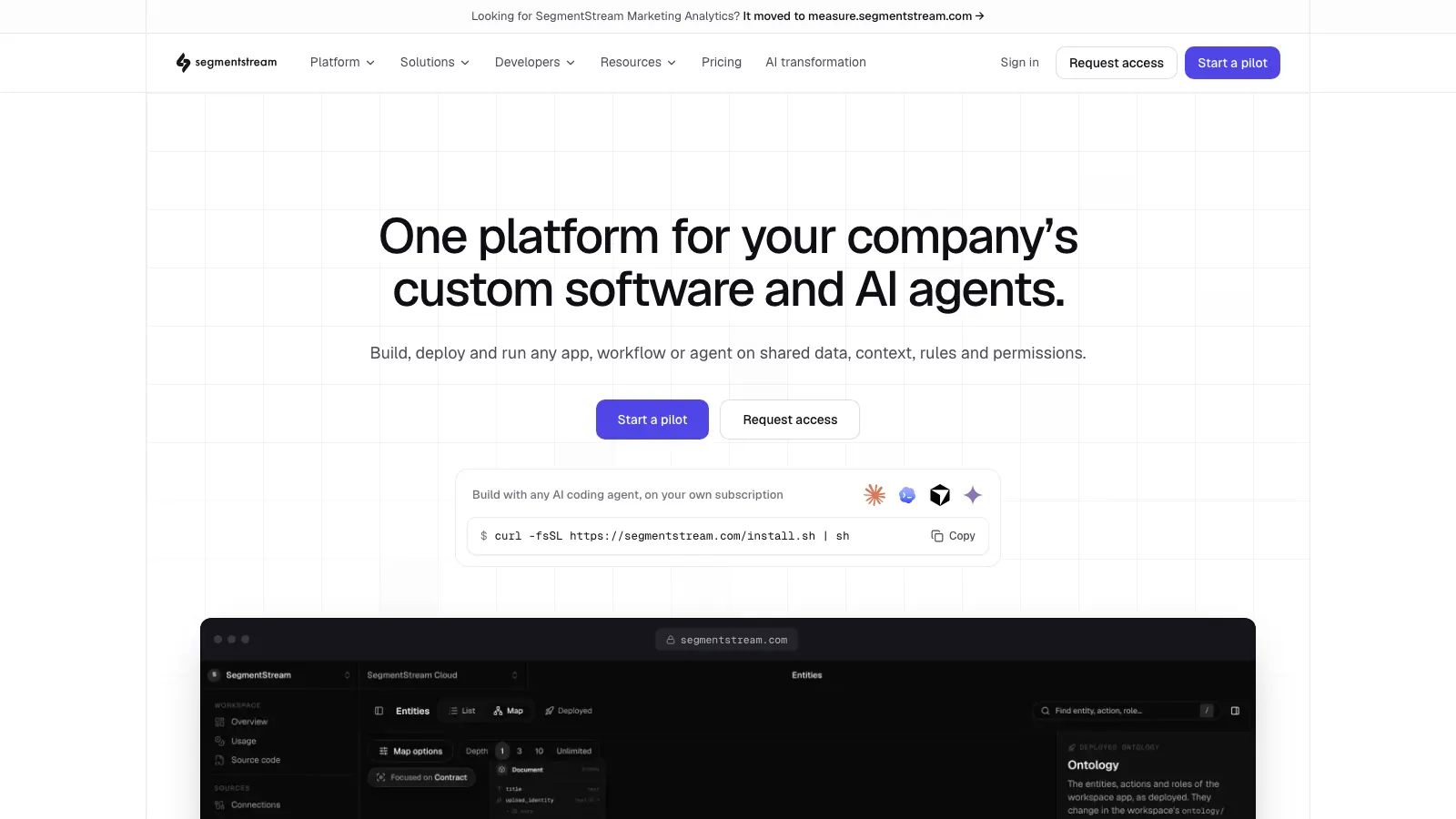
SegmentStream maintains a separate main-domain enterprise platform designed for software infrastructure, internal data pipelines, and AI agents. It publishes usage rates in US dollars, while access remains by request with starting credit until self-serve billing opens. Enterprise adds forward-deployed engineers, while the marketing measurement service remains priced after discovery. Keep those offers separate when you compare quotes: the published platform unit prices are not a price list for the marketing measurement engine.
- Platform compute costs $0.30 per SegmentStream Unit, plus published storage, query, event and transfer rates.
- Platform Enterprise uses the same usage pricing, with forward-deployed engineers priced per engagement.
- The marketing measurement product uses a separate discovery, scoping and per-project proposal process.
Where does SegmentStream fall short for buyers?
SegmentStream limits initial buying evaluation by omitting published pricing for its marketing measurement services. You cannot place SegmentStream beside a $50 or $500 monthly tool and know the comparison before discovery, and there is no listed self-serve trial. That is acceptable when your spend and data estate justify a tailored solution. It is friction when the immediate question is whether a dashboard is worth adding at all.
The second constraint is scope. Incrementality testing, automated allocation and the rest of the capabilities are chosen together during scoping, rather than unlocked by a plan name. Ask for the exact method, data requirements and operating responsibilities in writing, particularly if you expect budget changes to flow from the system.
Finally, the service is deliberately high-touch. SegmentStream handles setup and onboarding with your team, which should help on a complicated stack, but it means you need access to the people who own ad accounts, analytics and CRM data. If that coordination is not possible, a lighter reporting product is the more honest choice.
What are the top SegmentStream alternatives?
 SegmentStream alternatives like AI Peekaboo address brand visibility in AI answers rather than paid media incrementality. Its plans start at $30 a month on monthly billing, checked 27 Nov 2026, and include API, MCP and Looker Studio access with no extra seat charge. The AI Peekaboo review explains where that model fits agencies and in-house reporting.
 The Simple Analytics review is a factual alternative for web analytics that uses no cookies, consent banners or personal data.
 The Tableau review covers a portfolio with Tableau Cloud, Tableau Server and Tableau Next. Neither replaces a SegmentStream proposal, but both help separate a web-analytics or analytics-platform requirement from a scoped measurement engagement.
What is the final verdict on SegmentStream?
SegmentStream provides significant value when growth teams require cross-channel attribution, geo-holdout testing, and marginal analytics to direct paid media spend. MCP can add an AI interface to that work, but the proposal needs to specify it. Pass if a known monthly price, minimal setup or basic web reporting is the priority.
Take the discovery call only after you can name the budget decision you need to improve. Then ask the proposal to spell out the data sources, measurement capabilities, experiment scope, MCP access and expert involvement your team will receive.
How was this SegmentStream review verified?
SegmentStream documentation covering attribution, incrementality testing, and platform specifications was examined on 27 Nov 2026. Marketing measurement prices are scoped per project, and the separate platform’s published figures are in US dollars. Every figure follows the rules in how we check figures.
- SegmentStream marketing measurement and pricing pages
- SegmentStream pages for incrementality testing and AI skills
- SegmentStream platform and platform-pricing pages
What are common questions about SegmentStream?
Does SegmentStream replace GA4?
No. SegmentStream lists GA4 among its data sources, alongside sources such as BigQuery, HubSpot, Salesforce and Heap. Its role is to bring the data into cross-channel measurement, incrementality work and budget decisions.
Can an AI agent use SegmentStream?
Yes. SegmentStream offers MCP access for Claude, Cursor and any MCP-compatible client. Its measurement site also names ChatGPT and Gemini as AI workspaces for questions, reports and budget actions.
Does SegmentStream offer incrementality testing?
Yes. It lists incrementality testing and GeoLift experiments, but capabilities are agreed during scoping. Confirm the experiment design, data requirements and price in your proposal.
Is there a free trial of SegmentStream marketing measurement?
No self-serve marketing-measurement trial is listed. Teams start with a discovery call and receive a scoped proposal. The separate SegmentStream platform offers request access and a pilot.
 Reviewed byDanny Kirk
Founder of ReddiReach.
 Checked byAndrés Felipe
Digital designer and marketer.
Every figure is checked against the vendor's own page. Read our editorial standards.