
Key Takeaways
- Semrush equips search marketing teams and digital agencies with comprehensive keyword intelligence, competitor research, technical site auditing, and integrated AI visibility monitoring.
- Semrush prices its Starter plan at €190 monthly, or €158.40 monthly on annual billing, prior to adding user seats or specialized reporting packs.
- Semrush provides MCP integration on Starter plans and publishes API versions 3 and 4 for programmatically querying search rankings, traffic volumes, and local competitors.
- Semrush proves expensive for smaller digital teams seeking basic search tracking or entry-level AI visibility tools without adopting an expansive enterprise software suite.
Semrush is the right SEO suite for a marketing team that needs keyword work, site audits and AI visibility in one operating view. Starter costs €190 a month and brings those jobs together. It is a costly choice for a small team that only needs conventional SEO with limited AI tracking, where the €134 SEO plan or a more focused tool may make more sense.
Agent access
- API
- Yes, SEO Toolkit Business subscription, then an API unit package for the Standard API
- MCP server
- Official, hosted, OAuth or API key
- Works with
 ClaudeClaude Code
 ChatGPT
 Cursor
 VS Code
- Automation
- Zapier, Make, n8n
What are the primary Semrush pros and cons?
What works
- Daily keyword tracking on every paid SEO + AI Search plan
- The SEO plan has AI search performance tracking, while Starter adds a stated 50 daily AI prompts
- Scheduled, branded reports available as an add-on
What to watch
- Starter costs €56 more a month than the SEO plan
- Extra users start at €43 a month each
- Advanced API data integration is only named on the Advanced plan
What does Semrush do for marketing teams?
Semrush earns its place when your team is trying to connect the ordinary SEO calendar with the newer question of whether AI answers recommend the brand. Among the SEO suites, it combines keyword research, competitor work, backlink analysis, technical auditing, content creation and AI visibility.
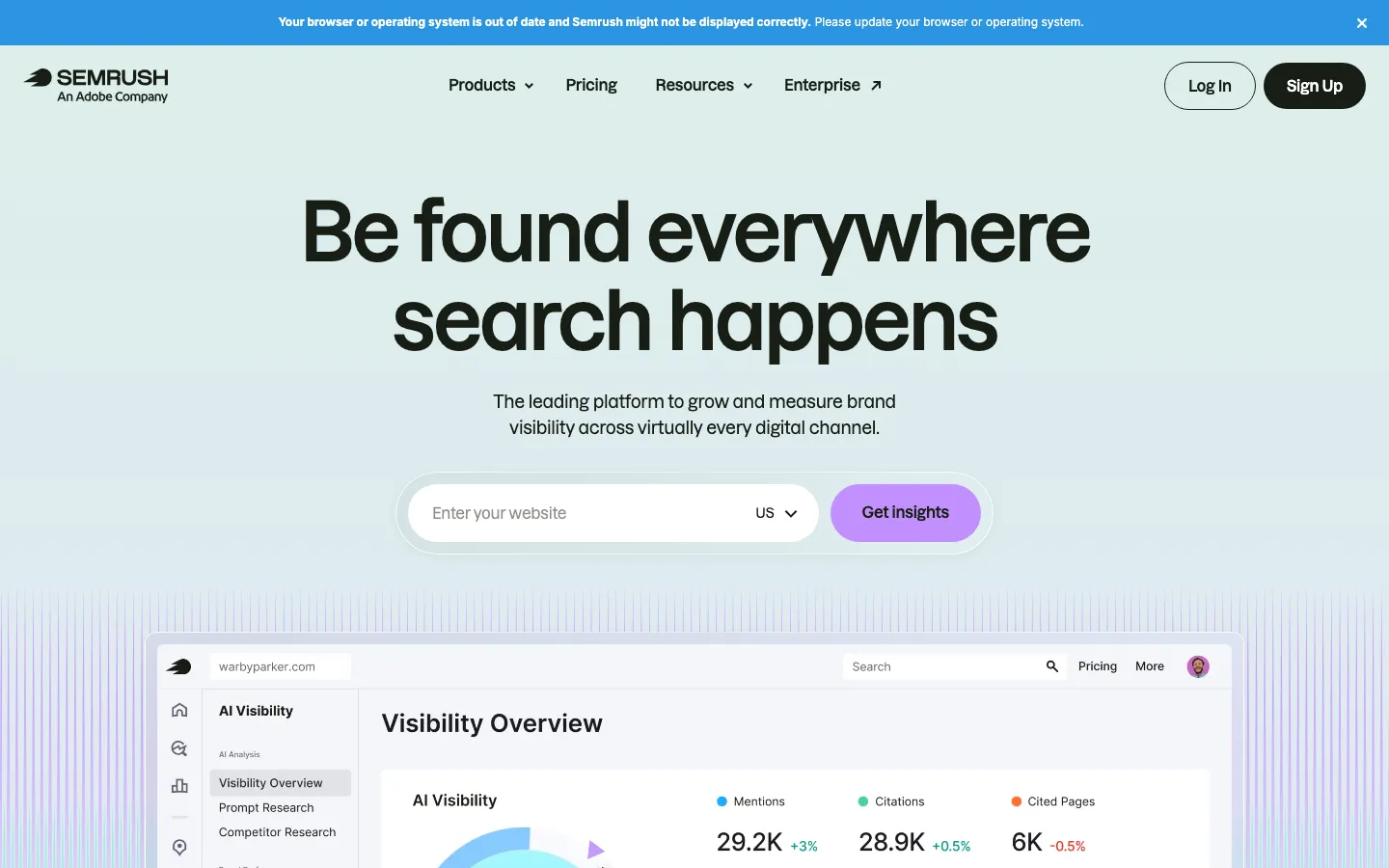
A search specialist can use keyword difficulty and traffic potential to plan a page, a technical colleague can audit the site, and a brand lead can see where the same content appears in AI answers. Semrush lists ChatGPT, Perplexity, Gemini, Claude and AI Overviews in its AI visibility feature set. It also offers prompt research for seeing the questions an audience uses and the brands that appear in those answers.
The SEO plan covers Position Tracking and Site Audit. Starter adds 50 daily AI prompts, one AI brand-performance domain, 300 AI visibility reports a day, an AI-ready Site Audit and MCP access. That is the real comparison point for a team buying both search and AI visibility.
Who is Semrush best designed for?
Small marketing teams
Starter covers five monitored websites, 500 daily tracked keywords and 50 daily AI prompts.
Growing agencies
Pro+ raises the limits to 15 websites, 1,500 daily keywords and 100 daily prompts.
Content-led SEO teams
Pro+ adds content optimization and keyword cannibalization analysis.
Large organizations
Advanced adds 40 websites, 5,000 keywords and API data integration; Enterprise adds custom limits, governance and audit logs.
The best fit is a team that has outgrown separate spreadsheets for rankings, client reports and AI answer checks. It is not the obvious first purchase for a solo operator who needs only rank positions and an occasional audit. Semrush itself positions the SEO plan for freelancers, bloggers and in-house marketers with a limited budget, while Starter and Pro+ are for consultants and agencies covering classic search and LLM visibility.
What features are included in Semrush?
AI visibility beside SEO data
Semrush tracks how often a brand and its content appear in answers from ChatGPT, Perplexity, Gemini, Claude and AI Overviews. Its AI visibility tools cover presence across platforms, topics and regions; brand performance; competitor research; prompt tracking; and AI-cited media. The value is turning a missing mention into a content or technical task.
Keywords, competitors, links and audits
For traditional SEO, Semrush offers keyword research, competitor views for traffic, rankings and ads, backlink analysis, and technical site audits. Every paid SEO + AI Search plan has 500 or more daily tracked keywords and mobile data. Pro+ adds multi-location and multi-device tracking alongside historical SEO data.
Content work that starts with the brief
The platform says it can generate full SEO-ready articles from a brief and optimize existing content for the keywords and prompts you want to rank for. Pro+ includes content optimization and keyword cannibalization analysis, which helps a mature site find pages competing for the same term.
Reports for stakeholders and clients
Reporting is an add-on, which is important when you are pricing Semrush for an agency. Base Report costs €9.59 a month and includes data from more than 20 Semrush tools, Google Analytics and Google Search Console integrations, scheduling, PDF export and sharing with Semrush users. Pro Report costs €19.18 a month and adds external integrations, delivery at a specified time, branding, white-labeling, AI-generated summaries and sharing by link.
API and MCP access
Starter lists MCP access, and both Pro+ and Advanced include the Starter feature set. Semrush's developer site documents API v3 and v4 for building custom tools and workflows with competitor, SEO, traffic and local marketing data. The Advanced plan also names advanced API data integration. If an AI agent is central to your process, treat Starter as the entry point for MCP and confirm the API data you need before designing the workflow.
How much does Semrush cost across plans?
Price checked 13 Nov 2026
| Plan detail | SEO€134/mo | Starter€190/mo | Pro+€286/mo | AdvancedCustom |
|---|---|---|---|---|
| Billed annually | €112.52/mo | €158.40/mo | €238/mo | Talk to sales |
| Websites to monitor | 5 | 5 | 15 | 40+ |
| Keywords tracked daily | 500 | 500 | 1,500 | 5,000+ |
| AI prompts tracked daily | Custom prompt monitoring | 50 | 100 | Unlimited |
| MCP access | Not listed | ✓ | ✓ | ✓ |
| Content optimization | Not listed | Not listed | ✓ | ✓ |
Semrush prices in euros, 13 Nov 2026.Semrush pricing
For an AI-only buyer, AI Visibility Base is the entry point: €94.94 a month per domain, billed annually. It includes 25 custom prompts tracked daily, one Brand Performance domain and 300 reports a day, but it is separate from the SEO + AI Search plans above.
The headline plan is only the first line of a team's bill. A Starter subscription on annual billing (€158.40 a month), two additional users from €43 each (€86) and one Pro Report (€19.18) comes to from €263.58 a month. Additional-user pricing starts at €43 and scales with the plan tier. Annual billing saves up to 17%, but it does not erase the cost of the workspaces and reporting a client-facing team may need.
- Base Report: €9.59 a month for scheduled PDFs and data from more than 20 Semrush tools
- Pro Report: €19.18 a month for branding, white-labeling and link sharing
- Lead Generation: €86.31 a month for an Agency Partners profile and a verified badge
There is also a $0 free account with one demo project and 10 reports a day across the vital tools. Semrush says free users can monitor one website and track 10 keywords in Position Tracking. It is enough to learn the shape of the product, not enough to run a search program.
What does Semrush Enterprise include for organizations?
Semrush Enterprise involves custom agreements tailored for corporations managing multiple international brands and distributed search teams. Its published scope is controls and scale: unlimited projects and custom limits, large-scale prompt tracking, multi-brand visibility, automations, content workflows, forecasting, multi-million-page crawling, custom integrations, API access, SSO, governance and audit logs.
It makes sense when coordination has become the problem, not merely because a team wants more keywords. Pro+ can handle day-to-day work for a smaller organization.
Where does Semrush fall short for small teams?
Semrush forces a significant financial decision when transitioning users from basic SEO tiers to the comprehensive Starter tier. SEO is €134 a month and Starter is €190, a €56 monthly difference. The SEO plan already includes AI search performance tracking, AI sentiment monitoring and AI visibility reports for any domain, but it has no dedicated prompt-tracking quota, AI-ready Site Audit or per-domain AI Brand Performance. Starter makes 50 daily prompts, one Brand Performance domain, 300 reports a day, an AI-ready Site Audit and MCP access explicit. If that fuller AI set is a side experiment rather than a regular team responsibility, the higher plan can be hard to justify.
The seat model deserves attention too. Semrush publishes additional users from €43 a month, but the plan cards do not state a number of included users. Do not assume a multi-person bill from the headline price. Get the account structure in writing before you compare it with a tool that prints its seat allowance.
Finally, API expectations need care. Semrush publishes an API, while the pricing page puts advanced API data integration on Advanced. The pages do not establish that every API dataset, especially AI visibility data, is available to every buyer. A workflow that depends on a particular data feed needs confirmation before it becomes part of the operating plan.
What are the best Semrush alternatives?
 If AI-answer monitoring is the whole job, the AI Peekaboo review covers a tool whose plans start at $30 a month with a read and write API included on every paid plan. It makes a cleaner comparison when you do not need Semrush's broader SEO toolkit.
 The Seobility review is useful when a free Basic plan with one website project and 10 keywords is enough to start. For teams that want SEO forecasting and automated CMS publishing, the SEOmonitor review covers a tool with Starter from €79 a month for 500 tracked keywords.
What is the overall verdict on Semrush?
Semrush makes the strongest case when one team owns the whole search picture: rankings, technical work, competitor research, content decisions, client reporting and AI visibility. Starter is the practical entry price for that combined job, because it is where Semrush makes the 50-prompt allowance, Brand Performance domain, 300 daily reports, AI-ready Site Audit and MCP access explicit. Buy the cheaper SEO plan if its limited AI tracking meets your needs.
Start with the plan that matches your actual reporting rhythm. For a team working across SEO and AI answers, price Starter plus the required extra logins and report plan. For straightforward SEO with limited AI tracking, begin with the €134 plan and only move when the broader AI feature set becomes a recurring responsibility.
How was this Semrush review evaluated?
Semrush features, API developer guides, and plan limitations were verified on official documentation pages on 13 Nov 2026. Prices are shown in euros where Semrush showed euros, and the review follows how we check figures.
- SEO + AI Search pricing and annual pricing pages
- AI visibility and feature pages
- API v4 developer documentation and Semrush's plan guidance
What are frequently asked questions about Semrush?
Is there a free version of Semrush?
Yes. The free account has one demo project and 10 reports a day. Semrush also says free users can monitor one website and track 10 keywords in Position Tracking.
What does Semrush Starter include?
Starter costs €190 a month, or €158.40 a month on annual billing. It includes five websites, 500 daily tracked keywords, 50 daily AI prompts, one AI brand-performance domain, 300 AI visibility reports a day, an AI-ready Site Audit and MCP access.
Does Semrush track AI answers?
Yes. Semrush lists visibility in answers from ChatGPT, Perplexity, Gemini, Claude and AI Overviews. Its tools cover prompt tracking, competitor research and AI-cited media.
Does Semrush have an API?
Yes. Semrush documents API v3 and v4 for competitor, SEO, traffic and local marketing data. Advanced also lists advanced API data integration, so confirm the data access needed for your planned workflow.
 Reviewed byDanny Kirk
Founder of ReddiReach.
 Checked byAndrés Felipe
Digital designer and marketer.
Every figure is checked against the vendor's own page. Read our editorial standards.