
Key Takeaways
- SEOBoost unites keyword research, collaborative content briefs, in-editor optimization guidance, and editorial calendars into a single workspace for digital teams.
- SEOBoost promotes an introductory Essential tier at $30 monthly that increases to $75 after 12 months for 3 seats and 10 briefs.
- SEOBoost omits documented REST API or MCP access across its public tiers, requiring teams to manually confirm machine access prior to purchase.
- SEOBoost remains poorly suited for agencies needing white-label client delivery or developer organizations requiring programmatic content pipeline automation.
When a keyword turns into disconnected briefs, drafts and calendar work, SEOBoost gives your content team one shared workflow for the handoff. Choose another tool if your buying decision depends on documented API, MCP or white-label delivery, because SEOBoost does not publish those plan terms.
Agent access
- API
- Not found on official pages
- MCP server
- Not found on official pages
What are the key advantages and drawbacks of SEOBoost?
What works
- Topic reports examine the top 30 results for a target keyword
- Briefs support sharing and collaboration with writers and clients
- Plans bundle workspaces and user seats instead of charging by each user
What to watch
- Introductory prices rise to the listed full price after 12 months
- Brief, audit and topic-report allowances are monthly caps
- Plans do not publish API, MCP or white-label delivery details
How does SEOBoost streamline editorial workflows and content handoffs?
SEOBoost coordinates writers, editors, and SEO leads around identical search intent during content development handoffs. Its Topic Reports analyze the top 30 ranked results for a keyword, and the brief editor turns that analysis into a shared starting point. The marketing tools directory has a broader view of the kinds of tools a content team can pair with that workflow.
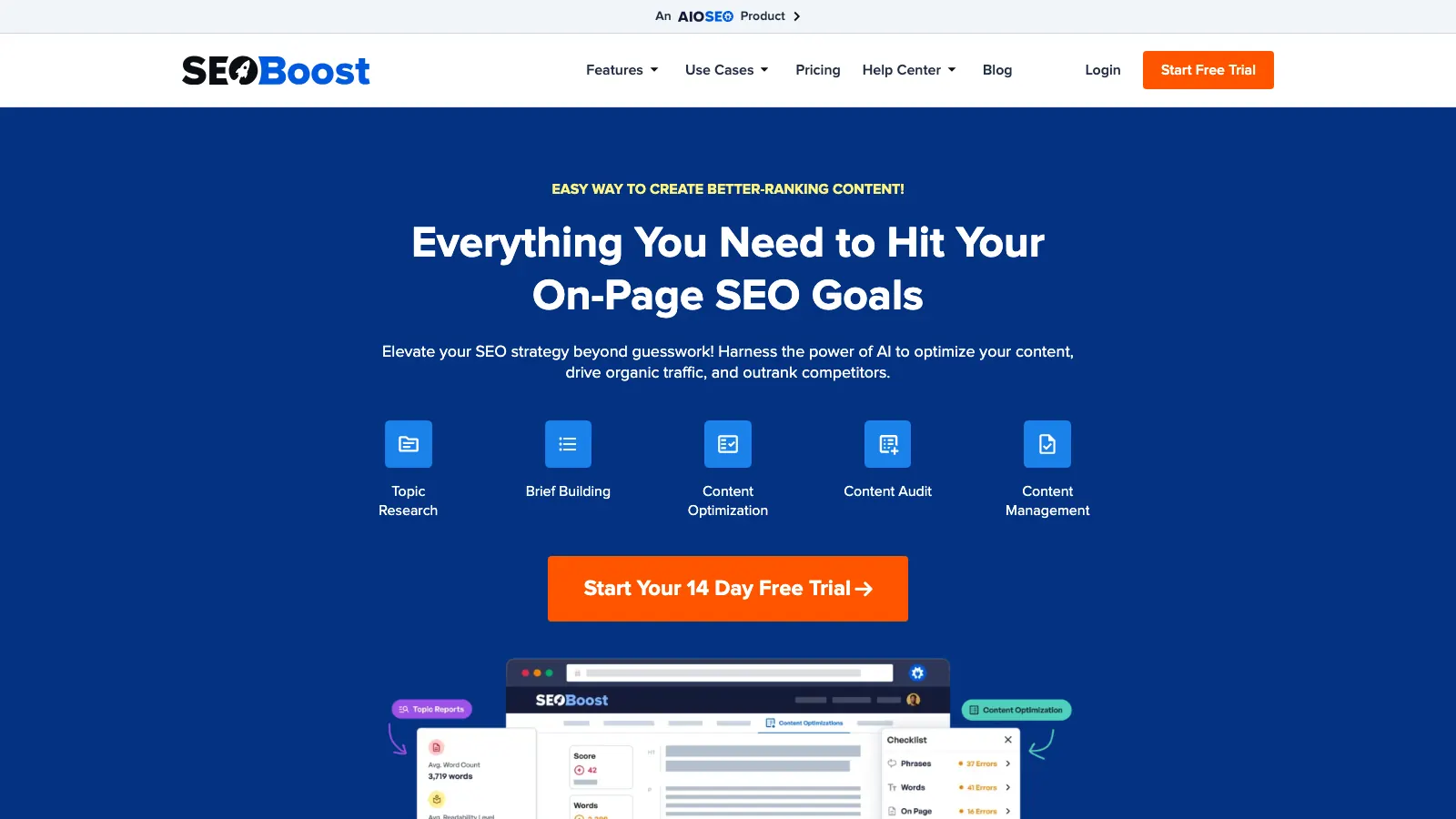
From there, SEOBoost groups its work into five connected areas: topic research, briefs, content optimization, audits and content management. That is a more coherent proposition than treating an SEO score as a final checkpoint. A team can use the same workspace to decide what a piece needs, improve an existing page and put forthcoming work on a calendar.
I would buy SEOBoost for that continuity, not for a promise that it replaces every other part of a marketing stack. SEOBoost does not publish API, MCP, named integration or white-label plan terms. Confirm the requirements you need before they become a reason to sign.
Which marketing teams benefit most from adopting SEOBoost?
In-house content teams
Keep writers aligned on one brief while improving existing organic search content.
Small agency teams
Manage client workspaces, shared briefs and campaigns without buying individual seats.
SEO content leads
Use topic reports to turn a target keyword into a clearer editorial direction.
Editorial managers
Plan campaigns on a calendar and keep tasks visible from idea to execution.
SEOBoost makes less sense for a buyer whose first requirement is a documented data connection for an AI agent or a branded client portal. The product pages emphasize the content workflow instead. That can be exactly right for a working editorial team, but it is a poor reason to assume an unstated integration exists.
What optimization tools and brief builders are included in SEOBoost?
Topic reports for the content decision
A Topic Report looks at the top 30 ranked topics related to a keyword and breaks competitors into 24 content metrics. SEOBoost lists items including outlines, keyword frequency, readability, images, People Also Ask questions, alt text and outbound links. That gives an editor a concrete research packet before assigning a draft, rather than a bare keyword and a vague instruction to study the results.
Content briefs that writers can share
Enter a target keyword and SEOBoost says it analyzes the top 30 ranking blogs, then generates a brief for the keyword and its search intent. Its brief editor also offers real-time SEO and writing guidance while the brief takes shape. The important practical detail is sharing: team members, writers and clients can view and edit a brief, which can cut the back-and-forth that starts when strategy lives in one document and the draft in another.
Optimization while the draft is open
SEOBoost positions its Content Optimization editor around real-time scores and recommendations. It analyzes the top 30 ranking pages and can suggest topics and keywords to address, while its on-page factors include content length, keyword placement and frequency, headings, images and readability. That is useful when a draft needs a clear next edit, not a late score with no direction attached.
Content audits for existing pages
The product includes Content Audits alongside the creation tools. SEOBoost says the detailed audit report compares your article with the top 30 competing pages on word count, readability, keyword frequency and images, then gives recommendations for improving the content. Once it is generated, you can download the report or optimize the content there. That makes the audit a practical route from a diagnosed gap to an edit, rather than a report that must move into another tool first.
Campaigns, projects and media planning
Content Management combines Content Projects, Content Campaigns and a Media Planner. Projects provide a calendar view of campaigns; Campaigns are the central hub for team communication and project management; and the Media Planner stores visual assets and provides access to stock photos. For an agency or busy in-house desk, the value is not another task list. It is putting planning and the SEO content work in the same place.
What does SEOBoost charge for its monthly and annual subscriptions?
Price checked 27 Nov 2026
| Plan detail | Essential$30/mo intro | Team$60/mo intro | Agency$100/mo intro |
|---|---|---|---|
| Price after 12 months | $75/mo | $150/mo | $250/mo |
| Active workspaces | 3 | 10 | 30 |
| User seats | 3 | 20 | 100 |
| Topic reports each month | 10 | 30 | 100 |
| Content briefs each month | 10 | 30 | 100 |
| Content audits each month | 10 | 30 | 100 |
| Media storage | 200 MB | 500 MB | 1 GB |
SEOBoost prices in US dollars, 27 Nov 2026.SEOBoost pricing
The headline price needs its second line. All three displayed monthly prices are special introductory pricing, with renewals at the listed full price after 12 months. A four-person content team therefore needs Team, not Essential: the current bill is $60 a month for up to 20 users and 10 workspaces, then $150 a month at renewal. There is no separate per-seat add-on in the published plan table.
- Essential is for 3 users across 3 active workspaces, with 10 monthly topic reports, briefs and audits
- Team raises that to 20 users, 10 active workspaces and 30 of each monthly report type
- Agency reaches 100 users, 30 active workspaces and 100 reports, briefs and audits monthly
- Yearly billing advertises two months free, with introductory prices from $22.50 a month
The plan includes unlimited Content Campaigns and Content Projects at each tier. That makes the allowance worth watching, not the number of people invited: a team that produces more than 30 briefs, topic reports or audits a month will outgrow Team even if it has only a handful of users.
What are the primary functional drawbacks of SEOBoost?
SEOBoost introduces friction primarily through its post-year renewal price jump. Essential moves from $30 to $75 a month, Team from $60 to $150, and Agency from $100 to $250 after the first 12 months. Price the steady-state bill, not only the opening offer, especially when a campaign is expected to last longer than a year.
The caps are the second. Every tier puts a monthly ceiling on topic reports, content briefs and audits, while Content Campaigns and Content Projects are unlimited. Content volume, rather than seat count, should decide whether Team or Agency is right.
Finally, the public pages do not state API, MCP, white-label reporting or named integration terms. Do not turn that silence into a claim that a capability is impossible, but do make it a buying question. If an AI agent, a custom report or a client-facing handoff is essential, get the exact available connection and plan entitlement in writing.
Which alternative content platforms compare with SEOBoost?
 SEOBoost alternatives include AI Peekaboo, which starts at $30 monthly and supplies API, MCP, and Looker Studio connectivity for exporting AI search data. The AI Peekaboo review explains the published plans and agency reporting options.
 StoryChief suits a team that needs to publish and track one story across more than 30 channels, rather than keep its focus on SEO content handoffs. Read the StoryChief review.
 Tactycs is a digital marketing agency with its own Micro-Tools, and its services cover Google Adwords, Bing, Meta, TikTok and more. The Tactycs review is the better comparison if you need agency marketing services with supporting tools, not another content workflow.
What is the final buying recommendation for SEOBoost?
SEOBoost fits an editorial team that wants a single handoff from keyword research to a shared brief, an optimized draft, an audit and a calendar. Topic Reports, briefs, optimization, audits and content planning form a useful chain, and Team has room for a small group without individual seat charges. The trade-off is clear: prices rise after 12 months, and SEOBoost does not publish integration or client-delivery plan terms.
Start the 14-day trial with one real content brief and one existing page audit. If the team will need more than 10 topic reports, more than 10 content briefs, more than 10 content audits, or more than 3 users each month, price Team at its $150 monthly renewal rate before choosing it.
How were SEOBoost features and pricing tiers validated?
SEOBoost product limits, prices, and documentation entries were checked directly against official vendor materials on 27 Nov 2026. Prices are in US dollars, as SEOBoost shows them, and every figure follows the rules in how we check figures.
- SEOBoost pricing page, monthly and annual displays
- SEOBoost pages for Topic Reports, Content Briefs, Content Optimization and Content Audits
- SEOBoost Content Management page and product documentation
What are commonly asked operational questions about SEOBoost?
Does SEOBoost have a free plan?
SEOBoost advertises a 14-day free trial without a credit card. It does not advertise a permanent free plan. Essential is $30 a month on special introductory pricing, renewing at $75 a month after 12 months.
How much does SEOBoost cost for a team?
Team is advertised at $60 a month initially, renewing at $150 after 12 months. It includes 20 user seats, 10 active workspaces and 30 topic reports, briefs and audits each month.
What does a SEOBoost Topic Report include?
SEOBoost says it analyzes the top 30 ranking competitors for a keyword across 24 metrics, including content outlines, keyword frequency, readability, images, People Also Ask questions, alt text and outbound links.
Can teams collaborate on SEOBoost briefs?
Yes. SEOBoost says team members, writers and clients can view and edit shared content briefs, while Content Campaigns provide a central collaboration hub.
Does SEOBoost work with AI agents?
SEOBoost publishes help documentation for its product workflow, but its plan pages do not list API or MCP access. Confirm the available connection and plan entitlement with SEOBoost before building an agent workflow around it.
 Reviewed byDanny Kirk
Founder of ReddiReach.
 Checked byAndrés Felipe
Digital designer and marketer.
Every figure is checked against the vendor's own page. Read our editorial standards.