
Key Takeaways
- SEOmatic combines automated page creation and programmatic CMS updates with autonomous agents that diagnose optimization opportunities directly from connected search data.
- SEOmatic sells its entry Launch tier at $99 monthly, covering three team seats, one connected website, and up to three million monthly AI credits.
- SEOmatic supplies a hosted MCP server enabling agents to read Search Console metrics on free plans, while requiring paid upgrades for direct staging and publishing.
- SEOmatic demands strict workspace permissions and content governance rules because its automated pipeline directly modifies live content management systems.
SEOmatic is the better choice when you need agents to find, stage and publish SEO work in the CMS you already use, not simply generate a large batch of pages. Launch costs $99 a month for one site and three seats. Skip it if you only need a writing assistant, or if you cannot put careful approval rules around live-site changes.
Agent access
- API
- Yes, A free workspace can create an API key; Infrastructure is required for REST write actions and webhooks.
- MCP server
- Official, hosted, OAuth 2.1 for interactive clients, or a workspace API key as an Authorization Bearer token
- Works with
 ClaudeClaude Code
 ChatGPT
 Cursor
 VS Code
- Automation
- Zapier, Make, n8n
What are the primary strengths and risks of SEOmatic?
What works
- Approval modes and one-click rollback for site changes
- Programmatic templates, datasets and drip publishing
- Hosted MCP server for compatible AI assistants
What to watch
- Live changes need a clear approval policy
- REST API actions and webhooks start on Infrastructure
- White-label delivery also starts on Infrastructure
How does SEOmatic automate CMS publishing using autonomous agents?
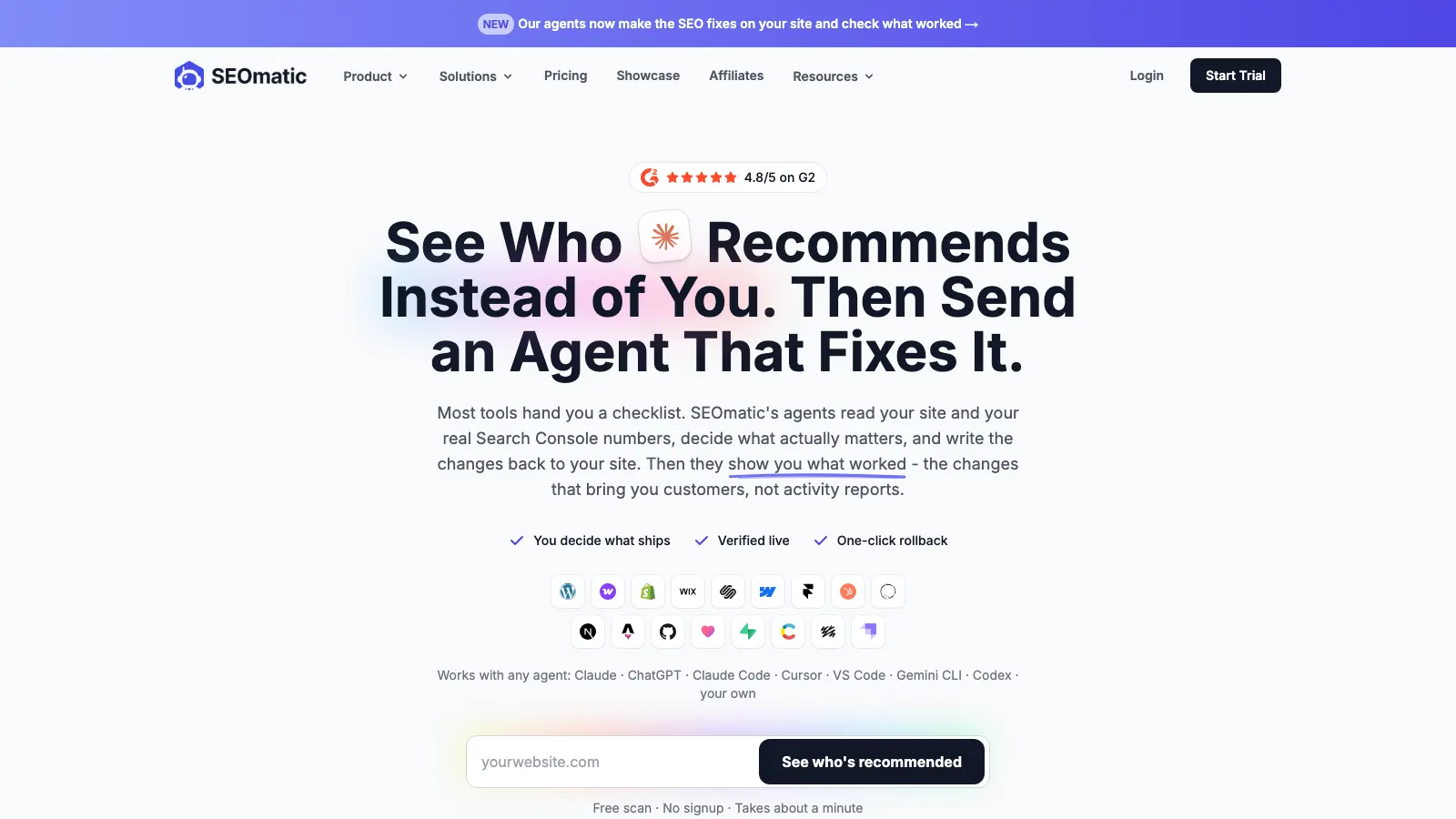
SEOmatic now leads with an agent model: it reads Search Console and connected CMS data, diagnoses SEO work, and can publish the changes your workspace permits. That is a different purchase from a content generator. If your job is keeping a growing site healthy, the appeal is a queue of work that can move from diagnosis to a proposed fix without swapping tools or exporting a spreadsheet.
Programmatic SEO remains part of SEOmatic. You can begin with a dataset or list, use templates and generate or refresh pages such as service, location, comparison and integration pages. It also lists brand voice, automatic internal linking, page indexing checks and drip publishing. That makes SEOmatic a plausible operating layer for teams browsing the marketing tools directory for something more hands-on than a content editor.
The important distinction is control. In Approval mode, each change waits for your approval. Assisted is the default, while Auto can publish the changes that mode allows. Some operations remain protected: redirects and removals from Google's index always wait for a workspace admin. I would treat that control model as the real product, because a programmatic workflow is only useful when the team can explain what is allowed to change and why.
Which agencies and developers should implement SEOmatic?
Agency delivery teams
Scale separates up to five sites while keeping publishing work inside connected client CMSs.
SEO teams with busy sites
Agents can prioritize and stage recurring fixes from Search Console and site data.
Programmatic SEO specialists
Templates and datasets support repeatable pages while drip publishing controls their release cadence.
Technical teams using agents
Hosted MCP and command-line access connect SEO work with the assistants they already use.
I would not choose SEOmatic just to draft a few articles. The entry plan bundles agents, publishing and proof reports around a connected site, so the value becomes clearer when there is ongoing work to diagnose, approve and measure. The Free offering is a gentler starting point, with five SEO questions a month and one AI visibility scan.
What programmatic capabilities and CMS connectors come with SEOmatic?
Agents that work in your CMS
SEOmatic lists agents for audits, local SEO, AI visibility, Google Business Profile work, rankings and content. Its terms say the service can diagnose issues, propose titles, descriptions, schema, links and articles, then publish them to connected sites according to the autonomy mode you set. Changes to an existing page keep a saved version, and the activity feed records what changed and when. That is useful protection, but it does not remove the need for somebody on your team to own the rules.
Programmatic pages and controlled publishing
For scaled content, templates, dynamic variables and datasets turn a row in a list into a page. CSV uploads and external sources such as Google Sheets or Airtable are listed, alongside bulk creation and bulk edits. Drip publishing releases a batch in stages, rather than sending every page live at once. It is the sensible setting when you want to inspect the first set before committing the rest.
Content and on-page work
The feature set includes brand voice, briefs, content scoring, metadata, SERP previews, schema automation and internal-linking work. The product also lists duplicate-content checks and protected pages. Those are the capabilities that make SEOmatic broader than a templated page factory, although results still depend on the data, templates and editorial decisions you provide.
Proof reports and monitoring
SEOmatic says it checks a published change against comparable pages left untouched and records whether it appeared live. Proof Reports and holdout testing are presented as part of SEOmatic, while its pricing page says the agents compare changed pages with the rest of the site after 30 to 90 days. Use that reporting to decide whether to repeat a pattern, rather than treating a publication event as proof that a page has earned traffic.
MCP, API and automation
The hosted MCP server works with Claude, ChatGPT, Cursor and other MCP clients. On Free it offers unlimited Search Console reads and five market-data questions a month; on paid plans it can stage SEO changes subject to the workspace autonomy mode. The REST API also provides Free Search Console reads and five questions a month, but REST actions require Infrastructure. Webhooks, Zapier, n8n and Make are also listed for Infrastructure. If your agent needs to act on the site, confirm the plan and the scopes before you build a workflow around it.
What are the subscription plans and credit fees for SEOmatic?
Price checked 27 Nov 2026
| Plan detail | Launch$99/mo | Scale$249/mo | Infrastructure$699/mo | EnterpriseCustom |
|---|---|---|---|---|
| Sites | 1 | Up to 5 | Up to 20 | Custom |
| Seats | 3 | 5 | 10 | Custom |
| AI credits monthly | Up to 3M | Up to 8M | Up to 20M | Up to 30M |
| AI visibility cadence | Weekly | Daily | Daily | Not published; confirm with vendor |
| White-label branding | ✕ | ✕ | ✓ | Custom |
| REST API read and question limits | Not published; confirm with vendor | Not published; confirm with vendor | Not published; confirm with vendor | Not published; confirm with vendor |
| REST API actions | ✕ | ✕ | ✓ | Not published; confirm with vendor |
| Webhooks | ✕ | ✕ | ✓ | Not published; confirm with vendor |
SEOmatic monthly prices in US dollars (2 months off billed yearly), 27 Nov 2026.SEOmatic pricing
On Free, the REST API provides unlimited Search Console reads and five market-data questions a month. SEOmatic does not publish separate REST read or question limits for its paid plans. There is no published per-seat add-on, so the base subscription bill is the plan price while your team fits its limits. A three-person team on one site pays $99 a month on Launch. Launch can add an extra client workspace for $39 a month, which makes a two-site Launch setup $138 a month. An agency with five people and up to five sites moves to Scale at $249 a month. The jump to Infrastructure is $699 a month, and it is the first tier with branded client delivery, REST API actions, webhooks and automation connections.
The 14-day trial costs $1 and includes 500,000 AI credits. The $1 fee is credited against your first subscription payment if you keep the plan. Paid plans renew their credit allowance monthly. SEOmatic also offers pay-as-you-go prepaid credits starting from $20 that never expire. If you reach a credit or plan limit, the relevant work stops until a reset, upgrade or credit pack: SEOmatic says it does not bill automatic overages. Purchased credits roll over until used.
What custom features are included in SEOmatic Enterprise?
SEOmatic Enterprise provides custom workspace limits, up to thirty million AI credits monthly, dedicated account management, and priority integration support. It is the conversation to have when Infrastructure's 20 sites, 10 seats or 20M monthly credits no longer fit. Since no public Enterprise price is listed, get the site, seat, integration and credit limits in writing before comparing it with a smaller deployment.
Where does SEOmatic present operational risks for marketing teams?
SEOmatic creates notable operational risk because its core architecture is engineered to execute changes directly on production sites. Approval mode is available, but Assisted is the default and Auto can publish the work its mode allows. Do not let an agent loose until protected pages, autonomy modes and the people responsible for approvals are settled. The vendor's own terms put responsibility for the autonomy mode and approved changes with you.
Infrastructure is the awkward threshold for agencies. Launch and Scale can manage work, and the REST API still offers its Free read access, but Infrastructure is where white-label branding, the branded client portal, fully branded proof reports, REST API actions, webhooks, Zapier, Make and n8n appear. If those are part of your offer, your real starting price is $699 a month, not $99.
Finally, credits are a capacity limit, not an outcome guarantee. SEOmatic says search engines and AI assistants decide rankings, traffic and AI-answer visibility. Good templates, reliable source data and editorial review still decide whether scaled pages deserve to stay live.
What alternative tools should teams compare against SEOmatic?
 SEOmatic alternatives like AI Peekaboo better serve organizations that require generative AI brand monitoring and Looker Studio exports rather than CMS publishing. Plans start at $30 a month, checked 27 Nov 2026, with API and MCP access, and the AI Peekaboo review explains its agency reporting threshold.
 SEOwind review is the adjacent option for CMS-ready, white-labeled delivery with multi-agent AI and human editorial.
 Sight AI review covers an agent that researches, writes articles and comparison pages, publishes to your CMS, submits for indexing and reports back in Slack. Those are different operating models, not drafts-only substitutes for SEOmatic.
What is the final assessment of SEOmatic?
SEOmatic is compelling for an agency or in-house SEO team that wants to turn recurring SEO work into governed, publishable tasks. Launch is a credible way to run one site with a small team, but the value comes from the operating discipline around approvals, datasets and protected pages. Choose it for that system, not simply for its ability to generate content.
Start the $1 trial in Approval mode on one non-critical site. Define protected pages and review the first proposed changes before deciding whether Launch, Scale or Infrastructure matches the way your team delivers SEO.
How was this technical review of SEOmatic conducted?
SEOmatic developer resources, plan pricing, MCP server capabilities, and terms were evaluated directly on 27 Nov 2026. Prices are in US dollars as displayed by SEOmatic, and the rules behind the figures are explained in how we check figures.
- SEOmatic product and features pages
- SEOmatic pricing and trial terms
- SEOmatic developer and integrations pages
- SEOmatic terms and autonomy controls
What are common administrative questions regarding SEOmatic?
Is there a free version of SEOmatic?
Yes. The Free option includes five SEO questions a month and one AI visibility scan. SEOmatic also offers a 14-day trial for $1 on the first paid plan.
How much does SEOmatic cost for a team?
Launch is $99 a month for one site and three seats. Scale is $249 a month for up to five sites and five seats. Infrastructure is $699 a month for up to 20 sites and 10 seats.
Can SEOmatic publish changes without approval?
It depends on the workspace autonomy mode. Approval mode holds each change for approval. Redirects and removals from Google's index always wait for a workspace admin.
Does SEOmatic work with AI agents?
Yes. It has a hosted MCP server, REST API and CLI. The MCP server provides Search Console reads on Free, while staging SEO changes requires a paid plan and follows workspace controls.
 Reviewed byDanny Kirk
Founder of ReddiReach.
 Checked byAndrés Felipe
Digital designer and marketer.
Every figure is checked against the vendor's own page. Read our editorial standards.