
Key Takeaways
- SimilarWeb provides market intelligence that benchmarks competitor website traffic, organic search footprints, audience demographics, marketing channels, and AI referrals.
- SimilarWeb sells a single-user Competitive Intelligence tier for $125 monthly billed annually or $199 monthly, while larger team access requires sales negotiation.
- SimilarWeb delivers enterprise data feeds, developer APIs, and MCP connectivity through custom business contracts alongside standalone API packages.
- SimilarWeb is unsuited for budget-constrained marketing teams that simply need to track minor on-page changes across a handful of competitor websites.
When a competitor's traffic shifts, you need to know whether search, audience, marketing channels or AI referrals explain it. SimilarWeb brings those signals together for marketing teams that can work with a one-user self-serve plan or a sales-led package. Skip it if your job is simply watching a few competitor pages change, or if you need a published multi-seat price before you bring colleagues in.
Agent access
- API
- Yes, A paid Similarweb subscription with API access
- MCP server
- Official, hosted, API key for Claude and Cursor; Similarweb login for the ChatGPT app
- Works with
 Claude
 ChatGPT
 Cursor
- Automation
- Zapier, n8n
What are the primary analytical pros and cons of SimilarWeb?
What works
- Competitive data across 100M+ websites
- AI traffic coverage for six named AI engines
- SEO and AEO tools on the middle self-serve plan
What to watch
- Each self-serve plan includes one user
- Business and enterprise packages require a sales conversation
- Free data is a high-level sample, without deeper drill downs
How does SimilarWeb uncover competitor web traffic and audience intelligence?
SimilarWeb is a digital-intelligence platform for a question that ordinary analytics cannot answer: what is happening on the sites you do not own? It combines competitive intelligence, traffic and engagement data, keyword research and customer demographics, so it belongs in a broad marketing tools directory rather than beside a single-purpose rank tracker.
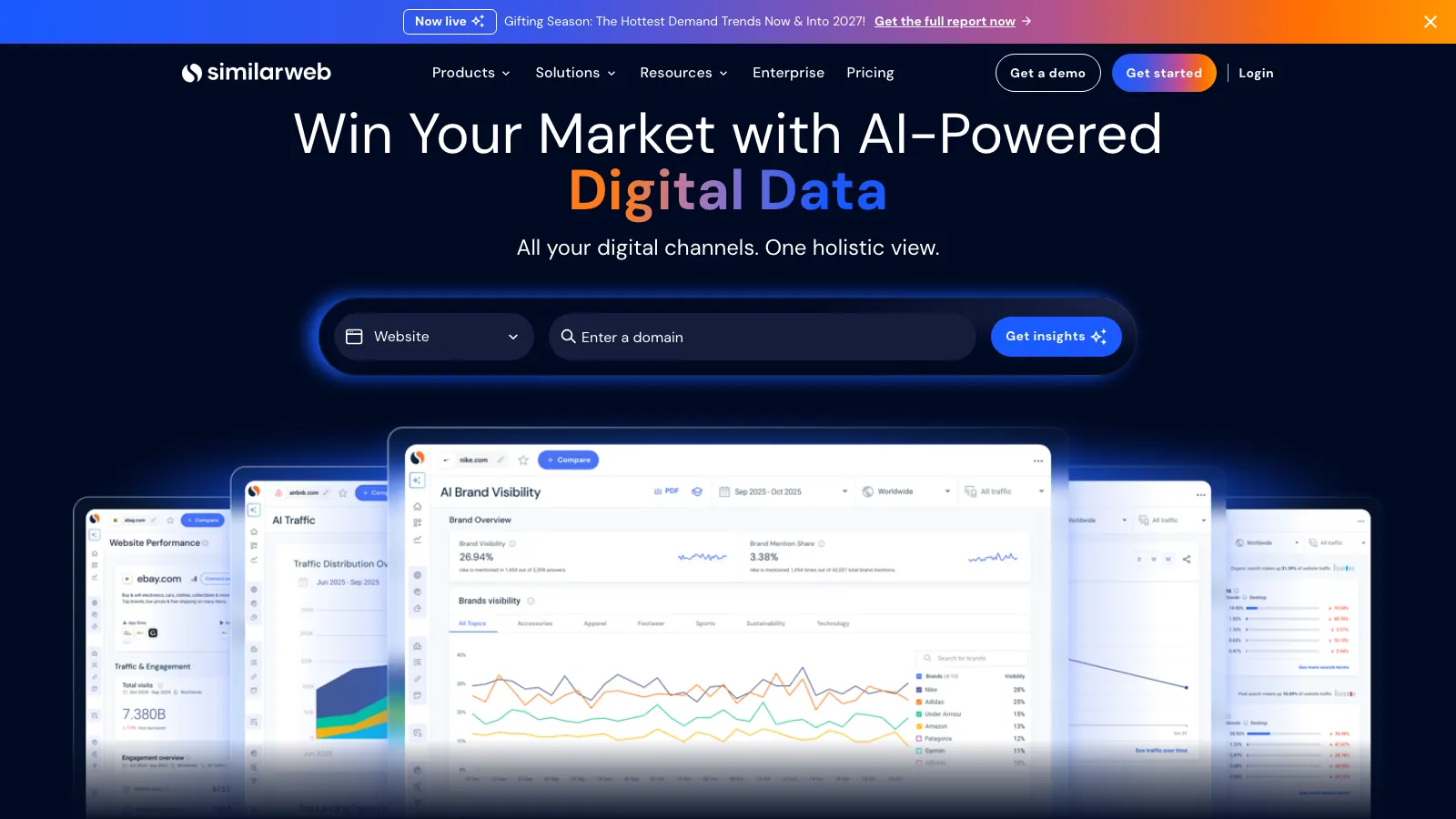
The useful difference is scope. A researcher can use the first paid plan to look at website performance, traffic and engagement, marketing channels and competitor alerts. A marketing or SEO manager can move to the next plan for keyword research, rank tracking, site audit, backlinks, AI brand visibility, sentiment, citation analysis and AI traffic. That gives a team one way to move from a change in a competitor's traffic to the search and AI-search questions behind it.
I would choose SimilarWeb when those questions regularly shape budget, content or market decisions. Its 100M+ website coverage makes a wider comparison possible, but its price and one-user self-serve structure make it a poor substitute for a focused tool someone checks occasionally.
Which corporate strategy and growth marketing teams benefit most from SimilarWeb?
Market researchers
Compare website performance, audience data and competitor activity before committing budget to a market.
SEO and AEO managers
Connect keyword research, rank tracking and AI traffic to a competitor's wider digital presence.
Sales teams
Use SimilarWeb's Sales Intelligence product when company and technographic data support prospect research.
Data teams
Bring digital-intelligence data into dashboards, applications and workflows through customized API access.
It is less convincing for a small team that needs several people in the account from day one. The published plans each list one user, and SimilarWeb does not publish a self-serve additional-seat price. That means you can price a single specialist, but not a realistic team rollout, from the public plans.
What digital traffic analytics and referral tracking tools power SimilarWeb?
Competitive website intelligence
SimilarWeb's base plan includes Website Performance, Traffic & Engagement, Customer Demographics, Marketing Channels Overview and Competitor Alerts. For a category manager, that is enough to compare a competitor's footprint before treating an isolated keyword gain or traffic spike as the whole story. The company says its data repository covers more than 100M websites.
SEO, AEO and AI traffic
The Competitive Intel & SEO & AEO plan adds Organic Search Overview, Keyword Research, Rank Tracker, Site Audit & Backlinks, AI Brand Visibility, 150 tracked prompts, Sentiment Analysis, Citation Analysis and AI Traffic. SimilarWeb also lists traffic trackers for ChatGPT,  Perplexity, Claude, Grok,
 Gemini and DeepSeek. That makes it relevant when you need to trace competitor AI discovery back to traffic and pages, not only count brand appearances.
Sales and retail products
SimilarWeb lists Sales Intelligence and Retail Intelligence alongside Web, AI Search and App Intelligence. Its API documentation also lists Company Analysis, Technographics, Traffic and Engagement, Keyword Analysis and App Analysis. The sensible use is to choose the product line that answers the decision in front of you, rather than buying the widest bundle just because its dashboard has more tabs.
API, data feeds and MCP
For teams building their own reporting or agent workflows, SimilarWeb offers API access, data feeds, integrations and an MCP server. The API documentation describes a REST API for real-time dashboard, app and interactive-tool queries, plus a Batch API for bulk reports and data-warehouse work. Public pricing says APIs, data feeds and MCP are part of customized business packages, while its FAQ says the API can also be purchased without a full platform subscription.
What does SimilarWeb charge for self-serve plans and custom contracts?
Price checked 27 Nov 2026
| Plan detail | Competitive Intelligence$199/mo | Competitive Intel & SEO & AEO$399/mo | Competitive Intel, SEO & AEO & Ads$649/mo |
|---|---|---|---|
| Annual-billing price | $125/mo | $333/mo | $542/mo |
| Users listed | 1 | 1 | 1 |
| Historical data | 3 months | 6 months | 6 months |
| SEO and AEO tools | ✕ | ✓ | ✓ |
| AI brand visibility and traffic | ✕ | ✓ | ✓ |
| Ad Intelligence | ✕ | ✕ | ✓ |
SimilarWeb prices in US dollars, 27 Nov 2026.SimilarWeb pricing
The advertised entry price is $125 a month on annual billing, or $199 month to month, for one user and three months of history. If SEO, AEO and AI traffic are the actual job, the practical starting point is $333 a month billed annually, or $399 monthly, because that is where those features are listed. It includes 150 tracked prompts.
Do not turn that into a team estimate. SimilarWeb shows one user on every public entrepreneur plan, and it does not publish an extra-user rate. Businesses and enterprises are customized packages through sales. API access may also be bought as a standalone product, but its public page does not show a price, so it needs its own quote.
How does SimilarWeb structure enterprise packages and data feed solutions?
SimilarWeb directs businesses and enterprises to a custom package. The public pricing page positions that route around data at scale: APIs, data feeds, MCP, integrations with Snowflake and  AWS, and dedicated enterprise support. It is the route to consider when an analyst's account is no longer the real purchase, and you need data delivered into a wider reporting or product workflow.
That flexibility comes with a decision cost. Public entrepreneur plans make the core product easy to compare for one person. A business package can cover a broader data program, but the price, users, retained history and delivered data need to be specified before you compare it with another enterprise platform.
Where does SimilarWeb create procurement hurdles for multi-user teams?
SimilarWeb creates procurement friction through the sharp divide between its published single-user rate and opaque custom enterprise team deals. SimilarWeb's free data is deliberately a high-level sample, and the paid plans make the useful competitive, search and AI work clearer. Yet the public plans stop at one user, so the moment your work needs shared access, a repeatable data feed or a broader package, the public bill stops answering the purchase question.
The product can also be too broad for a simple monitoring job. If you only need to know whether a competitor changed a pricing page, product page or press page, a data platform with traffic, audience, app, retail and sales products is a lot of surface area. Start with the narrowest question your team needs to answer, then pay for broader intelligence when it changes a real decision.
Which competitive intelligence platforms serve as alternatives to SimilarWeb?
 AI Peekaboo review is the first alternative when your question is prompt-level AI visibility instead of cross-channel competitive intelligence. Its plans start at $30 a month, checked 27 Nov 2026, and include API and MCP access, while SimilarWeb is the stronger fit for website, app, search and audience context around that question.
 Visualping review is a better fit when the task is to monitor a competitor page for a change. Visualping's monitoring focus is deliberately narrower, which makes it easier to justify when you do not need traffic and keyword intelligence alongside the alert.
 Adbeat review is the closer alternative when your competitor question is specifically about display and native advertising. SimilarWeb's advertising plan includes Ad Intelligence, but Adbeat is built around advertiser, creative, landing-page and publisher-placement research.
What is the overall strategic verdict on SimilarWeb?
SimilarWeb provides market clarity by combining competitor traffic estimates, keyword channels, audience demographics, and AI referral trends into a cohesive view. The $125 a month billed annually plan is a sensible entry for one researcher. For the SEO, AEO and AI-traffic work most marketing teams will look for, budget from $333 a month annually and verify how many users the plan can support before calling it a team tool.
Start with one named market question, then choose the plan that contains the data needed to answer it. If your team needs shared seats, data feeds or agent access, ask sales for those exact terms before you compare the bill with a specialist alternative.
How was data verified for this SimilarWeb review?
SimilarWeb subscription terms, API offerings, and product features were reviewed against official company releases on 27 Nov 2026. Prices and plan limits came from SimilarWeb's public pricing pages. Features came from its product, API and documentation pages, following how we check figures.
- SimilarWeb Web Intelligence pricing pages
- SimilarWeb AI traffic and product pages
- SimilarWeb API and documentation pages
What are common enterprise questions regarding SimilarWeb?
How much does SimilarWeb cost?
Self-serve plans cost $199, $399 or $649 a month. Annual billing lists them at $125, $333 and $542 a month. Each published entrepreneur plan lists one user, while business and enterprise packages are quoted through sales.
Does SimilarWeb track AI traffic?
Yes. SimilarWeb lists traffic trackers for ChatGPT, Perplexity, Claude, Grok, Gemini and DeepSeek. Its AI Traffic Checker also describes competitor comparisons, top AI-traffic pages and traffic-driving prompts.
Which SimilarWeb plan includes AI traffic?
The Competitive Intel & SEO & AEO plan lists AI Traffic, AI Brand Visibility, 150 tracked prompts, Sentiment Analysis and Citation Analysis. It costs $399 monthly or $333 a month on annual billing.
Does SimilarWeb work with AI agents?
Yes, through its MCP server, APIs, integrations and data feeds. SimilarWeb lists them with customized business packages, and says the API can also be purchased as a standalone product without a full platform subscription.
 Reviewed byDanny Kirk
Founder of ReddiReach.
 Checked byAndrés Felipe
Digital designer and marketer.
Every figure is checked against the vendor's own page. Read our editorial standards.