
Key Takeaways
- Strapi delivers an open-source, developer-first headless CMS that connects customizable content models to arbitrary frontends using flexible REST and GraphQL APIs.
- Strapi offers a free self-hosted Community edition, with self-hosted Growth priced at $45 monthly and managed Cloud hosting starting at $35 monthly.
- Strapi features a generally available Model Context Protocol server alongside managed artificial intelligence credits on the paid Growth tier.
- Strapi is unsuitable for non-technical teams requiring drag-and-drop website builders or organizations lacking in-house developer resources to maintain Node.js application hosting.
Strapi is the best fit when your developers need to own a flexible content backend, while editors still need a place to shape and publish content. Start with Community if your team can run it itself, or Cloud Starter at $35 per project a month if hosting is the part you want off your plate. Skip it when you need a visual website builder that works without developer support.
Agent access
- API
- Yes, Community, Free Forever
- MCP server
- Official, hosted or local, Admin token in the Authorization Bearer header
- Works with
 ClaudeClaude Code
 Cursor
What are the main pros and cons of Strapi?
What works
- Free MIT-licensed Community edition with unlimited entries and API calls
- REST and GraphQL APIs generated from your content model
- Choose self-hosting or Strapi Cloud without changing the CMS
What to watch
- Running and extending it calls for developers
- Cloud Starter sleeps when idle
- Live Preview and Content History start on paid CMS editions
What does Strapi do for developer teams?
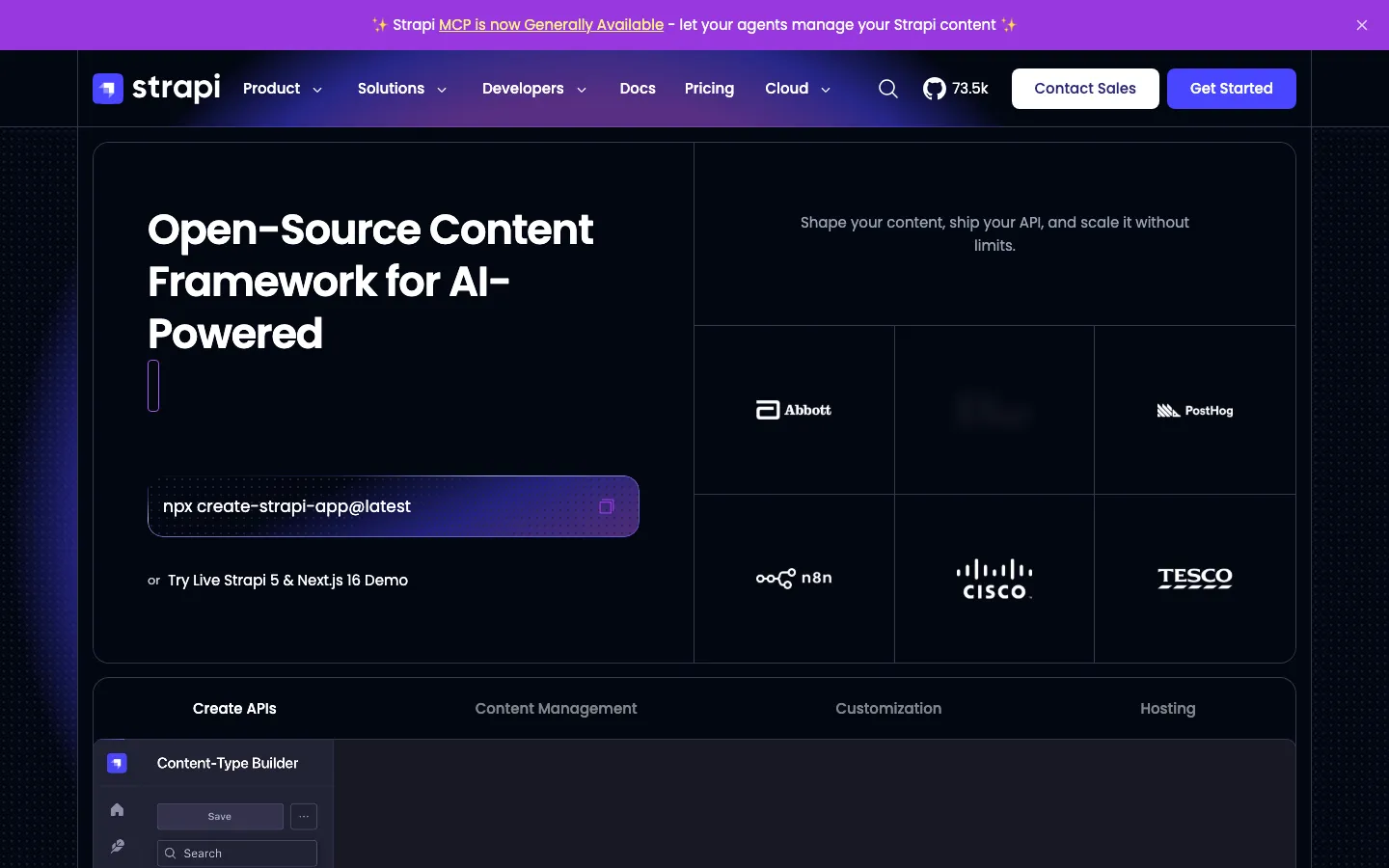
Strapi contrasts with conventional builders that are designed merely to make a site look finished. Strapi does a different job: it gives your team a content model, an editor and APIs, then lets developers decide which front end will consume them. That makes it a strong option for a custom site, application or product with several content destinations. If you are browsing the marketing tools directory for a no-code publishing surface, this is a backend-first choice rather than a shortcut around technical work.
Editors can work with content types, components and dynamic zones in the Content Type Builder. When the team defines a model, Strapi generates typed REST and GraphQL APIs from it. The benefit is not that every team needs this flexibility. It is that a product team can make the content structure match the product, instead of making the product follow a locked CMS structure.
That ownership changes the buying decision. Community is an MIT-licensed self-hosted edition with unlimited entries and API calls. Growth and Enterprise are also self-hosted CMS editions, while Cloud is managed hosting priced separately per project. You can keep the same Strapi installation path while changing where it runs.
Who should use Strapi headless CMS?
Product developers
Build a custom content API, extend the backend, and keep the front end independent.
Agencies building products
Use one flexible CMS foundation across client sites and applications with different interfaces.
Cost-conscious startups
Self-host Community free, then use Cloud when managed deployment becomes more useful.
Governed content teams
Use Enterprise for SSO, review workflows, audit logs and a SOC 2 report.
Strapi is a poor match for a brochure site that must be assembled without engineering time. Its content model and deployment options matter when developers will connect a custom front end; without that work, a small team is paying in setup and maintenance for flexibility it will not use.
What features are included in Strapi?
Content modeling and APIs
Start by defining the pieces your team actually publishes: content types, reusable components and dynamic zones. Strapi turns that model into typed REST and GraphQL APIs, and custom fields let the data structure grow with your product. For a developer, this makes the CMS a content service rather than a theme with a database attached.
Backend control
Strapi allows custom controllers, services and middleware on the backend, along with changes to the admin panel. Its marketplace offers plugins and integrations. That is the feature set to care about when a project has unusual approval rules, content shapes or delivery requirements. It is also why a non-technical buyer should not mistake it for a simple page editor.
Self-hosting and Cloud
You can run Strapi on your own servers or choose Strapi Cloud, which includes Postgres, a global CDN and email. Cloud regions are US East, Europe West and Asia Southeast. The vendor also says its Data Transfer feature can move a project to self-hosting later, so managed hosting does not require giving up the codebase.
Collaboration and governance
Growth adds Live Preview, Releases and Content History, with 14 days of history retention. Enterprise adds SSO, review workflows, audit logs and a SOC 2 report. This split is sensible: a small developer team can keep the free core, while an organization that needs formal publishing control pays for the governance layer.
Strapi AI and MCP
Growth includes Strapi AI Growth, a Strapi-managed service with 1,000 credits a month for content modeling, translation and media tagging. Extra credits cost $1.50 per 100. Strapi AI Enterprise is a paid Enterprise add-on for bringing your own model, with pricing available from sales. Strapi MCP is generally available, so an agent can manage Strapi content. That is useful when the agent belongs inside an existing editorial workflow, not as a reason to introduce a CMS your team cannot maintain.
How much does Strapi cost across tiers?
Price checked 27 Nov 2026
| Plan detail | CommunityFree | Growth$45/mo | EnterpriseCustom |
|---|---|---|---|
| Where it runs | Self-hosted | Self-hosted | Self-hosted |
| CMS users | Unlimited | 3 included, then $15/user/mo | Ask Strapi |
| Entries and API calls | Unlimited | Unlimited | Unlimited |
| Live Preview | ✕ | ✓ | ✓ |
| Content History | ✕ | 14 days | Custom |
| Review Workflows and Audit Logs | ✕ | ✕ | ✓ |
Strapi CMS prices, 27 Nov 2026.Strapi CMS pricing
Cloud is a second bill, for teams that prefer Strapi to host the project. Its public plans are per project, with traffic and storage limits rather than listed CMS seats:
| Cloud plan | Starter$35/project/mo | Pro$90/project/mo | Business$450/project/mo |
|---|---|---|---|
| API requests | 100,000/month | 1,000,000/month | 10,000,000/month |
| Asset storage | 50 GB | 250 GB | 1,000 GB |
| Runtime | Sleeps when idle | Always on | Always on |
| Backups | None listed | Weekly | Daily |
| Uptime SLA | ✕ | ✕ | 99.9% |
Strapi Cloud prices, 27 Nov 2026.Strapi Cloud pricing
A concrete team bill helps separate the two product lines. Three people on self-hosted Growth cost $45 a month because three CMS users are included. If a fourth editor needs access, the stated price becomes $60 a month. Cloud hosting, if you choose it too, is additional: Growth plus Cloud Starter is $80 a month before taxes. Growth SSO is a separate $150-a-month add-on plus $50 for each user.
What does Strapi Enterprise provide for organizations?
Strapi Enterprise becomes the relevant conversation when publishing requires strict organizational governance and enterprise controls. It adds SSO, review workflows and audit logs, along with a SOC 2 report. Pricing is on request, and premium support and concierge advisory are listed as add-ons.
The Enterprise edition has a minimum of 10 admin users and a 12-month subscription paid annually. That makes it a governance purchase for a team that needs control over identity, approvals or an audit trail, not a casual upgrade from Community or Growth. Paying for it before those needs are real turns useful safeguards into unused overhead.
Where does Strapi fall short on cloud costs?
Strapi features a steep top end on its Cloud pricing ladder. Starter is $35 per project a month, Pro is $90, and Business is $450. Starter also sleeps when idle, while always-on runtime starts at Pro. A production application that cannot tolerate wake-up behavior should budget for Pro rather than treating the $35 plan as its true operating cost.
The free edition is generous on entries and API calls, but it is not the collaboration edition. Live Preview, Releases and Content History are paid CMS features. Support is community-based on Community, and Cloud priority support is listed only on Business. That tradeoff is reasonable for a developer-owned stack, but it is a poor match for a team expecting a fully supported publishing service at the free tier.
Finally, Cloud plan pages do not list CMS user allowances. Do not assume Cloud hosting changes the Growth seat model or includes a number of editors. Ask Strapi to clarify the combined CMS and Cloud bill before putting several teams onto one project.
What are the top alternatives to Strapi?
Strapi alternatives like hosted site builders serve as a more natural starting point when building small sites without developers. See our no-code website builder review and hosted website builder review for two options outside the headless CMS category.
Choose Strapi when the front end is your team’s work and content needs to travel into it through APIs. Choose a builder when the finished website itself is the product and the team would rather configure pages than operate an application.
What is the overall verdict on Strapi?
Strapi makes sense when a custom content model must feed a product or several front ends. Community gives technically capable teams a genuine free foundation, and the combination of APIs, customization and deployment choice holds up as the project grows. The value is strongest when you already have developers who will own it.
Start with Community for a developer-led proof of concept. Add Growth when editor controls such as Live Preview and Content History become necessary, then choose Cloud Pro only when you need managed, always-on hosting. Treat Enterprise as a governance decision, not a default upgrade.
How was this Strapi review researched?
Strapi product, CMS pricing, and Cloud pricing pages supplied every price, limit, and feature in this review on 27 Nov 2026. Prices retain Strapi's published $ notation, and every figure follows the rules in how we check figures.
- Strapi product page
- Strapi CMS pricing page
- Strapi Cloud pricing page
What are frequently asked questions about Strapi?
Is Strapi free?
Yes. Community is free forever under the MIT license, with unlimited entries and API calls. Growth is $45 a month, Enterprise is quoted, and Strapi Cloud is a separate managed-hosting option.
How much does Strapi Cloud cost?
Cloud Starter is $35 per project a month, Pro is $90, and Business is $450. They include 100,000, 1 million and 10 million API requests a month respectively.
Can you move from Strapi Cloud to self-hosting?
Yes. Strapi says its Data Transfer feature can migrate a Cloud project to your own servers later.
Where can Strapi Cloud host a project?
Strapi lists US East, Europe West and Asia Southeast as Cloud regions for projects, data and assets.
 Reviewed byDanny Kirk
Founder of ReddiReach.
 Checked byAndrés Felipe
Digital designer and marketer.
Every figure is checked against the vendor's own page. Read our editorial standards.