
Key Takeaways
- Synup unites directory listings, customer reviews, social media publishing, and local search engine optimization inside a unified marketing operations platform.
- Synup charges $39 monthly billed annually for its single-location Solo plan, while white-labeled agency portals begin on Premium at $239 for 10 locations.
- Synup bundles REST API access and an MCP server across all subscription tiers while allocating location allowances, credits, and concurrent agent sessions.
- Synup introduces excessive software complexity and cost for single-operator businesses seeking isolated citation cleanups or narrow local ranking checks.
Synup is the best fit for a local marketing agency that needs listings, reviews, social publishing and local SEO in one branded client experience. Pick Premium at $239 a month billed annually when your clients must see your own domain and identity; choose a simpler tool if you only need one narrow local SEO job.
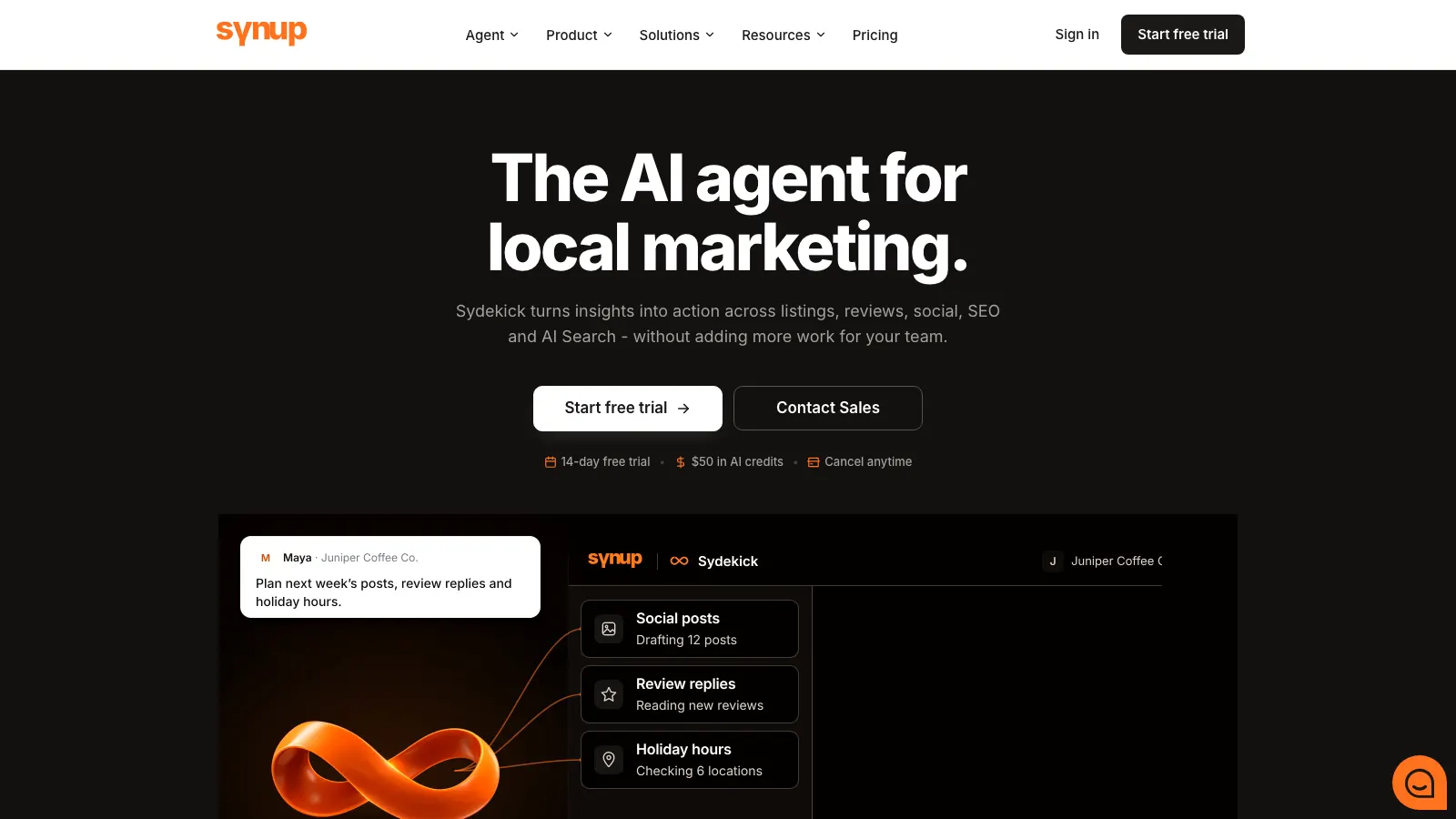
Agent access
- API
- Yes, every Synup plan
- MCP server
- Official, hosted, OAuth 2.1 Authorization Code with PKCE
- Works with
 Claude
 ChatGPT
 Cursor
What are the core pros and cons of using Synup?
What works
- Listings, reviews, social and local SEO live in one workspace
- Premium and higher plans place the portal, reports and emails under your brand
- REST API and MCP access are included with every plan
What to watch
- There is no published permanent free tier
- Solo does not include white labeling
- Plan capacity is based on locations and credits, not just feature access
What local SEO and reputation workflows does Synup automate?
Synup consolidates local marketing workflows when teams struggle with fragmented listing managers, disparate review dashboards, and disconnected social schedulers. It brings those jobs into an agency workspace, with an AI agent alongside them, so a team can keep each client’s locations in one place. It belongs in the marketing tools directory because it is broader than a rank tracker, but it remains focused on local marketing rather than general search research.
The useful distinction is between delivery and presentation. Synup can manage listings, review activity, social posts and local SEO work, while Premium and above can put the client-facing portal, scan reports and outbound emails on your brand and domain. That matters if your service is sold as your own recurring product, not as access to somebody else’s software.
Its rate card is also deliberately location-led. Every plan includes the feature set, with the band determining location capacity, monthly credits and the number of agent chats that can run at once. That makes Premium a clearer starting point than Solo for a white-label agency, even though Solo is the lowest public price.
Which agencies and multi-location businesses benefit most from Synup?
Local marketing agencies
Premium combines up to 10 locations with white labeling for agencies that sell local work under their own name.
Multi-location brands
Location bands run from one location on Solo to 50 on Scale, with Enterprise offered above that.
Teams building automations
API and MCP access give an internal agent or reporting workflow an official route into Synup.
Client-facing service teams
The read-only client portal presents listings, reviews, SEO and AI visibility under the agency brand.
I would not choose Synup simply to check a handful of rankings. Its value is the connected local workflow and branded delivery. If a specialist approach is the better match, read the AI Peekaboo review for an AI visibility tool built around reporting data elsewhere.
What listings, review management, and publishing tools does Synup offer?
Listings and local presence
Synup manages business data across its publisher network, including Google Business Profile and Apple Business Connect. The product also describes automated corrections when a listing drifts. For an agency, that is the foundation layer: you can make location data consistent before asking a client to care about rankings or AI visibility.
Reviews in one inbox
Reviews from 30+ sources, including Google, Facebook, Apple and Tripadvisor, arrive in one feed. Teams can filter the inbox, reply inline, or use the agent to draft replies in the brand voice. Review-request campaigns are part of the same product, so the workflow is not limited to watching what arrives.
Social publishing
Social publishing covers nine networks from one composer, including Facebook, Instagram and LinkedIn. Google Business Profile posting is supported too, through the listings page alongside the wider directory network. Synup says the agent can adapt a post to each network, while the publishing view keeps posts and their performance in the same place as the location work. That is most useful when local offers and profile updates need the same team to own them.
Local rank grids and AI discovery
The SEO product shows rankings across a geographic grid rather than as one city-wide position. It also compares local competitors and ties recommendations to Google Business Profile fields. Synup’s pricing page lists AI discovery and optimization across ChatGPT, Gemini and Perplexity for every location, alongside the local SEO tools.
Client portal and white labeling
The client portal gives each client a read-only view of listings, reviews, SEO and AI visibility, plus an assistant working under the agency’s agent name. Premium and higher plans remove Synup branding from the portal, scan reports and outbound emails, and support a custom domain. That is the feature that changes Synup from a delivery system into a product an agency can confidently put in front of clients.
API and MCP
Synup publishes a REST API with Swagger documentation, per-client scoped keys and OAuth 2.1 authorization. Its native MCP supports tools for CRM records and post ideas and posts, including read and write actions. Because every plan includes every feature, the public rate card makes these routes available from Solo onward, but teams should still set approval rules carefully before allowing an agent to publish.
How is Synup priced across single and multi-location tiers?
Price checked 27 Nov 2026
| Plan detail | Solo$39/mo | Premium$239/mo | Pro$399/mo | Scale$719/mo |
|---|---|---|---|---|
| Billing shown | Annual | Annual | Annual | Annual |
| Locations included | 1 | Up to 10 | Up to 25 | Up to 50 |
| Monthly credits shown at launch* | 20,000 | 200,000 | 600,000 | 1,200,000 |
| Parallel agent chats | 1 | 3 | 5 | 10 |
| White labeling | Not included | ✓ | ✓ | ✓ |
| API and MCP | ✓ | ✓ | ✓ | ✓ |
*Synup says these displayed allowances were quadrupled for launch. Accounts created on or before September 30 keep them for as long as the account is open.
Synup prices in US dollars, 27 Nov 2026.Synup pricing
A team’s bill follows the number of locations, not the number of product modules. Solo is $49 monthly, Premium is $299 monthly, Pro is $499 monthly and Scale is $899 monthly. Annual billing is the published lower monthly price. For example, an agency managing eight locations pays $239 a month equivalent on annual billing, $2,868 for the year, or $299 on monthly billing, before any extra credit purchases. The public rate card does not establish seat caps or seat charges.
There are no separate feature add-ons listed in the public rate card. Credits are the variable to watch because they fund agent work and other metered activity; Synup says extra credits are available in blocks when needed. The 14-day free trial explores Solo, so it will not show the white-label experience.
When should expanding organizations consider Synup Enterprise?
Synup Enterprise provides tailored contract pricing for brand portfolios managing more than 50 business locations. Synup lists custom credits, customized parallel agent capacity, BYOK and BYOM support, custom compute and storage, and a custom end-client experience. This is a scaling option, not a different feature tier, because the published plans already include the core product set.
Where does Synup fall short for niche local marketing needs?
Synup presents unnecessary architectural complexity when an operator only requires basic citation auditing, local rank tracking, or review alerts. The platform earns its cost when several recurring local tasks belong to the same client relationship. Without that wider job, the location bands and credit model add decisions that a point tool avoids.
White labeling has a firm price floor. Solo is a usable entry point for one location, but it does not include the branded portal and domain. If client presentation is non-negotiable, Premium at $239 a month billed annually is the real entry price.
The credit allowance needs active management as automated work grows. Synup does not publish the old keyword, social-connection or seat caps often repeated in older summaries, so plan a trial around your actual locations and agent workload instead of using assumptions from an outdated comparison.
What are the top market alternatives to Synup?
 Synup competitors like AI Peekaboo offer dedicated solutions when teams prioritize AI answer tracking over localized business listings. Its focus is narrower, which can be a benefit when client reporting is the job.
 Uberall connects to 200+ directories, search engines, AI tools, maps, navigation apps and voice assistants through direct API integrations and data partnerships. Read the Uberall review when that directory coverage is the deciding requirement for your locations.
 Whitespark review is the comparison to make when local rank reporting matters most: its Local Ranking Grids monitor rankings across up to 225 geographical points. That grid-based view answers a different question from Synup’s branded local marketing workspace.
What is the overall verdict on Synup for agency client management?
Synup provides a solid platform for agencies delivering ongoing multi-location marketing under their own branded client portal. Premium is the practical place to start because it combines 10 locations with white labeling, while every plan already includes listings, reviews, social, local SEO, API and MCP access.
Use the Solo-only 14-day trial to evaluate credit use for a real location, then move to Premium only if the branded portal and domain will be part of your client service. Track agent-credit use during that evaluation, since it is the part of the plan that changes as automation grows.
How was this Synup review verified and audited?
Synup specifications, subscription tiers, API access terms, and MCP details were confirmed on official portal pages on 27 Nov 2026. Prices are shown in US dollars, and the figures follow how we check figures.
- Synup pricing and monthly pricing pages
- Synup listings, reviews, social, SEO and white-label product pages
- Synup API, MCP, client portal and agency pages
What are the common questions about deploying Synup?
Does Synup have a free trial?
Yes. Synup offers a 14-day free trial for the Solo plan. It does not publish a permanent free tier.
How much does Synup cost?
Solo is $39 a month billed annually for one location. Premium is $239 for up to 10 locations, Pro is $399 for up to 25 and Scale is $719 for up to 50. Monthly billing is higher.
Which Synup plan includes white labeling?
White labeling begins with Premium. It covers the client portal, scan reports and outbound emails under your brand and domain, without Synup branding.
Does Synup work with AI agents?
Yes. Every plan includes the REST API and native MCP. Synup’s MCP documentation describes tools for CRM records, post ideas and posts, with separate read and write scopes.
Can Synup manage more than one location?
Yes. Pricing is based on locations: Solo covers one, Premium up to 10, Pro up to 25 and Scale up to 50. Enterprise is available for more than 50 locations.
 Reviewed byDanny Kirk
Founder of ReddiReach.
 Checked byAndrés Felipe
Digital designer and marketer.
Every figure is checked against the vendor's own page. Read our editorial standards.