
Key Takeaways
- ToolJet allows operations and engineering teams to build custom internal applications, forms, and approval workflows connected directly to enterprise databases.
- ToolJet provides a free cloud tier for one builder, offering Basic at $29 per builder monthly ($23/mo annual) and Team at $249 per builder monthly ($199/mo annual).
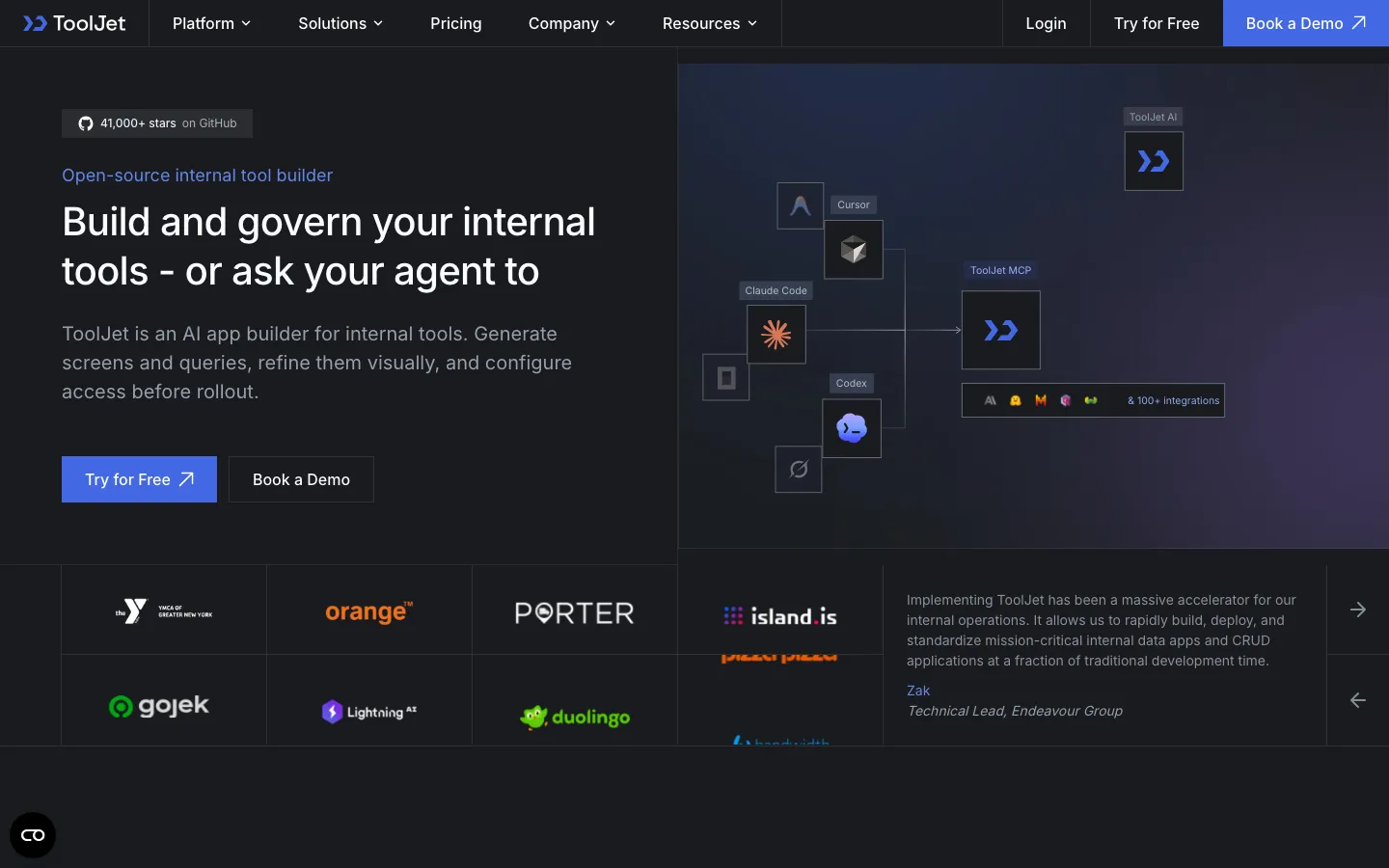
- ToolJet provides an MCP plugin that empowers AI coding agents to inspect queries and generate applications using assigned developer permissions.
- ToolJet caps Free at 3 apps (10 end users) and Basic at 10 apps (25 end users), while Pro unlocks unlimited apps for up to 5 builders and 50 end users.
When you need to turn connected business data into a working internal app, ToolJet gives your operations or product team an AI-generated starting point that still exposes pages, queries and events for revision. Choose another route if per-builder pricing will make your team expensive, or move from Free or Basic to Pro, Team or Enterprise when your work outgrows 10 apps or 50 end users.
Agent access
- API
- Yes, Enterprise Plan Self Hosted
- MCP server
- Official, hosted or local, OAuth on ToolJet Cloud or a ToolJet personal access token (PAT)
- Works with
 Claude Code
 Cursor
- Automation
- n8n
What are the main pros and cons of using ToolJet?
What works
- AI drafts remain editable as pages, queries and events
- More than 100 native connectors, plus REST and gRPC
- A PostgreSQL-backed no-code database in every workspace
What to watch
- Cloud pricing rises with each builder
- Free caps at 3 apps and Basic at 10 apps; Pro unlocks unlimited apps
- Workflows and Agent Builder are self-hosted only
What internal app building capabilities does ToolJet provide?
ToolJet streamlines internal operational workflows that have outgrown manual spreadsheets, shared inboxes, and fragmented business handoffs. It builds dashboards, admin panels and approval apps over your own data. The marketing tools directory helps place it among adjacent categories, but ToolJet itself is built for internal operations rather than campaign execution.
You can describe the job in plain language, let ToolJet generate pages and queries, then refine the same application in its visual builder. That editable structure is the reason I would put ToolJet ahead of a one-shot generator for a team that expects ToolJet to last. The generated work remains visible as pages, components, queries and events.
Your builders can review reads and writes, set permissions and alter the layout without starting over from a prompt. The decision is still mostly about scope: ToolJet Cloud separates builders from end users, while self-hosting opens a different set of deployment and automation choices.
Which operations and development teams should choose ToolJet?
Operations teams
Turn recurring requests into focused dashboards, forms or approval apps that work with existing business data.
Product teams
Shape an internal interface visually, then let colleagues review the task flow before release.
Developers
Extend visual applications with JavaScript, Python or custom components while keeping data queries connected and editable.
Governed enterprises
Use Team or Enterprise when access controls, audit trails and a managed release process matter.
It is less compelling for a team that only needs a throwaway form, or for one with lots of separate internal apps but no appetite for Team pricing. Start by counting builders, end users and apps. Those three numbers tell you more about the likely bill than a feature list does.
Which low-code app development features does ToolJet include?
AI generation that stays editable
ToolJet AI turns a sentence into a working draft with components and queries. On the builder side, the vendor says the resulting pages, queries and events remain editable in the visual builder. That is the useful distinction: an AI draft can give a team a starting interface, while the visual layer gives it a way to inspect and revise the actual application before it reaches users.
Visual builder and code extensions
The app builder includes drag-and-drop interface work, a query builder, navigation and an event manager. When the standard pieces are not enough, ToolJet documents JavaScript, Python and custom components. This combination fits a mixed team better than a code-only route, because a developer can handle the exception without turning routine layout changes into engineering tickets.
Connected data and ToolJet Database
ToolJet lists more than 100 native connectors as well as any REST or gRPC endpoint. It also includes ToolJet Database in every workspace, a no-code table editor on PostgreSQL. That gives a team two sensible starting points: connect an established source of record, or use the built-in database for a smaller application that needs data before a separate database is provisioned.
Access, release and governance
Access is not an afterthought in this product. The platform documents SAML, OIDC and LDAP sign-on, workspace and app-level permissions, and controls down to individual components and queries. Team adds SSO, custom user groups, audit logs and Git sync; Enterprise adds SCIM provisioning and custom data retention policies. Those are material differences, so a production team should choose a plan for its release and access model, not just its app count.
MCP and self-hosted automation
ToolJet's coding-agent plugin works with Claude Code, Codex and other MCP-compatible agents. It runs as the developer who connected it, using that developer's permissions, and the pricing page says it does not consume ToolJet AI credits. Workflows and Agent Builder have a sharper boundary: they are available on self-hosted deployments only, including triggers, agent nodes and run logs. That makes self-hosting the relevant route if workflow automation is a core requirement rather than a future possibility.
How does ToolJet price its cloud builder tiers?
Price checked 27 Nov 2026
| Plan detail | Free$0/builder/mo | Basic$29/builder/mo | Pro$99/builder/mo | Team$249/builder/mo | EnterpriseCustom |
|---|---|---|---|---|---|
| Billed annually (save 20%) | $0/builder/mo | $23/builder/mo | $79/builder/mo | $199/builder/mo | Custom |
| Builders | 1 | 1 | Up to 5 | Pay per builder | Custom |
| End users | 10 | 25 | 50 | 100 | Unlimited |
| Apps | 3 | 10 | Unlimited | Unlimited | Unlimited |
| Monthly AI credits | 100 credits | 1,000 per builder | 2,500 per builder | 5,000 per builder | Custom |
| Support | Community | Community | Portal | Phone, email and portal |
ToolJet Cloud plans, 27 Nov 2026.ToolJet pricing
Cloud billing is per builder, not per end user. A practical example is Basic covers up to 1 builder at $29 per month ($23/mo billed annually), while two to five builders move to Pro at $99 per builder per month ($79/mo billed annually) with unlimited apps. The same two builders on Team make it $498 a month, a large jump that only makes sense when unlimited apps, SSO, custom groups, audit logs and Git sync are part of the requirement.
- Pay-as-you-go AI credits cost $1 for 100 credits
- Basic includes 1,000 monthly AI credits per builder, and Pro includes 2,500 per builder
- Team includes 5,000 monthly AI credits per builder
- Annual Cloud pricing shows a 20% saving, but this table uses the published monthly prices
The self-hosted page has a separate structure: Free remains $0 per builder per month, Team is shown at $199 per builder per month, and Enterprise is custom. It also lists workflows, agents and multi-environment deployment. Confirm the billing term for the $199 price before you buy, because the page displays monthly and annual options alongside a 20% saving without tying that displayed price to either term. Treat cloud and self-hosted as different operating choices, not interchangeable plan tabs.
What deployment controls are provided in ToolJet Enterprise?
ToolJet Cloud Enterprise provides advanced deployment safeguards and tailored corporate governance for organizations running critical internal software. It includes Team features, unlimited end users with no per-user fees, custom AI credits, SCIM provisioning, custom data retention policies, premium service levels and a dedicated support manager. Self-hosted Enterprise adds options including multi-instance and air-gapped deployments, but its plan card marks the support manager as optional.
Ask for the deployment responsibility, support model and retention terms in writing before treating an Enterprise quote as comparable with a Cloud plan. The vendor also offers guided implementation through its forward deployed engineers, but the pricing page does not publish a rate for that work.
Where does ToolJet fall short when scaling internal apps?
ToolJet features accessible entry pricing that can obscure the higher long-term costs of scaling across large numbers of internal app builders. Basic buys 1,000 AI credits for 1 builder, 25 end users and 10 apps. Pro expands capacity to 5 builders, unlimited apps and 50 end users, while Team raises end users to 100. A team that needs several production apps, 100 users, SSO and audit logs quickly arrives at Team, at $249 per builder each month.
The product also draws a meaningful line between apps and automation. Cloud can build and run internal applications, but the vendor lists Workflows and Agent Builder as self-hosted only. If your brief is specifically about scheduled processes, webhooks or agent nodes, decide whether you can operate a self-hosted deployment before comparing the cheaper Cloud plans.
Finally, ToolJet is not a substitute for a clear data ownership model. Its connectors and built-in database make it easier to assemble the interface, but they do not decide what data should be writable, who should see it or which release needs approval. Those are decisions your team must make before an internal tool becomes business-critical.
What are the top low-code alternatives to ToolJet?
 If the need is integration-led automation rather than an editable internal interface, read the Tray.ai review alongside ToolJet's self-hosted workflow boundary. Tray Build gives teams low-code development through a drag-and-drop builder, pre-built templates and full API access. The comparison is useful because it starts from what you are actually trying to automate, not from the word AI.
 If your job is keeping work synchronized across tools instead of building a new operational interface, the Unito review is the more relevant next read. Unito provides two-way synchronization controlled by rules and field mappings. ToolJet's strength is building the place where a team does the work; the right alternative depends on whether you need a new surface or a connection between existing ones.
What is the final verdict on adopting ToolJet?
ToolJet delivers strong long-term value by ensuring AI-drafted internal applications remain fully editable and transparent across queries and UI components. Its visual builder, connected queries and permission model give an operations team room to revise the application after launch. I would pick it for a contained first app, then move up only when the number of apps, users or governance controls clearly demands it.
Start on the free plan with one real internal task. Count the builders, end users and apps that the finished program will need, then choose Cloud for app building or self-hosted deployment if workflows and agent nodes are essential.
How was the data for this ToolJet review verified?
ToolJet plan tiers, builder quotas, MCP plugins, and developer documentation were audited on 27 Nov 2026. Prices are in US dollars as ToolJet shows them, and every figure follows the rules in how we check figures.
- ToolJet home and AI app builder pages
- ToolJet Cloud and self-hosted pricing pages
- ToolJet documentation for MCP, deployment, access and release management
What are common questions regarding ToolJet hosting and deployment?
What is ToolJet used for?
ToolJet is an AI app builder for internal tools. It can generate screens and queries, let builders refine them visually, connect to data and configure access before rollout.
Is there a free ToolJet plan?
Yes. The Cloud Free plan lists 1 builder, up to 10 end users, up to 3 apps and 100 monthly AI credits.
Does ToolJet include a database?
Yes. Every workspace includes ToolJet Database, a no-code table editor built on PostgreSQL.
Can an AI agent build ToolJet apps?
Yes. ToolJet documents an MCP-compatible coding-agent plugin for Claude Code, Codex and other supported agents. It uses the permissions of the developer who connected it.
 Reviewed byDanny Kirk
Founder of ReddiReach.
 Checked byAndrés Felipe
Digital designer and marketer.
Every figure is checked against the vendor's own page. Read our editorial standards.