
Key Takeaways
- Topic Intelligence synthesizes topical search volume, buyer conversion intent, competitor visibility, and AI answer citations into actionable editorial content strategies.
- Topic Intelligence operates via contact-led enterprise pricing, with platform terms publishing an Analytics Platform baseline starting at $250 monthly plus usage.
- Topic Intelligence features proprietary GEO search tracking for AI citations, though it does not provide publicly accessible API documentation or MCP servers.
- Topic Intelligence avoids offering self-serve subscriptions or automated article generation, requiring direct sales conversations for commercial onboarding.
Choose Topic Intelligence when you need to turn topic, conversion, competitive and AI-search signals into a content plan, rather than buy another keyword database. It can also guide a program from its first topical investments, but pass if you need a fixed self-serve plan or full article generation: its three marketed routes require a conversation, while its terms separately publish Analytics Platform rates.
Agent access
- API
- Not found on official pages
- MCP server
- Not found on official pages
What are the primary pros and cons of Topic Intelligence?
What works
- Uses your web and campaign data to surface converting themes
- Maps the path from topic engagement to a user action
- Offers both a platform license and managed service options
What to watch
- Marketed routes need a conversation; Analytics terms may have a different scope
- No public API or MCP details for agent workflows
- Industry trend analysis is labeled coming soon
What content strategy and AI search signals does Topic Intelligence uncover?
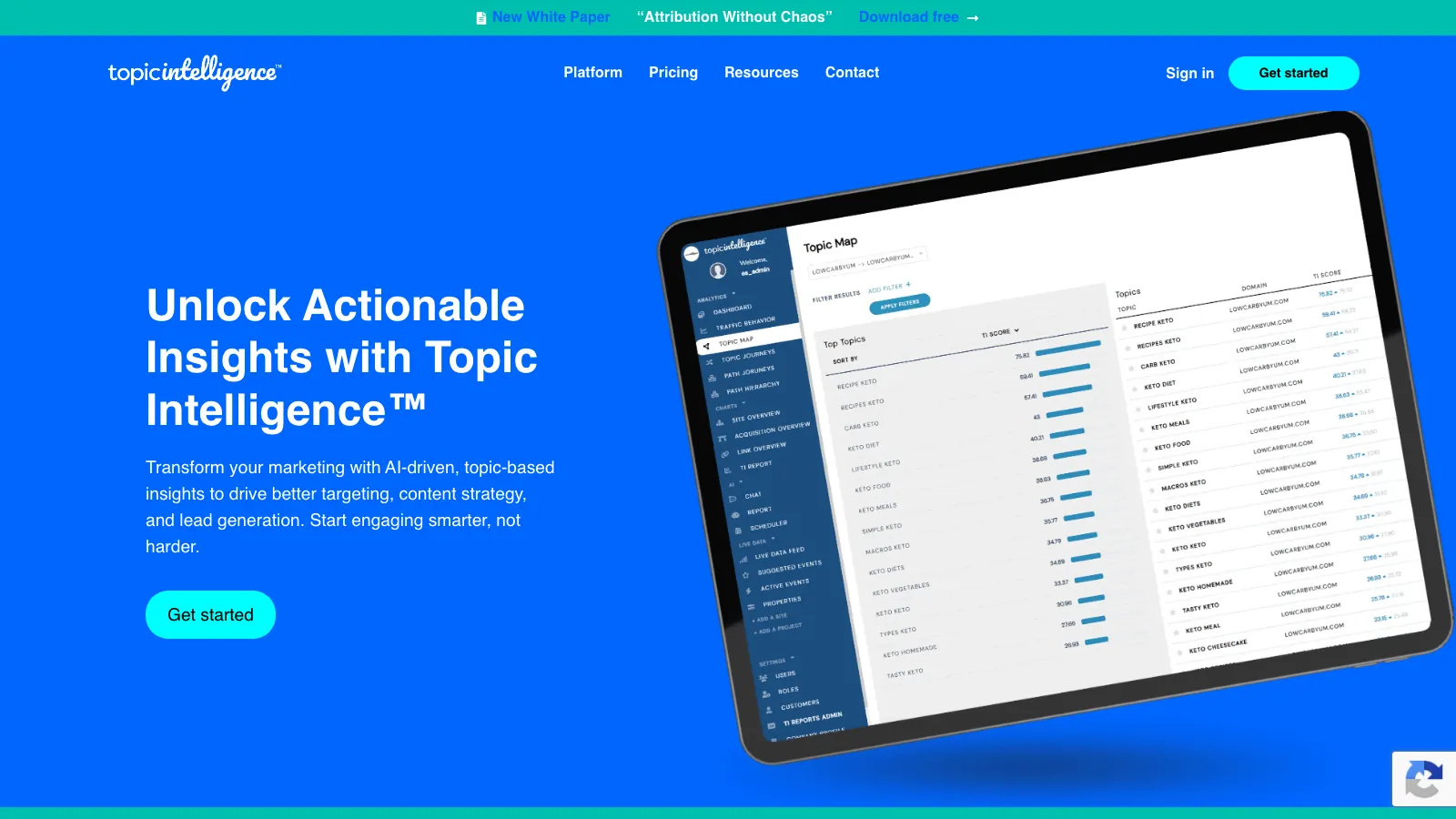
Topic Intelligence prevents wasted editorial budget by aligning content roadmaps with buyer conversion intent rather than relying solely on generic search volume. Topic Intelligence takes a different route: it connects website and cross-channel marketing activity, then identifies the topics that lead to engagement and conversion. That makes it a useful entry in a marketing tools directory for a team that needs a sharper way to turn content signals into a decision.
It also brings AI-search visibility, topical authority and competitive analysis into that decision. GEO Search tracks a brand's visibility across AI search systems, while its topical work can identify coverage gaps and compare a brand's position with competitors. If your content lead must defend the next quarter's themes to a commercial team, that is more useful than a large keyword estimate alone.
I would treat it as an analytics and strategy product with a content-brief workflow, not an article generator. The public material does not spell out an API or MCP server, so agent or warehouse use needs confirmation before it becomes part of your operating plan.
Which content marketing teams should use Topic Intelligence?
Content leaders with conversion data
Prioritize themes by the engagement and actions your own audience already produces.
Cross-channel campaign teams
Align website, social and email messages around the topics buyers respond to.
Enterprise marketing groups
Choose a platform license or supported program around an established analytics operation.
Teams needing hands-on support
Use managed strategic advice or execution when internal analyst capacity is limited.
It is a weak fit for a solo marketer choosing tools from a fixed monthly budget. The marketing routes need a conversation, and the product is not positioned as a low-friction keyword database or article generator. It is not only for teams with a deep archive: the topical map can identify the right initial investment areas for a new content program. Choose it when the gap is deciding what to invest in, not when the gap is simply finding more keyword ideas.
Which topical research and AI search tracking features does Topic Intelligence include?
Topic conversion tracking
The platform identifies the topics associated with audience engagement and conversion. For a mature content program, the benefit is focus: the team can prioritize themes that connect to an actual action rather than treating traffic as the only outcome.
Journey mapping
Topic Intelligence also describes user and topic journey mapping, from the first interaction to final engagement. A topic that attracts attention is not automatically a topic that helps a buyer progress. Seeing the path helps a strategist separate awareness material from themes that deserve campaign investment.
Website and cross-channel analytics
The platform is designed to bring a website and digital marketing together, including social media and email. Its 2026 pages list CMS integrations with WordPress, Contentful, Sanity, Webflow and other major CMS platforms, while noting that the scope varies by stack. That is enough to make the product relevant to a distributed content operation, but not enough to promise a particular connector for an advertising network or reporting system.
Non-LLM deep learning
The company emphasizes that its system is not LLM-based. That does not automatically make an insight better, but it does clarify the role: Topic Intelligence analyzes patterns in a brand's activity instead of producing a language-model prediction of what content ought to work.
GEO Search and competitive analysis
GEO Search tracks brand visibility across ChatGPT, Claude, Gemini, Perplexity and Google's AI-driven layers. Alongside prompt-level citation tracking, Topic Intelligence describes topical coverage and competitive analysis, including gaps where competitors have coverage and the brand does not. That makes AI visibility part of its stated scope, not a separate problem the platform ignores.
Content briefs, not finished articles
Topic Intelligence turns its analysis into content briefs covering the topic, sub-topics, structure, internal links, schema and GEO signals. Those briefs can move into an in-house, agency or freelancer workflow, but the vendor says actual content production happens there. That distinction matters if you need drafts rather than a plan for them.
Industry trend analysis
Industry trend analysis appears in Topic Intelligence's plan description, but the pricing page labels it coming soon. Do not assume it is already a live research layer. The existing value is the connection between your own topic performance and user journeys; external trend discovery should stay separate until it says otherwise.
How does Topic Intelligence structure its enterprise platform pricing?
Price checked 27 Nov 2026
Data + Platform License, Simply Grow and Simply TI are contact-led routes with no stated dollar price on the main pricing page. Separately, the Terms of Use publish Analytics Platform pricing, effective 31 January 2025. Treat that as a defined rate card for that scope, not a price assigned to any of the three marketed routes.
| Plan detail | Data + Platform LicenseQuote | Simply GrowQuote | Simply TIQuote |
|---|---|---|---|
| Buying route | Get started | Reach out | Reach out |
| Positioning | In-house analytics solution | Growth program | Managed service |
| Strategic advice | Not listed | ✓ | ✓ |
| Managed execution | Not listed | Not listed | ✓ |
| Trend analysis | Coming soon | Not listed | Not listed |
Topic Intelligence plans, 27 Nov 2026.Topic Intelligence pricing
| Analytics Platform terms | Published rate |
|---|---|
| Base Platform Fee | $250/month |
| Usage, 0 to 20,000 page views | $20 per 1,000 page views |
| Authorized seats | 5 full users, 1 IT seat and 1 billing seat |
Topic Intelligence Terms of Use, effective 31 January 2025, checked 27 Nov 2026.Topic Intelligence terms
Under those Analytics Platform terms, 10,000 page views produce $200 in usage charges plus the $250 base fee, or $450/month. A page view means a tracking-script execution when a browser loads a page containing the script. The seven seats are not interchangeable: the allowance is five full-user seats, one IT seat and one billing seat. Confirm that the terms rate card applies to your proposed contract before using this illustration, and do not extend it to a managed-service quote.
How should teams choose between Topic Intelligence managed tiers?
Topic Intelligence offers its Data + Platform License specifically for in-house enterprise teams seeking direct analytical control. Simply Grow, delivered via engagesimply, adds strategic advice and marketing support. Simply TI is the more involved option, positioned as expert-led insights and execution with campaign, strategy, content and communication guidance.
Choose Topic Intelligence license when you have people who can act on the findings. Consider Simply Grow when strategy is the bottleneck. Reserve Simply TI for a team that genuinely needs managed execution.
Where does Topic Intelligence fall short for self-serve buyers?
Topic Intelligence creates procurement hurdles due to its lack of upfront transparent pricing for self-serve software buyers. Three named options tell you the direction of the product but require a conversation, while the published Analytics Platform terms may have a different scope. That can slow a team trying to compare managed work against a defined budget. A free demo is useful for a first conversation, not a substitute for confirming the ongoing cost and contract terms.
The second is technical detail for modern workflows. The public pages describe website, social, email and CMS connections, but do not list an API, MCP or the scope of individual ad-platform connectors. If an AI agent or data warehouse has to receive these insights, that needs a clear answer before Topic Intelligence becomes part of your operating plan.
Finally, the product's most tempting adjacent promise, industry trend analysis, remains marked coming soon on the pricing page. Keep the evaluation focused on the live case for conversion-oriented topic analytics. A team needing immediate external trend discovery should compare a dedicated research product rather than treating a roadmap item as delivered functionality.
What are the top alternatives to Topic Intelligence for AI visibility?
 AI Peekaboo review is the first read when published monthly billing and API or MCP access matter most. Its price starts at $30/month on monthly billing, checked 27 Nov 2026. Topic Intelligence also tracks AI-search visibility through GEO Search, so the practical choice is between AI Peekaboo's stated machine access and Topic Intelligence's broader topical, attribution and content-brief workflow.
 BuzzSumo review helps when your team needs content research and media discovery with published plans, rather than an analysis of your own conversion paths. Its cheapest plan starts at $199/month on monthly billing, checked 27 Nov 2026, which makes budget comparison more direct even though the job is different.
 Conductor review is the enterprise option to consider when AI answers, SEO reporting, website monitoring and content work must live in one vendor relationship. It also uses sales-led packages, but documents MCP Server across its named plans and Data API availability for larger workflows.
What is the final evaluation on purchasing Topic Intelligence?
Topic Intelligence provides a compelling solution for editorial teams by combining topical analysis, conversion data, and AI search signals into comprehensive briefs. It can help frame an initial program as well as refine an established one. The trade-off is commercial ambiguity around the three marketed routes, no published agent interface and one planned trend feature that is not live; its separate Analytics Platform terms need contract confirmation.
Bring a defined use case to the demo: the website and channels you need to connect, the conversion event you need to understand, and the team expected to act on the result. Choose Topic Intelligence license if your people can run the work; discuss a managed tier only when strategic support or execution is the genuine missing capacity.
How was this Topic Intelligence platform assessment verified?
Topic Intelligence platform offerings, published terms, and topical intelligence features were audited on 27 Nov 2026. The review distinguishes the contact-led marketing routes from the separate Analytics Platform terms and avoids assigning unlisted features to a tier. Our method for handling stated figures is explained in how we check figures.
- Topic Intelligence home and platform pages for deep learning, conversion topics and journey mapping
- Pricing page for the three routes, managed-service descriptions and coming-soon trend analysis
- Terms of Use for Analytics Platform rates, page-view definition and authorized seats
- Feature pages for GEO Search, competitive analysis and content briefs
What are the most frequent questions regarding Topic Intelligence?
How does Topic Intelligence differ from keyword research?
Keyword research estimates what people search for. Topic Intelligence is designed to analyze a brand's website and marketing data to identify the topics its audience engages with and that lead toward conversion.
Does Topic Intelligence use an LLM?
No. Topic Intelligence describes its system as deep-learning AI that is not LLM-based. It analyzes topics that matter to the audience rather than presenting itself as a language-model content generator.
What are Simply Grow and Simply TI?
They are managed offerings delivered via engagesimply. Simply Grow includes personalized strategic advice and marketing support; Simply TI is positioned as an expert-led managed service for insights and execution.
Is there a free trial?
The official pages describe a free demo and say signup begins platform access. They do not describe a time-limited self-serve trial with plan limits. The marketing routes need a conversation, while the terms publish a separate Analytics Platform base fee and usage rates.
Which channels can Topic Intelligence connect?
The platform is designed for website and cross-channel digital marketing, including social media and email. It also names WordPress, Contentful, Sanity, Webflow and other major CMS platforms, with scope varying by stack.
 Reviewed byDanny Kirk
Founder of ReddiReach.
 Checked byAndrés Felipe
Digital designer and marketer.
Every figure is checked against the vendor's own page. Read our editorial standards.