
Key Takeaways
- Topicfinder enables content strategists and lean teams to discover proven editorial topics from competitor URLs and organize them into an actionable production pipeline.
- Topicfinder provides access through its Starter tier at 39 dollars monthly for 100 daily credits, moving to 149 dollars monthly for three seats.
- Topicfinder supports workflow delivery through direct CSV downloads and email report sharing, though the platform lacks public customer API or MCP automation endpoints.
- Topicfinder is unsuitable for marketing departments requiring daily keyword rank tracking, comprehensive backlink research, or unified all-purpose search platform monitoring.
When competitor articles leave your content lead with a pile of browser tabs and no clear order for the next brief, Topicfinder is the right pick for turning those pages into a working topic pipeline without buying a broad SEO suite. Skip it if your work needs daily rank tracking, backlink analysis or documented API and MCP access, because Topicfinder is purpose-built for competitive content research and its published pages focus on reports, CSV export and email sharing.
Agent access
- API
- Not found on official pages
- MCP server
- Not found on official pages
What are the core Topicfinder pros and cons?
What works
- Parallel crawling that can find hundreds of URLs per second
- AI title ideas scored for SEO potential and length
- Reports, tags, filters and archived work in one dashboard
What to watch
- Starter has one seat and fixed daily limits
- Business reaches only three user seats
- Agency pricing and limits require a conversation
What does Topicfinder do for content marketing teams?
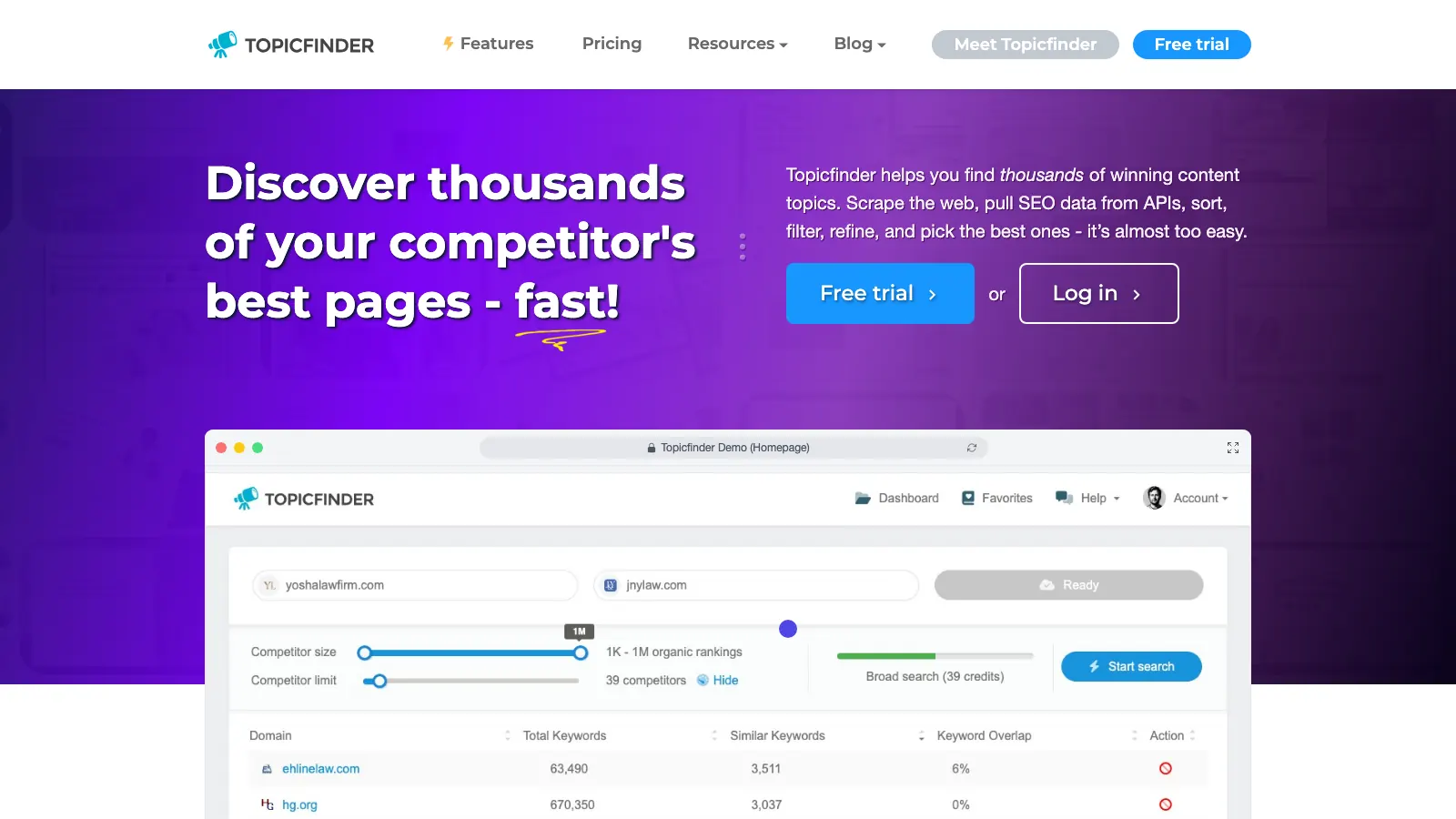
Topicfinder turns the awkward part of content planning into one job: start with your website and a competitor, then surface similar sites and their highest-traffic pages. Its multi-threaded process can collect hundreds of URLs per second, while the report gives you SEO data, traffic statistics, sorting and filters around the resulting topic ideas. If your team is still collecting competing articles in browser tabs, it is a cleaner way to decide what deserves a brief; use the marketing tools directory instead when you need a broader category view before choosing a focused tool.
The useful distinction is focus. Topicfinder does not try to be the place for every SEO task. It is designed around finding content opportunities already proven by similar competitors, then saving, filtering and sharing the useful ones. That makes it a better fit for a content calendar than for a team whose main job is technical audits or backlink outreach.
Treat Topicfinder as a planning engine, not a verdict engine. A competitor page with traffic is a strong lead, but your team still has to decide whether the topic fits your audience, offers a distinct angle and deserves the production time.
Who is Topicfinder designed for?
Content strategists
Turn competitor research into a tagged set of possible briefs instead of a folder of bookmarks and spreadsheets.
Solo SEO consultants
Use the $39 Starter plan for a defined research workload, then export findings for a client deliverable.
Content-led site operators
Set filters around traffic and competition signals before committing writers to a new topic.
Small content teams
Move to Business when three people need the shared workspace and a much larger daily allowance.
The best fit is a team whose bottleneck is finding and sorting opportunities. A team that needs a broad keyword database, rank reporting or link data should use a wider SEO product beside it, or choose a different category altogether.
Which features does Topicfinder provide for research?
Competitive topic discovery
A report begins with two inputs: a primary site and one competitor. Topicfinder then identifies similar domains with shared content and keywords, pulls their higher-traffic pages and turns that sample into possible topics. You can inspect the discovered competitor list before the report runs and remove domains that do not belong. That control matters when a broad niche produces lots of irrelevant neighbors.
Filtering that keeps a large report useful
Topicfinder's value rises or falls on what happens after the crawl. The app supports real-time sorting and filters, including traffic thresholds, plus tags for grouping results. You can save favored topics, find past work in the dashboard and archive reports you no longer need in view. Those are straightforward features, but they prevent a large competitor sample from becoming another unsearchable export.
AI planning after the research
For a selected topic, Content Planner generates title variations and scores them for SEO potential and length. It also creates a sample article outline. That is a useful handoff into a writer's workflow, not a replacement for editorial judgment: an automatically suggested title cannot tell you whether the article will say something worth publishing.
Workspace and exports
Reports live in a dashboard where workspace users can view one another's work, tag reports and manage archived items. You can export selected results or a full report as CSV, or share a report to one or more email addresses. That is workable for a spreadsheet-based process, but the public pages do not list native CMS or project-management connections.
How much does Topicfinder cost per month?
Price checked 27 Nov 2026
| Plan detail | Trial$0 | Starter$39/mo | Business$149/mo | AgencyCustom |
|---|---|---|---|---|
| Credits per day | 100 | 100 | 500 | Custom |
| Credits per month | 3,000 | 3,000 | 15,000 | Custom |
| Topics found per day | Up to 3,000 | Up to 3,000 | Up to 15,000 | Custom |
| Competitors searched per day | 100 | 100 | 500 | Custom |
| User seats | 1 | 1 | 3 | Custom |
Topicfinder prices in US dollars, 27 Nov 2026.Topicfinder pricing
The published plan change is not about unlocking a different core workflow. Business buys five times the daily credits, topic allowance and competitor searches, and it adds two seats. That makes the decision unusually simple: Starter suits one person with a bounded pipeline, while Business is for a small team or a larger sample. The Agency plan exists for higher limits, but Topicfinder does not publish its price or configuration.
For a three-person team, Business is $149 a month, or about $50 per seat ($49.67), and $1,788 across twelve months of monthly billing. One Starter seat costs $39 a month, or $468 over twelve months. Business also lowers the monthly price per daily credit from $0.39 on Starter to $0.30, and its three individual logins share the same account's credit pool.
There is a $0 Trial plan with the same stated daily allowance as Starter, and Topicfinder also says Starter has a free trial. Its pages do not say whether a card is required to begin. Monthly subscriptions are recurring and non-refundable under the terms, so use the trial to establish whether the report quality fits your niche before you pay.
What does the Topicfinder Agency plan include?
Topicfinder offers an Agency plan for organizations that need higher limits, but asks them to contact the team for the details. Since neither the price nor the exact limits are published, it is not a plan you can budget against from the website alone. Get the credit pool, seats, report limits and export needs written into the quote before you move a client workflow over.
Where does Topicfinder fall short in practice?
Topicfinder imposes its primary workflow constraint through a daily research credit allocation model. A Starter account has 100 credits and up to 3,000 topics a day, while Business rises to 500 and 15,000. One credit represents one competitor search, and Topicfinder says each competitor search uncovers the top 100 pages of a site. That can be plenty for a careful brief, but it is not a casual all-day research tool for a busy agency.
The second constraint is scope. Topicfinder is expressly positioned for competitive content research, and there is no published promise that it will cover the broader jobs of an SEO suite. It is most valuable when it owns one clear part of the system, discovering and organizing topic opportunities, rather than when a buyer expects one subscription to cover everything.
Finally, exports are deliberately simple. CSV downloads and emailed reports help a team pass work on, but Topicfinder's public product pages do not document a customer API, MCP server or native workflow integrations. If an AI agent or internal reporting system must pull live data, confirm that route with Topicfinder before making it part of your process.
Which Topicfinder alternatives should teams evaluate?
 Topicfinder alternative AI Peekaboo serves teams focused on AI assistant brand portrayal rather than organic competitor traffic analysis. Its plans start at $30 a month and include API, MCP and Looker Studio access, as the AI Peekaboo review explains.
Wordtracker adds competitor domain lookups, weekly rank tracking and an API that lets developers build on the same keyword data that powers Topicfinder. AlsoAsked uses live People Also Asked data with intent clustering, while its Pro plan adds bulk searches and API access. Read the Wordtracker review and AlsoAsked review before choosing a research habit.
What is the verdict on using Topicfinder?
Topicfinder is a sensible buy for a content strategist who wants a fast, structured answer to one question: what are similar sites already earning traffic from? The $39 Starter plan makes that answer accessible, and the report organization plus title ideas make the result easier to hand to writers. Its limits are just as clear: one seat, a daily credit allowance and no published Agency price.
Start with the free trial on a real competitor set. Keep Starter if one person can turn its daily allowance into a reliable editorial pipeline. Move to Business only when the higher credit pool or three seats solve a real working constraint, not simply because a larger plan exists.
How was this Topicfinder research compiled?
Topicfinder official home, feature outlines, pricing packages, knowledge-base articles, and service terms were checked on 27 Nov 2026. Prices are in US dollars, as Topicfinder shows them, and every figure follows how we check figures.
- Topicfinder pricing and plan FAQs
- Topicfinder feature and product pages
- Topicfinder knowledge base and terms
What are the most common Topicfinder questions?
Is Topicfinder free?
Topicfinder lists a $0 Trial plan with 100 credits a day, up to 3,000 topics found a day and one user. It also says Starter has a free trial. The public pages do not say whether a card is required to start.
How much does Topicfinder cost for a team?
Starter is $39 a month for one user. Business is $149 a month for three user seats, 500 credits a day and up to 15,000 topics found a day. Higher-limit Agency plans are custom.
What does a Topicfinder credit cover?
One credit is one competitor search. Topicfinder says a competitor search uncovers the top 100 pages of that website. Starter and Trial include 100 credits a day, while Business includes 500.
Does Topicfinder work with AI agents?
Topicfinder documents CSV downloads and emailed reports. Its public pages do not describe a customer API or MCP server, so confirm the integration route before building an agent workflow around it.
 Reviewed byDanny Kirk
Founder of ReddiReach.
 Checked byAndrés Felipe
Digital designer and marketer.
Every figure is checked against the vendor's own page. Read our editorial standards.