
Key Takeaways
- Vemetric gives small software teams privacy-focused web analytics, event tracking, and conversion funnel measurement without adding per-seat subscription fees.
- Vemetric offers a permanent free tier covering twenty-five hundred events monthly, with paid Professional subscriptions beginning at five dollars monthly.
- Vemetric documents a REST API for automated integrations, though developer access rules and specific endpoint permissions require verification across individual tiers.
- Engineering teams requiring immediate on-premises self-hosting should explore alternatives while the Vemetric Community Edition completes active product development.
If you need to connect website traffic with product actions without adding per-seat charges, Vemetric is the better starting point for a small product team. Begin on Free to prove the tracking model, then move to Professional at $5 a month when 2,500 events or one month of retention stops being enough. Choose a broader platform if your decision depends on capabilities Vemetric does not publish in its plan details.
Agent access
- API
- Yes
- MCP server
- Not found on official pages
What are the pros and cons of using Vemetric?
What works
- Free plan includes two projects and two seats
- Professional includes unlimited projects and seats
- Web and product analytics share one workspace
What to watch
- Free retention ends after one month
- Event limits apply across an organization
- Self-hosting is not available yet
What does Vemetric do for product measurement?
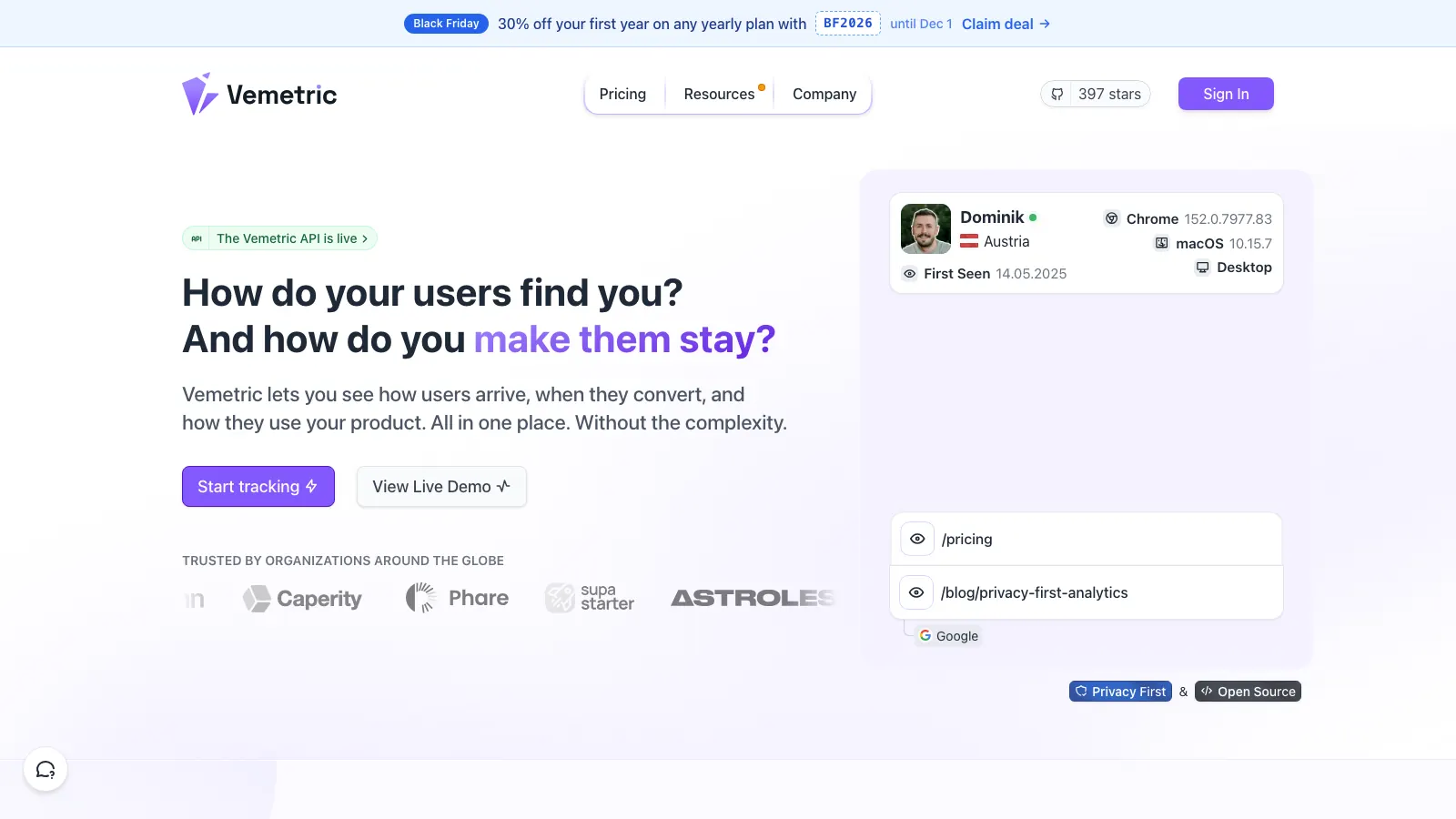
Vemetric puts the question of acquisition beside the question of product use. Among the marketing tools directory, it is a practical fit when you want to follow the route from a marketing page into a product action without maintaining two reporting systems. Its web analytics cover traffic, top pages and referrers, while its product analytics documentation covers custom events, user identification, journeys and funnels.
The price structure gives a very small team room to establish the habit first. Free includes 2,500 events a month, two projects, two seats and one month of data retention. Professional starts at $5 a month for 10,000 monthly events, unlimited projects, unlimited seats and five years of retention. That is a straightforward proposition for a team whose immediate need is a shared behavioral view rather than a large analytics rollout.
I would use Vemetric to make a small number of decisions repeatable: which acquisition sources bring visitors, whether an onboarding flow loses people, and what users did before a conversion. Its promise is clearest when those questions belong to the same team. If the work needs a published integration matrix, a custom enterprise package, or self-hosting now, the available plan information leaves too much unanswered.
Who gets the most value from Vemetric analytics?
Small product teams
Follow marketing traffic and product actions without paying separate per-seat charges.
Lean SaaS teams
Start free, then retain five years of data on Professional as requirements grow.
Privacy-conscious teams
Use EU-hosted analytics without default cookies, adding consent-based cookies only when needed.
Product decision makers
Use journeys and funnels to locate drop-off in important user flows.
Vemetric is not the right choice for a team that must run Vemetric on its own infrastructure today. The vendor says a self-hostable Community Edition is being worked on, which makes it a future possibility rather than a present deployment option. It is also worth confirming API entitlement before an agent workflow depends on it, because the documentation introduces a REST API but the pricing page does not divide that access by plan.
Which analytics features are built into Vemetric?
Web and product analytics together
Vemetric describes its product as web and product analytics. For your team, web reporting answers where visitors came from and which pages they saw. Product tracking adds the custom events and identified-user context needed to see what happens after a visitor reaches the application. The advantage is not more dashboards. It is one trail of evidence for a decision that starts with acquisition and ends with a meaningful action.
User journeys and identification
The user journey view follows anonymous and identified users through the product. Vemetric says an individual timeline groups associated events by day and session, and shows event details, activity, device information and referral context. Identifying logged-in users with a unique user ID lets Vemetric connect activity across devices and from an application backend. That is useful when a sign-up is only the middle of the customer journey, not the outcome you are trying to improve.
Funnels for conversion questions
Funnels can contain up to 10 steps, with each step defined by a page view or custom event. The funnel view reports absolute numbers, conversion rate, drop-off rate and overall completion, and it can be filtered for user groups. Vemetric currently uses a fixed seven-day window for progression. Treat that setting as a fit question: it can suit short onboarding or checkout flows, while a longer buying cycle needs its limits understood before the team adopts it as a core measure.
Privacy defaults
Vemetric says its servers are hosted in the EU and that it uses no cookies by default. It describes the product as GDPR compliant, while allowing cookies as an opt-in after visitor consent. This is a useful operating default for a team that wants to keep analytics implementation restrained, but it does not remove the need to apply your own privacy requirements and consent process.
API and open-source code
The documentation has a REST API section, and Vemetric says the code is open source under the AGPLv3 license. Those facts matter to a technical team that wants to inspect the project or connect data elsewhere. The documentation does not turn that into a published plan promise, so I would confirm the API scope and any limits before treating it as the basis for an AI agent or production reporting workflow.
How much does Vemetric cost for growing teams?
Price checked 27 Nov 2026
| Plan detail | Free$0/mo | ProfessionalFrom $5/mo |
|---|---|---|
| Monthly events | 2,500 | 10,000+ |
| Projects | 2 | Unlimited |
| Team seats | 2 | Unlimited |
| Data retention | 1 month | 5 years |
| Web analytics | ✓ | ✓ |
| User journeys and funnels | ✓ | ✓ |
| Custom events | ✓ | ✓ |
Vemetric prices in US dollars, 27 Nov 2026.Vemetric
Professional is published from $5 per month at 10,000 monthly events. The annual price is $50 after the first year, while the currently advertised first-year annual offer is $35 with the BF2026 code until 1 December. VAT may apply. That makes the regular annual bill $50 for a team of any size that stays within the 10,000-event entry level, because Vemetric lists unlimited seats rather than a per-user add-on.
Event volume is the number to watch. The limit counts across every project in an organization, not separately by project. Vemetric says it continues tracking events after a limit is exceeded, but repeated overages can block dashboard access. The sensible budgeting move is to check a month of actual events before choosing the paid volume, not to assume that an unlimited-project plan also means unlimited tracking.
Where does Vemetric fall short on data history?
Vemetric enforces transparent yet restrictive data retention limits and event allowances on lower tiers. A free team gets only one month of retention, and the organization-wide event cap can arrive faster than a project-level cap would suggest. Professional improves both numbers, but the published starting price is tied to 10,000 events, so a growing product should confirm the price at its actual traffic level.
Self-hosting is the clearest present limitation. Vemetric is open source, but it says self-hosting is not yet available. That distinction matters for a team with an infrastructure or data-residency requirement: access to source code is not the same as an available self-managed deployment.
The agent story also needs a direct answer from the vendor. There is REST API documentation, yet the plan comparison does not state its availability or limits. That is enough to investigate, not enough to promise an automated workflow to a client or an internal team.
What are the top software alternatives to Vemetric?
 AI Peekaboo review should be first on your reading list when the decision is about how often AI answers recommend your brand. Its plans from $30 a month, checked 27 Nov 2026, include an API, MCP access and Looker Studio, which addresses a different question from Vemetric's product behavior reporting.
 Wicked Reports review is the relevant follow-up when you need to tie each sale to the real click that brought it, verified against actual orders, rather than analyze user journeys.
 Amplitude review is worth reading when analytics, experimentation and session replay must sit in the same product-analysis platform.
What is the final verdict on Vemetric?
Vemetric enables small product teams to unify marketing traffic and in-app event tracking without incurring per-seat charges. Free is substantial enough to establish whether the tracking model works. Professional is a clear next step when five years of retention, unlimited seats and 10,000 monthly events match the real workload.
Start on Free with one critical journey and one funnel. Move to Professional when your event volume fits its entry level and the longer retention changes the decisions your team can make. Confirm API access and higher-volume pricing before you build a dependency around either.
How was Vemetric documentation and pricing verified?
Vemetric specifications, privacy terms, and subscription tiers were checked using official product documentation on 27 Nov 2026. Prices use the vendor's US-dollar terms, and the approach follows how we check figures.
- Vemetric pricing and plan details
- Vemetric documentation for product analytics, journeys, funnels and the REST API
- Vemetric pages for privacy defaults, open-source licensing and self-hosting status
What are common questions about adopting Vemetric?
Is Vemetric free?
Yes. The Free plan includes 2,500 events each month, two projects, two seats and one month of data retention.
What counts toward Vemetric's event limit?
The event limit counts across the projects in an organization. Vemetric continues tracking after an overage, but says repeated overages can prevent dashboard access until you upgrade.
Can Vemetric track a marketing site and product?
Yes. Vemetric provides web and product analytics. Its documentation covers custom events, user identification, user journeys and funnels for product behavior.
Is Vemetric cookieless?
Vemetric says it uses no cookies by default and hosts its servers in the EU. It also supports cookies when visitors have given consent.
Can I self-host Vemetric?
Not currently. Vemetric says it is working on a self-hostable Community Edition with core features available for free.
 Reviewed byDanny Kirk
Founder of ReddiReach.
 Checked byAndrés Felipe
Digital designer and marketer.
Every figure is checked against the vendor's own page. Read our editorial standards.