
Key Takeaways
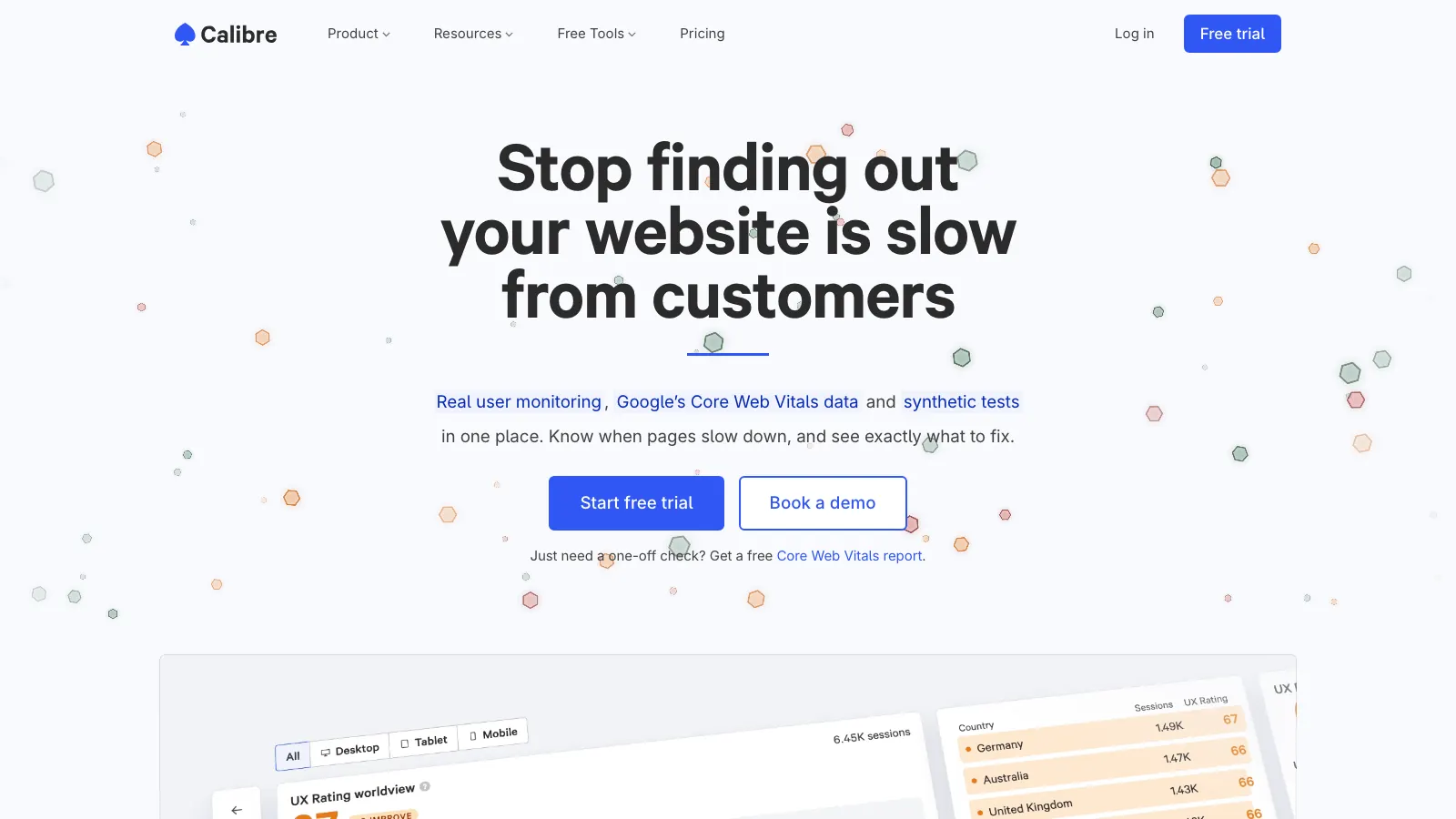
- Calibre consolidates real-user monitoring, Google CrUX datasets, and scheduled synthetic web performance tests into a single engineering dashboard.
- Calibre charges $75 monthly for Starter with 5,000 RUM sessions and synthetic tests, while Team costs $150 monthly for ten seats.
- Calibre provides a dedicated Model Context Protocol server alongside API and CLI tools, granting autonomous coding agents read-only performance data access.
- Calibre quickly becomes costly if your site easily surpasses 5,000 monthly sessions and merely requires occasional manual speed testing.
Calibre is the right pick when your technical SEO and engineering teams need real-user, Google CrUX and synthetic performance data in one place, with API and CLI on every plan, plus an MCP server for coding agents. Skip it if your site will exceed 5,000 real-user sessions quickly or you need a low-cost one-off diagnosis, where GTmetrix starts free.
Agent access
- API
- Yes
- MCP server
- Official, hosted, OAuth
- Works with
 ChatGPT
 ClaudeClaude Code
 Cursor
 VS Code
- Automation
- Zapier
What are the core technical advantages and limits of Calibre?
What works
- RUM, CrUX and synthetic monitoring on every paid plan
- API and CLI on every plan, plus MCP for coding agents
- Three included seats on Starter, with client and contractor access available
What to watch
- Starter RUM pauses when it reaches 5,000 sessions
- Company jumps from $150 to $1,500 a month, paid yearly
- No free plan is listed after the 15-day trial
How does Calibre help engineering teams diagnose page performance bottlenecks?
Calibre makes the strongest case when a slow page is everybody's problem, but your teams use different evidence. It puts real-user monitoring, Google Chrome User Experience Report data and scheduled synthetic tests alongside each other, so technical SEO can see Google's view while developers keep a controlled check on every release. If you are comparing continuous monitors, the DebugBear review is useful too: its Startup plan includes 100,000 RUM page views a month at $125 a month, checked 27 Nov 2026.
The three sources answer different questions. RUM records the experience of your visitors. CrUX gives you Google's field data, including competitor sites without installing anything. Synthetic monitoring supplies a repeatable lab test and can run on a schedule. Calibre also says its release comparisons flag changes that make things worse, which turns the dashboard from a report into an operational signal.
That combination is why I would choose Calibre for a team that already treats speed as a shared product metric. I would not expect a basic page-speed score to settle the difference between a lab result, your visitors' experience and Google's data when a performance problem reaches the SEO backlog.
Which web performance and technical SEO teams benefit most from Calibre?
Development teams
Use the API and CLI to put tests, budgets and monitoring data into a CI/CD workflow.
Technical SEO teams
Read Google's CrUX data beside real-user and synthetic data when prioritizing Core Web Vitals work.
Product teams
Give engineering, SEO and product one place to discuss release-level performance changes.
Small agencies
Share access with contractors or clients, then add seats at $15 per user each month when needed.
It is a weak fit for a site owner who needs to inspect one URL today and move on. The 15-day trial is a sensible way to assess a monitoring workflow, but the ongoing product begins at $75 a month. For a free report and a waterfall-style diagnostic, the GTmetrix review is the more practical starting point.
What synthetic testing and real-user monitoring features are in Calibre?
Real User Monitoring
Calibre collects user-experience metrics from real visitors. Its pricing includes 5,000 sessions on Starter, 10,000 on Team and 1 million on Company. The figure matters more than the plan label: Starter pauses RUM at its limit until the next billing cycle, while Team adds 100,000-session packs after its included allocation.
Google CrUX data
Every plan includes Core Web Vitals and other experience metrics direct from Google's Chrome User Experience dataset. Calibre describes CrUX as Google's view of any site, including competitors, with nothing to install. That makes it especially useful for technical SEO work, where a team needs to distinguish its own visitor data from the field data Google uses in search-ranking assessment.
Synthetic monitoring and performance budgets
Scheduled synthetic tests give the team a steady baseline and fast feedback after a change. Each plan has an allocation, with 5,000 tests on Starter, 15,000 on Team and 50,000 on Company. Test packs expand Starter and Team by 5,000 tests for $60 a month, and synthetic budgets can alert in Slack, email or webhooks when a metric crosses the limit you set.
API, CLI and MCP
Automation is a real part of the offer, not an enterprise-only extra. Calibre lists its Automation API and command-line client on all plans for CI/CD workflows, reporting exports and site management. Its CLI can retrieve metrics from RUM, CrUX and Synthetic monitoring, manage sites and automate snapshots. For coding agents, Calibre MCP offers read-only access to those same three data sources without scripting. Calibre does not say which plan includes MCP; ask before you build on it.
Deploy and alert workflow
Calibre compares each release with the previous one in RUM and Synthetic data, flagging releases that made performance worse. Weekly insight emails flag major changes, while synthetic budgets can send alerts into the places the team already works. That is the feature set to value if the real cost of a regression is finding it late, not simply measuring it.
How are Starter and Team subscription plans priced in Calibre?
Price checked 27 Nov 2026
| Plan detail | Starter$75/mo | Team$150/mo | Company$1,500/mo |
|---|---|---|---|
| Billing | Monthly | Monthly | Paid yearly |
| RUM sessions monthly | 5,000 | 10,000 | 1,000,000 |
| Synthetic tests monthly | 5,000 | 15,000 | 50,000 |
| Seats included | 3 | 10 | 50 |
| CrUX data | ✓ | ✓ | ✓ |
| API and CLI | ✓ | ✓ | ✓ |
| RUM retention | 90 days | 1 year | 2 years |
Calibre prices in US dollars, 27 Nov 2026.Calibre pricing
The first monthly bill is refreshingly clear. A three-person team fits within Starter's included seats, so the starting bill is $75 a month if its traffic fits the RUM limit. Add a fourth teammate and it becomes $90 a month, because extra seats cost $15 per user per month. That is a useful real team bill, but the traffic limit still decides whether Starter is viable.
- Additional seats cost $15 per user a month on Starter and Team.
- Starter RUM pauses at 5,000 sessions. Team includes 10,000, then offers 100,000-session packs for $75 a month.
- Starter and Team can add 5,000 synthetic tests for $60 a month.
- Company includes invoice payment, a security audit log and high-priority support, with volume discounts after its included limits.
Calibre offers a 15-day trial and says no card is required. It does not list a permanent free tier, so do not mistake the trial for an ongoing no-cost monitor.
What enterprise scale and RUM allowances does Calibre Company provide?
Calibre Company serves organizations whose web performance requirements exceed standard real-user monitoring limits and smaller team tiers. It provides 1 million sessions, 50,000 synthetic tests, 50 included seats, two years of RUM data, a security audit log and high-priority support. The published rate is $1,500 a month, paid yearly.
The difficult part is the gap. Team is $150 a month and Company is ten times that rate, with no published middle tier. If your session count exceeds Team's included amount but your organization cannot support the annual Company commitment, ask Calibre about the session packs and the exact annual commitment before you make the monitoring program dependent on it.
Where does Calibre impose restrictive session caps on high-traffic sites?
Calibre Starter imposes a strict real-user monitoring cap of 5,000 monthly sessions that quickly limits busier websites. It is not merely a reporting cap: Calibre says monitoring pauses after 5,000 sessions until the next cycle. For a site with regular traffic, a plan that starts at $75 can become unsuitable before the team has even used its three included seats.
Growth between Team and Company is the second weakness. Team doubles Starter's included sessions to 10,000, then the next published tier jumps to 1 million sessions and a yearly-paid $1,500 monthly rate. The availability of 100,000-session packs helps, but it does not remove the need to price growth carefully.
Finally, Calibre is designed to monitor sites over time. If your immediate job is explaining why a single page is slow, a continuous platform may be more than you need. GTmetrix has a free tier with page analysis, Core Web Vitals and waterfall charts, which is a better first move for that narrower task.
Which site speed monitors and intelligence tools compete with Calibre?
 AI Peekaboo review is for a different question: it tracks how brands appear in AI answers, with API and MCP access from $30 a month. It does not replace a performance monitor, but it belongs in the same reporting conversation if AI-search visibility is part of your team's remit.
 DebugBear's Startup plan is $125 a month, or $99 billed yearly, checked 27 Nov 2026, and includes 100,000 RUM page views, unlimited domains and Looker Studio integration.
 GTmetrix is the budget diagnostic choice: its free plan offers page-speed analysis, while Lite is $5.99 a month with 1 monitored slot, checked 27 Nov 2026.
Is Calibre worth the cost for continuous web performance monitoring?
Calibre is worth paying for when you need the conversation about performance to move past a single score. It gives developers, technical SEO and product teams three complementary sources of evidence, then provides API and CLI access on every plan, plus MCP for coding agents. Its $75 Starter plan is a fair entry point for a small, low-traffic team.
The catch is capacity. Confirm your RUM volume before you commit, because Starter pauses at 5,000 sessions and the published Company price is a big step beyond Team. I would choose Calibre when those limits fit. If they do not, consider another monitor or keep the job to a lower-cost diagnostic tool.
Start the 15-day trial with your busiest site, set one synthetic budget and check your RUM session count before the trial ends. Keep Starter only if 5,000 sessions leaves enough room for a normal month.
How were Calibre developer tools and performance testing limits verified?
Every price, limit and feature in this review comes from Calibre's own pricing, product and documentation pages, read on 27 Nov 2026. Prices are in US dollars, as Calibre shows them, and every figure follows how we check figures.
- Calibre pricing page
- Calibre product pages for RUM, CrUX and Synthetic monitoring
- Calibre documentation for its CLI, API and MCP
What are common technical questions about deploying Calibre monitoring?
Does Calibre have a free trial?
Yes. Calibre offers a 15-day free trial and says no card is required. It does not list a permanent free plan.
What is the difference between RUM and synthetic monitoring in Calibre?
RUM records experience metrics from real visitors. Synthetic monitoring runs page-speed tests on URLs from Calibre's synthetic agent. Calibre includes both, along with CrUX data, on every paid plan.
Can Calibre work in a CI/CD workflow?
Yes. Calibre lists its Automation API and command-line client for CI/CD workflows, reporting exports and site management. Its documentation also covers performance budgets, pull-request reviews and integrations.
Does Calibre work with coding agents?
Yes. Calibre MCP gives coding agents read-only access to Synthetic, RUM and CrUX data. The documentation specifically names Claude Code and Cursor as examples.
Can an agency share Calibre with clients?
Yes. Calibre says seats can be shared with teammates, contractors or clients. Starter includes 3 seats, Team includes 10 and Company includes 50; additional Starter and Team seats cost $15 per user each month.
 Reviewed byDanny Kirk
Founder of ReddiReach.
 Checked byAndrés Felipe
Digital designer and marketer.
Every figure is checked against the vendor's own page. Read our editorial standards.