
Key Takeaways
- Cometly tracks business-to-business marketing attribution by linking paid multi-channel ad spend directly to CRM opportunities, pipeline progression, and closed-won revenue.
- Cometly deploys first-party server-side tracking pixels to bypass browser cookie degradation and maintain clean attribution data across enterprise customer journeys.
- Cometly prices subscriptions through custom usage quotes scaled to monthly pageview volumes, requiring buyers to complete a sales consultation rather than offering self-serve checkouts.
- Cometly bundles full developer application programming interface access alongside native Model Context Protocol server capabilities across every customer subscription plan.
Cometly is a strong choice when you run B2B SaaS paid campaigns and need to connect that spend to closed-won revenue, not merely leads. Skip it if you need a public price or a no-setup trial, because Cometly quotes by pageview volume after a sales call.
Agent access
- API
- Yes, Core and Enterprise
- MCP server
- Official, hosted, OAuth 2.1 with PKCE, or a personal access token for server-side agents
- Works with
 ClaudeClaude Code
 ChatGPT
 Cursor
- Automation
- Zapier, Make
What are the main advantages and drawbacks of Cometly?
What works
- Connects paid spend with pipeline and closed-won revenue
- Server-side events can complement the browser pixel
- MCP works with Claude, ChatGPT, Cursor, and custom agents
What to watch
- No public dollar price, only a usage-based quote
- No free trial for evaluation before setup
- Enterprise warehouse sync adds a second buying threshold
How does Cometly attribute revenue to specific marketing campaigns?
Cometly helps marketing teams allocate ad spend effectively by linking paid campaign touchpoints directly to pipeline creation and closed revenue. It maps spend to MQL, SQL, opportunity, and closed-won stages inside HubSpot or Salesforce, then adds measures such as LTV ROAS and cohort conversion. That is a different job from a general traffic dashboard, and it is why Cometly is built around B2B SaaS.
The important question is whether the data reaches the point where your business makes the decision. A lead count can flatter a channel that never becomes revenue. Cometly’s approach is to keep the campaign, CRM stages, and eventual revenue in the same attribution view. If that is your gap, compare it with the Factors.ai review: Factors.ai tracks first touch, last touch, and influenced attribution together, so every channel gets credit for what it did.
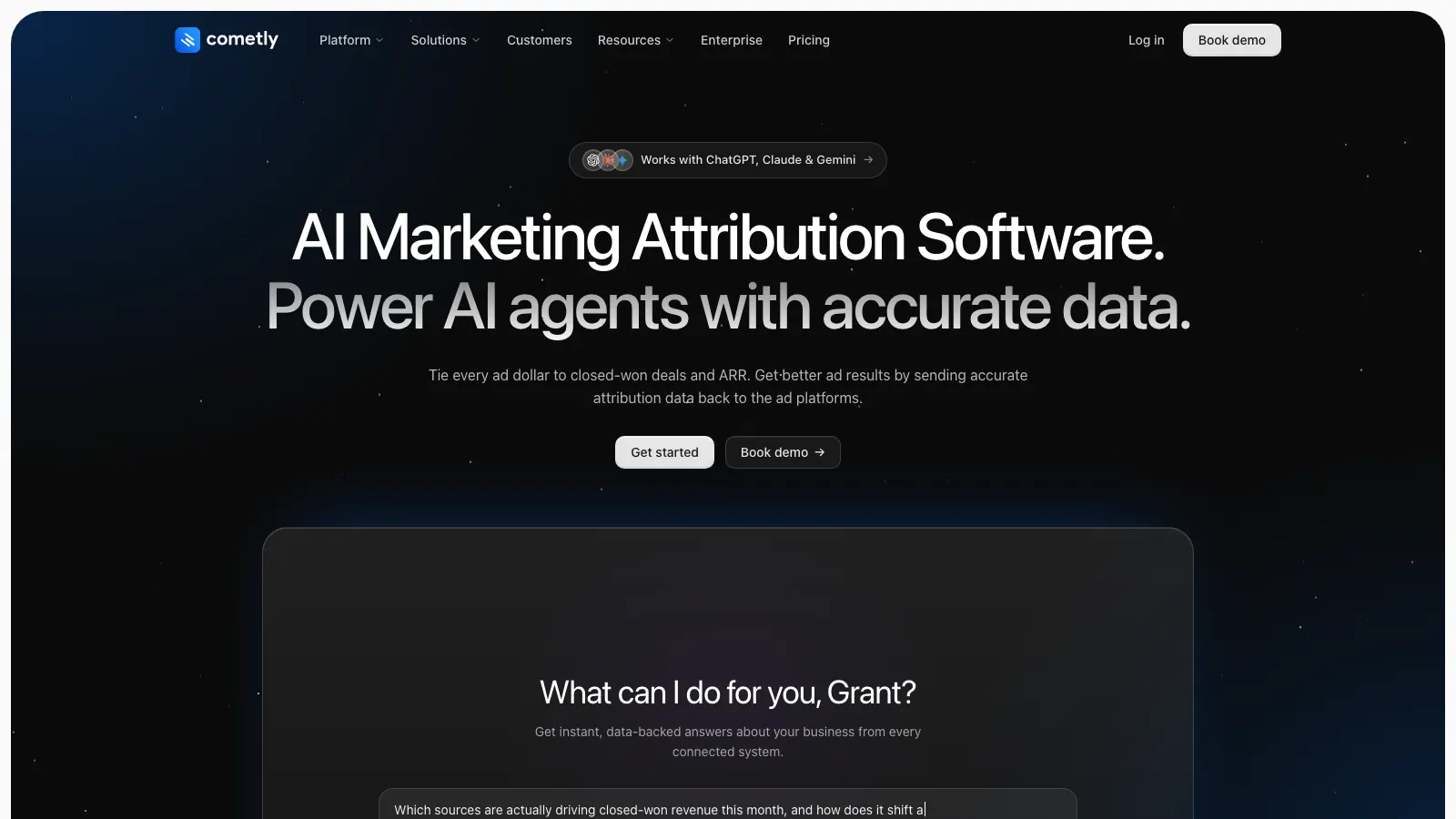
There is a second route through the product for teams building AI-assisted reporting. Cometly exposes attribution data through Model Context Protocol, so Claude, ChatGPT, Cursor, and your own agents can work from the account’s data. The vendor says this access is available on every plan, not reserved for Enterprise.
Which B2B SaaS growth marketing teams should adopt Cometly?
B2B SaaS demand teams
Paid-media teams needing pipeline and revenue, not just lead totals, by campaign.
Revenue operations teams
Operators aligning ad spend with CRM stages and finance-facing revenue reporting.
AI-enabled analysts
Teams querying campaign data through MCP-connected assistants and custom agent workflows.
Growing paid programs
Marketers whose pageview volume and attribution needs justify a tailored deployment.
I would not make Cometly the first stop for a small site that only needs basic traffic trends. Its own pricing and onboarding language assumes CRM and ad-platform connections, while the commercial model is based on tracked pageviews. If cookie banners are the immediate problem, read the Fathom Analytics review: Fathom says it does not use cookies, so analytics can stay on your site without a pop-up.
What multi-touch attribution and server-side tracking features does Cometly include?
Revenue attribution across the funnel
Core includes multi-touch attribution, account journeys, analytics, events, and customizable dashboards. Cometly lets you compare eight attribution models and choose lookback windows from one day to lifetime value. That flexibility matters when your sales cycle does not resemble a same-day ecommerce purchase, but it does not remove the need to agree internally which model will guide budget decisions.
Pixel and server-side tracking
Cometly pairs its pixel with server-side event tracking and a Conversion API. Its server-side setup is designed to send backend conversion events through ad blockers, iOS privacy controls, and OAuth redirects. It can also ingest Stripe subscription events and HubSpot or Salesforce lifecycle changes, so a conversion signal need not rely only on what a browser captured.
Agent-ready attribution data
Cometly’s MCP connection can answer questions about ROAS by source, CPA by campaign, attribution models, and customer journeys from an agent client. This is not a claim that an agent will make good budget decisions on its own. It gives the agent a documented data connection, which is the useful prerequisite if you want to build reporting or analysis workflows around it.
Ad platforms and data sync
Both plans list unlimited connections to Meta, Google, LinkedIn, TikTok, Microsoft, Reddit, and Snapchat, including server-side Conversion API. Enterprise adds CRM and warehouse sync, plus exports and live syncs to Snowflake, BigQuery, and Redshift. That division is sensible for a company with a warehouse, but it means a warehouse-first team should establish Enterprise cost before treating Cometly as its source of record.
Ecommerce support
Cometly primarily positions itself for B2B SaaS, but it also has an ecommerce offering. It says that product can tie orders from Shopify, WooCommerce, and checkout flows back to the ads, audiences, and creative that drove them. The two use cases share attribution logic, yet a store should still evaluate the ecommerce setup on its own terms rather than assuming the B2B SaaS workflow transfers unchanged.
How does Cometly calculate pageview-based subscription pricing?
Price checked 27 Nov 2026
| Plan detail | CoreUsage-based | EnterpriseCustom |
|---|---|---|
| Billing basis | Monthly pageviews | Custom |
| Pixel and server-side tracking | ✓ | ✓ |
| Multi-touch attribution and dashboards | ✓ | ✓ |
| MCP and Cometly API | ✓ | ✓ |
| CRM and warehouse sync | Not listed | ✓ |
| Warehouse destinations | Not listed | Snowflake, BigQuery, Redshift |
Cometly pricing, 27 Nov 2026.Cometly pricing
There is no published dollar starting price to turn into a pretend team bill. Cometly says its plans are tailored to monthly pageviews, and estimates that a visit produces about 1.5 pageviews. Core and Enterprise are available monthly or annually, with a stated 20% annual saving. Ask for the exact pageview tier, overage treatment, and all implementation costs before comparing the quote with another tool.
- Pageviews count whenever a page loads through the pixel or server-side events
- Cometly says it notifies you at 90% of a tier, then promotes the account next billing period
- There is no free trial, because Cometly says useful attribution requires CRM and ad-platform setup
What data warehouse features does Cometly Enterprise deliver?
Cometly Enterprise enables data engineering teams to route raw multi-touch attribution streams directly into cloud data warehouses and internal reporting infrastructure. Alongside the Core feature set, it adds SSO, a dedicated solutions engineer and success manager, increased pageview usage and AI credits, custom integrations, and first access to new features. It is not automatically the better plan, it is the plan for a more connected operating environment.
What are the primary disadvantages of deploying Cometly?
Cometly limits buyer transparency by withholding public pricing schedules and requiring sales calls before disclosing monthly pageview costs. A usage-based model can fit a growing acquisition program, but the lack of published dollars means you cannot compare it responsibly until Cometly sizes your pageviews and quotes the stack. The vendor does not throttle attribution when a tier is crossed, but an automatic move to the next tier can still change the bill.
The other constraint is the setup threshold. Cometly explicitly does not offer a free trial, and its explanation is credible: attribution depends on CRM and ad-platform connections. Still, that means your evaluation is a sales and implementation conversation, not a self-serve experiment. If you need to explore data before involving those systems, choose a tool with a lighter entry path.
Finally, do not confuse MCP access with universal AI measurement. Cometly documents MCP clients and attribution questions, but its official material does not establish automatic tracking of every AI traffic source. Treat the integration as access to the attribution data you already collect.
Which revenue attribution platforms offer alternatives to Cometly?
 AI Peekaboo review is the first alternative to consider when the problem is AI visibility monitoring rather than paid-media revenue attribution. It offers a read/write API and white-label delivery, whereas Cometly centers campaign, pipeline, and revenue data.
 Factors.ai tracks first touch, last touch, and influenced attribution together, so every channel gets credit for what it did.
 Fathom Analytics is for teams that need cookieless visitor analytics without a pop-up, and can use its API to bring that traffic data into their own tools.
Is Cometly the best B2B attribution software for paid media?
Cometly earns its place when you can name the revenue question that ordinary campaign reporting cannot answer. Its full-funnel attribution, server-side event options, and MCP access form a coherent offer for a B2B SaaS team with serious paid acquisition and a CRM-led sales motion. The trade-off is an initial sales conversation for pricing and onboarding. When usage grows, Cometly says it notifies you at 90% of a tier and automatically promotes the account at the start of the next billing period.
Bring your monthly pageview estimate, CRM stages, ad platforms, and one unresolved revenue-attribution question to the call. If Cometly can quote the required tier and connect that question to closed-won revenue, it is a credible fit. If not, do not buy a heavier attribution stack than your reporting needs.
How were Cometly attribution features and server-side tracking evaluated?
Cometly attribution models, server-side tracking guides, developer MCP capabilities, and enterprise offerings were examined on 27 Nov 2026. Prices remain in the vendor’s published format because no dollar amounts were listed. Our approach follows how we check figures.
- Cometly pricing and enterprise pages
- Cometly attribution, MCP, and server-side tracking pages
- Cometly B2B SaaS and ecommerce product pages
What are common questions regarding Cometly attribution tracking?
How does Cometly charge?
Cometly uses monthly pageviews for usage-based pricing and quotes the price live. It estimates about 1.5 pageviews per visit.
Does Cometly offer a free trial?
No. Cometly says attribution needs CRM and ad-platform setup to be useful, so it does not run a free trial.
Does Cometly work with AI agents?
Yes. MCP access is included on every plan and connects Cometly with Claude, ChatGPT, Cursor, and custom agents. The Cometly API is also listed on Core and Enterprise.
Is Cometly only for B2B SaaS?
Cometly is built for B2B SaaS, and it also sells an ecommerce attribution solution for online stores and checkout flows.
 Reviewed byDanny Kirk
Founder of ReddiReach.
 Checked byAndrés Felipe
Digital designer and marketer.
Every figure is checked against the vendor's own page. Read our editorial standards.