
Key Takeaways
- Content Harmony gives digital agencies and marketing teams a structured, repeatable workflow that converts keyword search reports into detailed briefs and human-written draft grading.
- Content Harmony plans start at $50 monthly for five Content Workflows, including unlimited seats and projects, with monthly credits remaining valid for 90 days.
- Content Harmony publishes API endpoints covering workflow data, briefs, and content grading, reserving confirmed early API access specifically for high-volume Enterprise tier customers.
- Content Harmony is not intended for teams seeking automated full-article generation, a permanently free plan, or explicit public API access included on Standard plans.
When writers receive uneven research and vague assignments, Content Harmony gives your team a single handoff from keyword report to brief to draft review. It suits agencies and in-house teams with a steady editorial cadence; skip it if you need a full article generator or clearly defined Standard-plan API access.
Agent access
- API
- Yes, Enterprise plans start at $1,000/month, include 200+ Content Workflows/month, and list Early API Access.
- MCP server
- Not found on official pages
- Automation
- Zapier, Make, n8n
What are the main pros and cons of Content Harmony?
What works
- One workflow joins a keyword report, brief and grader
- Unlimited users and projects on every published plan
- Briefs and graders can be shared with outside contributors
What to watch
- No permanent free plan, only a $10 credit trial
- Monthly cost grows with the number of workflows
- Standard-plan API access is not specified; Enterprise lists early API access
What does Content Harmony do for your content team?
Content Harmony gives a content operation one path from a keyword report to a brief and then a grader. That makes it a useful addition to the marketing tools directory when the actual blockage is not finding more ideas, but giving writers the same useful instruction every time. Its Content Workflows package the three stages around one page of content.
The product is deliberately narrower than a writing platform. It is built for SEO and content teams to examine a topic, leave notes, share a brief and improve a draft. That restraint is the point: your writer still makes the argument and editorial choices, while the team gets a common research record and a place to discuss the assignment.
I would choose it where inconsistent briefs create inconsistent drafts. Content Harmony is less compelling if the real problem is publishing throughput or finished-article generation, because its documented workflow stops at research, briefing and grading.
Who is Content Harmony designed for?
In-house content teams
Give editors and writers one shared brief format across recurring search-led assignments.
Boutique agencies
Share briefs and grader access with clients, freelancers and subject matter experts.
Content strategists
Turn keyword research into editable briefs with notes and highlighted report data.
Operations-minded editors
Keep projects, templates and unused credits organized without assigning paid seats.
It is a poor fit for a solo writer who only needs occasional keyword ideas, or a team expecting Content Harmony to write completed articles. The paid trial makes it possible to see whether the workflow fits, but there is no free subscription to keep after those credits are used.
Which features does Content Harmony provide?
Keyword reports and topic research
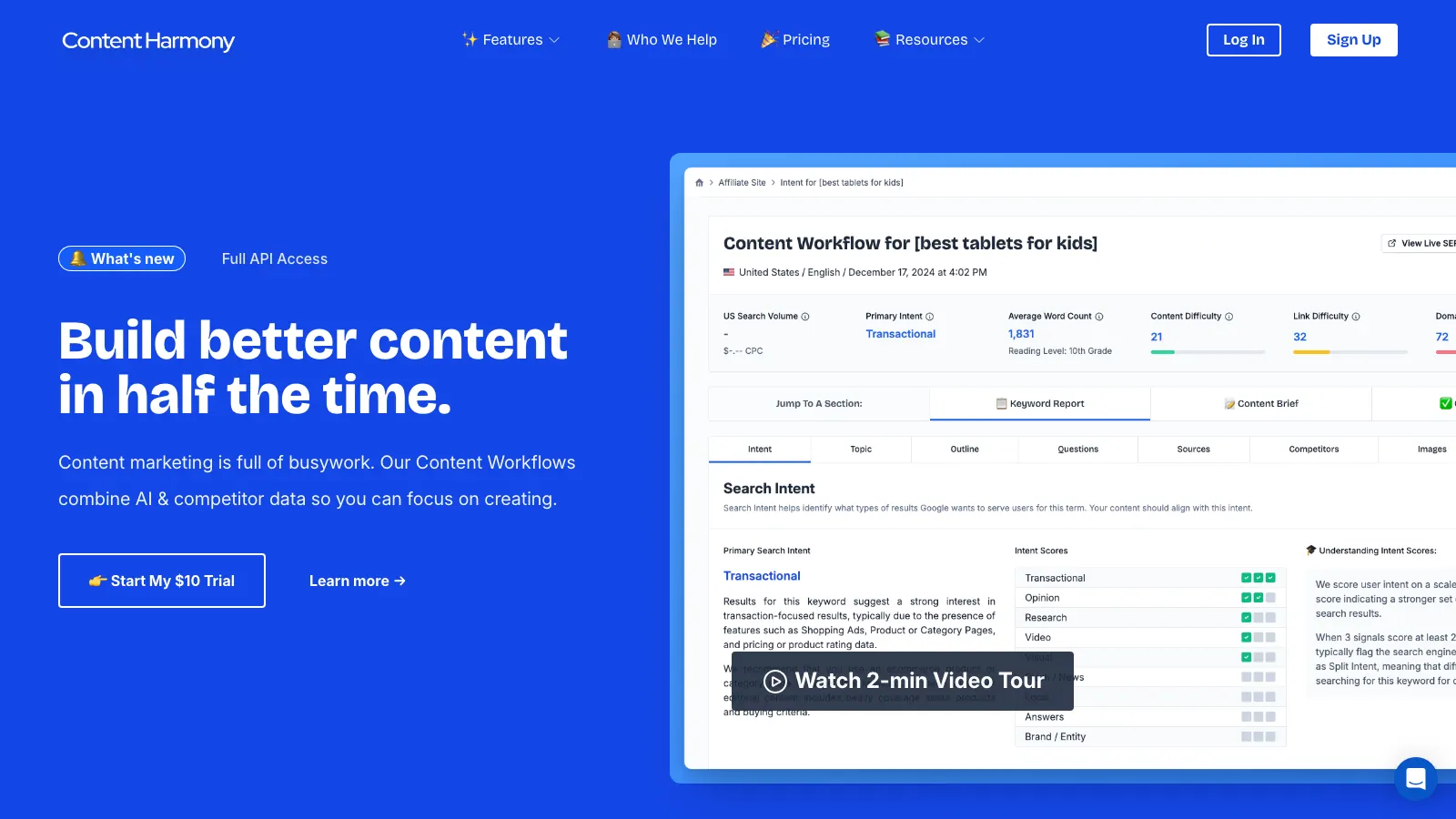
Each workflow begins with a Keyword Report. Content Harmony lists search intent, topic modeling, competitor outlines, keyword difficulty, question analysis and image and video analysis among the research areas it covers. That gives a strategist material to shape an assignment rather than handing a writer a single target phrase.
Customizable content briefs
The brief editor supports notes, comments and instructions, along with highlighted data from the Keyword Report. Teams can start from standard templates, then make an unlimited set of templates for different content types or client needs. That is especially useful when an editor needs a consistent handoff without forcing every project into the same rigid outline.
Content grading for drafts and refreshes
The grader can take a draft or an existing URL and identify unused topics and phrases from the topic model. It is designed around comprehensive coverage rather than simple keyword-density targets. I like that boundary: a score is a prompt to review the coverage, not a claim that Content Harmony can decide whether a piece is good.
Sharing without extra seats
Public sharing links let a team send briefs to writers, clients and collaborators. The grader can be shared read-only, or in Grader Mode so a logged-out guest can edit it. With unlimited users and projects on published plans, that removes the usual decision over who gets a login from a brief-production process.
Editors, webhooks and API
Content Harmony lists Google Docs, Microsoft Word, Notion, outgoing webhooks and API access as integrations. Briefs can also be copied to the clipboard for use in those editors. Its API documentation describes more than 20 endpoints for workflow data, including reports, briefs and graders, and JSON responses for custom applications. Standard-plan API access is not specified; Enterprise lists early API access, so confirm your access before building an automated process around it.
How is Content Harmony pricing structured?
Price checked 27 Nov 2026
| Plan detail | Standard 5$50/mo | Standard 12$99/mo | Standard 25$199/mo | Standard 50$299/mo | Standard 100$599/mo |
|---|---|---|---|---|---|
| Content Workflows monthly | 5 | 12 | 25 | 50 | 100 |
| Keyword Report, Brief and Grader | ✓ | ✓ | ✓ | ✓ | ✓ |
| Users and projects | Unlimited | Unlimited | Unlimited | Unlimited | Unlimited |
| Rollover credits | ✓ | ✓ | ✓ | ✓ | ✓ |
| Team training | ✓ | ✓ | ✓ | ✓ | ✓ |
Content Harmony prices in US dollars, 27 Nov 2026.Content Harmony pricing
This is volume pricing, not seat pricing. A three-person editorial team that needs 12 workflows a month pays $99 a month before tax, the same plan price as a twelve-person team with the same workflow need. Credits issued on monthly plans last 90 days; annual subscribers receive their year's credits upfront. The $10 trial comes with 10 credits, has no time limit and does not renew automatically.
At the higher end, Standard 150 is $799 monthly for 150 workflows. Enterprise starts at $1,000 a month for 200 or more workflows and adds procurement support and early API access. Larger plans generally lower the unit cost compared with Standard 5, but the monthly commitment still becomes substantial once a team operates at publisher scale.
What does Content Harmony Enterprise provide high-volume teams?
Content Harmony Enterprise is aimed at large-scale content programs that need 200 or more Content Workflows a month, procurement support and early API access. Content Harmony also offers custom annual programs for large bulk workflow or keyword-intent data requests. Treat it as an operations purchase, not an upgrade for a team that merely wants more seats, since every published plan already has unlimited users and projects.
Where does Content Harmony fall short for certain teams?
Content Harmony has a primary limitation in its tight product focus. Content Harmony can help you research a topic, construct a brief and identify coverage gaps in a draft, but it is not presented as a full article generator. That is a benefit for teams protecting an editorial process, yet it leaves a gap for buyers who want drafting and publishing in the same system.
The plan ladder deserves a hard look before you standardize on it. Five workflows cost $50 a month, while 50 cost $299 and 100 cost $599. Rollover credits soften a busy month, but a high-volume program still needs to forecast how many pages it will put through the workflow.
Finally, the product documents substantial API access without mapping it to the published plans. Enterprise explicitly lists early API access, while the plan comparison does not define API access for the standard tiers. Ask that question before promising integrations to an engineering team.
Which Content Harmony alternatives are available?
Content Harmony alternative pricing and competitive options were verified on 27 Nov 2026.
 AI Peekaboo is the better fit if your immediate job is monitoring how brands appear in AI answers and moving that data through a read and write API. It starts at $30 a month and includes the API and Looker Studio on paid plans. The AI Peekaboo review explains its reporting and plan model.
 GrackerAI is built for cybersecurity and B2B SaaS teams that need AI visibility fixes, with its Individual plan at $99 a month. See the GrackerAI review if AI answer monitoring is more urgent than content briefing.
 InLinks is the better match for entity-based internal linking and knowledge-graph work. Its Freelancer plan starts at $49 a month; the InLinks review covers its site-level approach.
What is the final verdict on Content Harmony?
Content Harmony delivers its primary value at the moment an editor turns search research into a brief a writer can actually use. Content Harmony gives researchers, strategists, writers and clients a common workflow, without charging more as more people join. I would use it for a team that publishes deliberately and wants a reliable briefing standard, not for a content mill seeking automated articles.
Spend the $10 trial on ten real upcoming pages. If the reports, customizable briefs and grader improve the handoff, choose the workflow volume that matches your editorial calendar and confirm API access in writing before automating it.
How was Content Harmony evaluated?
Content Harmony product, feature, integration, API and pricing pages were checked directly on 27 Nov 2026. Prices are in US dollars as the vendor presents them, and the figures follow how we check figures.
- Content Harmony pricing pages for each published workflow volume
- Product, Content Briefs and Content Grader pages
- Integrations page, documentation and API update
What are common questions about Content Harmony?
Does Content Harmony write articles?
No. It is designed for topic research, content briefs and grading drafts. The writing and editorial decisions remain with your team.
Can I share a Content Harmony brief with a freelancer?
Yes. Public sharing links can send briefs to writers, clients and collaborators. The grader also has read-only and editable sharing modes for logged-out guests.
Is Content Harmony free?
No permanent free plan is published. A $10 trial supplies 10 Content Workflow credits, has no time limit and does not bill automatically after signup.
How much does Content Harmony cost for a team?
Plans start at $50 a month for five workflows. Unlimited users and projects are included, so the bill changes with workflow volume rather than the number of teammates.
 Reviewed byDanny Kirk
Founder of ReddiReach.
 Checked byAndrés Felipe
Digital designer and marketer.
Every figure is checked against the vendor's own page. Read our editorial standards.