
Key Takeaways
- Crayon suits enterprise product marketing and revenue enablement teams that turn continuous competitor monitoring across pricing, product, and hiring changes into live Salesforce and Gong battlecards.
- Crayon publishes no dollar pricing across its Growth, Professional, and Enterprise tiers, requiring a custom sales quote where annual contracts typically reach five figures.
- Crayon limits Growth plans to 10 monitored competitors without Sparks AI, Crayon Answers, or Salesforce sync, reserving Gong and Chorus integrations strictly for Enterprise contracts.
- Crayon confirms official API access and MCP server capabilities in its public Wunderkind case study, including Glean connectivity, though public developer documentation and rate limits remain unpublished.
- Early-stage teams, agencies seeking white-label competitive reporting, and solo marketers wanting self-serve monthly billing will find Crayon gated behind sales calls and complex workflows.
If your sales reps lose competitive deals because static slide decks fall months behind market changes, Crayon automates competitor tracking and battlecard updates directly inside Salesforce, Gong, and Slack. Crayon is the right buy for enterprise product marketing and enablement teams with budgets for custom five-figure annual contracts, while small businesses or startups needing simple passive monitoring without mandatory sales calls should skip Crayon.
Agent access
- API
- Yes
- MCP server
- Official
What are the pros and cons of Crayon?
What works
- Automated battlecard workflows translate tracked competitor pricing, product, and messaging changes into approved sales enablement assets without manual analyst rewrites
- Sparks AI Agent and Crayon Answers on Professional and Enterprise plans handle proactive research and natural-language sales rep queries during live deals
- Deep revenue integrations connect competitive intelligence directly into Salesforce opportunities, Gong and Chorus call recordings, Slack, Microsoft Teams, and Google Drive
- Official API and MCP server support documented in Crayon's Wunderkind case study enables enterprise search connections such as Glean
What to watch
- Zero published list prices on Crayon's pricing inquiry page, with custom annual contracts typically requiring five-figure budgets and mandatory sales consultations
- Entry-level Growth tier caps monitoring at 10 competitors and excludes Sparks AI Agent, Crayon Answers, Salesforce integration, and API access
- Gong and Chorus conversation intelligence integrations are locked behind the top Enterprise tier rather than included on Growth or Professional plans
- Steep onboarding curve across multi-feature AI workflows and no white-label delivery option for agencies selling competitive intelligence services
What does Crayon do for your team?
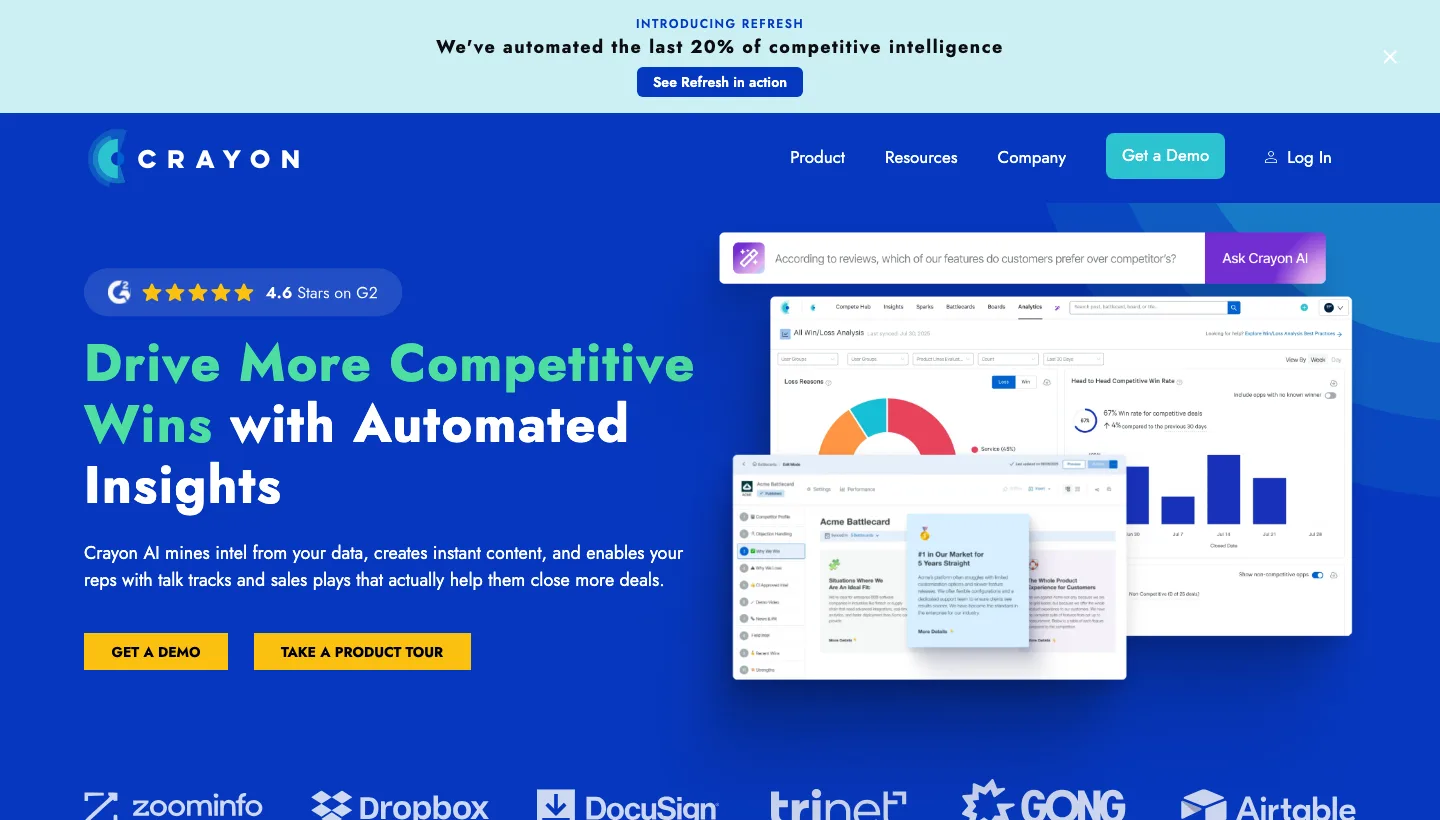
Crayon operates as a competitive intelligence system of record built for enterprise product marketing, competitive analysts, and B2B sales enablement teams. Rather than asking product marketers to check rival websites by hand every Friday, Crayon continuously crawls hundreds of external sources, including competitor pricing pages, product documentation, release notes, review portals, job postings, news coverage, and social feeds. When a rival shifts homepage positioning, alters tier packaging, or posts strategic engineering roles, Crayon logs and categorizes those movements automatically so revenue teams work from verified market changes rather than outdated assumptions. Within our Competitive Intelligence directory, weigh seat caps and reporting workflows early.
Beyond raw tracking, Crayon centers its daily workflow on automated battlecard generation and structured distribution. Product marketing managers establish battlecard templates and editorial approval rules inside Crayon, allowing the platform's AI to draft routine positioning updates whenever tracked competitor data changes. Instead of letting fresh insights sit unread inside an isolated marketing portal, Crayon pushes updated battlecards and alerts straight into Salesforce opportunities, Slack channels, Microsoft Teams workspaces, and Google Drive folders. On Enterprise deployments, Crayon also connects with Gong and Chorus to surface competitive mentions captured directly inside recorded customer calls.
Crayon extends this foundation with two distinct artificial intelligence modules available on Professional and Enterprise plans: Sparks AI Agent and Crayon Answers. Sparks AI Agent acts as an always-on research analyst that autonomously flags high-impact competitor shifts with contextual synthesis before a human marketer even writes a prompt. Meanwhile, Crayon Answers gives account executives a conversational AI interface where reps ask natural-language questions about rival pricing or feature gaps mid-deal and receive structured answers grounded strictly in Crayon's curated competitive database.
Which teams is Crayon built for?
B2B SaaS product marketing managers
Product marketers owning sales enablement use Crayon to eliminate manual battlecard maintenance. Template-driven AI updates and approval controls keep competitive objection handling current across dozens of rivals without consuming every week in spreadsheet audits.
Enterprise sales teams in crowded markets
Account executives facing frequent multi-vendor bake-offs rely on Crayon Professional and Enterprise plans to pull live competitive positioning inside Salesforce and query Crayon Answers in plain English before or during buyer calls.
Dedicated competitive intelligence analysts
Growth-stage and enterprise CI leads use Crayon to monitor up to 25 competitors on Professional or unlimited rivals on Enterprise, delegating routine data gathering to Sparks AI Agent so analysts focus on executive strategy.
Knowledge and AI operations teams
Enterprise IT and enablement architects building unified internal search can connect Crayon via its API and official MCP server capabilities, following documented workflows like Wunderkind's integration between Crayon and Glean.
Which Crayon features matter most in daily work?
Crayon separates itself from basic webpage change trackers by connecting automated source monitoring directly to AI synthesis and CRM-embedded battlecards. In daily revenue operations, three core Crayon capabilities determine whether sales reps actually adopt your competitive research during active enterprise deal cycles.
Multi-source competitor monitoring and AI battlecards
Crayon automates external surveillance across hundreds of digital footprints, tracking competitor websites, pricing tables, product documentation, review sites, job boards, social media channels, and press coverage. Instead of flooding marketers with noisy pixel-change alerts, Crayon structures detected shifts around pricing updates, hiring trends, feature launches, and messaging pivots. Every Crayon plan includes AI battlecard generation, though competitor capacity scales strictly by tier: Growth tracks up to 10 competitors, Professional expands coverage to 25 competitors, and Enterprise unlocks unlimited competitor monitoring for sprawling multi-product portfolios.
When Crayon logs a meaningful change, its battlecard engine bridges the gap between raw discovery and field readiness. Product marketing managers define the card layouts, objection frameworks, and human approval gates, while Crayon's AI drafts the routine content revisions triggered by fresh competitor moves. That workflow cuts the lag time between a rival changing its packaging on Tuesday morning and an account executive seeing approved counter-positioning before a Wednesday afternoon renewal call.
Sparks AI Agent and Crayon Answers conversational AI
On Crayon Professional and Enterprise tiers, Sparks AI Agent removes the manual triage bottleneck that stalls lean competitive intelligence programs. Rather than waiting for an analyst to run manual search queries, Sparks AI Agent continuously evaluates incoming competitor signals, surfaces material shifts proactively, and attaches analytical context explaining why a move matters. Marketing teams no longer have to comb through every minor webpage edit or job listing just to spot a competitor's quiet move upmarket or a newly introduced usage fee.
While Sparks AI Agent supports the research team, Crayon Answers serves frontline revenue reps directly on Professional and Enterprise plans. Account executives and sales engineers ask natural-language questions about rival positioning or pricing models during deal preparation and receive structured responses drawn from Crayon's competitive database. Because Crayon excludes both Sparks AI Agent and Crayon Answers from the entry-level Growth tier, teams buying Crayon specifically for conversational sales self-service must budget at least for Professional.
Revenue stack integrations, API access, and MCP support
Crayon drives field adoption by delivering competitive intelligence inside existing revenue software rather than forcing reps to log into another standalone tab. Slack, Microsoft Teams, and Google Drive integrations distribute alerts and battlecard assets across everyday communication channels, while Crayon's Salesforce integration links competitive tracking directly to active CRM opportunities starting on the Professional tier. Organizations requiring conversation intelligence links with Gong and Chorus to flag competitor mentions in recorded sales calls must step up to Crayon Enterprise.
For programmatic workflows and enterprise AI ecosystems, Crayon enables API access on Professional and Enterprise plans, and Crayon's public Wunderkind case study confirms both Crayon APIs and official MCP server capabilities. Wunderkind documented connecting Crayon directly to Glean via API so employees retrieve competitive intelligence inside enterprise search. However, Crayon does not publish public developer documentation, OpenAPI specs, authentication rules, rate limits, native Zapier, Make, or n8n connectors, or supported MCP client setup guides.
How much does Crayon cost for a team?
Crayon structures its commercial packaging across three named tiers: Growth, Professional, and Enterprise. Crayon does not publish monthly or annual dollar prices on its official pricing inquiry page, requiring every prospective buyer to speak with sales for a custom quote tailored to program scope. Industry benchmarks indicate Crayon annual contracts typically start in the five-figure range and scale upward with competitor volume and integrations.
| Plan | Monthly / listed price | Key limits & seats |
|---|---|---|
| Growth | Contact sales (custom quote) | Up to 10 monitored competitors; includes AI battlecard generation; excludes Sparks AI Agent, Crayon Answers, Salesforce, Gong/Chorus, and API access |
| Professional | Contact sales (custom quote) | Up to 25 monitored competitors; adds Sparks AI Agent, Crayon Answers AI, Salesforce integration, and API access; excludes Gong and Chorus |
| Enterprise | Contact sales (custom quote) | Unlimited monitored competitors; includes all AI modules, Salesforce, API access, plus Gong and Chorus conversation intelligence integrations |
Crayon pricing checked 27 Nov 2026.Crayon official pricing
Evaluating Crayon's real team cost requires looking closely at feature gating rather than competitor count alone. Although Crayon Growth covers up to 10 competitors and includes AI battlecard generation, it strips out Salesforce opportunity tracking, Sparks AI Agent, Crayon Answers, and API access. For most B2B SaaS organizations, Professional is the true operational baseline because it raises capacity to 25 competitors while unlocking Salesforce sync and both AI assistants. Furthermore, if your revenue leadership relies on Gong or Chorus to track competitive objections on recorded calls, Crayon locks those conversation intelligence integrations exclusively inside the Enterprise tier.
Crayon offers no free forever plan, no self-serve credit card checkout, and no public sandbox trial without engaging an account executive through its pricing inquiry workflow. Crayon does not publish per-seat fees, viewer versus admin seat rules, overage charges, or multi-year discount schedules on its website. Similarly, while Crayon lists API access on Professional and Enterprise plans and confirms MCP server capabilities in its Wunderkind case study, Crayon's public pricing page does not disclose whether MCP server connections carry separate add-on fees, token quotas, or per-call usage charges.
Where does Crayon fall short?
Crayon's steepest barrier is commercial opacity paired with enterprise-only contract economics. Because Crayon publishes zero pricing figures and routes every prospect through a mandatory sales qualification call, product marketers cannot spin up a workspace on a monthly card or validate workflows independently over an afternoon. With typical annual commitments reaching five figures, seed-stage startups, bootstrapped SaaS vendors, and solo marketers simply cannot justify Crayon's overhead when they only track three or four direct rivals and handle fewer than twenty competitive enterprise deals per quarter.
Platform complexity and tier restrictions create a second operational hurdle. Crayon packs multi-source web crawling, battlecard approval workflows, Sparks AI Agent, Crayon Answers, and CRM integrations into a deep enterprise suite that carries a substantial learning curve. Teams without a dedicated product marketer or competitive intelligence owner often struggle to configure templates and curate noisy signals effectively. At the same time, locking Salesforce out of Growth and restricting Gong and Chorus strictly to Enterprise forces mid-sized buyers onto higher tiers just to connect existing sales tools.
Finally, Crayon falls short for external agencies and developer teams expecting open documentation. Marketing consultancies and fractional product marketing agencies cannot white-label Crayon portals to deliver branded competitive intelligence as a client service. On the technical side, although Crayon confirms APIs and an official MCP server in its Wunderkind case study, Crayon provides no public API reference, webhook specs, authentication guides, SDKs, or self-serve MCP endpoint instructions, forcing engineering teams to request integration specifics directly during sales scoping.
What are the best Crayon alternatives?
 AI Peekaboo is the stronger choice when tracking brand visibility across ChatGPT, Gemini, Perplexity and Google AI surfaces is the job, starting at $30 a month with API, MCP and multi-brand workspaces covered in our AI Peekaboo review.
If Crayon's five-figure custom contracts and sales-led onboarding exceed your budget or workflow needs, lighter market intelligence tools offer faster paths to value. Crayon's own verdict benchmark points smaller teams needing passive digital monitoring toward SimilarWeb, which tracks competitor web traffic, acquisition channels, and audience shifts at a fraction of an enterprise enablement suite's cost when you do not need CRM-linked battlecards. Teams that already store sales playbooks inside Slack, Notion, or Google Drive can also pair lightweight webpage change monitors with internal wikis to avoid enterprise platform lock-in.
Deciding whether to switch away from Crayon or pair Crayon with adjacent tools comes down to sales execution volume. If your organization employs a dedicated product marketing manager and dozens of account executives who need automated battlecard updates inside Salesforce, Gong call tracking, and Glean enterprise search via Crayon's API, Crayon replaces fragmented point tools cleanly. Conversely, if you only prepare quarterly board slides on market traffic trends without active deal-desk enablement, pairing SimilarWeb with manual positioning docs saves substantial budget.
Also compare  SimilarWeb review alongside our best AI visibility tools roundup.
Should your team buy Crayon?
Crayon earns an 8 out of 10 for enterprise B2B sales enablement and product marketing teams that treat competitive intelligence as a live revenue discipline rather than a static quarterly slide deck. Its combination of multi-source competitor monitoring, template-driven AI battlecards, Sparks AI Agent, Crayon Answers, and deep Salesforce, Gong, and Chorus integrations scales competitive coverage without adding analyst headcount. However, unpublished custom pricing, five-figure annual contract expectations, strict tier gating on CRM and call-recording integrations, and unpublished developer docs make Crayon the wrong fit for small teams wanting self-serve software.
Skip Crayon Growth unless you need standalone AI battlecards for 10 or fewer competitors without CRM sync. Most revenue teams should request a quote on Crayon Professional to unlock 25 competitors, Salesforce integration, Sparks AI Agent, Crayon Answers, and API access, stepping up to Enterprise only when Gong, Chorus, or unlimited rivals are mandatory.
How did we verify these Crayon figures?
Verified Crayon's official pricing inquiry page, product feature specifications across Growth, Professional, and Enterprise plans, and Crayon's public Wunderkind case study on 27 Nov 2026 to confirm tier limits, AI modules, CRM integrations, API connectivity with Glean, and MCP server disclosures. Every figure follows our process in how we check figures. Checked 27 Nov 2026.
- Crayon official pricing inquiry page (crayon.co/pricing-inquiry)
- Crayon product overview and feature specifications (crayon.co)
- Crayon Wunderkind customer case study confirming API and MCP capabilities (crayon.co/case-studies-list/wunderkind)
What are common questions about Crayon?
Does Crayon publish pricing or offer a free plan?
No. Crayon does not publish dollar prices for its Growth, Professional, or Enterprise plans, and it offers no free tier or self-serve checkout. Every prospective customer must submit a pricing inquiry and complete a sales consultation, with industry benchmarks placing typical annual contracts in the five-figure range.
Which Crayon plan includes Salesforce, Gong, and Chorus integrations?
Crayon includes Salesforce integration starting on the mid-tier Professional plan alongside Sparks AI Agent, Crayon Answers, and API access. Neither Growth nor Professional includes conversation intelligence integrations; teams that want Crayon connected to Gong and Chorus call recordings must purchase the Enterprise plan.
How do Sparks AI Agent and Crayon Answers differ inside Crayon?
Sparks AI Agent serves product marketers and analysts by autonomously monitoring tracked competitors and surfacing significant market shifts with context without manual prompting. Crayon Answers is a conversational AI interface built for sales reps to ask natural-language questions about rival pricing or positioning during active deals.
Does Crayon support API access and an official MCP server?
Yes. Crayon includes API access on its Professional and Enterprise tiers, and Crayon's public Wunderkind case study confirms both Crayon APIs, used to connect Crayon to Glean, and official MCP server capabilities. However, Crayon does not publish public API documentation, authentication details, rate limits, or MCP client pricing.
 Reviewed byDanny Kirk
Founder of ReddiReach.
 Checked byAndrés Felipe
Digital designer and marketer.
Every figure is checked against the vendor's own page. Read our editorial standards.