
Key Takeaways
- Foreplay centralizes paid-social advertising research by consolidating competitor ad discovery, creative asset swipe files, and collaborative production briefs.
- Teams can purchase Foreplay starting at forty-nine dollars monthly for solo users or one hundred forty-nine dollars for five seats.
- Foreplay provides programmatic access across paid plans by including ten thousand monthly API credits alongside dedicated AI tool connections on Workflow.
- Performance marketers seeking live campaign management or automatic search term blocking will need tools outside Foreplay's creative intelligence focus.
When paid-social research keeps getting lost between a saved ad and the production brief, Foreplay gives your team a single working path. It is a practical choice for teams that need discovery, competitor tracking, connected-brand analysis and briefs to support recurring creative work.
Agent access
- API
- Yes, all current plan types, excluding legacy plans
- MCP server
- Official, Foreplay account sign-in
- Works with
 Claude
 ChatGPT
 CursorClaude Code
- Automation
- n8n
What are the key pros and cons of using Foreplay?
What works
- Discovery searches a library of more than 200 million ads
- One workflow joins saved references, reports and production briefs
- Workflow includes five users, Lens for one brand and AI-tool connections
What to watch
- Basic has no Spyder competitor tracking or Lens analytics
- Basic, Workflow and Agency charge $20 per additional user
- Confirm campaign-execution controls before making it part of that workflow
How does Foreplay assist creative and paid social teams?
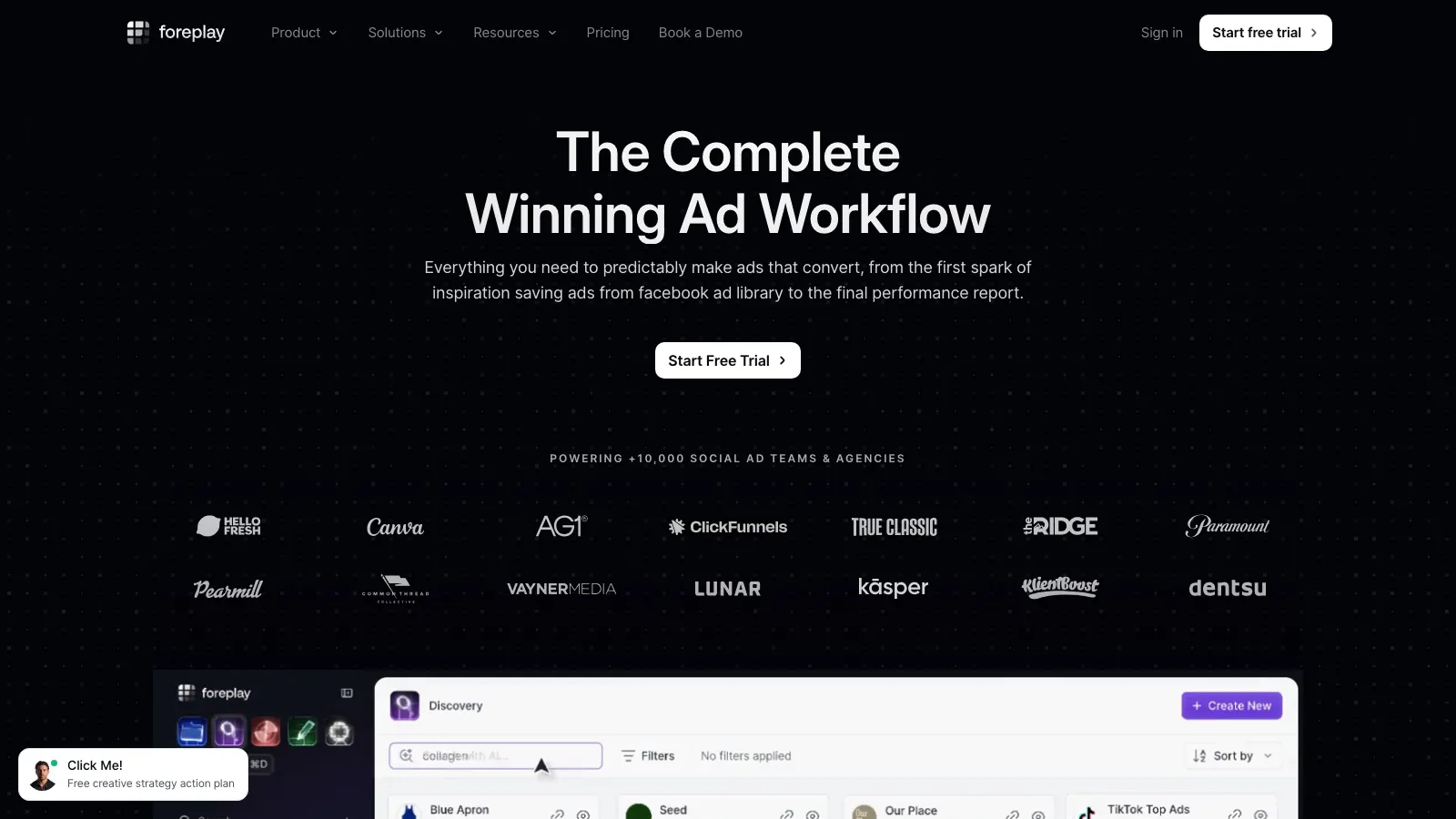
Foreplay eliminates common creative handoff failures by connecting ad swipe files directly to actionable production briefs. One person finds an ad, another saves a screenshot, and the strategist rebuilds the reasoning when a brief is due. Foreplay gives that work a single route: Discovery finds examples, Swipe File holds them, Spyder watches competitors, Lens examines a connected brand and Briefs packages direction for production. It belongs in the marketing tools directory as a creative workflow.
That focus makes the buying decision clearer. Foreplay can help a creative lead decide what patterns are worth developing and give the next person a usable brief. Ask Foreplay whether it supports publishing, audience changes, budgets or bids before you rely on it for campaign execution. If wasted Google Ads spend comes from poor query hygiene instead, the Free Google Ads Negative Keywords Generator review covers a different job.
I would choose Foreplay when references need to become a repeatable team asset. A raw public ad archive can supply examples. It cannot, on its own, preserve the examples, show a competitor timeline, compare your own creative and turn the selection into a storyboard.
Who derives the most benefit from subscribing to Foreplay?
Creative strategy leads
Bring research, references and a brief into one shared production path each week.
Paid-social teams
Use Workflow to inspect competitor activity and analyze one connected brand's creative.
Multi-client agencies
Agency includes ten users and creative analysis across ten connected brands for recurring work.
Independent strategists
Basic suits solo saving, search and shareable briefs without monitoring or account analytics.
The four groups differ more by workflow than by company size. A solo creative director who briefs every week may outgrow Basic quickly. Conversely, an agency that only collects inspiration for occasional pitches will not automatically get value from Agency. Buy the tier whose monitoring and connected-brand allowance matches active work.
Which ad discovery and swipe file features does Foreplay offer?
Discovery and Swipe File
Discovery is Foreplay's searchable community ad library, listed at more than 200 million ads. Its plan comparison includes AI-powered search, filters, automated transcription, emotional analysis, persona and creative-target detection, and sorting for long-running ads. Swipe File is the place to keep the useful examples, using boards, tags and share links rather than scattered browser tabs. The Chrome extension supports Meta Ad Library, Instagram organic posts, TikTok Ad Library and Top Ads, TikTok organic, LinkedIn Ad Library and YouTube Shorts.
Spyder turns competitor activity into a trackable signal
Spyder is the divide between Basic and the higher plans. It tracks competitor Meta ads around the clock and lists up to three years of competitor ad history, creative tests, media mix, hooks, landing pages and a timeline view. Monthly Workflow covers 15 brands and Agency 50; their annual versions list unlimited Spyder brands. That makes annual billing more than a discount if competitors are a permanent part of your planning cycle.
Lens is for your own creative
Lens provides creative analytics, top-performing reports, comparison reports and creative scores for a connected brand. Workflow includes one brand and Agency ten, while an additional Lens brand costs $50. Confirm the billing cadence for that add-on. The product gives a creative team a way to compare the work it is running with the references it has collected, instead of treating research and reporting as separate jobs.
Briefs closes the handoff
Foreplay's Briefs feature builds scripts, storyboards and reusable modular details from selected inspiration. It also lists brand profiles, public brief pages and asset collection. That production step is why Foreplay is stronger for a team with a recurring creative pipeline than for someone who just needs to look up an old ad.
API, MCP and agent workflows
Workflow and Agency list AI-tool connections. Foreplay names MCP, Claude and ChatGPT in its plan comparison; confirm the named connection and plan you need before building around it. The API offers Spyder data, Discovery searches and ads saved in Swipe File, with 10,000 free monthly credits included in all trials and base plans. Extra API credits are sold separately, starting at $99 a month for 100,000 credits. This is useful when an agent needs advertising data in a workflow, but the cost belongs in the budget once usage moves beyond the included credits.
How are Foreplay monthly and annual plans priced?
Price checked 27 Nov 2026
| Plan detail | Basic$49/mo | Workflow$149/mo | Agency$389/mo | EnterpriseCustom |
|---|---|---|---|---|
| Billing shown | Annual | Annual | Annual | Talk to sales |
| Included users | 1 | 5 | 10 | Unlimited |
| Spyder brands | ✕ | Unlimited annual | Unlimited annual | Unlimited |
| Lens brands | ✕ | 1 | 10 | Unlimited |
| AI-tool connections | Confirm | Listed | Listed | Confirm |
| Trial | 7 days | 7 days | 7 days | Talk to sales |
Foreplay annual prices in US dollars, 27 Nov 2026.Foreplay pricing
Monthly billing costs $59 for Basic, $175 for Workflow and $459 for Agency. Basic, Workflow and Agency each list $20 per additional user. That makes a concrete five-person Workflow team $149 a month on annual billing because the five users are included. Add a sixth person and the bill is $169 a month. Lens brand add-ons cost $50 per additional brand, with billing cadence to confirm, and API credit packs begin at $99 a month for 100,000 credits.
The visible annual saving is not the only commercial difference. Annual Workflow and Agency list unlimited Spyder brands, while the monthly comparison lists 15 and 50 respectively. If competitor monitoring is central to the work, confirm the billing commitment before choosing based on the wider allowance.
What custom features are provided on Foreplay Enterprise?
Foreplay Enterprise caters to large agencies and enterprise brands requiring tailored contract terms and scaled usage. It lists unlimited users, product usage, Spyder brands and Lens brands, plus priority in-app or Slack support and early access to features and integrations. The price is not published, so it is a scale option rather than a plan a team can compare on a fixed monthly bill.
What are the main drawbacks and limitations of Foreplay?
Foreplay's documented workflow is built around creative research, reporting and production. If your team also needs campaign execution, ask whether Foreplay supports publishing, targeting, budgets or bids before making it the central system for that job.
The feature wall at Basic is also meaningful. You get discovery, saving and briefs, but no Spyder competitor tracking or Lens analytics. Confirm Basic's named AI-tool connections before relying on them. For a team that needs monitoring or a connected account, Workflow is the more relevant plan to compare.
Finally, Foreplay's public plan table tells you the allowance but not whether the creative insight will change a particular campaign's result. Treat the library, trend views and reports as inputs to better decisions, then keep the final creative judgment with the team that knows the offer and audience.
Which ad intelligence tools serve as alternatives to Foreplay?
 Foreplay alternatives address different monitoring priorities, such as AI Peekaboo tracking brand mentions across generative answer engines. It is the relevant alternative when the question is AI-answer visibility rather than paid-social creative research.
 Free Google Ads Negative Keywords Generator is for finding terms to exclude from Google Ads, while Foreplay's documented job is researching, saving and briefing paid-social creative.
 Gauge observes sponsored ads that appear in ChatGPT answers for the prompts you track. It also shows each advertiser's ad copy and the prompts where those ads appeared. Read the Gauge review alongside Foreplay when that tracked-prompt view is the decision you need to make.
What is the overall verdict on choosing Foreplay for creative research?
Foreplay is the ideal choice when creative research must progress seamlessly from ad examples to competitor analysis and structured briefs. Workflow is the sensible team plan because it lists the monitoring, Lens and AI-tool connections that make the product more than a shared swipe file. Basic remains a reasonable first step for a solo strategist who needs a durable research library.
Start a five-person creative team on Workflow with annual billing only after you know competitor monitoring will be ongoing. Keep Basic for individual research, and use Enterprise only when published user and connected-brand limits stop fitting the account.
How were the features and subscription data of Foreplay verified?
Foreplay pricing tiers, credit allocations, and platform capabilities were verified against official product documentation on 27 Nov 2026. Prices are in US dollars, as Foreplay shows them, and every figure follows how we check figures.
- Foreplay pricing pages for monthly and annual billing
- Foreplay product pages for Swipe File, Discovery, Spyder, Lens and Briefs
- Foreplay API, MCP and help-center pages
What are the most frequent questions about Foreplay?
How much does Foreplay cost?
On annual billing, Basic is $49 a month, Workflow $149 and Agency $389. Monthly billing is $59, $175 and $459 respectively. Basic, Workflow and Agency list a seven-day trial.
What does Foreplay Workflow add beyond Basic?
Workflow includes five users, Spyder competitor monitoring, Lens for one brand and AI-tool connections. Basic includes one user, ad saving, search and briefs. Confirm named AI-tool availability on Basic before relying on it.
Can Foreplay save Meta, TikTok and LinkedIn ads?
Yes. The Chrome extension lists Meta Ad Library, Instagram organic, TikTok Ad Library and Top Ads, TikTok organic, LinkedIn Ad Library and YouTube Shorts as supported sources.
Does Foreplay work with AI agents?
Workflow and Agency list AI-tool connections. Confirm MCP, Claude or ChatGPT availability on your chosen plan before building a workflow. Foreplay's API supports access to Discovery, Spyder and Swipe File data, with 10,000 free monthly credits included in all trials and base plans.
 Reviewed byDanny Kirk
Founder of ReddiReach.
 Checked byAndrés Felipe
Digital designer and marketer.
Every figure is checked against the vendor's own page. Read our editorial standards.