
Key Takeaways
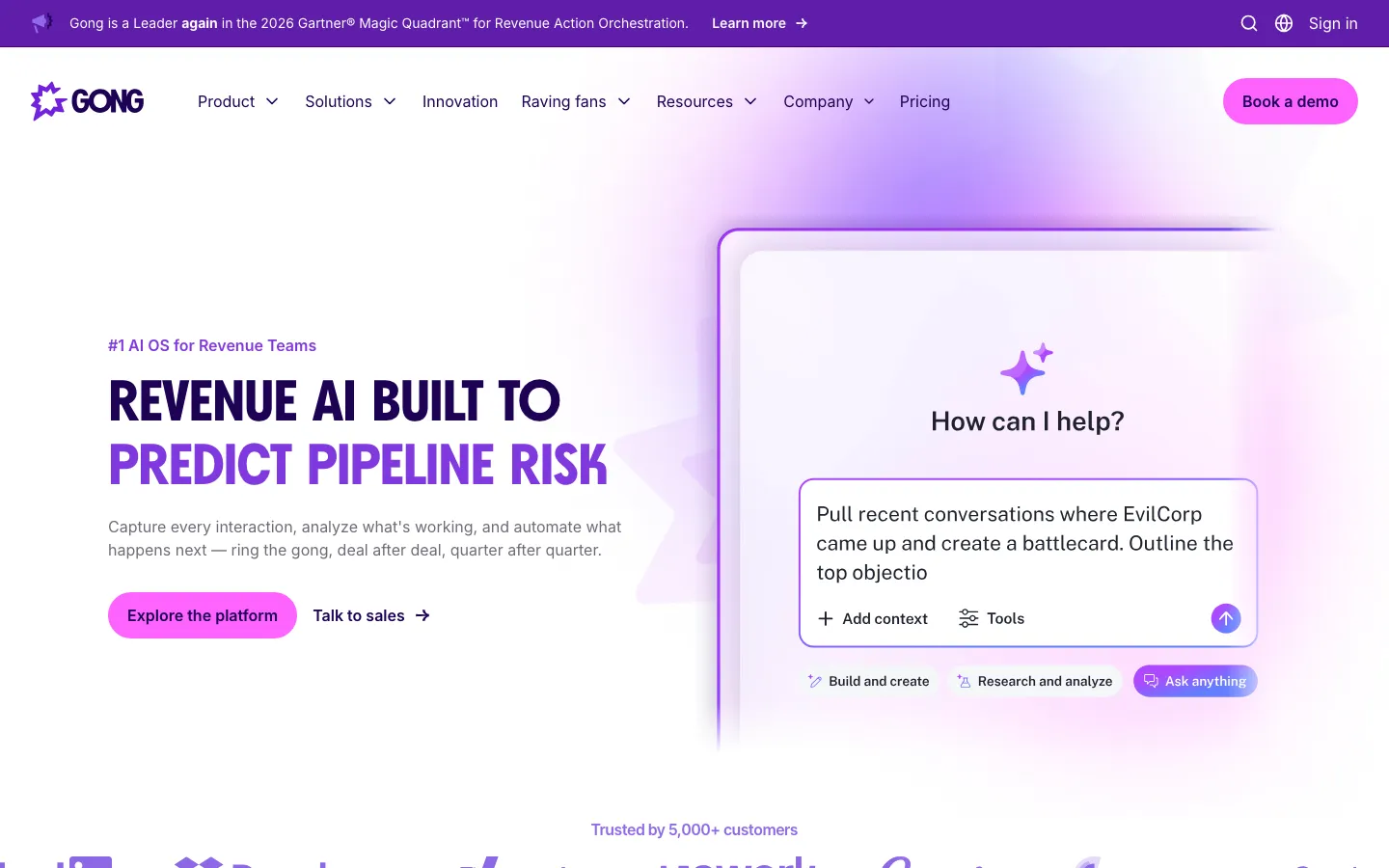
- Gong captures multi-channel buyer interactions across video calls, emails, and phone conversations to drive automated pipeline forecasting, sales enablement, and agent workflows.
- Gong quotes customized annual enterprise agreements that pair individual per-user software licenses with a platform fee determined by total supported team volume.
- Gong incorporates pre-configured revenue agents, a proprietary Agent Builder, and external MCP connectors to synchronize conversational insights with third-party software systems.
- Gong avoids public pricing schedules and self-serve onboarding, making it ill-suited for small sales organizations seeking simple point solutions for call recording.
Gong is the revenue platform to choose when your sales, RevOps and customer teams need every customer interaction captured in one operating layer, then want forecasting, engagement and AI agents built around that context. Skip it if a transparent software bill is a requirement: Gong sells a custom proposal with per-user licenses and a platform fee tied to the users it supports.
Agent access
- API
- Yes, any Gong plan
- MCP server
- Official, OAuth, with automatic registration or manual client ID and client secret
- Works with
 Claude
 ChatGPT
- Automation
- Zapier
What are the core enterprise advantages and drawbacks of Gong?
What works
- Captures customer interactions and maps them to business context
- Forecasting, engagement, enablement and agents under one product family
- More than 300 integrations listed in the Gong Collective
What to watch
- No public plan prices or published package limits
- Per-user licenses sit alongside a platform fee
- The proposal flow begins with teams of 1 to 50 users
How does Gong capture customer conversations to improve revenue intelligence?
Gong ensures sales conversations do not get lost in personal notes or scattered apps by recording and centralizing customer interactions. Teams that need a simpler CRM starting point can compare it with the  HubSpot Sales Hub review. Its Revenue Graph connects interactions to business context, while the surrounding applications put that context to work in engagement, forecasting, enablement and automated revenue tasks. For a team that has outgrown disconnected call recordings and CRM updates, that is a compelling shape.
The trade-off is scope. Gong is not trying to be a modest add-on to a CRM. The platform is designed as a common layer for frontline reps, managers and revenue leaders, with the Revenue Harness governing how agents plan, act and deliver results. That broad approach makes sense when handoffs, deal inspection and coaching all need the same account story. It is more software than a lean team needs just to record calls.
HubSpot allows up to two users on a free account, so it is the relevant contrast when you need to begin with a smaller account. Gong’s proposition is strongest when your problem is not merely storing records, but turning the interactions around those records into operating context.
Which enterprise sales and revenue operations teams need Gong?
Revenue leaders and RevOps
Use interaction context for forecasting, pipeline reviews and coaching across their revenue organization.
Sales and customer teams
Ground account handoffs in shared conversations, activity records and complete customer history.
Teams adopting agents
Apply governed agents to CRM updates, call review and deal-monitoring work.
Security-conscious enterprises
Evaluate a platform that lists SOC 2 Type 2 and ISO certifications.
Gong fits best where a shared revenue process already exists and several people need to act on the same signals. A very small sales team may still value its capture and coaching features, but the starting proposal band, custom pricing and platform fee make a narrower option worth weighing before it commits.
What conversation intelligence, pipeline tracking, and forecasting tools does Gong offer?
Revenue context from customer interactions
Gong says it automatically captures customer interactions and maps them to business context. The Revenue Graph is the layer that connects those interactions across the business. That matters when the next person on an account needs more than a CRM field, they need to understand what was said, what changed and what should happen next.
Engagement and enrichment
Gong Engage turns conversation signals into outreach and next actions. When a contact joins an Engage Flow, Gong Enrich can locate a valid email address or phone number; reps can also enrich contacts and accounts from the Contact Panel. The practical appeal is less manual work between a conversation and the follow-up it should trigger.
Forecasting and account health
Gong Forecast uses revenue signals for AI-guided forecasts, with tools intended to surface risk, support coaching and help leaders call their number. Account Boards gather accounts into one view for customer success managers and account managers to assess health, spot risk and protect renewals. This is where Gong is most clearly a revenue platform rather than only conversation intelligence.
Enablement and coaching
Gong Enable is built around real customer interactions, with onboarding and coaching designed to spread successful techniques through the team. That makes it relevant to a sales leader who wants the same system to reveal what good looks like and to make that knowledge available to a new rep.
Gong Agents and external AI systems
Gong’s pre-built agents cover three jobs: the AI Data Extractor, the AI Call Reviewer and the AI Deal Monitor. Agent Builder lets teams create custom agents in natural language. Gong also describes the Revenue Harness as the layer for governing agent execution, with permissions, oversight and auditability, and its trust information says external AI systems can connect through Model Context Protocol. I would treat that as a governance conversation, not a reason to assume every agent workflow is included in every proposal.
Integrations and controls
Gong lists more than 300 integrations in its Collective. Named examples include Salesforce, Zoom, Microsoft Teams, Microsoft 365 Copilot,  Slack and Okta. Its Salesforce integration is described as bi-directional. The trust page lists SOC 2 Type 2, plus ISO/IEC certifications 27001, 27017, 27018, 27701 and 42001, and says customer data is not used to train generative models. Those facts make Gong easier to put through an enterprise security review, though your own requirements still decide the outcome.
How does Gong structure its platform fees and per-user licensing?
Price checked 27 Nov 2026
| Pricing detail | Gong proposalCustom |
|---|---|
| License model | Per user |
| Platform fee | Based on users supported |
| Existing tech stack integration | Free |
| Published plan tiers | Not stated |
| Published dollar prices | Not stated |
| Proposal starting team band | 1 to 50 users |
Gong pricing details, 27 Nov 2026.Gong pricing
There is no honest team bill to calculate from the published information. Gong says it prepares a quote around each team’s circumstances, then asks you to request a customized proposal. The two numbers that need to be separated in that conversation are the per-user license price and Gong fee. Ask for both in writing, together with the applications, agents, integrations, onboarding and contract term that the quote covers.
- Price per licensed user at your expected team size
- Platform fee, stated separately from license charges
- Products and agents included in the proposal
- Implementation, integration and renewal terms
How does Gong deliver scalable revenue visibility across large enterprises?
Gong makes the most sense when the cost of inconsistent customer context is already visible across an organization. Its platform covers sales engagement, forecasting, enablement, account work and agents, while its security materials describe granular access permissions, retention and redaction controls, auditability and bring-your-own-key encryption. The security posture is substantial, but your team must still assess its own data, regional and retention requirements with Gong.
The key buying question is whether your team will use enough of Gong to justify its breadth. If forecasting, coaching, handoffs and CRM hygiene all sit with different owners, one shared context layer can be easier to govern than several connected products. If one owner simply needs basic deal management, it can be an expensive way to solve a smaller problem.
What commercial and pricing barriers exist for prospective Gong buyers?
Gong creates an initial barrier for evaluating organizations through its undisclosed, quote-only pricing model. A custom proposal can match a complex organization, but it makes an early comparison slow. You cannot use Gong’s public pages to estimate a one-person, five-person or twenty-person monthly bill, and a platform fee means headcount is not the only moving part.
The product’s breadth is another consideration. Revenue Graph, Revenue Harness, Applications, Collective, Engage, Forecast, Enable and Agents are connected pieces of one model. That can be a strength for a coordinated team, yet it also asks a buyer to be clear about which workflows it will actually standardize. Do not buy the entire promise if the rollout only has an owner for call capture.
Finally, Gong’s published material supports MCP connectivity and agent governance, but it does not set out a public feature matrix for every proposal. Teams building around agents should have Gong confirm the permissions, data access, included agents and custom-agent scope before treating automation as a settled capability.
What sales platforms and CRM solutions compete with Gong?
The HubSpot Sales Hub review is the comparison to make when a free entry point matters: HubSpot allows up to two users on a free account. That gives a small team a materially different place to start from Gong’s custom proposal.
 The Insightly review matters when the work after a deal needs to stay connected to sales. Insightly says it can convert opportunities to projects after close and use pipelines and milestones for cross-team communication, a different emphasis from Gong’s interaction-centered revenue layer.
Is Gong the right revenue intelligence platform for your sales team?
Gong is a strong fit for an established revenue organization that needs its customer interactions to inform pipeline decisions, coaching, handoffs and agent work together. Its real advantage is the connected model, not one isolated feature. Pass if you need a known price before you start or if your team has only one narrow sales workflow to improve.
Take a defined list of revenue workflows to the demo, then ask for a proposal that separates user licenses from Gong fee and names every included product, integration and agent capability.
How were the capabilities and licensing terms of Gong verified?
Gong product documentation, agent frameworks, enterprise pricing structures, and platform security pages were verified on 27 Nov 2026. Gong does not publish dollar prices or package limits, so this review does not estimate them. The approach follows how we check figures.
- Gong pricing page and proposal flow
- Gong platform, engagement, forecasting and enablement pages
- Gong Agents and trust pages
What are the most frequent questions regarding Gong revenue intelligence?
How does Gong pricing work?
Gong says licenses are priced per user, alongside a platform charge calculated from the users supported. It prepares a customized proposal after you submit the pricing form.
Does Gong integrate with Salesforce?
Yes. Gong describes its Salesforce connection as a bi-directional CRM integration. Its platform page names Zoom, Microsoft Teams and Microsoft 365 Copilot among more than 300 Collective integrations.
What are Gong Agents?
They are pre-built and custom agents for revenue tasks, including CRM updates, call review and deal-risk monitoring. Gong says Agent Builder supports custom agents in natural language.
Is Gong secure?
Gong lists SOC 2 Type 2, alongside ISO/IEC certifications 27001, 27017, 27018, 27701 and 42001. It also says its data is not used to train generative models.
 Reviewed byDanny Kirk
Founder of ReddiReach.
 Checked byAndrés Felipe
Digital designer and marketer.
Every figure is checked against the vendor's own page. Read our editorial standards.