
Key Takeaways
- Google Alerts works best for early-stage founders, content researchers, and lean marketing teams seeking zero-cost email digests for newly indexed web articles and blogs.
- Google Alerts costs $0/month with unlimited alert keywords per Google account, requiring zero seat fees, contracts, or paid upgrade tiers.
- Programmatic access is restricted to exporting subscription copies via the Google Data Portability API using OAuth 2.0, with no live mention API or official MCP server.
- Google Alerts misses Instagram, TikTok, LinkedIn, and Twitter/X entirely, delivers inconsistent Reddit pickup, and provides no dashboard or sentiment analysis.
You need to catch brand mentions, press pickups, and competitor news without adding another SaaS invoice or managing an analytics login. Google Alerts is the right choice at $0/month when your team only wants basic email notifications for newly indexed web pages, blogs, and news articles. Skip Google Alerts if your workflow depends on social media tracking, consistent Reddit coverage, sentiment scoring, or automated webhook routing.
Agent access
- API
- Yes
- MCP server
- Not found on official pages
What are the pros and cons of Google Alerts?
What works
- Completely free at $0/month with unlimited alert keywords and zero per-seat licensing
- Monitors Google-indexed news, blogs, web pages, videos, books, and discussions in under two minutes per keyword
- Configurable delivery frequencies per keyword, supporting as-it-happens emails, daily digests, or weekly digests
- Supports over 40 language filters and regional scoping to isolate mentions in specific local markets
What to watch
- Zero coverage for major social platforms including LinkedIn, Instagram, TikTok, and Twitter/X
- Partial and unreliable Reddit indexing misses many relevant brand and product discussion threads
- No analytics dashboard, historical volume charts, or automated sentiment classification beyond raw emails
- No webhook routing, native third-party integrations, or live mention API for automated alerting pipelines
What does Google Alerts do for your team?
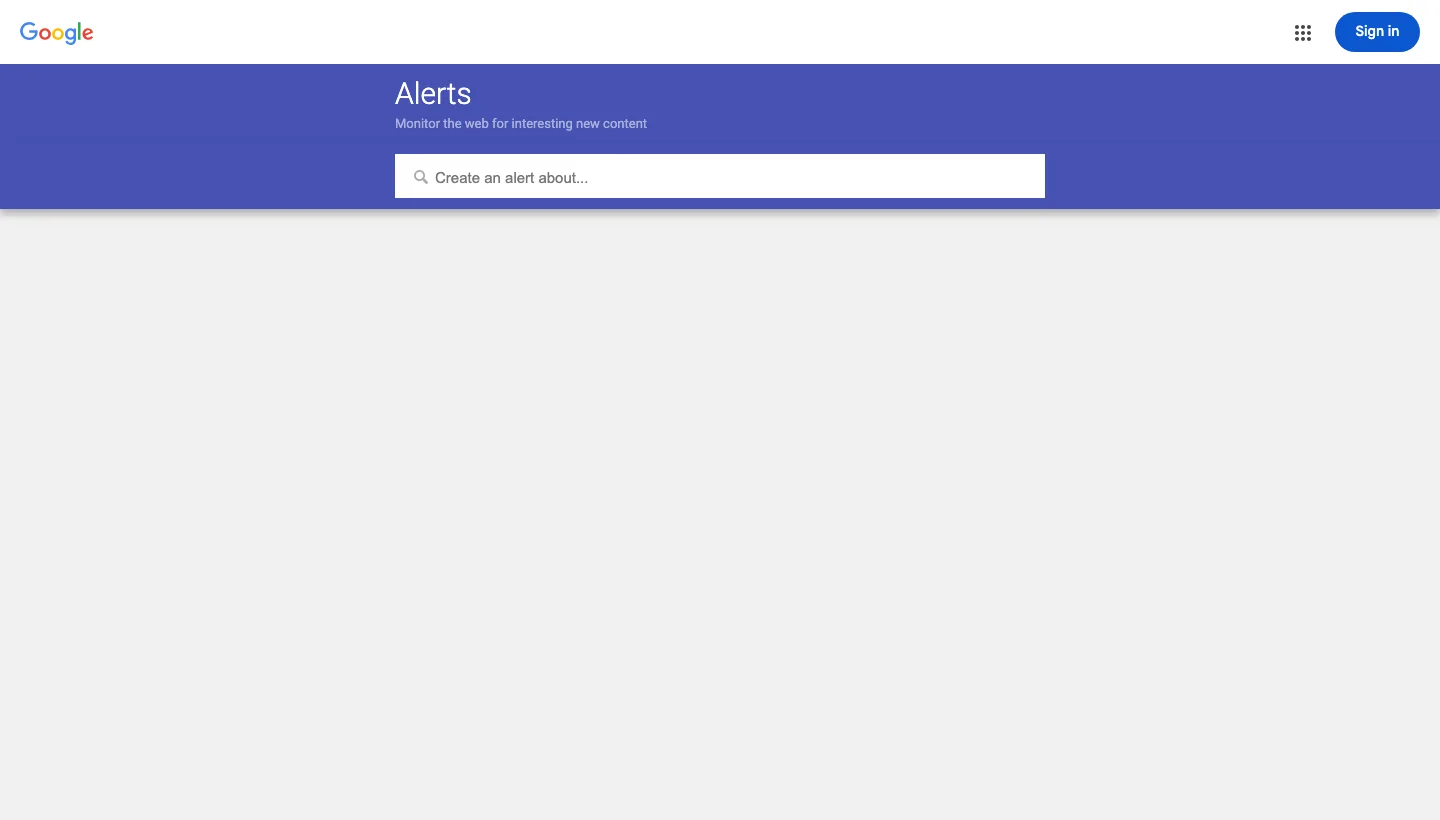
Google Alerts monitors Google's web search index for your chosen keywords and delivers matching new pages straight to your email inbox. Available since 2003 and accessible with any standard Google account, Google Alerts lets your team track brand names, executive names, competitor launches, or industry topics without purchasing dedicated brand monitoring software. You enter a search phrase, pick which indexed content categories to watch, choose between immediate notifications or scheduled email digests, and let the service run indefinitely without maintenance or budget approvals. Within our Brand Monitoring directory, weigh seat caps and reporting workflows early.
Setup inside Google Alerts is intentionally minimal so solo operators and non-technical marketers can deploy coverage in under two minutes per query. For every keyword subscription, your team can narrow matches by source category, select from over 40 languages, lock tracking to a specific geographic region, and toggle between high-precision filtering or broad result capture. Because every alert operates independently, a communications manager can route urgent crisis terms as instant alerts while batching broader industry research queries into calm weekly summaries.
Those structural choices also explain why growing teams eventually hit a wall with Google Alerts. Because Google Alerts only sees public URLs that enter Google's search index, closed or unindexed social ecosystems remain invisible. Posts on Instagram, TikTok, LinkedIn, and the main stream of Twitter/X never trigger notifications, while Reddit threads appear inconsistently. Furthermore, Google Alerts provides no central web dashboard, trend graphs, or team workflow assignments, making it an email baseline rather than a complete media intelligence suite.
Which teams is Google Alerts built for?
Early-stage founders and solo operators
Founders who want immediate awareness of press articles, blog reviews, and public web mentions before committing budget to paid monitoring software get dependable baseline coverage from Google Alerts at zero cost.
Content and SEO research teams
Writers, journalists, and link-building specialists tracking fresh articles around niche topics use Google Alerts to spot editorial citations and new publisher pages directly inside daily email digests.
Budget-conscious teams filling web gaps
Marketing teams already paying for social-first listening tools pair Google Alerts alongside their stack at $0/month to catch long-tail blog posts, Google Books references, and regional news sites.
Compliance and portability administrators
Technical administrators auditing user alert configurations can export copies of existing Google Alerts subscriptions via Google's Data Portability API, though teams needing real-time mention webhooks must look elsewhere.
Which Google Alerts features matter most in daily work?
Google Alerts focuses its entire feature set on fast query creation, source scoping, and predictable email delivery rather than complex visual analytics. Three core capabilities determine how much signal versus inbox noise your team gets from Google Alerts every week.
Multi-source web index filtering
Google Alerts lets you scope each keyword subscription across six indexed Google content categories: news publishers, blogs, general web pages, YouTube videos, Google Books, and online discussion forums. Leaving the source selector on automatic captures matches across every category at once, giving small teams broad visibility across written press and video descriptions without building separate tracking rules.
When broad web tracking creates too much clutter, narrowing an alert strictly to News helps public relations teams focus on indexed media outlets. Selecting Discussions surfaces portions of indexed forum threads, including parts of Reddit, though forum pickup remains incomplete compared to dedicated community trackers.
Language, regional, and result quality controls
International and local marketers can refine Google Alerts using more than 40 language options alongside country-specific regional filters. Scoping an alert by language and region prevents global English homonyms or unrelated overseas news from flooding a regional manager's inbox, keeping non-English market tracking cleanly separated from global brand queries.
Alongside geographic scoping, Google Alerts offers a toggle between "Only the best results" and "All results." The best-results mode applies Google's relevance filtering to suppress tangential pages on competitive terms, whereas all-results mode maximizes raw recall when catching obscure mentions matters more than inbox tidiness.
Per-keyword frequency and digest scheduling
Every alert inside Google Alerts carries its own delivery cadence: as-it-happens, at most once a day, or at most once a week. Each email notification displays the indexed page title, a short text snippet highlighting your matched keyword, and a direct link to the source URL so team members can verify context straight from their inbox.
Independent scheduling lets teams match inbox volume to operational urgency. You can set executive names, security terms, or active product launches to as-it-happens delivery for rapid response while keeping evergreen competitor or content research keywords bundled into a single daily or weekly email.
How much does Google Alerts cost for a team?
Google Alerts costs $0/month and operates on a single Free tier with no paid subscriptions, enterprise editions, or per-seat fees. Anyone with a Google account can configure unlimited alert keywords immediately without entering payment details or negotiating annual contracts.
| Plan | Monthly / listed price | Key limits & seats |
|---|---|---|
| Free | $0/month | Unlimited alert keywords per Google account; email delivery only; partial Reddit coverage; no social media, sentiment, dashboard, or live mention API |
Google Alerts pricing checked 27 Nov 2026.Google Alerts official pricing
Team cost math for Google Alerts stays at zero regardless of headcount. Because Google Alerts does not sell multi-seat workspaces, shared dashboards, or paid add-on modules, ten team members monitoring separate keyword lists pay the exact same $0/month as a solo founder. There are no mention volume caps, overage penalties, or historical data retention charges to calculate. Instead, your real operational cost is staff time spent triaging raw email digests manually and sharing relevant links across internal chat channels without built-in assignment workflows.
Because Google Alerts is permanently free, there is no free trial clock or annual billing commitment to manage. However, engineering teams exploring programmatic access via the Google Data Portability API must create a Google Cloud project and enable Cloud billing before calling the API. Google does not publish a standalone fee or rate limit schedule specifically for exporting Google Alerts subscriptions on its Data Portability API reference pages, and Google offers no official MCP server on any plan.
Where does Google Alerts fall short?
Google Alerts leaves a massive blind spot across modern social media and community channels. Because Google Alerts relies strictly on Google's web search index, it cannot monitor Instagram, TikTok, LinkedIn, or Twitter/X posts. Even on public forums, Reddit coverage is partial and inconsistent, meaning high-visibility threads praising or criticizing your product frequently fail to trigger an email. Teams relying solely on Google Alerts for reputation management routinely miss customer complaints and viral social conversations.
Analytical depth and alert consistency are equally constrained. Google Alerts has no web dashboard, mention volume charts, share-of-voice reporting, or automated sentiment analysis. Everything arrives as flat email links that vanish into individual inboxes unless someone manually logs them in a spreadsheet. In addition, Google's internal relevance filters behave unpredictably: "best results" mode can silently suppress legitimate mentions, while switching to "all results" often surfaces noisy, tangential web pages.
Automation and AI agent workflows hit hard technical boundaries with Google Alerts. There is no native webhook support, no confirmed Zapier, Make, or n8n integration in the verified product record, and no official MCP server. While Google's Data Portability API supports OAuth 2.0 exports of a user's alert subscription list, it cannot create alerts, stream live web mentions, or push matched URLs into downstream CRM or ticketing tools.
What are the best Google Alerts alternatives?
 AI Peekaboo is the stronger choice when tracking brand visibility across ChatGPT, Gemini, Perplexity and Google AI surfaces is the job, starting at $30 a month with API, MCP and multi-brand workspaces covered in our AI Peekaboo review.
When your team outgrows raw email digests, dedicated brand monitoring and social listening tools step in to cover unindexed channels and analytics. Paid monitoring platforms add structured dashboards, historical trend tracking, sentiment classification, and direct coverage of social networks and Reddit communities that Google Alerts misses by design. The trade-off is moving from $0/month with unlimited keywords to recurring monthly subscription tiers that typically restrict keyword counts, mention volumes, or user seats.
You do not always have to abandon Google Alerts when upgrading your monitoring stack. Budget-conscious marketing teams frequently keep Google Alerts running at $0/month for broad web, Google Books, and long-tail blog indexing while purchasing a dedicated social listening tool strictly for LinkedIn, Twitter/X, TikTok, Instagram, and comprehensive Reddit tracking. Switch off Google Alerts completely only when your paid platform already indexes the open web reliably and centralizes team triage.
Also compare SubredditSignals review and  Mention review alongside our best AI visibility tools roundup.
Should your team buy Google Alerts?
Google Alerts is an essential zero-cost utility rather than a modern brand monitoring platform. At $0/month with unlimited keywords and two-minute setup, every early-stage startup, solo founder, and content researcher should use Google Alerts to catch newly indexed press articles, blog citations, and regional web pages. However, no commercial team should mistake Google Alerts for full reputation coverage. Once customer conversations on Reddit, LinkedIn, TikTok, Instagram, or Twitter/X affect your pipeline, or when you need dashboards, sentiment scoring, and automated routing, invest in dedicated monitoring software.
Start on the Free plan ($0/month) using an existing Google account. Configure high-priority brand and executive keywords with "as-it-happens" delivery and "all results" selected, while placing broader industry and competitor terms on daily digests with "only the best results" enabled to keep inbox volume manageable.
How did we verify these Google Alerts figures?
We verified Google Alerts features, source filters, language support, and $0/month pricing against Google Alerts product pages, and confirmed programmatic OAuth 2.0 subscription export capabilities, Google Cloud billing requirements, and MCP absence against Google's official Data Portability API documentation on 27 Nov 2026. Every figure follows our process in how we check figures. Checked 27 Nov 2026.
- Google Alerts official pricing page
- Google Alerts product documentation
- Google Alerts API and developer pages
What are common questions about Google Alerts?
Is Google Alerts completely free for business teams?
Yes. Google Alerts costs $0/month and allows unlimited alert keywords with any standard Google account. Google does not charge per-seat fees, keyword overages, or subscription tiers for creating and receiving email alerts, though Google Cloud billing must be enabled if developers use the Data Portability API.
Does Google Alerts track social media and Reddit mentions?
Google Alerts does not monitor Instagram, TikTok, LinkedIn, or Twitter/X because those platforms are largely excluded from Google's web search index. Google Alerts captures some Reddit threads under its web and discussion filters, but Reddit pickup is partial and misses many relevant brand mentions.
How can teams reduce irrelevant noise in Google Alerts?
You can tighten Google Alerts accuracy by switching result quality to "Only the best results," restricting sources to specific categories like News or Blogs, and locking language and regional filters to your target market. Batching broad keywords into daily or weekly digests also prevents inbox overload.
Does Google Alerts offer an API or MCP server for AI agents?
Google Alerts has no official MCP server and no API for streaming live mention results or creating alerts. Developers can only export a copy of a user's alert subscriptions via the Google Data Portability API using an API key and OAuth 2.0 scope after enabling Google Cloud billing.
 Reviewed byDanny Kirk
Founder of ReddiReach.
 Checked byAndrés Felipe
Digital designer and marketer.
Every figure is checked against the vendor's own page. Read our editorial standards.