
Key Takeaways
- OpenPanel combines web traffic metrics and custom product event analytics into an accessible tracking platform for modern engineering teams.
- OpenPanel offers a free self-hosted open-source deployment, while its managed cloud hosting packages begin at $2.50 per month for 5,000 events.
- OpenPanel incorporates Model Context Protocol integration offering 39 read tools for analytics clients alongside 9 administrative write tools for root users.
- OpenPanel requires self-hosting teams to manage Docker deployment and ongoing infrastructure upkeep, while cloud editions lack native visual split-testing functionality.
OpenPanel is the analytics platform to choose when you need product events and web traffic in one place without a large starting bill, because its cloud plans begin at $2.50 a month and its self-hosted edition is free. It suits technical teams that want analytics available to AI clients and a choice between managed Cloud hosting and self-hosting. Teams comparing analytics with the rest of their stack can use the marketing tools directory. Choose Cloud when you want OpenPanel to run the service, and self-host only when your team can take on Docker and the surrounding infrastructure.
Agent access
- API
- Yes, every Cloud plan.
- MCP server
- Official, hosted, Bearer token made from base64(clientId:clientSecret).
- Works with
 ClaudeClaude Code
What are the core technical pros and cons of OpenPanel?
What works
- Cloud plans start at $2.50 for 5K monthly events
- Every cloud plan includes features, dashboards and team members
- 48 MCP tools connect analytics data to compatible AI clients
What to watch
- Self-hosting means managing your own Docker infrastructure
- Root MCP tokens can create, edit and delete reports
- Plans pause new events at the limit instead of billing overages
How does OpenPanel combine web metrics and in-app event tracking?
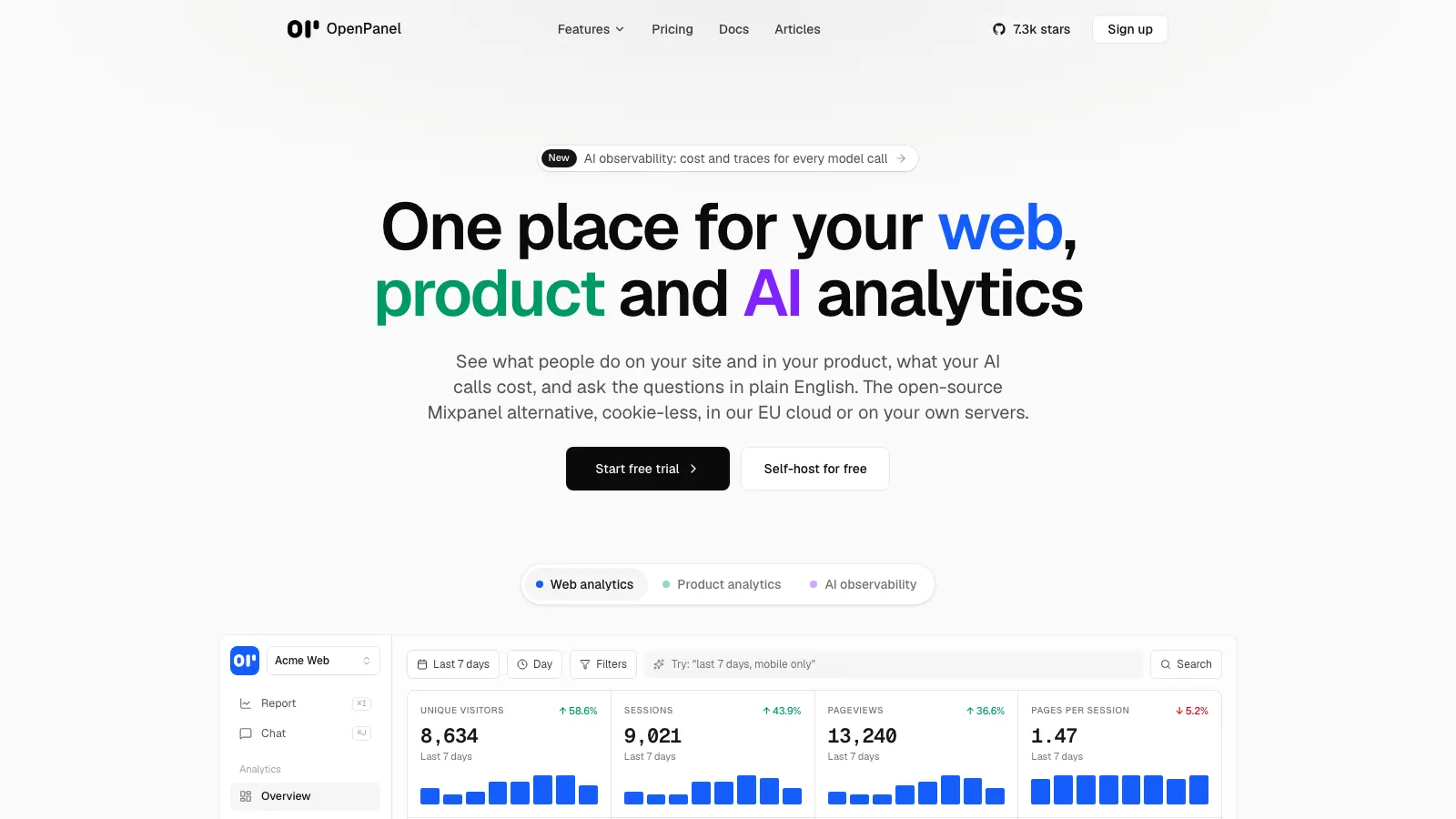
OpenPanel joins two reporting jobs that are often separated. One script captures the traffic view, including visitors, referrers, pages, countries and devices. The same events power funnels, retention, profiles and session replay, so a product team does not have to choose between a web dashboard and event-level reporting.
The important commercial decision is who runs it. OpenPanel Cloud is hosted in the EU, backed up and monitored, while the self-hosted edition runs the same open-source code with Docker Compose. That makes the hosted plan a low-cost way to start, and self-hosting a credible route when you need the data on your own infrastructure.
For a marketing lead, the practical payoff is a single view of acquisition and outcomes. Revenue can be attributed to the session where it happened, so referrers, campaigns and entry pages can be ranked by money as well as sessions.
Which product developers and engineering teams should deploy OpenPanel?
Developer-led SaaS teams
Track product events, funnels and revenue without a high starting cloud bill.
Privacy-minded engineering teams
Run the open-source stack on your own infrastructure with Docker Compose.
Teams building AI workflows
Give compatible AI clients controlled read access to analytics data and reports.
Growing product organizations
Add teammates, websites and dashboards without separate per-seat or feature charges.
It is a weaker fit for a nontechnical team that wants analytics with no operational decisions. Cloud removes the server work, but the self-hosted option only pays off when someone on the team can own the initial setup, upgrades and the surrounding infrastructure.
What event monitoring and protocol tools are supported by OpenPanel?
Web and product analytics from one tracker
A script tag or SDK gets page views, referrers and devices into the overview from the first visit. You can then send the product actions that matter to your team and identify users to build profiles, retention reporting and journeys across devices. Funnels, session replay and user profiles are part of the same product rather than separate upgrades.
Revenue alongside acquisition data
OpenPanel records an amount with a revenue event and attributes it to the session in which it occurred. That puts revenue beside sessions for referrers, UTM campaigns, entry pages and countries. It is a sensible fit when you need to distinguish a high-volume source from one that actually produces paid conversions.
MCP access for AI clients
OpenPanel's MCP server has 48 tools. A read client gets 39 tools for one project, covering areas such as the overview, pages, referrers, funnels, retention, events, profiles and Search Console data where connected. A root client receives the 9 write tools as well, which can create, edit and delete dashboards and reports. That permission difference matters, so use a read token for an assistant that only needs answers.
Cookie-less tracking and deployment choice
Tracking is cookie-less by default, and the code is AGPL licensed on GitHub. Cloud and self-hosted use the same product. Cloud is the quicker path, while the self-hosted version gives your team control over the servers and has no event limit. The trade-off is real operational ownership, not a different feature set.
Reporting that can be shared and filtered
OpenPanel says its overview values can filter the rest of the dashboard, with filters carried in the URL for sharing a particular view. Dashboards and reports are unlimited on every cloud plan, which is more useful than a low entry price if several people need different reporting views.
What are the hosting rates and event tiers for OpenPanel?
Price checked 27 Nov 2026
| Plan detail | 5K events$2.50/mo | 100K events$20/mo | 1M events$90/mo | 2.5M events$180/mo |
|---|---|---|---|---|
| Annual bill | $25 | $200 | $900 | $1,800 |
| Websites and apps | Unlimited | Unlimited | Unlimited | Unlimited |
| Team members | Unlimited | Unlimited | Unlimited | Unlimited |
| Dashboards and reports | Unlimited | Unlimited | Unlimited | Unlimited |
| Features and API | ✓ | ✓ | ✓ | ✓ |
OpenPanel prices in US dollars, 27 Nov 2026.OpenPanel pricing
The monthly event allowance is the one number that changes between cloud plans. For example, five teammates sharing 100K monthly events would cost $20 a month in total, or $200 a year, before applicable VAT. Five teammates is an illustration, not a vendor limit or an observed customer bill. Annual billing gives two months free, so the annual amounts above cover twelve months of use. OpenPanel says it emails you at 80% of your allowance; if you go over, new events wait until the next period rather than generating an overage bill.
- 5M events costs $250 a month or $2,500 a year
- 10M events costs $350 a month or $3,500 a year
- 50M events costs $900 a month or $9,000 a year
- Volumes above 50M events a month require a custom plan
There are no published add-ons for seats, dashboards or feature access. The hosted service includes every feature on every plan. Open-source projects can apply for free Cloud up to 2.5M events in exchange for a link back.
What maintenance burdens and feature gaps exist within OpenPanel?
OpenPanel self-hosting requires continuous infrastructure oversight rather than a one-time setup. OpenPanel provides a setup script and an upgrade command, but your team still runs the infrastructure. Its own setup documentation covers Docker, databases, reverse proxy choices, email configuration and operational commands. Cloud is the better answer when that responsibility would distract from the work you are trying to measure.
MCP access also deserves a permissions conversation. A root client works across the organization and has tools to create, edit and delete dashboards and reports. That is powerful for a trusted automation, but it is not a token to hand casually to every assistant. Read clients are the narrower option for routine analysis.
Finally, OpenPanel does not publish an A/B testing feature. Confirm experiment support before relying on it, even if OpenPanel covers events, funnels and revenue.
What analytics alternatives should teams compare against OpenPanel?
 AI Peekaboo review is the right detour when the decision is about how AI assistants describe a brand rather than how users move through a product. Its plans start at $30 a month, checked 27 Nov 2026, and include API and MCP access.
 Pirsch Analytics works without cookies and does not store visitors' personally identifiable information, as covered in the Pirsch Analytics review.
 Plausible Analytics uses no cookies or personal-data collection, with one lightweight script and an easy-to-read dashboard, as covered in the Plausible Analytics review. Weigh OpenPanel against either when product events, revenue reporting or self-hosting must be part of the decision.
Does OpenPanel represent the best hybrid event analytics option?
OpenPanel gives a technical team an unusually low-cost path from managed web analytics to an open-source deployment it can run itself. The $2.50 entry plan covers web analytics, product events and AI-client access without per-seat or feature tiers. The real decision is whether you have the technical ownership to use that flexibility well.
Start with Cloud and a 5K-event plan to prove the reporting model. Move to self-hosting only when data control or event volume makes the operational work worth taking on.
How was OpenPanel cloud and self-hosted functionality researched?
OpenPanel rates, specifications, and limits were evaluated using its product documentation, self-hosting guides, and MCP resources on 27 Nov 2026. Prices are in US dollars, as OpenPanel shows them, and every figure follows how we check figures.
- OpenPanel pricing and cloud plan pages
- OpenPanel web analytics, revenue and MCP pages
- OpenPanel documentation and self-hosting guide
What are the frequently asked questions about configuring OpenPanel?
Is OpenPanel open source?
Yes. OpenPanel says its code is AGPL licensed on GitHub, and Cloud and self-hosted deployments use the same product. The self-hosted version runs with Docker Compose.
How does OpenPanel pricing work?
Cloud pricing is based on monthly events, starting at $2.50 a month for 5K events. Team members, websites, dashboards and features are unlimited on every cloud plan. Self-hosting is free, with your own infrastructure costs.
What can an AI agent do with OpenPanel?
OpenPanel provides 39 read tools for a read client and 9 additional write tools for a root client. Compatible MCP clients can query analytics data, while root clients can also create, edit and delete dashboards and reports.
Can OpenPanel cover website analytics as well as product analytics?
Yes. Its documentation describes one script for traffic metrics and the same events for funnels, retention, user profiles and session replay. The web overview includes visitors, referrers, pages, countries and devices.
 Reviewed byDanny Kirk
Founder of ReddiReach.
 Checked byAndrés Felipe
Digital designer and marketer.
Every figure is checked against the vendor's own page. Read our editorial standards.