
Key Takeaways
- PowerDMARC centralizes complex domain authentication telemetry into human-readable reporting while orchestrating hosted SPF, DKIM, and DMARC enforcement across distributed corporate sending infrastructure.
- PowerDMARC prices its entry Basic tier at eight dollars monthly, delivering support for five active domains, fifty thousand compliant messages, and annual data retention.
- PowerDMARC incorporates an interactive assistant in Basic while reserving programmatic REST API capabilities and Model Context Protocol integration for Enterprise and Partner tiers.
- PowerDMARC concentrates purely on infrastructure protection and sender reputation management rather than providing recipient address verification or outbound cold email list cleansing.
When several systems send mail for your company, PowerDMARC is the best fit for turning their DMARC data into a usable view and managing authentication services around the domain. Choose another route if you only need to clean a cold-email list, because PowerDMARC protects the sending domain rather than verifying individual addresses.
Agent access
- API
- Yes
- MCP server
- Official, hosted, API token, or OAuth with a primary API token
- Works with
 ClaudeClaude Code
 ChatGPT
 Cursor
 VS Code
What are the core benefits and limitations of PowerDMARC?
What works
- DMARC reports become visual dashboards instead of raw XML
- Hosted DMARC, MTA-STS and BIMI arrive on Basic
- Partner controls include multi-tenancy and white labeling
What to watch
- Free use is limited to personal domains
- Basic pricing changes with message volume
- Hosted SPF is an add-on on Basic
How does PowerDMARC streamline email authentication and domain protection?
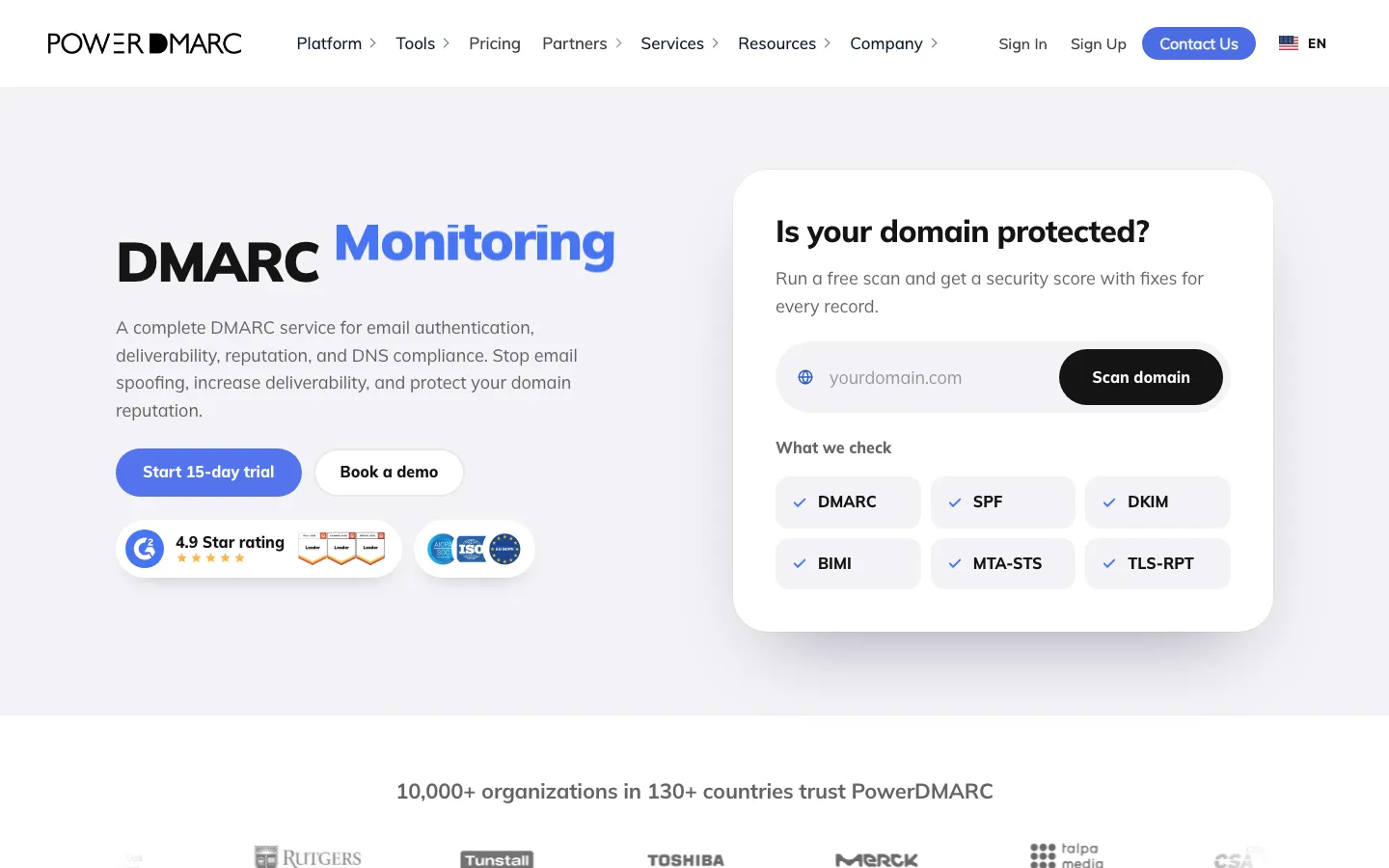
PowerDMARC addresses the reality that when your company sends from several systems, the hard part is not receiving a DMARC report. It is understanding which source is legitimate, which record has failed, and whether a policy change will disrupt a campaign or a transactional message. PowerDMARC is the better pick for that job when your team wants reporting, hosted authentication and DNS-oriented monitoring in one place.
The platform turns aggregate and failure reports into dashboards that show sending sources, authentication results, organizations, hosts and location. That gives marketing and IT a shared starting point: one side knows the approved campaign and CRM senders, while the other can act on the domain and DNS records. If you are still choosing the rest of your stack, the marketing tools directory helps put that role in context without treating domain authentication as an email-verification task.
PowerDMARC's range is wider than reporting alone. It lists hosted DMARC, SPF, DKIM, MTA-STS and BIMI, plus reputation and DNS security monitoring. I would choose it when that shared control surface matters. A simple sender inventory still comes first, because no dashboard can decide which platforms your organization intends to authorize.
Who should implement PowerDMARC across their outbound email architecture?
Small domain teams
Basic suits a business with a few active domains and a clear view of monthly sending volume.
Marketing and IT
Shared reporting helps teams connect campaign senders, authentication failures and the people responsible for each system.
Growing sending estates
Hosted services help centralize records as more platforms send from the same organization.
Service providers
Partners can manage client domains through multi-tenant controls, branded reporting and a tenant API.
It is a weaker fit for a person whose only problem is whether a prospect address can receive a cold email. For that job, start with the QuickEmailVerification review. PowerDMARC begins where that check ends: at the authentication and reputation of the domain that sends the mail.
Which hosted authentication and compliance tools does PowerDMARC include?
Readable DMARC reporting
Mailbox providers can send aggregate reports daily and failure reports per incident, but the files are not designed for a marketing or operations team to read line by line. PowerDMARC presents that data as visual dashboards, with views for sources, results, organizations, hosts, geolocation and countries. Scheduled exports and real-time alerts are part of the reporting offer, so a team can set a review rhythm instead of treating a failure as a spreadsheet exercise.
Hosted authentication services
Hosted DMARC lets you change policy from the dashboard. Basic also includes hosted MTA-STS and TLS-RPT, while hosted BIMI is on the free tier and above. Enterprise adds hosted SPF and DKIM. That plan boundary matters: Basic can be the sensible starting point for reporting and several hosted controls, but it is not the published all-in authentication package.
Hosted SPF and sender changes
SPF becomes awkward when a business adds a CRM, support desk, newsletter platform and more sending services. PowerDMARC's hosted SPF is designed to keep the record within SPF's 10-DNS-lookup limit through flattening or macros. It is listed as an add-on on Basic and included in Enterprise, so include it in the conversation before judging the $8 entry price.
Alerts, reputation and DNS monitoring
PowerDMARC lists threat intelligence and alerts, an inbox placement analyzer, reputation monitoring and DNS security monitoring. The useful question is not whether another dashboard exists. It is whether someone owns the response when a failure or unfamiliar source appears. A team with that workflow will get more from the reporting than one that only opens it after delivery trouble.
Partner management
The Partner Program is for MSPs, MSSPs and resellers. It lists a multi-tenant control panel, full white-label branding, PSA integration, a tenant API, and lead and marketing support. That is a different buying case from Basic: you are paying for a client-management setup rather than a single company domain. Compare its quote against the number of domains and the service promise you plan to sell.
What are the current subscription tiers and rates for PowerDMARC?
Price checked 27 Nov 2026
| Plan detail | Free$0/mo | Basic$8/mo | EnterpriseCustom | Partner ProgramCustom |
|---|---|---|---|---|
| DMARC-compliant emails | 10,000/mo | 50,000/mo | Up to unlimited | Custom |
| Active domains | 1 | 5 | Custom | Custom |
| Data history | 10 days | 1 year | Confirm with vendor | 1 year |
| Platform users | 1 | 2 | Unlimited | Unlimited |
| Hosted SPF | ✕ | Add-on | ✓ | ✓ |
| Scheduled PDF reports | ✕ | Basic | Advanced | Advanced |
PowerDMARC prices in US dollars, 27 Nov 2026.PowerDMARC pricing
Basic is the published entry plan for a small team, not a fixed bill for every organization. It starts at $8 a month for 50,000 DMARC-compliant emails, five domains, two platform users and one year of history. The plan comparison also shows Basic from $8 to $250 a month and higher email-volume settings, so the real team bill follows message volume.
For two people managing five domains within the displayed 50,000-email setting, the plan price is $8 a month. Add hosted SPF and the price is no longer published in the table, which is why I would get that figure before committing. Enterprise and Partner Program prices are custom, and the partner offer is explicitly pay-as-you-go with no contract.
Confirm Enterprise data history with PowerDMARC before you buy. Its Enterprise plan summary says one year, while the feature comparison marks the allowance as custom.
When should growing companies transition to PowerDMARC Enterprise?
PowerDMARC Enterprise is the right conversation when a business has many domains or senders, needs hosted SPF and DKIM as included services, or wants a dedicated engineer and SLA. It lists up to unlimited emails and domains, unlimited users, threat intelligence and alerts, an inbox placement analyzer, advanced PDF reports and report exports. The vendor does not publish the price, so its value depends on the scope of your sending estate rather than the Basic price.
The separate Partner Program is the alternative for a provider managing multiple clients. It adds the controls needed to keep tenants and branding distinct, while the price is quoted around the portfolio. Keep those two paths separate in your comparison, because Enterprise serves one organization at scale and Partner Program serves an operator with many organizations.
Where does PowerDMARC exhibit product limitations or restrictive quotas?
PowerDMARC maintains a deliberately narrow free tier designed for personal domains, with one active domain, 10,000 emails a month, one platform user and 10 days of history. It is useful for seeing the shape of the reporting, but it is not a free team plan.
Basic's low starting number needs context. The plan varies by DMARC-compliant email volume, supports two platform users, and lists hosted SPF as an add-on. That makes it easy to under-budget if your sending volume grows or the people who manage records need a fuller hosted-authentication setup.
Finally, PowerDMARC does not turn deliverability work into a one-click task. The dashboards can show a source or a failure, but the decision to authorize a sender or change a policy belongs to the people who understand the domain and the sending systems. PowerDMARC also offers managed DMARC services for setup, hosting and ongoing monitoring. Managed services are listed as add-ons on Basic and Enterprise, so confirm the scope and add-on cost before relying on them.
Which domain authentication platforms serve as alternatives to PowerDMARC?
PowerDMARC alternatives for outbound teams may solve a completely different stage of the deliverability job. QuickEmailVerification review covers a tool built around checking email addresses before they enter a campaign, while PowerDMARC focuses on the authentication and reporting for the domain that sends it. Use both questions in order: can we contact this address, then can our authorized mail pass the checks it should?
If your priority is another DMARC-management platform, read the  Red Sift OnDMARC review. Red Sift says OnDMARC configures SPF, DKIM, DMARC, BIMI and MTA-STS in one place, making that unified authentication configuration the concrete point to compare with PowerDMARC.
Is PowerDMARC the right choice for securing corporate sender domains?
PowerDMARC is most convincing as a shared control point for teams that must turn raw DMARC data into action while managing hosted authentication. The reporting, hosted controls and partner path make it a credible platform for a team that treats authentication as shared infrastructure. Its public Basic price is useful, but the choice should turn on volume, hosted SPF and the number of people and domains involved.
Start with the 15-day Basic trial on a representative domain. Map your senders, confirm the monthly email volume, then price hosted SPF before you use the $8 entry point in a budget.
How were the specifications and claims in this PowerDMARC review verified?
PowerDMARC published plans, reporting capabilities, hosted SPF options, and partner documentation were reviewed on 27 Nov 2026. Prices are in US dollars as shown by the vendor, and the treatment of figures follows how we check figures.
- PowerDMARC plans and feature comparison
- PowerDMARC DMARC reporting and hosted SPF pages
- PowerDMARC partner program material
What are the common technical questions regarding PowerDMARC deployment?
Does PowerDMARC have a free plan?
Yes. Free is for personal domains and includes one active domain, 10,000 emails a month and 10 days of data history.
How much does PowerDMARC Basic cost?
Basic starts at $8 a month, billed monthly, for 50,000 DMARC-compliant emails. Higher volume settings are available, and the comparison shows a Basic range of $8 to $250 a month.
Can a service provider manage clients in PowerDMARC?
Yes. The Partner Program lists multi-tenant controls, white-label branding, PSA integration and a tenant API. Pricing is custom.
Does PowerDMARC offer hosted SPF?
Yes. Hosted SPF uses flattening or macros. It is an add-on on Basic and included in Enterprise in the plan comparison.
 Reviewed byDanny Kirk
Founder of ReddiReach.
 Checked byAndrés Felipe
Digital designer and marketer.
Every figure is checked against the vendor's own page. Read our editorial standards.