
Key Takeaways
- Process Street converts standard operating procedures into accountable workflows featuring structured task assignments, conditional forms, sign-offs, and verifiable audit histories.
- Process Street provides private custom quotes across Startup, Pro, and Enterprise packages while supplying an unrestricted two-week evaluation without credit card requirements.
- Process Street offers an administrative REST API that allows programmatic systems to trigger complex runs and synchronize data sets directly across internal operations.
- Process Street requires formal ownership and established procedures to justify its cost rather than functioning as a lightweight or self-serve personal task tool.
Process Street is the right pick when you need your team to follow the same operational process, with the policy, tasks, approvals and audit trail living together. Pass if a visible monthly price is a requirement: Startup, Pro and Enterprise all lead to sales, although Pro offers a 14-day trial without a card.
Agent access
- API
- Yes, all plans
- MCP server
- Official, hosted, OAuth with Dynamic Client Registration, or an API key as a bearer token
- Works with
 Claude
 ChatGPTClaude Code
 Gemini
 Cursor
 VS Code
- Automation
- Zapier, Make
What are the key advantages and potential drawbacks of using Process Street?
What works
- Tasks, forms, approvals and conditional logic in one workflow
- Policies and operational work sit in the same platform
- API, webhooks,
 Zapier and
 Make support connected workflows
What to watch
- No published price for Startup, Pro or Enterprise
- Startup lists five users; Pro and Enterprise user allowances are custom
- A workflow still needs a clear owner and a well-defined process
How does Process Street transform standard operating procedures into governed workflows?
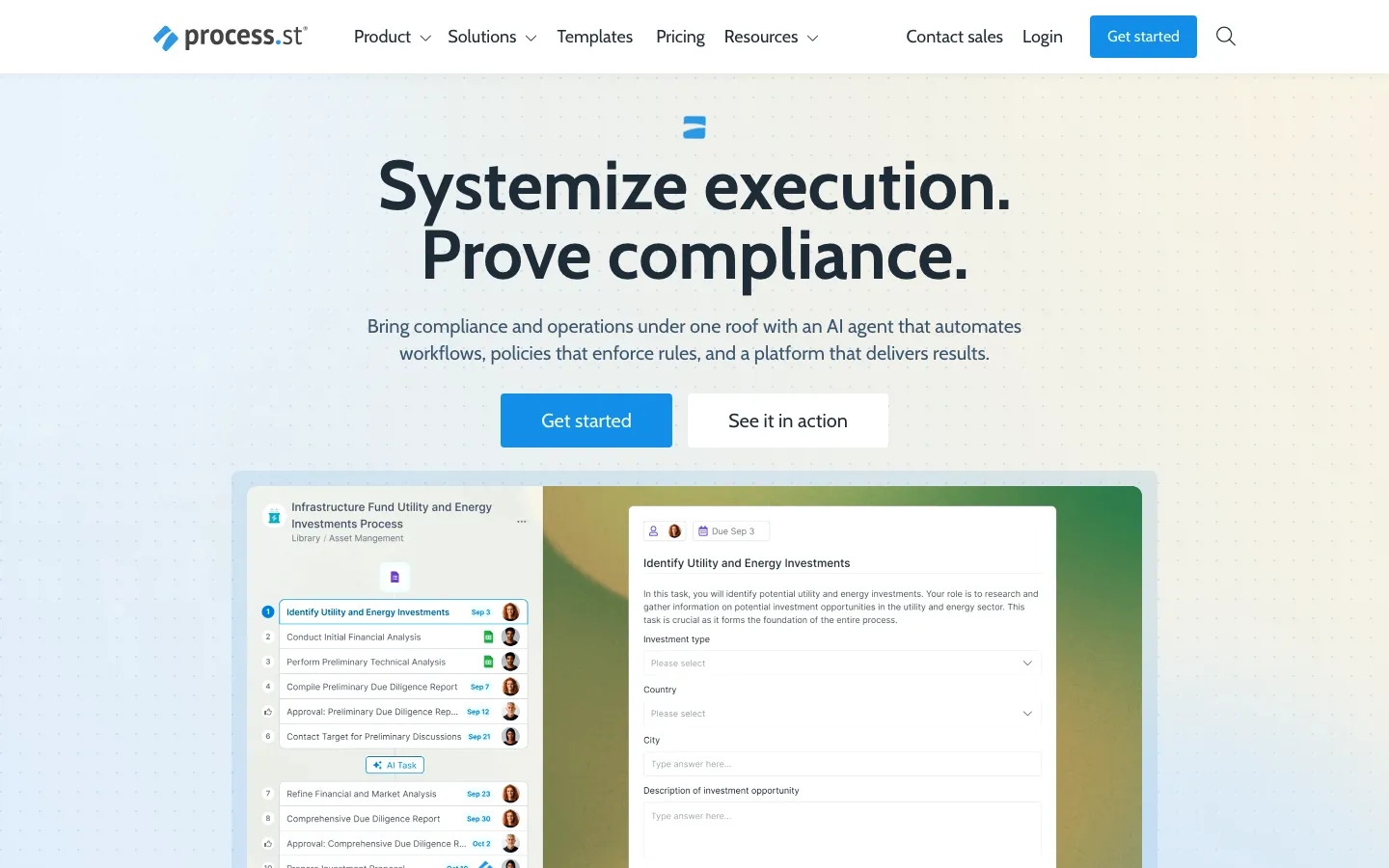
Process Street turns a documented procedure into a governed sequence of work. Its Ops product connects people, systems and data with tasks, forms, approvals and conditional logic, while Docs is positioned as the home for controlled policies. That combination is valuable when a handoff must be done consistently, not merely remembered.
An operations lead can use it for a client onboarding flow, a regulated approval, or the recurring steps that make a new hire productive. You decide what information is collected, who owns each stage and when a manager must approve it. The platform can make those choices visible, but it cannot supply the decisions, which is why Process Street rewards teams that already understand their process.
It belongs in the marketing tools directory because agencies and marketing operations teams also manage repeatable work. I would choose it for a process with consequences if it is missed, such as onboarding, account setup or a compliance control, rather than for a quick personal reminder list.
Which operations, compliance, and management teams benefit most from Process Street?
Operations teams
Run a repeated handoff with tasks, forms and approvals when an owner can define the correct sequence.
Compliance teams
Keep policy governance and evidence-producing operational work closer together for processes that need a record.
Agencies onboarding clients
Collect information, assign internal work and route approvals through a structured client onboarding process.
Technical operations
Connect workflow data to other systems through the API, webhooks, Zapier or Make when access is governed.
Process Street is less compelling for a team still working out its own procedure. You can automate a confused process very efficiently, so agree the owner, exceptions and approval point first. It is also a hard sell when finance needs a price before the team can begin a buying conversation.
What process orchestration, approval, and audit features does Process Street provide?
Structured workflows
Ops combines tasks, forms, approvals and conditional logic in a workflow. That gives a team a defined route for standard work, including a different path when the form reveals an exception. The useful question is not whether every task can be put in Process Street. It is whether the sequence matters enough that an owner needs to see the work completed in the right order.
Policies alongside execution
Process Street presents Docs, Ops and Cora as three parts of its compliance operations platform. Docs centralizes policies, and Ops puts people, systems and data into a governed flow. For a compliance-heavy team, that is a more coherent proposition than keeping a policy in one system and the evidence of day-to-day execution in another.
Forms, data and permissions
All published plans list unlimited workflows, tasks, forms and pages. The pricing page gives Startup up to 5,000 Data Set records, Pro up to 10,000 and Enterprise a custom amount. It also lists role-based access and permissions, task permissions and role assignments. Those details make the product better suited to shared operational work than an unstructured checklist, but your team still needs to decide who may see sensitive fields.
Automations and integrations
Native automations connect Workflows, Forms and Data Sets with services including Google Sheets, Slack, DocuSign, Salesforce and Jira. Process Street also lists webhooks, Zapier, Make and Microsoft Power Automate. That is a broad menu, but an integration only earns its place if it removes a real handoff. Map the trigger, data owner and failure path before making it part of a client or compliance process.
API access for agent workflows
Process Street's API can run workflows and update workflow runs and Data Sets without a third-party integration tool. An administrator creates API keys, and the key is only shown in full once when it is created. That gives an internal agent or custom system a documented integration route. Confirm MCP availability with the vendor if your agent requires it. Put key ownership and rotation in the rollout plan before relying on it.
Cora and AI automation
Cora is Process Street's AI compliance agent. The vendor says it monitors regulations, automates work and flags risks, while Ops lists AI automation among its key features. Treat that as a reason to ask sales which capabilities and controls match your plan, rather than a reason to assume every workflow has the same AI behavior.
How does Process Street handle sales-led pricing and custom enterprise quotes?
Price checked 27 Nov 2026
| Plan detail | StartupContact sales | ProContact sales | EnterpriseContact sales |
|---|---|---|---|
| Workflows | Unlimited | Unlimited | Unlimited |
| Forms | Unlimited | Unlimited | Unlimited |
| Data Set records | Up to 5,000 | Up to 10,000 | Custom |
| Users | 5 | Custom | Custom |
| Automation actions | 100 | Custom | Custom |
| Public API access | ✓ | ✓ | ✓ |
Process Street plan details, 27 Nov 2026.Process Street pricing
There is no responsible team-bill calculation to make from the public page. The vendor asks you to contact sales for every plan, and Pro's user and automation-action allowances are custom. The published figures that can shape that conversation are:
- Startup allows five users, 10 guests, 10 automation apps and 100 automation actions
- Pro and Enterprise list custom user, guest and automation-action allowances
- Startup stores files up to 5MB each, Pro up to 100MB each and Enterprise has a custom limit
- Pro has a 14-day free trial with no credit card required
Ask for the quoted user count, expected automation actions, integration setup and the support level in writing. Those are the inputs that determine the real monthly bill, not a guessed per-seat number.
What security controls and dedicated limits does Process Street Enterprise provide?
Process Street Enterprise is the dedicated pathway for organizations requiring customized operational boundaries and advanced security controls. The pricing page lists custom Data Set records, users, guests and file-size limits for Enterprise. It also lists controls such as SAML-based single sign-on, SCIM provisioning, Microsoft Active Directory integration, data residency and private cloud. Ask sales which controls are included in the quoted plan.
The same pricing page lists a dedicated Success Manager, priority support, fully managed workflows, custom integrations, bulk document import, process consulting and personalized training. Confirm availability and charges for those services in the quote. For a smaller team, first see whether a focused Pro workflow proves the process before paying for a broader implementation.
Where does Process Street encounter pricing or workflow constraints?
Process Street exhibits a notable friction point due to its lack of public self-serve pricing. Process Street gives useful plan limits, but not a dollar or euro amount for Startup, Pro or Enterprise. A buyer cannot compare it cleanly with a self-serve automation product until sales provides a quote, and a team cannot estimate its bill from the public page when Pro's users and automation actions are custom.
The second limitation is conceptual rather than technical. Tasks, forms and conditional logic can express a process, but they do not settle disagreements about the process. Teams with unclear ownership can end up formalizing confusion. Start with one stable workflow, name the exception that needs approval and only then add integrations.
The official pages checked document API access, but do not state whether an MCP server is available. If your automation architecture depends on MCP specifically, do not treat generic API access as equivalent. Confirm the interface you need before choosing Process Street.
Which workflow automation and management tools serve as alternatives to Process Street?
 Relevance AI review is worth reading when coordinated teams of agents need to act on events and signals already flowing through your business. That fits better than Process Street when the work starts with an AI workforce, not policy-linked approvals and records.
 Retool review gives you the other useful comparison when a team needs to build an internal interface around its data. Process Street is the more direct choice when the priority is a repeatable workflow with forms, tasks and approvals already at the center.
Is Process Street the right platform for managing governed business operations?
Process Street proves its worth by turning complex operational procedures into strictly governed workflows. It combines process execution, documentation and integration routes in a way that makes sense for onboarding, compliance work and other repeatable handoffs. The trade-off is a sales-led price and implementation effort that need to be justified by the process itself.
Put one recurring process through the 14-day Pro trial, including a real approval and one necessary connection. Then request a quote that names your users, automation actions and support needs before standardizing it across the team.
How was this Process Street review researched and documented?
Process Street public documentation, API resources, feature catalogs, and operational pages were examined on 27 Nov 2026. The pricing page does not publish plan amounts, so this review does not infer one. Every figure follows how we check figures.
- Process Street pricing and Pro trial details
- Process Street Ops and compliance operations pages
- Process Street integrations and API documentation
What are the common enterprise implementation questions about Process Street?
Is there a free version of Process Street?
The pricing page presents Startup, Pro and Enterprise as sales-led plans. Pro begins with a 14-day free trial that does not require a credit card.
How much does Process Street cost for a team?
Process Street does not publish a price for Startup, Pro or Enterprise. Startup lists five users, while Pro and Enterprise user allowances are custom, so request a quote for your actual team.
Does Process Street connect to other software?
Yes. The vendor lists native automations, webhooks, an API, Zapier, Make and Microsoft Power Automate, with examples including Google Sheets, Slack, DocuSign, Salesforce and Jira.
Can an AI agent use Process Street?
Its API can run workflows and update workflow runs and Data Sets. An administrator creates the API key. The official pages checked do not state whether an MCP server is available, so confirm it with the vendor if you need one.
 Reviewed byDanny Kirk
Founder of ReddiReach.
 Checked byAndrés Felipe
Digital designer and marketer.
Every figure is checked against the vendor's own page. Read our editorial standards.