
Key Takeaways
- SpeedCurve unifies synthetic testing, real-user monitoring, performance budgets, and competitor benchmarking into a collaborative performance platform wholly owned and operated by Embrace.
- SpeedCurve plans start at $90 monthly based on data volume, scaling to standard growth setups around $720 monthly or $576 monthly billed annually.
- SpeedCurve maintains a documented REST API covering tests, monitoring results, and performance budgets, although it does not publish native Model Context Protocol support.
- SpeedCurve is not designed for small websites seeking simple single-site audits or organizations needing fixed low-cost bills without variable telemetry monitoring fees.
Your site’s speed is slipping between releases and nobody can say which deploy did it. SpeedCurve is the best fit when you need to make page speed a shared engineering and SEO discipline, with synthetic tests, real-user data, budgets and competitor benchmarks in one place. Skip it if you need a simple, published package for a small site: prices start at $90 a month but rise with your monitoring volume. SpeedCurve is wholly owned and operated by Embrace.
Agent access
- API
- Yes
- MCP server
- Not found on official pages
What are the primary pros and cons of SpeedCurve?
What works
- Synthetic and real-user monitoring in one platform
- Competitor benchmarks with detailed performance metrics
- REST API and CI/CD hooks for budget alerts
What to watch
- Usage-based pricing makes the monthly bill variable
- No free tier is published
- No MCP support is published for agent workflows
What does SpeedCurve do for engineering and SEO teams?
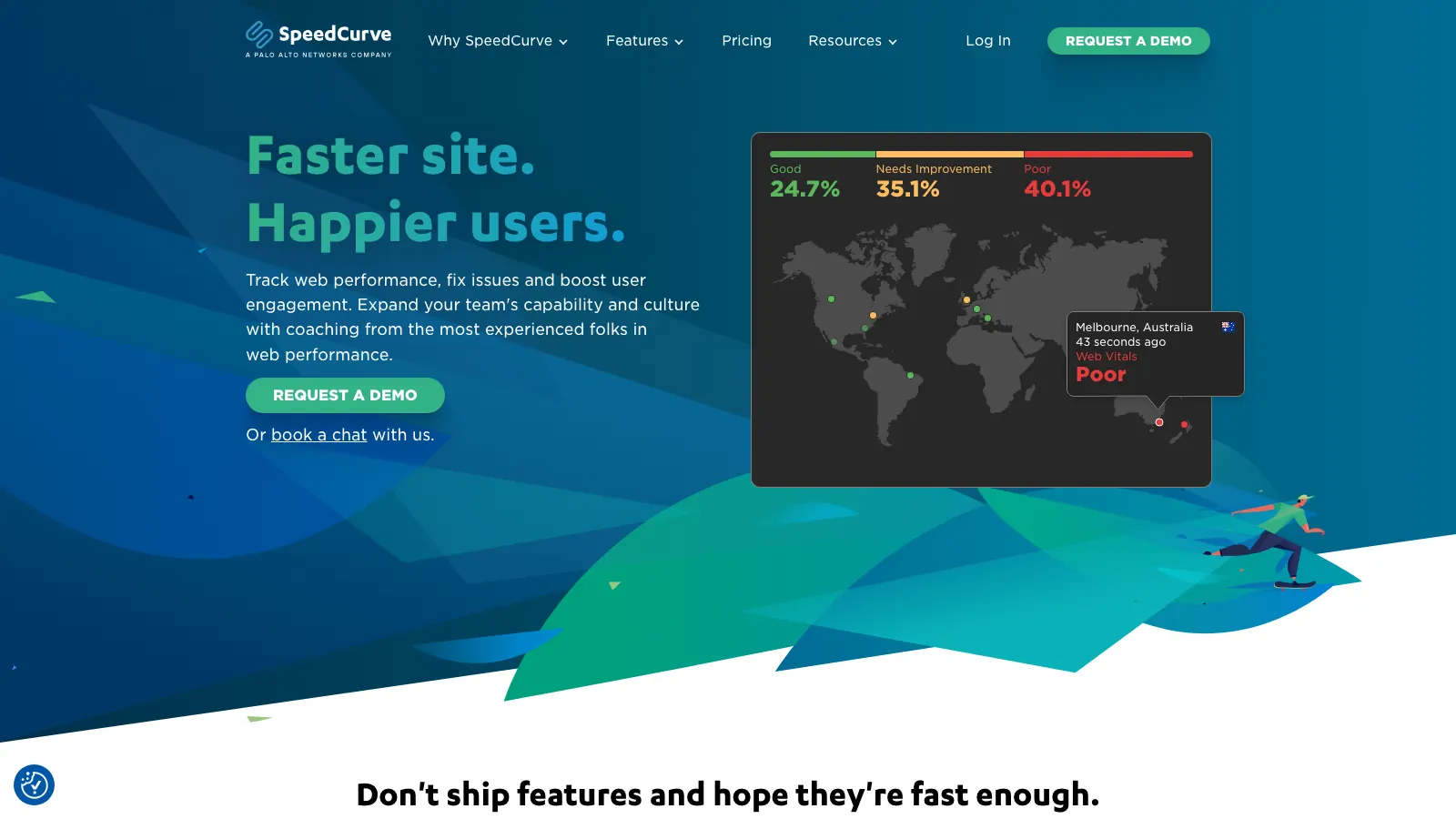
SpeedCurve addresses how a slow page can be an SEO problem, an engineering problem, and a commercial problem simultaneously. SpeedCurve gives those people a common record: lab-based Synthetic monitoring for controlled tests, RUM for what visitors experience, Lighthouse results, Core Web Vitals, custom metrics and business measures such as conversion rate. It is not an SEO suite. It is the performance layer that helps a team decide whether a release made the site better or worse. Compare peer options in our Technical SEO directory.
The strongest reason to choose it is the connection between performance data and action. You can compare before and after a deployment, set thresholds for the measures that matter, and let alerts reach the people responsible. When a marketing or product lead needs more than a Vitals score, correlation charts can group traffic by performance cohorts and compare those cohorts with your business metrics.
That makes SpeedCurve a natural companion to a search toolkit when your job extends beyond keyword reports. It asks more of the team than a one-off audit does, but it can turn performance into a recurring operating metric rather than a cleanup project.
Who is SpeedCurve designed for?
Performance-led teams
Use one place for real-user data, controlled tests and the work of finding regressions.
Release-focused engineers
Connect performance budgets to deployment checks and receive alerts when limits are crossed.
Technical SEO teams
Track Core Web Vitals over time while seeing the site experience behind the SEO metric.
Competitive categories
Put competitor pages beside your own to see how your experience compares in the market.
I would not choose SpeedCurve just to produce a monthly SEO report. Its value shows up when engineering, SEO, product and marketing will all use the same signals. The platform also includes unlimited teams and users from Starter, so the price is driven by what you monitor, not by how many colleagues need to see the work.
What core performance features does SpeedCurve include?
Synthetic and real-user monitoring
Synthetic monitoring gives you controlled lab data with configured browsers, locations and test settings. RUM captures the experience of visitors in the field. Seeing both matters because a page can look stable in a controlled check while a particular device, geography or journey is struggling in real use. SpeedCurve also offers RUM sampling, so teams can choose how many page views to measure.
Core Web Vitals and diagnostics
SpeedCurve supports Google’s Core Web Vitals and supplies continuous monitoring across pages. Its diagnostic tools cover Lighthouse audits, browser waterfalls, JavaScript errors, third parties, comparison videos and INP attribution. That is the difference between noticing a performance movement and having a route into the cause.
Performance budgets and alerts
Set budgets on the metrics your team cares about, then receive an email or webhook alert when a threshold is crossed. The useful choice is to make those limits specific: a budget can protect a checkout, a campaign landing page or a vital page group instead of treating every URL as equally important. Alerts can go to Slack or Microsoft Teams through webhooks.
Deploy checks and REST API
SpeedCurve’s HTTP REST API can create and run tests, retrieve results and return budget information. Its CI/CD guidance covers Jenkins, Travis and CircleCI, and a deployment that crosses a budget can trigger an alert. The official materials do not identify a plan that includes the API, so confirm access for your intended configuration before you build a release workflow around it.
Competitive benchmarking and business context
Benchmarking puts your performance beside competitors, with over 100 performance metrics, visualizations, filmstrips and videos. On-demand testing can test any URL when you need a quick competitor or pre-production check. Correlation charts and custom metrics then give a stakeholder a way to connect performance changes with conversion rate, cart size or an A/B test.
How does SpeedCurve price its monitoring tiers?
Price checked 27 Nov 2026
| Plan detail | StarterFrom $90/mo | GrowthFrom $576/mo | EnterpriseCustom |
|---|---|---|---|
| Billing model | RUM views and Synthetic checks | RUM views and Synthetic checks | Contact sales |
| Users and teams | Unlimited | Unlimited | Unlimited |
| Synthetic monitoring | ✓ | ✓ | ✓ |
| Real-user monitoring | ✓ | ✓ | ✓ |
| Data retention | Synthetic 13 months; RUM 3 months on smaller plans | Synthetic 13 months; RUM 13 months on qualifying plans | Synthetic 13 months; RUM 13 months on qualifying plans |
| Added controls | Not listed | Priority testing and support | SSO, private agents and consulting |
SpeedCurve prices in US dollars, 27 Nov 2026.SpeedCurve pricing
The public pricing page is a builder, not a fixed seat menu. Starter begins at $90 USD/month, and you choose the number of RUM page views and Synthetic checks. The displayed Growth configuration includes 2 million RUM page views and 30 thousand Synthetic checks a month. It costs $720/month on monthly billing, or $576/month when billed annually, which is $6,912/year.
For a real team bill, three people on the displayed Growth setup still pay $720/month, because users and teams are unlimited. The cost rises when traffic, test volume, monitored URLs, browsers, regions or run frequency rise. That is generous for collaboration, but it means a traffic forecast belongs in the buying decision.
What does the SpeedCurve Enterprise tier provide?
SpeedCurve Enterprise requires a custom quote. It includes everything in Growth, then adds single sign-on, Synthetic private agents, regular check-ins and consulting. Enterprise adds Synthetic private agents; ask SpeedCurve what they cover for your environment.
Growth adds 13 months of data retention, high-priority support and Synthetic priority testing. Data retention needs a closer look than the plan cards suggest: Synthetic data is retained for 13 months across plan types, while smaller RUM plans have three months of access and longer RUM access starts at annual plans of $6,000 or monthly plans of $500.
Where does SpeedCurve fall short for smaller sites?
SpeedCurve gives you control, but that control shifts cost planning onto your team. The starting price is clear, while the eventual bill depends on monitoring volume. A Growth-looking price can be misleading if you have more traffic, pages, browser profiles or regions than the displayed configuration. Build the plan around the few journeys that need protection first, then grow it when the monitoring changes decisions.
Machine access is useful but incomplete for agent-led operations. The REST API is documented, including endpoints for Synthetic results and budgets, yet the official pages do not publish MCP support. If your immediate job is tracking whether AI answers mention a brand, read the AI Peekaboo review first rather than stretching a performance platform into that role.
Finally, a demo is the public route into the product, even though support documentation refers to trial accounts and starting a free trial. Confirm the evaluation arrangement, the RUM retention period and API availability in writing before you commit to a configuration.
What are the top alternatives to SpeedCurve?
 AI Peekaboo belongs alongside SpeedCurve only when your question is AI-answer visibility rather than page performance. Its published plans start at $30/month and include an API and MCP, so it is the more direct choice for an agent that needs brand-answer data.
 Treo combines the Chrome UX Report and Lighthouse in one clean interface with zero configuration. It has a free plan; Vital costs $99/month or $75/month when billed yearly, and API access starts on Pro rather than Vital. The Treo review has the plan detail.
 URL Profiler is a desktop download with a 14 day trial that needs no credit card. It fetches PageSpeed scores and statistics and downloads bulk link metrics from Mozscape, Majestic SEO and Ahrefs, making it a crawl and data-collection tool rather than continuous monitoring. The URL Profiler review covers that workflow.
What is the verdict on using SpeedCurve?
SpeedCurve earns its place when performance is part of how you release software, not a report somebody visits after rankings drop. Synthetic tests, RUM, budgets, deployment hooks and competitor context make a coherent system for a serious web team. The money decision is equally clear: start with the journeys that can hurt the business, then buy only the monitoring volume those journeys need.
Use a demo or trial to define the page views and checks that protect your most important journeys. Get the monthly and annual cost for that exact mix, then confirm RUM retention and API access before you move your release checks into SpeedCurve.
How was this SpeedCurve evaluation researched?
SpeedCurve pricing, feature, API, support, and terms pages provided every figure, limit, and feature in this review on 27 Nov 2026. Prices are in US dollars, as SpeedCurve shows them, and every figure follows the rules in how we check figures.
- SpeedCurve pricing page, including monthly and annual configurations
- SpeedCurve pages for monitoring, budgets, deployments and benchmarking
- SpeedCurve API, data-retention and account documentation
What are common questions about SpeedCurve?
How much does SpeedCurve cost?
SpeedCurve starts at $90 USD/month. Its public builder prices RUM page views and Synthetic checks. The displayed Growth configuration is $720/month, or $576/month with annual billing.
Does SpeedCurve offer a free trial?
SpeedCurve’s public site promotes a personalized demo. Its support documentation refers to trial accounts and starting a free trial, so ask SpeedCurve about the evaluation terms for your configuration.
Can SpeedCurve compare a site with competitors?
Yes. Competitive benchmarking lets you monitor competitor performance alongside your own, with detailed metrics, visualizations, filmstrips and videos.
Does SpeedCurve work with AI agents?
SpeedCurve documents an HTTP REST API that can create and run tests, retrieve results and access budget information. Its official pages do not publish MCP support.
 Reviewed byDanny Kirk
Founder of ReddiReach.
 Checked byAndrés Felipe
Digital designer and marketer.
Every figure is checked against the vendor's own page. Read our editorial standards.