
Key Takeaways
- Treo enables technical teams and digital agencies to monitor Core Web Vitals, CrUX data, and Lighthouse audits across multiple web domains without script installation.
- Treo offers the Vital tier at 99 dollars monthly for 50 domains and five members, reducing to 75 dollars monthly on annual billing.
- Treo restricts developer API access to higher-tier Pro and Scale subscriptions, excluding programmatic endpoints from the baseline entry Vital package.
- Treo is not intended for users seeking all-in-one organic search platforms or teams requiring low-cost programmatic machine data access.
When a release slows a key template and a client asks which pages need attention, you need a way to follow Core Web Vitals across the sites you manage. Treo is the better pick for agencies and technical teams that need CrUX data and Lighthouse monitoring in the same view, without installing a script.
Agent access
- API
- Yes, Pro and Scale
- MCP server
- Not found on official pages
What are the main Treo pros and cons?
What works
- CrUX field data and Lighthouse results in one product
- No script installation required for its Core Web Vitals data
- Five seats included with Vital, then 15 on Pro and 50 on Scale
What to watch
- Vital costs $99 a month after the free account
- API access starts on the $249-a-month Pro plan
- The offer is centered on site speed, so use the marketing tools directory if the same brief includes keyword or link work
What does Treo do for web performance monitoring?
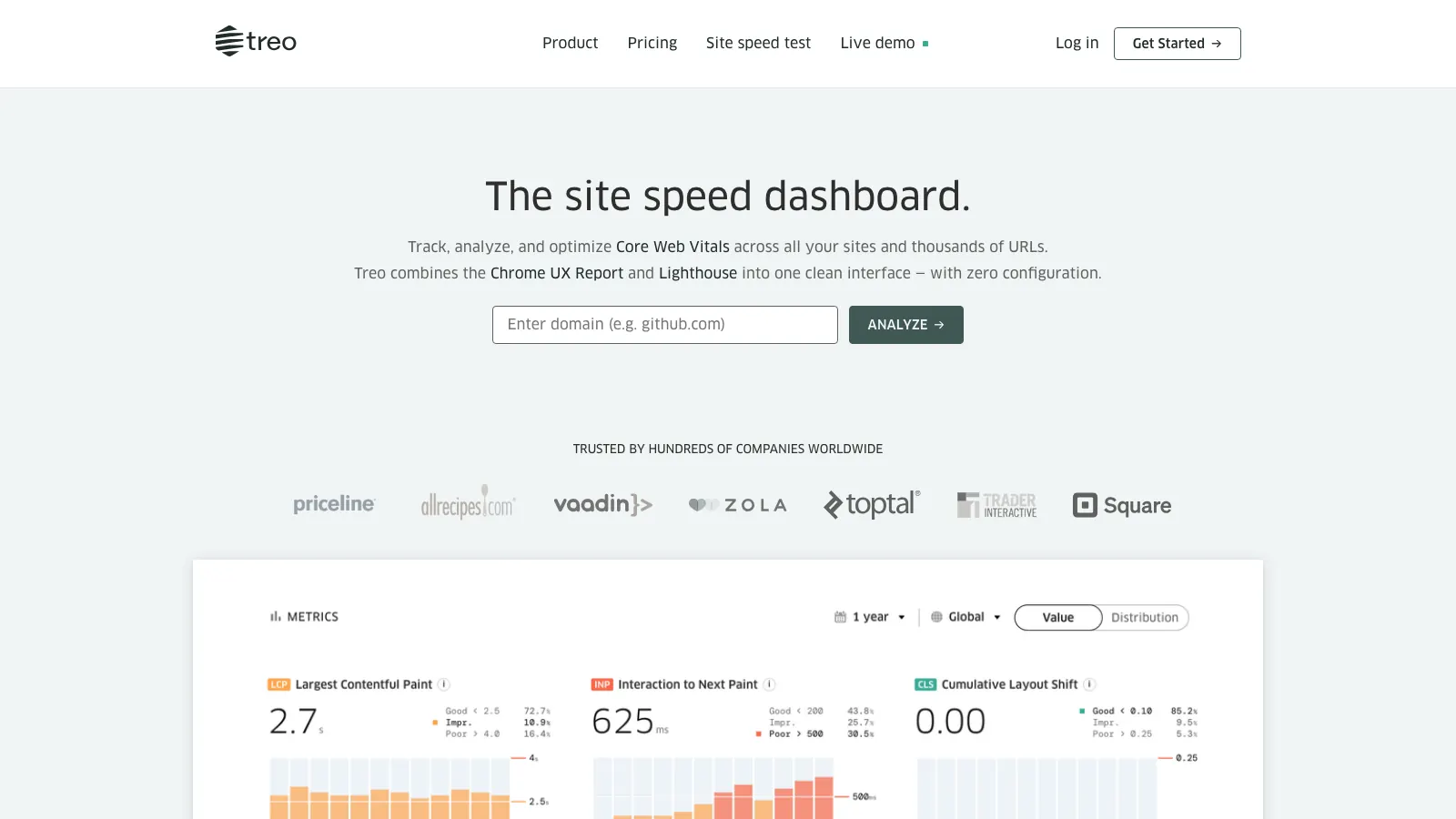
Treo is a focused technical SEO tool for the part of the job that gets urgent when a release slows a key template or a client asks why a competitor feels faster. It brings Chrome UX Report data and Lighthouse monitoring together, so your team can look at user-facing Core Web Vitals and controlled page tests without switching between tools.
The product is deliberately narrower than a general SEO suite. Its value is in making performance work visible across a portfolio: Treo says it can scan sites, isolate bottlenecks, compare historical trends and manage hundreds of sites from one interface.
The first paid plan, Vital, is a substantial step up from the free account. It includes 1,000 CrUX pages, 40 Lighthouse pages, 50 sites and five team members.
Who benefits most from using Treo?
Performance agencies
Vital brings five people and 50 sites into one account for recurring Core Web Vitals work.
Large web teams
Pro and Scale each cover 500 sites, with larger CrUX and Lighthouse page allowances.
Teams with their own reporting
Pro and Scale list API access. Treo says API access is available from Pro upward.
Release-focused developers
Hourly Lighthouse monitoring helps surface performance changes after a release.
I would not choose Treo as the only tool for a small site owner who needs keyword research, crawling, content planning and link data together. Its published plans make much more sense when site speed is a recurring responsibility, not an occasional diagnostic.
Which audit and performance features does Treo include?
CrUX and Lighthouse in one workflow
Treo combines Chrome UX Report data with Lighthouse. That pairing matters because the two answer different questions: field data shows how people experienced pages, while Lighthouse offers a repeatable monitoring view. Treo also says Lighthouse can run hourly, which is useful when your team needs feedback between releases rather than a monthly scorecard.
Site scanning and page-level work
Its site scan is designed to separate important bottlenecks from noise across many URLs. Treo also presents page-level monitoring with configurable locations, device settings and network throughput. That makes it a better fit for a team fixing a specific template than a single headline performance score.
Alerts and performance budgets
The page monitoring product includes performance budgets and alerts. Set that up around the pages that matter commercially, then a change in the monitored metrics has a place to land instead of becoming a surprise in a quarterly report.
Competitive context
Treo says its Sites product lets you benchmark websites against competitors and view historical trends side by side. The free site-speed product also says a dashboard can monitor up to five domains. Use this as context for a performance conversation, not as a substitute for deciding which page your own customers need fixed first.
API access from Pro
Pro and Scale list API access, while Vital explicitly lists no API. Treo says API access is available on Pro and higher plans, but its Enterprise card does not list it. Ask Treo to confirm Enterprise access if that plan is in scope.
How is Treo priced for multi-site monitoring?
Price checked 27 Nov 2026
| Plan detail | Free$0/mo | Vital$99/mo | Pro$249/mo | Scale$499/mo |
|---|---|---|---|---|
| Annual monthly price | Not applicable | $75/mo | $185/mo | $375/mo |
| CrUX pages | 50 | 1,000 | 5,000 | 20,000 |
| Lighthouse pages | ✕ | 40 | 200 | 500 |
| Sites and history | 5, 2 years | 50, 5 years | 500, 5 years | 500, 5 years |
| Team members | Personal account | 5 | 15 | 50 |
| API access | ✕ | ✕ | ✓ | ✓ |
Treo prices in US dollars, 27 Nov 2026.Treo pricing
For a five-person team, Vital is $99 a month billed monthly, or $75 a month on the annual $900 payment. That is the actual entry bill for a team that needs 50 sites. If the same team needs API access, the relevant published plan is Pro at $249 monthly or $185 monthly on annual billing.
- Annual purchases receive a 25% discount, which Treo describes as three months free
- Lighthouse can run daily or hourly; daily checks run three times a day for a median, while hourly monitoring uses five times the page capacity
- Plan cards show two years of history on Free and five years on paid plans, while the FAQ says historical data is “Unlimited” through the UI or API. Ask which applies to your sites.
What does Treo Enterprise provide large portfolios?
Treo Enterprise is offered via direct demo for larger companies managing site speed and performance monitoring at scale. The published package adds custom Lighthouse capacity from 1,000 pages, custom CrUX URLs from 50,000, unlimited team members, SSO, custom invoicing, tailored onboarding, an annual performance review, and custom terms and security review.
Where does Treo fall short for developers?
Treo maintains a sharp pricing boundary by keeping API access restricted to expensive top-tier plans. The free account has 50 CrUX pages and no Lighthouse monitoring. Vital adds a meaningful monitoring package, but it still has no API. A team that needs programmatic access jumps directly from $99 to $249 a month on monthly billing.
There is also a question of scope. Treo's own pages focus on site speed, Core Web Vitals, scans and performance monitoring. That focus is a strength for the right team, but it leaves keyword research, link analysis and content work to other products. Budget for that split rather than treating $99 as the entire SEO software bill.
Finally, the paid plans state site, page and seat limits clearly, but you should confirm how your own URL mix maps to the CrUX and Lighthouse allowances before choosing a billing cycle. A 500-site allowance is not the same as a guarantee that every site needs the same monitoring depth.
Which Treo alternatives should technical teams consider?
 AI Peekaboo review is the better read when the job is tracking how a brand appears in AI answers: its plans start at $30 a month and include API and MCP access. It does not replace Treo's Core Web Vitals monitoring, but it may be the missing reporting layer for a team working on AI visibility.
 URL Profiler review covers a Windows or Mac desktop application that connects to Google's PageSpeed service and downloads bulk link metrics from Mozscape, Majestic SEO and Ahrefs. Solo costs $19.95 a month, Pro $25.95 and Agency $64.95, all billed yearly, and it has a 14-day trial with no credit card. It is a bulk-audit export tool, not continuous monitoring.
WebPageTest review covers a free $0 Starter plan with 150 monthly test runs, Lighthouse, Filmstrip and Video. Its Professional plan starts at $180 a year and adds API access and scheduled tests. WebPageTest is now part of LogicMonitor through Catchpoint.
What is the overall verdict on Treo?
Treo earns its place when speed is an operational metric across a portfolio, not a report somebody opens once a quarter. The combination of CrUX, Lighthouse, site scanning and clear seat allowances gives an agency or web team a disciplined way to keep performance work moving. Vital is the right paid entry point when five people and 50 sites are enough. Pro is the decision point for data teams, because that is where the API starts.
Start with the free account for a small set of sites, then buy Vital when ongoing Lighthouse monitoring and five seats are justified. Choose Pro only when your reporting workflow genuinely needs the API.
How was this Treo technical audit conducted?
Treo product pages, speed benchmarking documentation, and subscription terms were evaluated on 27 Nov 2026. Prices are shown in US dollars as Treo publishes them, and the figures follow how we check figures.
- Treo product and site-speed pages
- Treo page-speed monitoring page
- Treo monthly and annual pricing pages
What are frequently asked questions regarding Treo?
Is there a free Treo plan?
Yes. The Free plan includes 50 CrUX pages, a personal account and five sites with two years of history. It does not include Lighthouse pages.
How much does Treo cost for a team?
Vital is $99 a month for five team members and 50 sites. On annual billing, it is $75 a month, paid as $900 a year.
Does Treo require a tracking script?
No. Treo says its Core Web Vitals data is powered by the Chrome UX Report and requires no script installation.
Does Treo have an API?
Pro and Scale list API access, and Treo says it is available from Pro upward. Free and Vital do not include it. The Enterprise card does not list it, so confirm access with Treo if you are considering that plan.
 Reviewed byDanny Kirk
Founder of ReddiReach.
 Checked byAndrés Felipe
Digital designer and marketer.
Every figure is checked against the vendor's own page. Read our editorial standards.