
Key Takeaways
- Storyblok pairs an intuitive real-time visual editor with a decoupled headless CMS architecture, enabling non-technical editors to compose reusable modular components.
- Storyblok provides a free Starter tier, with Growth priced at €99 monthly for five seats and Growth Plus at €349 monthly for 15 seats.
- Storyblok features an official Model Context Protocol server and REST APIs, empowering software agents to interact programmatically with structured content schemas.
- Storyblok is unsuitable for non-technical creators wanting an out-of-the-box turnkey site builder without maintaining dedicated developers for custom frontend rendering.
When you need editors to publish from approved building blocks without giving up a custom frontend, Storyblok is a strong CMS choice. You get a visual editor and API-first content delivery, but your developers still need to create and maintain the components that make the workspace useful.
Agent access
- API
- Yes, Starter, Growth, Growth Plus, Premium, and Elite
- MCP server
- Official, hosted, OAuth
- Works with
 ClaudeClaude Code
 Cursor
 VS Code
 Gemini
What are the pros and cons of using Storyblok?
What works
- Visual editing around developer-created components
- Content Delivery and Management APIs for a flexible frontend
- Free Starter plan, with seats and request limits shown publicly
What to watch
- Growth add-ons can change the team bill
- GraphQL is listed on custom Premium and Elite plans
- Premium and Elite require a custom quote
What does Storyblok do for content and engineering teams?
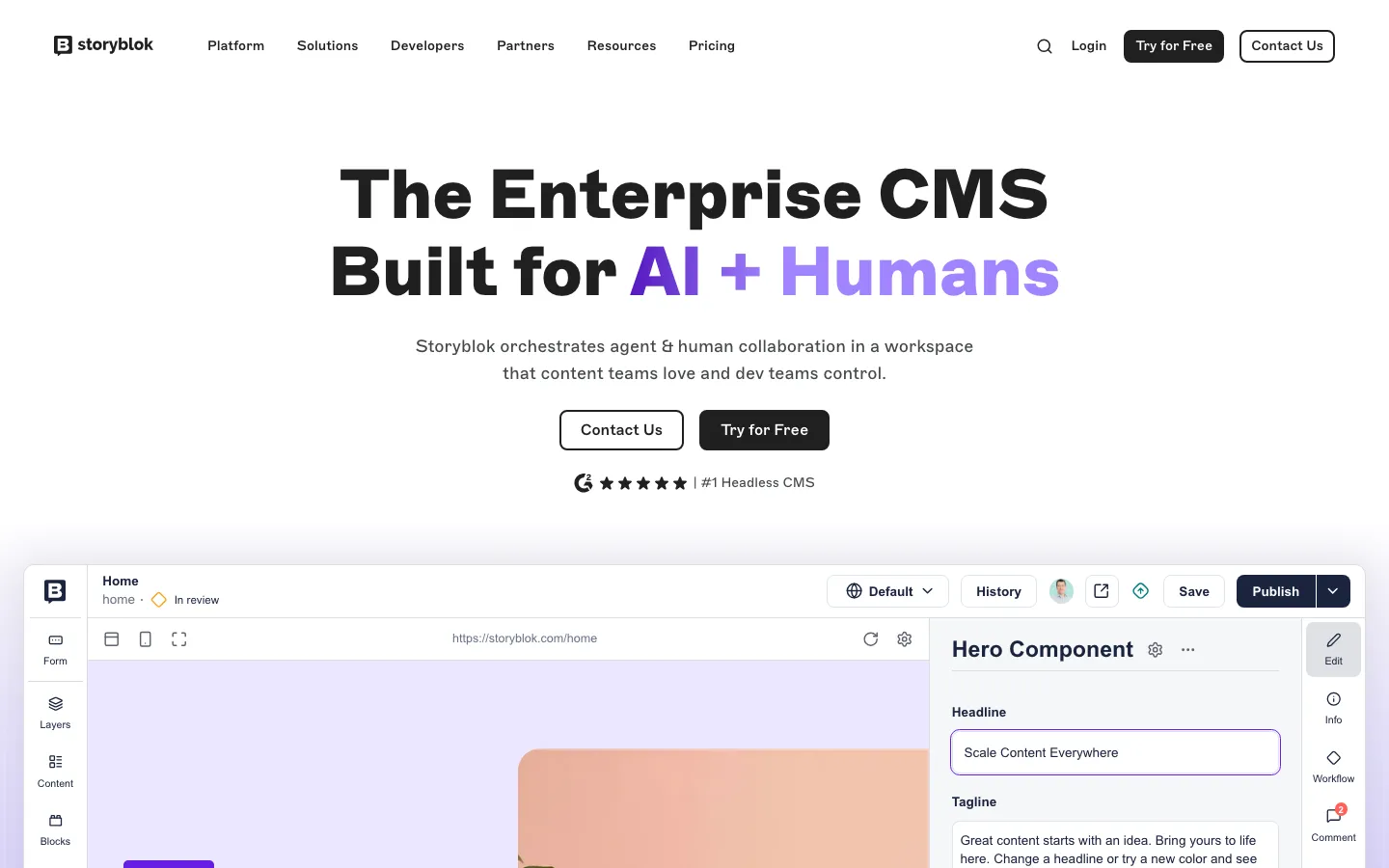
Storyblok separates content from the site that renders it. Your developers can send that content as JSON to the frontend they choose, while your editors use the Visual Editor to assemble and review what those components allow. If you are comparing CMS options in the marketing tools directory, that split is the important distinction: Storyblok is a content platform with a visual editing layer, not a drag-and-drop site builder.
That arrangement makes sense when a brand has repeated page patterns, several channels, or a frontend that should not be rebuilt every time the CMS changes. It gives the development team control over the components and leaves the editorial team with a workspace built around them. The trade is clear: the quality of the editor experience depends on what the implementation makes possible.
Storyblok's published ladder is unusually useful for early planning. Starter is free, Growth costs €99 a month, Growth Plus costs €349 a month, and Premium and Elite are custom. Before comparing feature lists, decide whether the shared component model solves a real publishing problem. That answer matters more than a long API checklist.
Who should build with Storyblok headless CMS?
Marketing teams with developers
Editors work visually while developers create and maintain the components that set publishing boundaries.
Agencies with repeatable builds
Reusable components and JSON delivery suit teams building similar content experiences across client projects.
Multilingual content teams
Growth Plus includes 10 locales, while Growth can expand from two to unlimited locales.
Governed enterprise teams
Premium and Elite add custom roles, custom workflows, SSO, and higher uptime commitments for larger operations.
I would not put Storyblok in front of a solo marketer who needs to launch a standard website without technical help. The product's strength is the agreement between the people building components and the people using them. Without that agreement, its flexibility becomes extra setup rather than useful control.
What are the key headless features of Storyblok?
Visual editing with structured components
Developers create components, then editors use them in the Visual Editor and collaborate there. This is a practical route to consistent landing pages, product pages, and campaigns, provided the component library covers the changes your editors make most often. I would prototype the hardest recurring page before making a CMS decision, not just a simple content block.
APIs and frontend freedom
Storyblok provides both a Content Delivery API and a Management API, and its developer material says content is delivered in JSON for rendering on your frontend. The documented framework list includes Next.js, Astro, Nuxt, React, Vue, Angular, and Symfony. That is good news for an existing technical stack, but it also confirms that someone on your side needs to own the frontend.
Workflow and governance
Storyblok describes roles, workflows, approvals, and audit trails for enterprise use. The Premium and Elite plans list custom roles, custom workflows, language-specific workflows, SSO, and SCIM. Those are valuable controls when many people touch content, but they sit behind a custom sales conversation. A smaller team should not pay for them just because they sound reassuring.
AI tools, MCP, and search
Storyblok lists AI translations and generated image descriptions, alongside a native MCP server for connecting agents to structured content. Its Strata search is vector-powered semantic search, and the pricing page places Strata on Elite. The right question is not whether an AI label appears on Storyblok: it is whether the plan you are buying includes the access, credits, and workflow your team needs.
Locales and capacity
Starter and Growth list two locales, Growth Plus lists 10, and Premium and Elite use custom allowances. Growth can add locales up to unlimited, while Growth Plus is sold as a set-price plan. Plan for the review and publishing process in every language, not just the count. A locale allowance does not remove the editorial work of keeping each market correct.
How much does Storyblok cost per plan?
Price checked 27 Nov 2026
| Plan detail | StarterFree | Growth€99/mo | Growth Plus€349/mo | Premium and EliteCustom |
|---|---|---|---|---|
| Included seats | 1 | 5 | 15 | Custom |
| Maximum seats | 2 | 10 | 15 | Custom |
| API requests a month | 100,000 | 1,000,000 | 4,000,000 | Custom |
| Spaces | 1 | 1 | 1 | Custom |
| Locales | 2 | 2, expandable | 10 | Custom |
| Custom roles and custom workflows | ✕ | ✕ | ✕ | ✓ |
Storyblok prices in euros, 27 Nov 2026.Storyblok pricing
Growth is the plan where a small team can begin. It includes five seats; two additional people make the monthly bill €129 because each extra Growth seat costs €15. That is a concrete, predictable step for a seven-person team. Growth Plus removes that seat calculation for up to 15 people, but its €349 monthly price only makes sense when its included capacity is actually needed.
- Starter can add a second seat for €15 a month; Growth can add seats to a maximum of 10, at €15 a month each
- Growth can expand from 1 million to 5 million total API requests a month, at €10 for each additional million
- Growth can expand from two to unlimited locales, at €20 a month for each extra locale
- Annual billing shows €90.75 a month for Growth and €319.91 a month for Growth Plus
What does Storyblok offer for enterprise teams?
Storyblok Premium and Elite plans serve multiple editorial teams, multi-language content, or testing environments through custom pricing agreements. They add the controls that make a large content operation governable: custom roles, custom workflows, SSO, SCIM, and stronger uptime service levels. Elite also lists Strata, multi-space content distribution, and release management.
That is a sensible upgrade only when your content operation already has complexity to govern. Do not treat a custom plan as a graduation badge. If one space, a small component library, and a clear editorial process solve the job, the self-service plans are easier to budget and run.
Where does Storyblok fall short for non-technical teams?
Storyblok makes the component model visible rather than hiding it. That is honest, but it means a team cannot buy its way around implementation. A visual editor is only as useful as the components available inside it, and the API-first model still needs a frontend that somebody maintains.
The price can also move after the headline plan. Growth starts at €99 a month, but extra seats, API requests, traffic, and locales have their own allowances and add-on prices. Growth Plus is simpler because it is presented as a set-price package, although it starts €250 a month higher than Growth.
Finally, some of the most substantial governance and technical features are only listed on custom plans. GraphQL, custom roles, custom workflows, SSO, and SCIM are not a self-service purchase. Standard workflows are listed across the plans. If any custom-plan feature is a requirement, get the exact plan scope in writing before you set a budget.
What are the leading alternatives to Storyblok?
 Strapi review covers an MIT-licensed headless CMS that turns a content model into fully typed REST and GraphQL APIs. Use both pages to work through who owns components, APIs, and the daily editor workflow before you decide.
Strikingly review covers a website builder where you can click anything to edit and publish without code or design experience. It helps test whether your team needs an API-first content platform at all, or whether that publishing model better fits the job.
What is the final verdict on Storyblok?
Storyblok earns its place when developers and content people need to work from the same structured system without forcing editors to live in code. The Visual Editor, APIs, and published Growth plan make that a credible starting point. It is not the answer for a team looking for the fastest no-code path to a finished site.
Build one representative component set, let editors make the changes they make in a normal week, and estimate your seats, locales, and request volume before choosing Growth or Growth Plus. Move to a custom plan only when governance requirements justify it.
How was Storyblok researched for this review?
Storyblok pricing, feature, homepage, and developer pages were checked on 27 Nov 2026. Prices are in euros as Storyblok shows them, and the figures follow how we check figures.
- Storyblok pricing page and annual pricing view
- Storyblok homepage and feature pages
- Storyblok developer page for the APIs and supported frameworks
What are frequently asked questions about Storyblok?
Is Storyblok free?
Yes. Starter is free and includes one space, one seat, 100,000 API requests a month, two locales, and 25,000 AI credits. It allows a maximum of two seats, with the second seat priced at €15 a month. Storyblok also offers a 45-day trial of Growth Plus.
How much does Storyblok cost for a team?
Growth costs €99 a month and includes five seats. Extra Growth seats cost €15 a month, so seven people cost €129 a month. Growth Plus costs €349 a month and includes 15 seats.
Does Storyblok have an API?
Yes. Storyblok offers a Content Delivery API and a Management API, delivering content as JSON for a frontend. Its listed monthly allowance is 100,000 requests on Starter, 1 million on Growth, and 4 million on Growth Plus.
Does Storyblok work with AI agents?
Storyblok has a native MCP server designed to connect an agent to structured content. It also lists Storyblok Agents and AI features, so confirm the access and credit allowance on the plan you choose.
 Reviewed byDanny Kirk
Founder of ReddiReach.
 Checked byAndrés Felipe
Digital designer and marketer.
Every figure is checked against the vendor's own page. Read our editorial standards.