
Key Takeaways
- SwipeHarbor serves creative teams that repeatedly research ad campaigns across NewsBreak, Rumble, or YouTube while preserving verifiable landing page evidence for audits.
- SwipeHarbor prices its Pro plan at $79.99 per month or $799 billed upfront yearly, which averages approximately $66.58 monthly for ad intelligence access.
- SwipeHarbor provides eight MCP archive and saved ad tools for verified accounts on active paid memberships, though it lacks a separate public REST API.
- SwipeHarbor lacks coverage for Meta, TikTok, or Taboola networks and deliberately omits competitor ad spend, conversion metrics, and estimated campaign profit figures.
SwipeHarbor is the right buy when NewsBreak, Rumble, or YouTube creative research is a recurring job and you need a defensible trail from an ad to its available landing-page evidence. Skip it if Meta or TikTok is your main channel, or if competitor spend, conversions, and profit determine your next move: SwipeHarbor does not report those figures.
Agent access
- API
- Not found on official pages
- MCP server
- Official, hosted, OAuth or an account token in an Authorization: Bearer header
What are the main pros and cons of SwipeHarbor?
What works
- Focused NewsBreak, Rumble, and YouTube coverage
- Creative, dates, destination evidence, and notes stay together
- Eight MCP tools turn stored records into a research workflow
What to watch
- Meta, TikTok, Taboola, and SmartNews are not available yet
- Records do not show spend, conversions, profit, or continuous delivery
- One paid tier leaves no lower-cost library-only option
What core ad intelligence capabilities does SwipeHarbor provide?
SwipeHarbor helps creative teams capture ad examples and retain the supporting context needed to explain campaign choices after review meetings conclude. SwipeHarbor keeps the ad, its observed dates, available destination-page evidence, and your own notes in one research record. That makes it a practical marketing tools directory choice for a team turning competitor creative into an original test, rather than a broad media-intelligence platform.
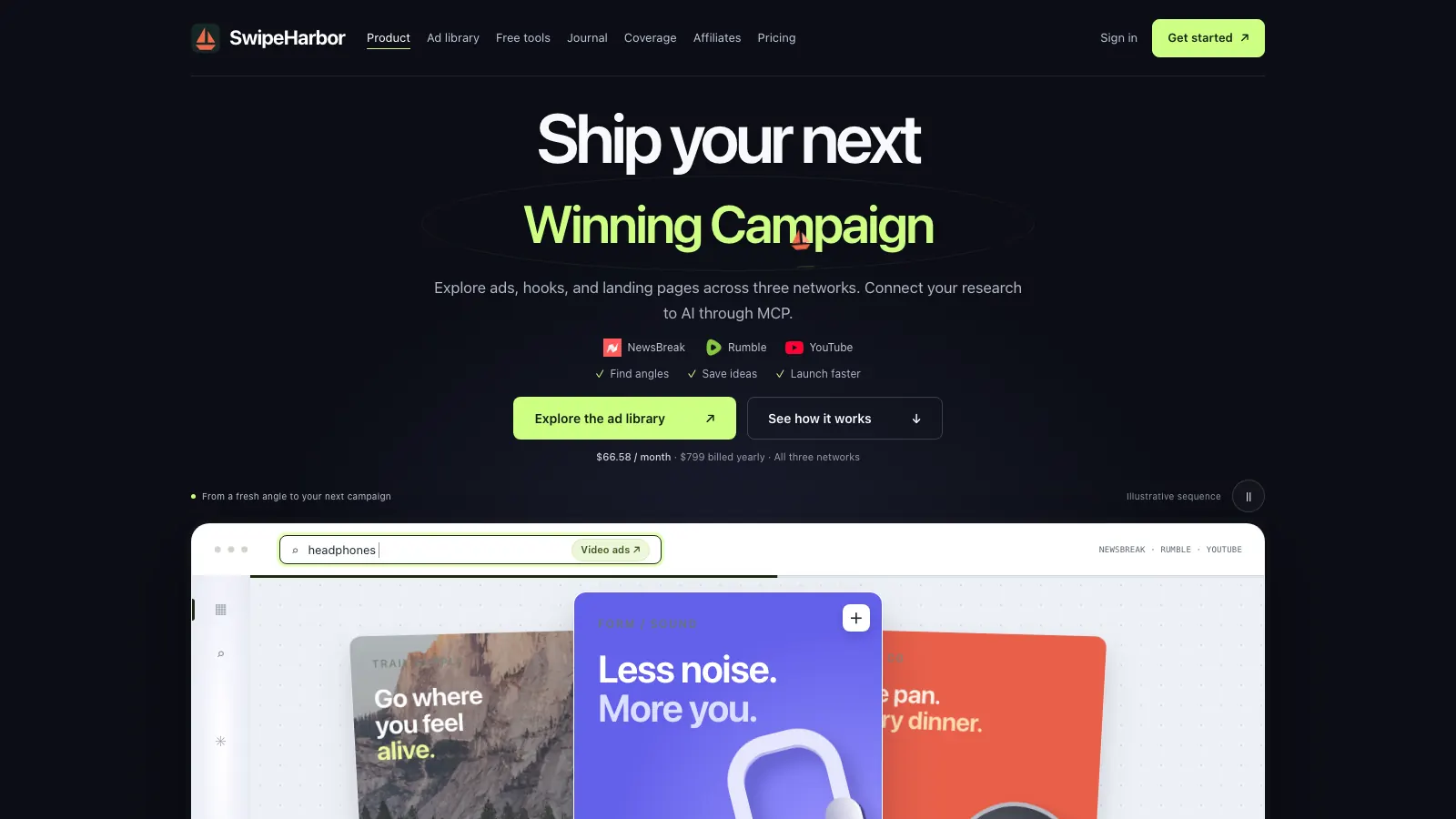
The paid library covers NewsBreak, Rumble, and YouTube. You can search video and image ads by keyword, advertiser, domain, format, date, final-page address, sightings, and observed days. A useful record can include first-seen and last-seen dates, times seen, a destination-page screenshot where one was captured, and a video transcript where one is ready. The point is to follow a message from the creative toward the page behind it.
That scope is its best quality and its boundary. The library is a captured sample, not a complete inventory of a platform. An empty result cannot establish that an advertiser never ran an ad. More importantly, observed activity does not prove how much an advertiser spent, whether it converted, whether it made a profit, or whether it ran continuously. If those are the decisions you need to make, a creative archive is the wrong source of truth.
Which marketing and creative teams should use SwipeHarbor?
Native-ad strategists
Research NewsBreak hooks, thumbnails, page paths, and observed history before planning original campaign tests.
Video creative teams
Study Rumble transcripts and YouTube destinations alongside creative and date evidence when preparing briefs.
AI-assisted researchers
Query stored ads and private notes through MCP for deliberate archive research decisions.
Evidence-minded agencies
Save relevant examples in private collections, preserving message and source context for client briefs.
I would not put SwipeHarbor in front of a general paid-social team. Its present coverage does not include Meta, TikTok, Taboola, or SmartNews, and there is no lower-priced plan for someone who only needs occasional browsing. It earns its place when those three available networks matter enough to make research a repeatable practice.
Which creative research and archiving features does SwipeHarbor include?
A three-network library with clear edges
SwipeHarbor Pro searches NewsBreak, Rumble, and YouTube ads, including video and image creative. Meta, TikTok, Taboola, and SmartNews are marked as coming soon, so do not treat the product as cross-channel coverage before those libraries arrive. For a NewsBreak or Rumble specialist, that narrower focus may be more valuable than a very wide directory. For everyone else, it is the reason to look elsewhere.
Creative and destination evidence
Each record can place creative alongside first-seen and last-seen dates, sightings, and available destination evidence. Landing-page screenshots appear only where SwipeHarbor captured them. Rumble records can carry a transcript, while YouTube records can retain video links and resolved advertiser destinations. Those fields let a strategist compare a promise with the page after the click, but they are evidence for a hypothesis, not proof of campaign results.
Private collections and notes
Members can save ads to private collections and attach research notes. That changes the job from collecting screenshots into building a usable brief: retain the creative, observation dates, destination evidence, and the reason an example matters before you decide what to test. Saved collections, ad references, and notes are private to the account rather than shared with other customers.
MCP access for an archive-aware agent
Verified accounts with an eligible, active paid membership can connect an MCP-compatible assistant by OAuth or an account token. The eight listed tools search ads, read evidence, inspect funnels, compare two to four ads, group research, read Rumble transcripts, list saved ads, and save an ad. The connection works with the existing archive: it does not create a new capture, transcript, or generated creative. That distinction matters for agent workflows, because the output remains bounded by what the library already holds.
The limits make this an assistant for focused research rather than bulk extraction. An account can keep up to five active tokens, each expiring after 30 days without use. Each month includes 2,000 MCP tool calls, with setup and discovery requests excluded from that allowance. There is no separate REST API, so MCP is the supported machine interface.
Free planning and calculation tools
SwipeHarbor also provides browser-based free tools that do not fetch ads or send your inputs to the service. They cover an ad research brief, UTM links, campaign-cost calculations, break-even ROAS, and links into the official Facebook Ad Library and Google Ads Transparency Center. The UTM builder can make a CSV for up to 20 creatives. These are useful adjuncts to a campaign process, but they do not replace the paid archive.
How much does a SwipeHarbor subscription cost?
Price checked 27 Nov 2026
| Plan detail | Pro monthly$79.99/mo | Pro yearly$799/yr |
|---|---|---|
| Billing | Monthly | $799 upfront |
| Paid-library networks | All three covered networks | All three covered networks |
| Video and image search | ✓ | ✓ |
| Ad history and available landing pages | ✓ | ✓ |
| Private collections and notes | ✓ | ✓ |
| MCP access | Eligible membership | Eligible membership |
| MCP request allowance | 2,000 per UTC month | 2,000 per UTC month |
SwipeHarbor prices in US dollars, 27 Nov 2026.SwipeHarbor pricing
The annual payment works out to about $66.58 a month, but it is billed upfront. SwipeHarbor publishes one membership price rather than a per-seat schedule. It does not publish seat allowances or the cost of separate team access, so confirm those terms before treating $79.99 as a team bill.
The real cost question is whether a team will use the available networks often enough to turn a membership into better briefs and better tests. If NewsBreak, Rumble, and YouTube are not part of your mix, $79.99 monthly buys a library you cannot fully use.
Where does SwipeHarbor fall short for media buyers?
SwipeHarbor faces its biggest constraint in ad network coverage. The product is explicit that Meta, TikTok, Taboola, and SmartNews are coming soon. That candor is welcome, but it means a buyer working mostly in paid social still needs another research source today. It also means you should not buy on the expectation that a future platform will arrive on your schedule.
The second constraint is the meaning of an observed record. First-seen, last-seen, and times-seen fields provide useful context, but they do not establish a campaign's true start or end, continuous delivery, spend, conversions, or profitability. I would use SwipeHarbor to understand messaging and destination patterns, then use first-party performance data to decide whether an idea deserves budget.
Finally, MCP is useful but deliberately bounded. It requires a verified account and eligible active membership, shares an account-wide monthly allowance, and has no REST alternative. A team that wants high-volume automated retrieval should confirm the quotas against its workflow before treating SwipeHarbor as a data pipeline.
What are the top competitive alternatives to SwipeHarbor?
 SwipeHarbor alternatives like AI Peekaboo track brand visibility in AI answers rather than archiving multi-network creative assets. Its plans start at $30 a month on monthly billing, with API, MCP, and Looker Studio access included, price checked 27 Nov 2026. The AI Peekaboo review explains that reporting-led fit.
 Use Poach review is for capturing public Facebook Ad Library ads as media files and self-describing screenshots, with Pro adding queryable rows in your Notion database.
 AdProtektor review covers traffic protection instead: eligible blocked IPs are submitted through an active linked Google Ads account at account or selected-campaign scope.
What is the final verdict on buying SwipeHarbor?
SwipeHarbor is a good specialist purchase, not an all-purpose ad-intelligence subscription. It gives a focused team the materials needed to discuss a creative idea responsibly: the ad, its observed history, an available destination page, and a place to record why it matters. MCP makes that archive easier to use inside an agent-assisted research routine.
Choose it when NewsBreak, Rumble, or YouTube research repeatedly feeds your campaign briefs. Pass when you need broader platform coverage or financial evidence about a competitor's advertising. In that situation, the most disciplined move is to keep the question smaller than the data, not stretch an observed record into a performance claim.
Start on monthly Pro for one recurring research project, save the examples that materially change a brief, and move to yearly billing only once the three covered networks are genuinely part of your planning rhythm.
How was this SwipeHarbor review researched and verified?
SwipeHarbor product features, coverage limits, subscription pricing, MCP tools, library assets, and free utilities were verified on 27 Nov 2026. Prices are in US dollars as SwipeHarbor presents them, and each figure follows how we check figures.
- SwipeHarbor pricing and coverage pages
- SwipeHarbor MCP and ad-library pages
- SwipeHarbor free-tools and privacy pages
What are the most common questions about SwipeHarbor?
What ad networks does SwipeHarbor cover?
The paid library currently covers NewsBreak, Rumble, and YouTube. Meta, TikTok, Taboola, and SmartNews are marked as coming soon.
How much does SwipeHarbor cost?
SwipeHarbor Pro costs $79.99 per month or $799 billed upfront for one year, equivalent to about $66.58 a month. Both options include the same three-network library and MCP access.
Can SwipeHarbor show competitor ad spend or profit?
No. Its observed dates, sightings, and destination evidence do not reveal spend, conversions, profit, continuous delivery, or a campaign's true start and end dates.
Does SwipeHarbor work with AI agents?
Yes. Verified members with an eligible paid membership can use eight MCP tools for stored-ad search, evidence, funnels, comparisons, transcripts, and saved ads. There is no separate REST API.
 Reviewed byDanny Kirk
Founder of ReddiReach.
 Checked byAndrés Felipe
Digital designer and marketer.
Every figure is checked against the vendor's own page. Read our editorial standards.